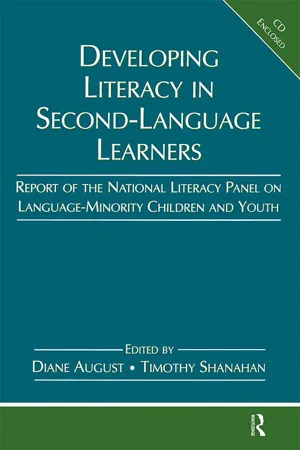
This volume reports the findings of the National Literacy Panel on Language-Minority Children and Youth. The formal charge to the panel—a distinguished group of expert researchers in reading, language, bilingualism, research methods, and education—was to identify, assess, and synthesize research on the education of language-minority children and youth with respect to their attainment of literacy. Funding for the project was provided to the Center for Applied Linguistics and SRI International by the U.S. Department of Education’s Institute of Education Sciences and the Office of English Language Acquisition, with additional funding from the National Institute of Child Health and Human Development provided through the U.S. Department of Education.The authors review the state of knowledge on the development of literacy in language-minority children and youth, organized around five specific themes:
*Development of Literacy in Second-Language Learners;
*Cross-linguistic Relationships in Second-Language Learners;
*Sociocultural Contexts and Literacy Development
*Educating Language-Minority Students: Instruction and Professional Development; and
*Student AssessmentEach part begins with a synthesis chapter that spells out the research questions for the chapters in that part, provides background information, describes the methodology used, summarizes the empirical findings reported, addresses methodological issues, and makes recommendations for future research. The following chapters provide more detail on the individual studies reviewed for specific research questions. The volume includes two opening chapters, “Introduction and Methodology” and “Demographic Overview”; a closing chapter that summarizes the report, identifies cross-cutting themes, and makes recommendations for future research; and a CD-ROM providing a searchable database of research references.The audiences for this volume include researchers interested in the development of literacy in language-minority children and youth as well as those studying literacy more generally, and those concerned with improving the education of this population of students.
eBook - ePub
Developing Literacy in Second-Language Learners
Report of the National Literacy Panel on Language-Minority Children and Youth
- 688 pages
- English
- ePUB (mobile friendly)
- Available on iOS & Android
eBook - ePub
Developing Literacy in Second-Language Learners
Report of the National Literacy Panel on Language-Minority Children and Youth
About this book
Information
1
Introduction and Methodology
Charge to the Pan
The formal charge to the National Literacy Panel on Language-Minority Children and Youth was to identify, assess, and synthesize research on the education of language-minority children and youth with respect to their attainment of literacy, and to produce a comprehensive report evaluating and synthesizing this literature. The panel’s review indicates that many factors influence second-language literacy development, among them the age at which skills are acquired, individual differences in second-language oral proficiency and cognitive abilities, first-language oral proficiency and literacy, some sociocultural variables, and classroom and school factors. Our review also reports on our knowledge base about assessment.
Key terms germane to the panel’s charge are defined next.
Literacy skills are defined in this review as including prereading skills, such as concepts of print and alphabetic knowledge; word-level skills, including decoding, word reading, pseudoword reading, and spelling; and text-level skills, including fluency, reading comprehension, and writing skills. For purposes of this review, oral language proficiency denotes knowledge or use of specific aspects of oral language, including phonology, vocabulary, morphology, grammar, and discourse domains; it encompasses skills in both comprehension and expression. We also include studies that examine phonological processes (phonological recoding, phonological memory, and phonological awareness) because it has been hypothesized that these processes mediate the development of written forms of language (Adams, 1990; Ehri, 1998; Metsala & Walley, 1998; Scarborough, 2001).
A frequently used term is societal/national/official language. A societal language is one, often one of several, of the languages used in a country. A language considered to be the chief language in a country is the national language. English is the national language of the United States, but it is not its official language (although some states have made English the official language within their boundaries). Official status is conferred on a language by national law or by the nation’s constitution. An official language is mandated for use in official government transactions and communications, in courts of law, and in laws and regulations governing the nation as a whole. French is both the national and official language of France. Canada has two official languages—English and French.1
There are many labels for the students and programs under consideration in this report. The most commonly used term, language minority, refers to individuals from homes where a language other than a societal language is actively used, who therefore have had an opportunity to develop some level of proficiency in a language other than a societal language. A language-minority student may be of limited second-language proficiency, bilingual, or essentially monolingual in the second language (August & Hakuta, 1997). Individuals who come from language backgrounds other than a societal language and whose second language proficiency is not yet developed to the point where they can profit fully from instruction solely in the second language are called second-language learners. In instances where the students are acquiring English as a second language, they are referred to as English-language learners. We have elected to use this term, first proposed by Rivera (1994) and adopted by the National Research Council’s Committee on Developing a Research Agenda on the Education of Limited-English-Proficient and Bilingual Students (August & Hakuta, 1997). The term limited English proficient (LEP) may be used, however, when we are quoting another source or citing legal requirements. Note that we have chosen to forgo the editorially convenient practice of reducing English-language learners to an abbreviation. Appendix 1.B includes a list of standard terms used in the report to describe study subjects and the language status of the language or literacy components they are acquiring (e.g., vocabulary in their first language, oral proficiency in their second language).
Two other terms appear frequently in this volume. The first is bilingual students/education programs. Some of the programs intended to serve the needs of second-language learners use the students’ native language as they acquire the second language. Thus, the term bilingual is often used to refer to programs when they use students’ first language as well as a societal language for instructional purposes. We use the term bilingual to refer to an individual with a language background other than the societal language who has developed proficiency in his or her primary language and some proficiency in the second language.
PURPOSE OF THE VOLUME
The main purpose of this volume is to contribute to the construction of a knowledge base on the development of literacy in language-minority students by conducting a comprehensive review of the research on this topic and generating from this review answers to the specific research questions posed in the report. A second purpose is to develop a research agenda to address key knowledge gaps. To accomplish these goals, the panel was comprehensive in its review of the research; it focused broadly on language-minority students and, as noted later in the section on the nature of the review, included a variety of study types addressing a broad array of questions deemed pertinent to the literacy education of language-minority children. As is seen, not all such questions can be classified as what works questions, despite their obvious relevance to literacy attainment of language-minority students.
The panel established strict criteria for the identification and selection of relevant literature. The panel incorporated into the review and reported on all studies deemed relevant to the proposed questions that also met our inclusion criteria in the expectation that the studies might, in the aggregate, shed light on our research questions, even if they failed to do so individually. These decisions were motivated by the knowledge that such a comprehensive approach to the review, evaluation, and report was crucial for benchmarking the progress we have made in developing a science of literacy education for language-minority children and for determining the future research that is needed in this endeavor.
PROCEDURES USED TO CONDUCT THE REVIEW
Panel Staff
In constituting the panel, individuals were invited only if they had deep expertise in critical components of literacy, language learning, or research methodology, and an effort was made to include language-minority researchers. Five of the panelists have non-English-language backgrounds, including Spanish/Argentinian, Hebrew, Spanish/Mexican, and Japanese. In addition, five panelists have important cross-cutting expertise: two are methodologists, two are experts in learning disabilities, and one is an expert in the assessment of students from culturally and linguistically diverse backgrounds.
To address the research questions detailed herein, the panel was divided into five subcommittees, each of which was responsible for overseeing the synthesis of the research in a particular domain. The panel was served by a principal investigator, Diane August, who managed the project; a chairperson, Timothy Shanahan, who helped guide the panel’s work; and two methodologists—David Francis, who provided expertise in quantitative methodology, and Frederick Erickson, who provided guidance in qualitative methodology. Catherine Snow and Donna Christian served as senior advisors to the panel. In addition, the panel was served by two senior research associates who were instrumental in preparing several of the chapters: Nonie Lesaux (chaps. 3, 4, and 14) and Cheryl Dressler (chap. 9). A list of the subcommittees can be found in Appendix 1.A. Biographical sketches of the panel members and other contributors can be found at the...
Table of contents
- Cover
- Half Title
- Title Page
- Copyright Page
- Table of Contents
- Foreword, Peggy McCardle
- Preface
- 1 Introduction and Methodology
- 2 Demographic Overview
- Part I Development of Literacy in Second-Language Learners
- Part II Cross-Linguistic Relationships in Second-Language Learners
- Part III Sociocultural Contexts and Literacy Development
- Part IV Educating Language-Minority Students: Instructional Approaches and Professional Development
- Part V Student Assessment
- Biographical Sketches
Trusted by 375,005 students
Access to over 1.5 million titles for a fair monthly price.
Study more efficiently using our study tools.
Frequently asked questions
Yes, you can cancel anytime from the Subscription tab in your account settings on the Perlego website. Your subscription will stay active until the end of your current billing period. Learn how to cancel your subscription
No, books cannot be downloaded as external files, such as PDFs, for use outside of Perlego. However, you can download books within the Perlego app for offline reading on mobile or tablet. Learn how to download books offline
Perlego offers two plans: Essential and Complete
- Essential is ideal for learners and professionals who enjoy exploring a wide range of subjects. Access the Essential Library with 800,000+ trusted titles and best-sellers across business, personal growth, and the humanities. Includes unlimited reading time and Standard Read Aloud voice.
- Complete: Perfect for advanced learners and researchers needing full, unrestricted access. Unlock 1.5M+ books across hundreds of subjects, including academic and specialized titles. The Complete Plan also includes advanced features like Premium Read Aloud and Research Assistant.
We are an online textbook subscription service, where you can get access to an entire online library for less than the price of a single book per month. With over 1.5 million books across 990+ topics, we’ve got you covered! Learn about our mission
Look out for the read-aloud symbol on your next book to see if you can listen to it. The read-aloud tool reads text aloud for you, highlighting the text as it is being read. You can pause it, speed it up and slow it down. Learn more about Read Aloud
Yes! You can use the Perlego app on both iOS and Android devices to read anytime, anywhere — even offline. Perfect for commutes or when you’re on the go.
Please note we cannot support devices running on iOS 13 and Android 7 or earlier. Learn more about using the app
Please note we cannot support devices running on iOS 13 and Android 7 or earlier. Learn more about using the app
Yes, you can access Developing Literacy in Second-Language Learners by Diane August,Timothy Shanahan, Diane August, Timothy Shanahan in PDF and/or ePUB format, as well as other popular books in Education & Education General. We have over 1.5 million books available in our catalogue for you to explore.