- 160 pages
- English
- ePUB (mobile friendly)
- Available on iOS & Android
eBook - ePub
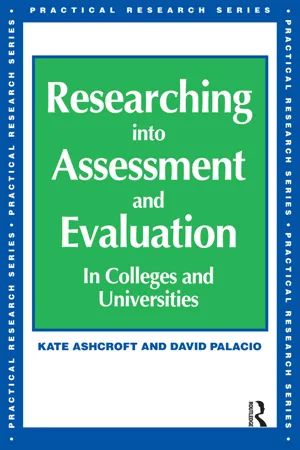
Researching into Assessment & Evaluation
About this book
This study enables the lecturer to explore issues, dilemmas and situations which confront the stakeholders in further and higher education. It explores how assessment and evaluation of student learning and tutors teaching are affected by institutional and governmental arrangements.
Information
Chapter 1
Series Introduction
The research that colleges and universities engage in covers a very wide spectrum, including basic research into fundamental problems as well as entrepreneurial work, often contracted by a particular customer. Each of the books in this series is focused on a particular form of research: that of small-scale insider research. Each looks at issues of teaching, learning and management within colleges and universities. The aim is to provide you with starting points for research that will improve your practice, that of your students and the context for learning and teaching that your institution provides. The research that you undertake may also help you to understand the context in which teaching and learning is managed and should provide you with the raw material for publication in research-based media.
The series is aimed at creating a range of quick and easy to read handbooks, so you can get started on research into aspects of your practice. Each book includes a version of this introductory chapter by the series editor about insider research, its principles and methods.
The chapters in this book are focused on contemporary issues relating to assessment and evaluation. They include a range of examples of research instruments and suggestions as to how you might use or adapt them to your own context for enquiry. The starting points for research cover the following areas:
● the perspectives of the main participants in the business of assessment and evaluation;
● the context in which they operate;
● their existing practice;
● their existing values; and
● the relationships between the context and the values and practice.
A range of methods used in insider research into assessment and evaluation is included within the research tasks.
None of the books includes sufficient information for you to complete a research project for publication. You will need to find out more about the particular aspects of assessment or evaluation and the research methodology that you decide to use. Similarly, the book will introduce you to some of the theoretical frameworks open to you, but the discussion will not be deep enough, of itself, to ensure that your research is grounded in theory. For these reasons, an annotated reading list is included at the end of each chapter.
Synopsis of the Series
The series is designed to appeal to lecturers in further and higher education who are interested in developing research skills and who would find concrete suggestions for research and some exemplar research questions and instruments helpful. We have tried to avoid using technical terms and jargon unnecessarily, but where these have to be included, we have tried to explain them in as simple a way as possible.
Increasingly, lecturers are required to produce regular research papers. In the UK, the process of research rating means that lecturers in universities restrict their career opportunities if they do not engage regularly in research and publication. (I describe the process of research rating in the introductory chapter to Bennett et al., 1996.) Many do not know where to start. Others are unable to manage their time in order to incorporate their research and publication alongside their teaching work. Some feel that a commitment to research would detract from their preferred role as teachers.
The series provides a framework of ideas and starting points for research which can be carried out alongside your current practice. The books present these ideas in such a way that, rather than detracting from your practice, they might enhance it. They introduce methods for you to use (adapted or unadapted) for researching into your own teaching. For example, a description of the process of action research is included in Chapter 6. This process is applicable to a variety of research problems.
You should find the books useful if you are new to teaching or if you are an experienced lecturer who needs or wishes to develop a research and publication profile within education. In the case of higher education, this is a major focus that involves all tutors. You may be under pressure to publish for the first time in order to contribute to research rating exercises. You might be undertaking a qualification that includes a research element. A masters degree or doctorate is an increasing requirement for promotion in further and higher education. In the UK, more masters degree courses are being developed and geared towards this sector. In higher education, many staff are now expected to achieve a doctorate. Some of the starting points within this book could be developed into a fairly sophisticated research project.
You may be interested in researching your own practice for its own sake. For instance, you may wish to explore your students' actions in response to various assessment tasks that you have set. The interest in insider research is percolating into colleges and universities from the action research movement within schools and may grow at a comparable rate.
Insider Research and the Model of Reflection
Insider research is a form of participant research. It is principally about understanding and improving practice within the researcher's institution. It can be focused on a problem and involve cycles of data collection, evaluation and reflection, as in action research.
Insider research need not be problem-centred. It is an appropriate approach for a matter of personal curiosity or interest that you decide to investigate in a systematic way. Many tutors who have used the approach have found that insider research is an empowering process. It often comes up with surprises and enables you to see problems in new ways. It is probably the most effective way of exploring the functioning of real life classrooms and investigating the effects of your interventions. It deals with the real problems and issues you face and, in doing so, may transform those problems and the way you construe teaching and learning. It has a moral base, in that it allows you to explore your actions and those of others in the light of the values that supposedly underpin them.
The series is built on the model of the reflective practitioner of education as described by Dewey (1916) and developed by Zeichner, Ashcroft and others (see, for instance, Ashcroft, 1987; Ashcroft and Griffiths, 1989; Deakin, 1982; Isaac and Ashcroft, 1986; Stenhouse, 1979; Zeichner, 1982; and Zeichner and Teitiebaum, 1982). The model takes the view that knowledge is not absolute or static and that lecturers in further and higher education should take an active role in constructing and reconstructing it. This suggests that educationists have some sort of moral responsibility for the truth, and indeed that it is part of their duty to act as whisde-blowers when the powerful define truth in ways convenient for their purposes. It sees reflective practice as much more than a passive ‘thinking about’. It embraces active professional development, directed at particular qualities: open-mindedness, commitment and responsibility. The enquiry considers the question of ‘What works?’ but also moves on to pose questions of worthwhileness. This demands investigation into action, intervention and the perspectives of a number of the participants in the educational process: students, tutors, institutional managers, employers, the government, funders and community representatives. It also suggests that intentions, attitudes and values are explored, as well as behaviour and outcomes.
Each of the qualities of open-mindedness, commitment and responsibility has particular definitions and demands prerequisite skills and understandings. This series of books is partially directed at helping you to acquire research skills and skills of analysis. Open-mindedness requires that you seek out and analyse the perspectives of each of the stakeholders in education. For this reason, this book includes a variety of examples of ways to collect and organize data that you might use to find out about the behaviours, thoughts, attitudes and experience of students, other lecturers, managers, employers and others. In Chapter 3 we suggest that you might use group interviews to find out the definitions of ‘good’ assessment favoured by various of the stakeholders in education. Our intention in introducing you to various research processes is to enable you to collect data and to analyse them in the light of your emerging theory of practice (see Argyris and Schon, 1974, for more details of this notion of theory in action.)
Commitment implies a real and sustained attachment to the value of your work and to improving its context. You need optimism in order to sustain this: to believe that you are one of the stakeholders in the institution and community, and that you have the duty and power to effect changes and to secure the appropriate teaching and learning environment for your students. This is not easy, particularly in circumstances where resources are very short or where you work within an autocratic or chaotic management regime. Insider research cannot solve these kinds of problems, but it may help you to understand their nature and go some way to helping you to cope. For example, in Chapter 5 we suggest a method for exploring the lecturer's use of time. From this kind of investigation you may be able to see ways that limited time might be used more effectively and the stress caused by time pressures reduced.
Responsibility implies that you are interested in the long- and short-term consequences of action. This means that you collect evidence as to your effectiveness and the intended and unintended outcomes of your teaching and management. We suggest a range of research instruments that may help you to discover what you actually do (as opposed to what you think you do) in the course of your work, what effects your behaviour has on others, how they see it and the attitudes resulting from it. For instance, in Chapter 6, we suggest a model for exploring the effects of an educational innovation on student skills, knowledge and attitude development.
Insider research can be empowering. It is one way of finding out about the needs and interests of others and expressing these in terms that create a powerful case for change. For this reason, we have included a range of starting points for research that will enable you to enquire into management issues and the working of your institution.
We have stated that research skills are an essential prerequisite to reflective practice. This should not be taken to mean that they are sufficient. Reflective practice in teaching also requires that you acquire a range of other skills. These include technical teaching skills, such as voice projection; interpersonal skills such as counselling skills and the ability to work as part of a team; communication skills in a variety of contexts; and the ability to criticize the status quo from a moral point of view. Insider research, perhaps uniquely, can help you to acquire each of these skills. By providing feedback on your actions, insider research directs you to problems that you are creating or failing to solve. You can then experiment with new ways of approaching them and use insider research to provide information on the effectiveness of your new ways of thinking and acting. In Chapter 7 we suggest a range of evaluation methods that you may want to use in order to explore your practice and that of others.
Reflective practice is an ideal that can be at its most painful when it is achieved. It requires that you question your deepest beliefs and compare your actions with your values. In doing this, you may find that you must abandon cherished beliefs or practices. Despite the loss that change brings and the risks that it involves, the value of reflective practice is in the process of continual questioning and renewal that is essential for professional development and growth in understanding. Nobody is able to sustain reflective practice at all times. During the process of teaching and research you will sometimes delude yourself. You may frame your problem according to assumptions that you feel comfortable with, you may interpret data to fit your preferred solution, or you may fail to notice the most important data. For this reason, we suggest that your methods and interpretation should be made public in some way. You need other people to challenge your assumptions.
Research in Colleges and Universities
In the UK, the proportion of young people going into higher education has doubled in recent years. When the members of this educated population enter colleges and universities, they expect to be taught by people who are expert at a very high level. This expertise is generally achiev...
Table of contents
- Cover
- Title Page
- Copyright Page
- Table of Contents
- Chapter 1 Series Introduction
- Chapter 2 The Purposes of Assessment
- Chapter 3 Assessment and Quality
- Chapter 4 Methods of Assessment
- Chapter 5 Managing Assessment
- Chapter 6 Models of Evaluation
- Chapter 7 Methods of Evaluation
- Chapter 8 Series Conclusion
- Index
Trusted by 375,005 students
Access to over 1.5 million titles for a fair monthly price.
Study more efficiently using our study tools.
Frequently asked questions
Yes, you can cancel anytime from the Subscription tab in your account settings on the Perlego website. Your subscription will stay active until the end of your current billing period. Learn how to cancel your subscription
No, books cannot be downloaded as external files, such as PDFs, for use outside of Perlego. However, you can download books within the Perlego app for offline reading on mobile or tablet. Learn how to download books offline
Perlego offers two plans: Essential and Complete
- Essential is ideal for learners and professionals who enjoy exploring a wide range of subjects. Access the Essential Library with 800,000+ trusted titles and best-sellers across business, personal growth, and the humanities. Includes unlimited reading time and Standard Read Aloud voice.
- Complete: Perfect for advanced learners and researchers needing full, unrestricted access. Unlock 1.5M+ books across hundreds of subjects, including academic and specialized titles. The Complete Plan also includes advanced features like Premium Read Aloud and Research Assistant.
We are an online textbook subscription service, where you can get access to an entire online library for less than the price of a single book per month. With over 1.5 million books across 990+ topics, we’ve got you covered! Learn about our mission
Look out for the read-aloud symbol on your next book to see if you can listen to it. The read-aloud tool reads text aloud for you, highlighting the text as it is being read. You can pause it, speed it up and slow it down. Learn more about Read Aloud
Yes! You can use the Perlego app on both iOS and Android devices to read anytime, anywhere — even offline. Perfect for commutes or when you’re on the go.
Please note we cannot support devices running on iOS 13 and Android 7 or earlier. Learn more about using the app
Please note we cannot support devices running on iOS 13 and Android 7 or earlier. Learn more about using the app
Yes, you can access Researching into Assessment & Evaluation by Kate Ashcroft,David Palacio in PDF and/or ePUB format, as well as other popular books in Education & Education General. We have over 1.5 million books available in our catalogue for you to explore.