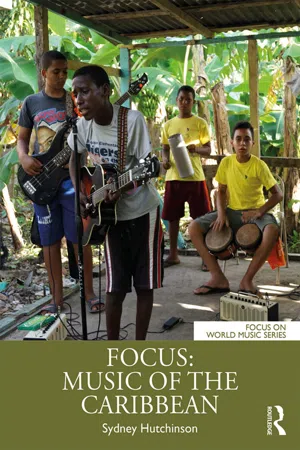
Focus: Music of the Caribbean presents the most important issues of Caribbean musical history and current practice, discussing thought-provoking questions in a student-friendly fashion. It uses current ethnomusicological research on Caribbean music to tell the stories of Caribbean history—those of colonialism and neocolonialism, race and nationalism, marginalization and globalization—and to explore that history's continuing impact on the lives, cultures, musics, and dance of modern-day people in the Caribbean and beyond.
In three parts, the text presents an embodied understanding of the sounds, rhythms, and movements that exemplify the history, culture, and politics of Caribbean music:
I. Caribbean Music and Caribbean History establishes a framework for thinking about Caribbean musical history and the roles race and migration play
II. Music and Dance in Caribbean Societies considers how contrasting forms of dance music reconcile competing ideas about Caribbean identities past and present
III. Focusing In: The Social Lives of Musical Instruments in Merengue Típico explores the music of the Dominican Cibao region through a focus of the genre's dominant musical instruments
Accessible to all students regardless of musical background, Focus: Music of the Caribbean is bolstered by web resources, including more than sixty detailed listening guides and accompanying playlists, vocabulary lists, and student quizzes. Discussion questions and activities for each chapter are featured in the text.
Figure 1.1Statues in front of the Museo del Hombre Dominicano. Photo by the author.
The picture on this page (Figure 1.1) shows three statues that stand in front of the Museo del Hombre Dominicano (Museum of the Dominican Man), a museum in Santo Domingo dedicated to educating the public about Dominican culture. From left to right, the men there depicted are Sebastián Lemba, Bartolomé de las Casas, and Enriquillo. Lemba was a slave from the southeast African ethnic group of the same name who, in the early sixteenth century, led a rebellion in Hispaniola, or Quisqueya – the island that today is home to both the Dominican Republic and Haiti. Las Casas was a Spanish missionary who wrote passionately in defense of the subjugated indigenous people of that island at about the same time. And Enriquillo was a leader of those people, the Taíno, who organized a sixteenth-century rebellion with which Las Casas sympathized.
Why are these three men immortalized in front of a museum dedicated to Dominican identity and located in the center of the Dominican capital city? And what does this have to do with music? As we will see in this book, these statues symbolize an important narrative, a kind of foundational myth that has guided a great deal of thinking about Caribbean culture – including (perhaps even especially) music – up to the present day. According to this story, Caribbean people and their culture are the result of the blending of three cultures: the indigenous, the African, and the European. Their fusion in a process often called creolization gives the Caribbean its uniqueness. It also means that Caribbean people often think about race and heritage differently than do people from countries such as the United States, where mixture has not been a central part in narratives of national identity.
Figure 1.2Seal of the Instituto de Cultura Puertorriqueña.
The seal of the Instituto de Cultura Puertorriqueña (Institute of Puerto Rican Culture [ICP]) shows another official version of the three-cultures story (Figure 1.2). Created in the 1950s as Puerto Ricans sought to distinguish themselves and their culture from the mainland United States, the three cultures are here depicted through generic figures holding particular accessories: on the left, a Taíno man holds a cemí, or stone idol; the Spanish gentleman in the center holds a book; and the African on the right holds a drum and a machete. While the seal ostensibly represents the equality of the foundational elements, Puero Rican scholar Arlene Dávila has pointed out that the centrality of the Spanish Catholic man with the book, representing highly valued literacy, and the association of the African with labor and with rhythm can be seen as replicating colonial hierarchies and stereotypes (Dávila 1997: 69–71).
I call this narrative the “myth of the three cultures.” While it is in some sense true, the harmony the story implies is illusory, as the example of the ICP seal suggests, and as the defiant postures of the Lemba and Enriquillo statues make even more obvious. In reality, not only have people of these three cultures been differently valued (or devalued) throughout Caribbean history, but theories of Caribbean cultural identity have also always tended to emphasize one over the others and to place them in a hierarchy in which national narratives – and the largely European elite who created them – prize some people and cultures more highly than others. Thus this “myth” – which provides the organizing principle behind Part I of this book – can also be seen as an ideology, or a set of ideas and beliefs, especially those propagated by a dominant class in order to maintain a status quo. And as such, it demands that those who wish for greater social justice actively question its premises. Why does one culture take precedence over the others at a particular moment? What causes the hierarchy to shift over time? What roles do music and dance play in creating and expressing Caribbean identities, whether focused on mixture or “purity”? And how are these three cultures present in the musical lives of Caribbean people today? We will explore these and related questions in this chapter and throughout this book, using examples drawn from all over the region.
The Three Cultures (or Two Cultures?) in Caribbean Music
The examples given above show representations of the three cultures from the twentieth-century Hispanic Caribbean. This location makes sense, because the ideology is rooted in earlier narratives common in hispanophone Latin America, such as indigenismo and mestizaje, and in concepts of syncretism and creolization. In general, these ideas became prominent at the time of independence struggles or during other moments of nation-building. In the hispanophone Caribbean, independence occurred in 1844 for the Dominican Republic (from Haiti) and 1902 for Cuba (from the United States). Nineteenth-century indigenismo was a movement to legitimize modern nations in Latin America by tying them to an indigenous heritage. Among other things, Caribbean indigenismo resulted in Dominican writer Manuel de Jesús Galván’s novel Enriquillo, about the aforementioned Taíno leader.
The slightly later ideology of mestizaje built on indigenismo by arguing that Latin American cultures were unique and valuable because of how they blended the indigenous American and European heritages (notably, though, the African was often left out of this limited melting pot). Mestizaje became the dominant narrative in Mexico, for example, where it inspired artists such as muralist Diego Rivera (husband to Frida Kahlo) and served as a reference point for much writing about mariachi, the music that serves as a potent symbol of the Mexican nation around the world. In Cuba, national hero and poet José Martí wrote lovingly in the 1890s of “our mestizo America” but sought to go beyond race in his conception of Cuban identity, affirming the basic equality of all humans. In fact, he worked to create an explicitly anti-racist Cuban national identity in clear contrast to the blatantly racist United States. Post-independence, the concept of mixture resurfaced in the work of groundbreaking anthropologist Fernando Ortiz, who described Cuban culture as an ajiaco, a stew made up of meat, vegetables, and tubers.
By the 1940s, concepts such as syncretism and creolization were becoming central to the anthropological study of Caribbean cultures. Syncretic religions were those that fused or overlaid Christianity (usually Catholicism) with African beliefs, giving rise to blended practices such as Cuban santería. Clear examples of syncretism are found in the correspondences between Catholic saints and African deities, so that, for instance, an image of Saint Lazarus, who famously rose from the dead, can simultaneously represent Babalú Ayé, the Yoruba deity of disease and healing, and their names may be used interchangeably. Similarly, creolized cultures were those in which practitioners actively selected elements from two or more roots and fused them into something new. For example, Haitian Kreyol, a creole language, combines vocabulary and grammar from French and West African sources.
Each of these concepts – indigenismo, mestizaje, syncretism, and creolization – has something in common with the three-cultures myth, and each has been influential in Caribbean intellectual and musical history. However, the idea that three separate cultures (not only two, as some of the earlier ideologies implied) contributed more or less equally to modern Caribbean culture, particularly its music, did not emerge in full force until well into the twentieth century – and even then, not everywhere in the Caribbean. In fact, this narrative seems to have appeared first in Brazil, which in many ways resembles the Caribbean because of their shared history of colonization and slavery. There, anthropologist Gilberto Freyre was already theorizing local culture as a “harmonious blend” of indigenous, European, and African in 1946. In 1979, Brazilian anthropologist Roberto Da Matta cleverly reworked this idea to account for the ideological effects of carnival: he saw civic parades as representing hierarchy, order, and white Brazilians; the processions of the pious as a representation of the neutralization of hierarchy, and hence black Brazilians; and carnivals themselves as an inversion of order and hierarchy, thus representing “Indians” (or other marginalized peoples).
Representations of national culture as a fairly even blend of the three cultures came only later to the islands. In Cuba in the 1920s, for instance, composer Eduardo Sánchez de Fuentes argued that Africa had had little influence on Cuban musical culture, so that any non-European elements had to be the result of Taíno heritage. But beliefs changed over the decades, so that by the 1980s Cuban essayist Antonio Benítez-Rojo could announce the Cuban cult of the Virgen de Caridad de Cobre as a “super-syncretism” that combined Taíno, Spanish, and African belief systems that were themselves already syncretic.
Meanwhile in the Dominican Republic, music historian Flérida de Nolasco, who worked mainly in the 1930s and 1940s, disproportionately emphasized the European elements of Dominican music, while also arguing that nothing remained of the Taíno in current musical practice. In that country, the first person to insist on the three-cultures narrative may have been self-taught folklorist René Carrasco, who put on a series of programs on folklore titled “Lo que se pierde en Santo Domingo” (“What Is Being Lost in the Dominican Republic”) beginning in 1965. But the term “Afro-Dominican” does not seem to have come into use until the 1970s, when US ethnomusicologist Martha Ellen Davis began to study Dominican folk Catholicism.
The three-cultures myth thus emerged in different guises in different countries, but eventually became widespread in the Hispanic Caribbean. It has frequently been used to discuss musical practices, particularly through the purported origins of musical instruments, which are made to embody one of the three. Dominican merengue típico, the topic of Part III, provides an excellent example. Seen as the progenitor of modern popular merengue, this traditional music, originally from the northern Cibao region, became a national symbol after dictator Rafael Leonidas Trujillo (in power 1930–1961) mandated its performance in society ballrooms all over the country.
Figure 1.3Merengue típico quartet performing on the beach at Sosúa, Dominican Republic, 2012. Photo by the author.
Merengue típico, also known as perico ripiao, is often explained as an ideal embodiment of national heritage because of its three principal instruments: the güira scraper, which some see as a Taíno musical legacy, as we will discover in the next chapter; the tambora drum, which some view as an African inheritance; and the accordion, which was imported from Europe (see Figure 1.3). Similarly, the South American joropo, Venezuela’s national dance, is sometimes described as the union of European harp, African singing style, and indigenous maracas, while many Puerto Ricans portray their own jíbaro (peasant) music as the fusion of Spanish stringed instruments and poetic forms with indigenous güiro and (some add) African rhythmic approaches. In Colombia, some describe the basic rhythms of the Caribbean coastal vallenato ensemble – another trio of accordion, scraper (guacharaca) and drum (caja) – as each deriving from one of the three cultures: the merengue from Africans, paseo from Spanish, and puya from indigenous peoples.1
The anglophone Caribbean, in contrast, has more often subscribed to a two-culture narrative, emphasizing African and European heritage but relegating the Taíno and/or Carib presence to the distant past. (Note that this contrasts with hispanophone two-culture ideologies, which instead focused on European and indigenous heritage.) This is true even in descriptions of modern-day musics closely related to the Hispanic genres just described, such as Bahamian rake and scrape, and Turks and Caicos ripsaw music. Both these musics have an ensemble quite similar to that of Dominican merengue típico, consisting of a goatskin goombay drum, a scraped saw blade, and an accordion or concertina, but there these are seen as representing only Europe (through the accordion or concertina) and Africa (through the drum and scraper). Some Turks and Caicos accounts, however, suggest that the scraped saw was an emulation of the Dominican güira or Haitian graj, a metal version of the gourd güiro that Dominicans and Puerto Ricans see as emblematic of the Taíno legacy. These competing narratives show that musical instruments often serve as empty vessels to be filled with nationalist ideology and/or local ideas about race – not as objects with fixed histories and heritages of their own. They also form part of a broader pattern in which music plays a significant role in forming and maintaining Carib...
Table of contents
Cover
Half Title
Series Information
Title Page
Copyright Page
Contents
Figures
Tables
List of Listening Guides
Series Foreword
Acknowledgments
How to Use This Book: A Note to Instructors
PART I Caribbean Music and Caribbean History
PART II Music and Dance in Caribbean Societies: Embodied Culture
PART III Focusing In: The Social Lives of Musical Instruments in Merengue Típico
Appendix D: Music/Dance Genres and Ensembles by Country
Index
Trusted by 375,005 students
Access to over 1.5 million titles for a fair monthly price.
Study more efficiently using our study tools.
Frequently asked questions
Yes, you can cancel anytime from the Subscription tab in your account settings on the Perlego website. Your subscription will stay active until the end of your current billing period. Learn how to cancel your subscription
No, books cannot be downloaded as external files, such as PDFs, for use outside of Perlego. However, you can download books within the Perlego app for offline reading on mobile or tablet. Learn how to download books offline
Perlego offers two plans: Essential and Complete
Essential is ideal for learners and professionals who enjoy exploring a wide range of subjects. Access the Essential Library with 800,000+ trusted titles and best-sellers across business, personal growth, and the humanities. Includes unlimited reading time and Standard Read Aloud voice.
Complete: Perfect for advanced learners and researchers needing full, unrestricted access. Unlock 1.5M+ books across hundreds of subjects, including academic and specialized titles. The Complete Plan also includes advanced features like Premium Read Aloud and Research Assistant.
Both plans are available with monthly, semester, or annual billing cycles.
We are an online textbook subscription service, where you can get access to an entire online library for less than the price of a single book per month. With over 1.5 million books across 990+ topics, we’ve got you covered! Learn about our mission
Look out for the read-aloud symbol on your next book to see if you can listen to it. The read-aloud tool reads text aloud for you, highlighting the text as it is being read. You can pause it, speed it up and slow it down. Learn more about Read Aloud
Yes! You can use the Perlego app on both iOS and Android devices to read anytime, anywhere — even offline. Perfect for commutes or when you’re on the go. Please note we cannot support devices running on iOS 13 and Android 7 or earlier. Learn more about using the app
Yes, you can access Focus: Music of the Caribbean by Sydney Hutchinson in PDF and/or ePUB format, as well as other popular books in Media & Performing Arts & Ethnomusicology. We have over 1.5 million books available in our catalogue for you to explore.