Solar Air Systems
eBook - ePub

Solar Air Systems

A Design Handbook

  1. 292 pages
  2. English
  3. ePUB (mobile friendly)
  4. Available on iOS & Android
eBook - ePub

Solar Air Systems

A Design Handbook

About this book

Active solar systems for air heating are a straightforward yet effective way of using solar energy for space heating and tempering ventilation air. They offer some unique advantages over solar water systems, can offer improved comfort and fuller use of solar gains than passive solar systems and are a natural fit with mechanically ventilated buildings.

They can be economical, with short pay-back periods and can act not only as space heating or ventilation air heating but also for water pre-heating, sunshading, electricity generation (with hybrid photovoltaic systems) and can help induce cooling.

This design handbook takes architects and building engineers through the process of designing and selecting an active solar system from the six types presented, optimizing the system using nomograms and curves, and finally dimensioning the components of the system. Tips are offered regarding the construction and how to avoid problems.

The book will provide essential design information for all architects, building engineers and other building design professionals and all those concerned to reduce the environmental impact of buildings.
Frequently asked questions

Yes, you can cancel anytime from the Subscription tab in your account settings on the Perlego website. Your subscription will stay active until the end of your current billing period. Learn how to cancel your subscription.
At the moment all of our mobile-responsive ePub books are available to download via the app. Most of our PDFs are also available to download and we're working on making the final remaining ones downloadable now. Learn more here.
Perlego offers two plans: Essential and Complete
  • Essential is ideal for learners and professionals who enjoy exploring a wide range of subjects. Access the Essential Library with 800,000+ trusted titles and best-sellers across business, personal growth, and the humanities. Includes unlimited reading time and Standard Read Aloud voice.
  • Complete: Perfect for advanced learners and researchers needing full, unrestricted access. Unlock 1.4M+ books across hundreds of subjects, including academic and specialized titles. The Complete Plan also includes advanced features like Premium Read Aloud and Research Assistant.
Both plans are available with monthly, semester, or annual billing cycles.
We are an online textbook subscription service, where you can get access to an entire online library for less than the price of a single book per month. With over 1 million books across 1000+ topics, we’ve got you covered! Learn more here.
Look out for the read-aloud symbol on your next book to see if you can listen to it. The read-aloud tool reads text aloud for you, highlighting the text as it is being read. You can pause it, speed it up and slow it down. Learn more here.
Yes! You can use the Perlego app on both iOS or Android devices to read anytime, anywhere — even offline. Perfect for commutes or when you’re on the go.
Please note we cannot support devices running on iOS 13 and Android 7 or earlier. Learn more about using the app.
Yes, you can access Solar Air Systems by Robert Hastings in PDF and/or ePUB format, as well as other popular books in Architecture & Construction & Architectural Engineering. We have over one million books available in our catalogue for you to explore.

Information

II.
Systems

II.1
System 1: Solar heating of ventilation air

Chapter author: Søren Østergaard Jensen

Introduction

Solar air heating of ventilation air is a simple and cost-effective application where fresh air to a building is heated in a solar air collector. The concept has proven to be very successful. Many commercial products are available including ‘off the shelf systems. Available systems range from small units for dehumidification/heating of holiday cottages to more than 50,000 m2 installed in industrial buildings to provide solar heated fresh air. The payback time, especially for large applications e.g. industry, is very short, often a couple of years. If the installation of the system is carried out as part of the renovation of a wall or a roof the extra cost of a solar heating system compared to a traditional facade or roof will be small.
The performance of such systems is high, as solar heated air below room temperature is also valuable. The systems will thus save energy even on cloudy days. Because the systems deliver heated fresh air to the buildings they may eliminate problems often associated with ‘sick building syndrome’.

System description

Figure II.1.1 shows the reference configuration of System 1. It consists of a flat-plate wall-mounted solar air collector connected to the building via a duct system.
Figure II.1.1. Reference system of System 1
There may or may not be a fan in the system. The system consists of the following components:
  • collector
  • duct system
  • diffusers
  • optional fan, filters, dampers and noise reducers.

System variations

Several variations of the systems exist according to the type of collector, where the heated air is delivered to and if the system includes storage.

Collectors

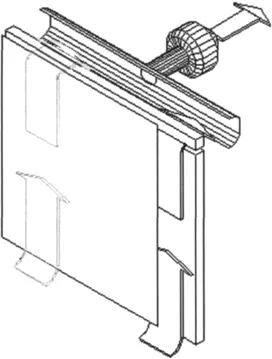
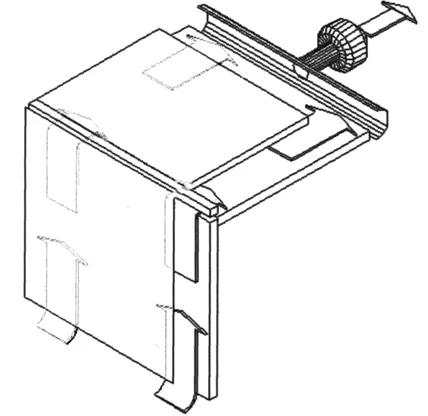
Flat-plate collectors, window collectors, perforated collectors, double facades and spatial collectors maybe used in this type of system.

Distribution

The ventilation system connected to the collector may be identical for all types of collectors. The air from the solar air collector may be:
  • Delivered directly to an adjacent room: the collection may either be ‘active’ i.e. fan-driven or ‘passive’ i.e. with no fan, but e.g. driven by the underpressure created by exhaust ventilation of the building.
  • Ducted to a remote room. Heated air is delivered by ductwork to spaces farther away from the collector, in particular to north-facing colder rooms. This is a good solution if the direct solar gain is high through the windows of the room behind the solar air collector. This variation will in most cases be fan-driven.
  • Distributed to a central mechanical ventilation system. Heated air is delivered to all the rooms connected to the mechanical ventilation system of the building.

Storage

The solar air system may be with or without storage:
  • Without storage: The heat from the system is delivered to the building without delay. The air flow may be active- or passive-driven.
  • With storage: The delivery of heat to the building is delayed and the delay increases with increasing storage. This is beneficial if there is a large direct gain through the windows of the room(s) to which the air is delivered and heat is, therefore, not needed before the evening/night. The storage may be with either active or passive discharge. In active discharge an air stream through the storage discharges the stored heat in the same way as it is charged. In passive discharge the stored heat is mainly discharged by radiation and convection from the external surfaces of the storage.
Storage is often not beneficial if the room temperature is deliberately lowered at night (setback) or when the building is unoccupied and fresh air is not required.

Control

The way the system is controlled is not a system variation as such, but may strongly influence how the systems perform. Control options include:
  • continuous operation
  • temperature control
  • solar cell control
  • timer control.

Storage and control

Not all combinations of storage and control strategies are reasonable. In order for active discharge storage to be useful the building must have a heat demand in the evening and there must be an air flow through the storage at least in the evening. The latter is not the case in systems with temperature and solar control, but may be the case with time control, if the ventilation system is allowed to run in the evening.
Passive discharge storage may be combined with all the control strategies. However, as with active discharge storage the building must have a heat demand during the evening/night in order to profit from the stored heat (Table II.1.1).
Figure II.1.2. System 1 variation with a hypocaust
Table II.1.1. Reasonable combinations of control strategy and storage type
Control strategy Storage
active discharge passive discharge

Always running possible possible
Temperature or solar control not recommendable possible
Time control maybe possible

Advantages and limitations of the system

Advantages

  • Very simple and inexpensive especially if installed as a replacement to existing ventilation systems. In that case the ducting and fans as well as the electricity are already paid for.
  • When heating ventilation air, temperatures below room temperature are also useful. A principal difference between System 1 and Systems 2-6 is that small temperature increases and low absolute temperatures are adequate to preheat fresh air for a building. There is no demand that specific temperature levels have to be reached i.e. >20°C for space heating. The building has to be supplied with fresh air, so if the ambient temperature is – 10°C and the temperature increase across the collector is 5 K (leading to an absolute temperature out of the collector of-5°C) the gained heat is still useful. If the incoming solar heated air, however, is warmer than the room temperature, part of the building transmissions heat losses will also be covered.
  • As small temperature increases are valuable, there is generally no restriction on the collector types. Covered and uncovered, simple (e.g. perforated collectors) and advanced collectors but also spatial collectors (sunspaces, atria or roof space collectors) may serve as a collector in a solar air heating system fo...

Table of contents

  1. Cover
  2. Title
  3. Copyright
  4. Dedication
  5. Contents
  6. Foreword
  7. I INTRODUCTION
  8. II SYSTEMS
  9. III ALTERNATIVE USES OF SYSTEMS
  10. IV COMPONENTS
  11. V ACCESSORIES
  12. APPENDICES
  13. Index