eBook - ePub
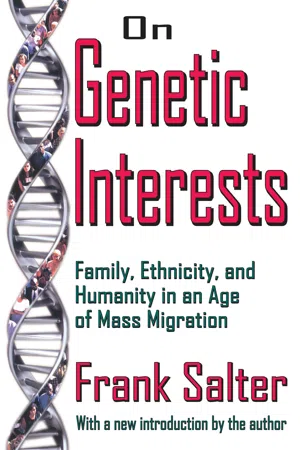
On Genetic Interests
Family, Ethnicity and Humanity in an Age of Mass Migration
- 388 pages
- English
- ePUB (mobile friendly)
- Available on iOS & Android
eBook - ePub
About this book
From an evolutionary perspective, individuals have a vi- tal interest in the reproduction of their genes. Yet this interest is overlooked by social and political theory at a time when we need to steer an adaptive course through the unnatural modern world of uneven population growth and decline, global mobility, and loss of family and communal ties. In modern Darwinian theory, bearing children is only one way to reproduce. Since we share genes with our families, ethnic groups, and the species as a whole, ethnocentrism and humanism can be adaptive. They can also be hazardous when taken to extremes. On Genetic Interests canvasses strategies and ethics for conserving our genetic interests in an environmentally sustainable manner sensitive to the interests of others.
Information
Part I: Concepts
1. Introduction: Genetic Continuity as the Ultimate Interest
Summary
Since life is evolved, reproduction is the ultimate interest, one of overriding importance. Organisms are evolved to reproduce at the cost of all other interests, even personal survival. Reproduction is achieved by passing on genes down the generations, both in one’s children, collateral kin, and fellow ethnics. Reproductive interests are therefore genetic interests. An individual’s genetic interest is the sum of all his or her distinctive genes in the species. A distinction can be made between the ultimate interest of reproduction and proximate interests such as life, liberty and resources. The latter are subsidiary goals we are evolved to value because they serve, or once served, our genetic interests. Despite their overriding importance, genetic interests have not been explicitly incorporated into political theory.
The sight of a bald eagle reintroduced to the wild, soaring over the Grand Canyon and tending its hatchlings, is reward enough for conservationist efforts. But on deeper reflection, what is it about staving-off extinction that is worth celebrating? Surely not the mere sight of an object that resembles a beautiful living creature. Replenishing the Grand Canyon with robotic eagles would somehow be less satisfying than saving the real thing, even if the outer resemblance were perfect, even if the robots hunted and laid eggs. So what is it about the bald eagle that we treasure? One might work through a checklist of characteristics including appearance, behaviour, contribution to the ecosystem, and biodiversity, all of which we value. One might even appreciate authentic eagles because of the possibility that some of their genes will someday prove of commercial or medicinal value to humans. Still something is missing. Real eagles are descended genetically from other real eagles.
The same applies to ersatz humans. If robots could be made that imitated our children perfectly in outward appearance and behaviour I doubt that many parents would be willing to make the substitution, even if their real children were to go to loving foster homes and robot children were cute and healthy, were toilet trained and winners at school. I have never come across a parent willing to substitute a child even for another human child. Why? The objection is emotional, based on the bond that has developed between parent and child. And this bond serves genetic interests, the preservation of the parent’s distinctive genes.
In this essay I argue for the importance of genetic continuity as an end in itself, for humans as well as for other species. Conserving any species or one of its races entails preserving its genes, in addition to a conducive environment; not only because genes code for the properties that we value, but because we affiliate with life for its own sake. And we know that life is not only dependent on ecology but on phylogeny, the evolutionary experience of a species impressed on its genes. If eagles could speak they would probably demand the right—or at least the chance—to survive and flourish, as do we. That is life’s overriding goal, its ultimate interest.
Even the embryo strives to live, as do its precursors, the gametes of ovum and sperm and fertilized ovum, or zygote. The sperm is most spectacular in its striving to reach and fertilize the egg, and the prize is large—all the sperm’s (and ovum’s) genetic material is copied into the new organism should the embryo develop into a viable foetus, child, and adult. Half the genes of that new individual are passed on to the next generation should it reproduce. When born into an environment for which they are adapted, all forms of life, including human beings, strive to survive and to multiply.
Life is the ultimate interest, though we are all destined to die. Phenotypes— organisms put together from information supplied by genes plus environment— are mortal. The causes of life are in the transgenerational evolutionary process stretching back three billion years to the first self-replicating entity. It follows that ultimate interests do not reside in individual survival but in the reproduction of the information used by the organism to construct itself. The basic bits of information are ‘germ-line replicators’, reproduced with great accuracy. They are the ‘units of selection’ on which ultimate processes of selection and mutation operate. They are genes, the digitally coded bits of information coded in deoxyribonucleic acid, known as DNA.
Genes decompose with the organism but the information they carry can have great longevity compared to individual lifespans. This is because genes reproduce by cloning, making perfect copies and, rarely, not-so-perfect copies of themselves. But without the aid of modern science, sexually reproducing organisms cannot clone themselves. Children are made by blending a random sample of the genes of two individuals. Individuals are assemblages of tens of thousands of genes in combinations that are never repeated (except in identical twins), no matter how many offspring the individual produces. But genes reproduce with digital fidelity, by copying genetic ‘words’ spelt from just four molecular ‘letters’, the nucleic acids: adenine, cytosine, guanine, and thymine.
Except for rare mutations, genes are descended from long chains of clones often originating in pre-human ancestors who lived millions of years ago. All genes, including mutants, are potentially the parents of similarly long chains of descendants. According to neo-Darwinian theory humans, like all other species, are constructed using information carried in genes interacting with environments conducive to life. Like other species, humans have evolved a set of behaviours for propagating their genes. Indeed, in the tradition of Darwinian evolutionary theory, propagating one’s genes is life’s raison d’etre. Darwin realized that a major philosophical import of his 1859 book, On the Origin of Species by Means of Natural Selection, or The Preservation of Favoured Races in the Struggle for Life,1 was that it represented nature as governed by physical laws and placed humans in the continuum of life, with the same origin in the struggle for existence.
Individuals might choose any purpose in life, including ones that prevent their genes from being passed on to the next generation. However, maladaptive choices tend to eliminate genes that contribute to those choices within prevailing environments. Genes will not survive the organism in which they reside unless they launch the organism on an adaptive life course—avoiding predators, metabolising food, learning the local language, resisting parasites, finding mates and, in social species, nurturing offspring and defending the kin group. The individual phenotype is a survival vehicle constructed by a parliament of genes, each cooperating to perpetuate itself.2 This modern evolutionary view of humans (and all other species) has been dramatically expressed by Richard Dawkins3: They are in you and in me; they created us, body and mind; and their preservation is the ultimate rationale for our existence. . . . [T]hey go by the name of genes, and we are their survival machines.’ Genes are not the ultimate rationale for anything, of course, since only a proposition can perform that function. But the process of genetic evolution is certainly the ultimate cause of our existence. Individual humans are links in a chain of life stretching back millions of generations of human and prehuman species that managed to perpetuate their genes. A developmental program coded in the genes and enabled by the environment, guides individual behaviour over the lifespan, for example by producing a distinctive physiology and psychology. These ‘proximate mechanisms’ evolved due to the ultimate cause of biological evolution—the process of differential survival and reproduction of genomes within populations.
The needs and wants of the phenotype are interests, and conventional social theory adopts this perspective. All interests have some importance, even if only subjectively. But some interests are more important than others. Abraham Maslow4 pointed this out quite explicitly in his ‘hierarchy of needs’. We consider some interests vital. Most of us give priority to the survival and well being of ourselves as individuals. For emotional reasons we also give priority to the welfare of kith and kin and other individuals and groups for whom we have sympathy. Nutrition and freedom from disease also rate highly on our hierarchy of needs. Resources and rank are two interests usually considered vital, once survival and good health have been secured. Yet as compelling as these may seem, and despite contributing to reproductive fitness, they are actually of secondary importance to the ultimate interest. Biologist Richard Alexander5 notes that when ‘ interests are seen as reproductive, not as individual survival, . . . pleasure and comfort are postulated to have evolved as vehicles of reproductive success’. These secondary goals can be referred to as proximate interests. They are the short-term goals served by adaptations, including motivations and appetites. Yet in relation to the ultimate interest of genetic continuity, the means distilled in proximate interests are expendable. For example, the avoidance of injury is a readily understood proximate interest served by the adaptation of the pain reflex. Still, adaptations such as the pain response are not ends in themselves. As evolutionary theorist George C. Williams points out, these adaptations have the ‘ultimate purpose’ of promoting ‘genetic success’—transmitting one’s genes into the next generation.6 From the biological perspective even personal survival— usually taken to be an end in itself—is a means to genetic success. Since it is an important means, individuals are adapted to defend life and limb. Nevertheless, self-sacrificial behaviour can be observed in all societies. Examples exist in heroic self sacrifice by parents trying to save children and warriors defending their homelands.
The most comprehensive concept of genetic success, ‘inclusive fitness’, was introduced by the ethologist William D. Hamilton in a famous 1964 paper. Hamilton showed that an individual’s genetic interests are advanced not only through personal reproduction, but by aiding the reproduction of other individuals who share some of its genes, typically kin. Richard Alexander expresses this well:
[HJumans like other organism[s] are so evolved that their "interests" are reproductive. Said differently, the interests of an individual human (i.e., the directions of its striving) are expected to be toward ensuring the indefinite survival of its genes and their copies, whether these are resident in the individual, its descendants, or its collateral relatives.7
From an evolutionary perspective, based on observation of many species, genetic continuity is the ultimate interest of all life, since it has priority over other interests. People are prone to risk their lives for close relatives in emergencies, testament to the power that inclusive fitness has to shape human action. Valuing of proximate interests such as self preservation evolved to the extent that they enhanced the ultimate reproductive interest. Edward O. Wilson puts proximate interests in neo Darwinian perspective thus:
In a Darwinist sense the organism does not live for itself. Its primary function is not even to reproduce other organisms; it reproduces ge...
Table of contents
- Cover
- Title Page
- Copyright Page
- Dedication Page
- Table of Contents
- List of Tables
- List of Figures
- List of Maps
- Introduction to the Transaction Edition
- Preface
- Acknowledgements
- Part I: Concepts
- Part II: Strategies
- Part III: Ethics
- Appendix 1. Kinship and population subdivision (by Henry Harpending)
- Appendix 2. Glossary
- References
- Index
Trusted by 375,005 students
Access to over 1.5 million titles for a fair monthly price.
Study more efficiently using our study tools.
Frequently asked questions
Yes, you can cancel anytime from the Subscription tab in your account settings on the Perlego website. Your subscription will stay active until the end of your current billing period. Learn how to cancel your subscription
No, books cannot be downloaded as external files, such as PDFs, for use outside of Perlego. However, you can download books within the Perlego app for offline reading on mobile or tablet. Learn how to download books offline
Perlego offers two plans: Essential and Complete
- Essential is ideal for learners and professionals who enjoy exploring a wide range of subjects. Access the Essential Library with 800,000+ trusted titles and best-sellers across business, personal growth, and the humanities. Includes unlimited reading time and Standard Read Aloud voice.
- Complete: Perfect for advanced learners and researchers needing full, unrestricted access. Unlock 1.5M+ books across hundreds of subjects, including academic and specialized titles. The Complete Plan also includes advanced features like Premium Read Aloud and Research Assistant.
We are an online textbook subscription service, where you can get access to an entire online library for less than the price of a single book per month. With over 1.5 million books across 990+ topics, we’ve got you covered! Learn about our mission
Look out for the read-aloud symbol on your next book to see if you can listen to it. The read-aloud tool reads text aloud for you, highlighting the text as it is being read. You can pause it, speed it up and slow it down. Learn more about Read Aloud
Yes! You can use the Perlego app on both iOS and Android devices to read anytime, anywhere — even offline. Perfect for commutes or when you’re on the go.
Please note we cannot support devices running on iOS 13 and Android 7 or earlier. Learn more about using the app
Please note we cannot support devices running on iOS 13 and Android 7 or earlier. Learn more about using the app
Yes, you can access On Genetic Interests by Frank Salter in PDF and/or ePUB format, as well as other popular books in Social Sciences & Ecology. We have over 1.5 million books available in our catalogue for you to explore.