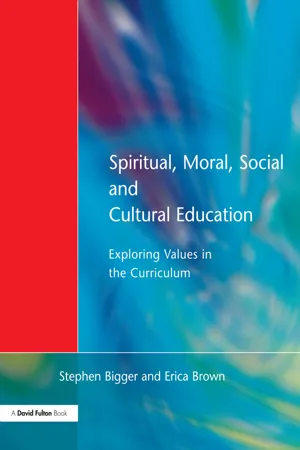
First published in 1999, this book, by a range of teachers and teacher trainers, explores specified values in the curriculum as well as whole curriculum issues, including religious education, drama, citizenship and vocational education, as well as the National Curriculum subjects. As a hugely controversial topic area, without general consensus on many key points, this book provides an introductory platform, consistently pointing to sources of further reading and suggesting signposts through the issues. Readers will get a wider insight into spiritual, moral, social and cultural issues, as well as the development of values in general, by reading the specialist chapters.
eBook - ePub
Spiritual, Moral, Social, & Cultural Education
Exploring Values in the Curriculum
- 187 pages
- English
- ePUB (mobile friendly)
- Available on iOS & Android
eBook - ePub
About this book
Information
The Whole Curriculum
Chapter 1
Spiritual, Moral, Social and Cultural Education
What kind of young people are being turned out by the education system? Youngsters who know facts about academic subjects? Or motivated responsible young adults with a thirst for understanding, a curiosity about life, a concern to contribute to the communities in which they find themselves, and to build relationships with other people? The compulsion to ‘reform’ education has focused on systems and curriculum, but should not lose sight of how education affects pupils and fits them for the tasks ahead. Which vision of education we choose helps us to create policies and priorities on teaching and learning. There is a tension in British education between many different voices, debating teaching and assessment methods, accountability, relationships between schools and parents, and values.
Schools have been turned upside down by developments stemming from the 1988 Education Reform Act which brought in a National Curriculum of traditional subjects, choosing a vision that pupils should be aware of and interested in these. ‘It is quite common for people to excel at subjects yet not have benefited as persons’ (Newby 1997, p. 292): this raises the question of the extent to which education should focus on understanding life and the world and our place and role within it – educating the whole person (Erricker et al. 1997). As a response, cross-curricular perspectives and themes were put in place, demonstrating how social, personal, environmental, vocational and citizenship perspectives could be introduced. These are of low priority in a crowded school curriculum.
The 1988 Education Reform Act had higher aspirations as is revealed by its opening statement, that the school curriculum should promote the spiritual, moral, cultural, mental and physical development of pupils and to prepare pupils for the opportunities, responsibilities and experiences of adult life. The National Curriculum Council (NCC 1993) produced a discussion paper with a broad secular view of spirituality, and with moral values ‘which contain moral absolutes’ sounding like a behaviour policy. The Schools Curriculum and Assessment Authority (SCAA) reported on a national conference regarding the place of spiritual and moral development in education for adult life (SCAA 1996). From this came a national forum to advance discussion. The focus on spiritual, moral, social and cultural aspects of education recognises the importance of human experience – of life, of how we think about ourselves, our responsibilities, our place in the world, and our responses to others who are different. Whatever else it does, education should help children understand themselves and their world and enable them to make an informed and responsible contribution to their community and to society. Academic subjects have a part to play, contributing to a school’s positive ethos. The Office for Standards in Education (OFSTED) are required to monitor this.
In this book we examine the human side of the school curriculum – both in the formal curriculum which is planned and taught, and the informal curriculum of hidden messages that pupils pick up. If pupils are taught justice but experience unfairness in the school system, the informal learning from experience may be the more powerful. The legally prescribed daily act of collective worship can provide a focus for a caring, sharing ethos: but we need a substantial redefinition of ‘worship’ (usually used in the context of believers) to have an educational rather than confessional purpose, for groups of pupils from a range of religious backgrounds or with secular life-stances. A focus on the values discussed here provide a starting point.
Values
The main aim of education is a matter of political debate, but answers revolve around the following:
- knowledge and understanding;
- preparing children for later life and wider society;
- the development of responsible attitudes.
In a sense education sets out to teach students to become informed and functioning members of society with the skills to contribute to work and to the community. These different aims present dilemmas as to how balance is best achieved. The traditional curriculum packaged knowledge into named subjects, each with a body of skills and an implicit ‘canon’ of preferred subject content. Assessment ensured that the material has been understood. The structure of the National Curriculum encourages this, although skills, attitudes and values can, and are encouraged to be explored in relation to the topics covered by appropriate teaching and learning methods.
OFSTED distinguishes between good and bad schools, according to its own set criteria, in which attainment in academic subjects predominate. A school might be getting excellent academic results but not developing responsible young adults ready to play a part in the wider world. This has been expressed sharply by deschooling arguments, such as by Ivan Illich (1971) who argued that, if the educational focus is inappropriate, schools are not preparing young people for life but are damaging their abilities to become responsible and creative members of society. Schools, on this view, are bad for pupils, however good their academic results.
Our task is to enable schools to become good for children by encouraging participation in learning which includes responsible problem-solving, critical management of information, informing choices and developing skills. That this can be done through the curriculum orders is implicit in government statements. The emphasis on spiritual, moral, social and cultural aspects of learning can help to transform teaching and learning strategies and address wider and deeper issues. Watson and Ashton (1995, p. 73) stressed the usefulness of the concept of openness – openness to fresh evidence; to the experience of others; to appreciating real needs and situations, especially relating to other people; and to critical assessment. Values are highlighted in the cross-curricular perspectives and themes which begin to address environmental, multicultural, vocational, economic and political values. These are not assessed, so not all schools will give them high priority (let alone a budget). Teachers need the support of other adults in the community – parents, the business community, the police, medical, social and youth services. Partnership strategies have flourished over the past decade and are a potent underused strategy towards a more socially integrated education system.
Schools deliberately promote their core values – generally expressed as tolerance, respect, responsibility, fairness, caring, sharing, cooperation, and commitment. They try, not always successfully, to put these values into practice in daily routines. We will now explore the parameters of the terms spiritual, moral, social and cultural, widely used today as a guide to organisation and planning. We will then examine, in later chapters, how curriculum areas can respond positively to this agenda.
Spiritual aspects
The word ‘spiritual’ tends to evoke religious feelings of prayer, meditation, mystical vision and relationship with the divine. This stems from a time when sacred and secular were scarcely divided: the ‘spiritual’ was embedded in story, of deities, of divine actions in the world, of Jesus, or Krishna, or Shiva, of personal relationships with deities, and of faith. Inner feelings of trust, commitment and aspiration were seen naturally as part of this domain. True there was tension between mystical spirituality and orthodox religion which felt threatened by the lack of doctrinal boundaries. And as a result, some paid with their lives, accused of being heterodox (i.e. not orthodox, or as the authorities would say, heretical). A religion can nevertheless be big enough to encompass spiritual growth and insight, and many religious leaders were spiritual innovators.
The word ‘spiritual’ has a curious history, deriving from the Latin spirare ‘to breathe’. ‘Spirit’ was commonly the same word as ‘breath’ and ‘wind’. The Greek pneuma (which gives us our word pneumatic) can mean breath, wind or Holy Spirit. Observation noted that breath is evidence of life, so it was used as a metaphor for the inner life, the self, the life force. Wind then mythically symbolises God’s breath, evidence of a Creator’s existence. ‘Spirit’ is primarily a metaphor for that which animates us, which includes intellect, emotions, personality and personal commitments. That it was customary to operate within current frameworks of religious doctrine should not restrict us today at a time when secular life-stances are also common. The spiritual focuses on contemplation about ourselves, our place in the cosmos, our responsibilities and the meaning we give to our lives and experiences. We seek inner peace. The insights, flashes of deeper understanding and awareness, can be life transforming. Issues of life and meaning are often mundane as we struggle to work things out the hard way. Today these are by no means, and need not be, tied to religious doctrine.1
What we mean by ‘self involves both physical and inner dimensions: we have an inner picture of ourselves which is not necessarily accurate. People underesteem or over-esteem their abilities and personalities. In a sense ‘self is our image of the inner consciousness, the word we use to describe our personal togetherness. However, personality can dramatically change after brain damage, and emotions can be stimulated by electrical brain stimulation, so our inner being is influenced by outer stimuli. Are we a body filled with personality which departs elsewhere at death? Traditional Christianity talks of body, soul and spirit, dividing our inner consciousness from our enduring spiritual essence. The belief, that when we die, we survive, we are not annihilated, is the root of religious hope. The alternative is that when the body dies, the whole being dies with it, because our ‘self’ is only the accumulated experiences and perceptions processed by our brains. On this secular view, there are no ghosts and no immortality. To die is to cease to be. Either view is properly possible as an expression of spirituality.
Schools are religiously neutral educational institutions: we need to tread a careful path between assumptions and beliefs about spirituality found in a society that includes a variety of religions and a strong secular trend. The spiritual, our inner life or self, our non-tangible personality, our self-awareness, cannot be located in a post mortem. We appreciate beauty, reflect on experience and creatively express our personality. We create an holistic understanding of our human lives as a step towards recognising personal meaningfulness. OFSTED commented (1994b): ‘Spiritual development is to be judged by how well the school promotes opportunities for pupils to reflect on aspects of their lives and the human condition through, for example, literature, music, art, science, religious education and collective worship, and how well the pupils respond’. In practice however, it has proved difficult to conceptualise and to implement (A. Brown 1996)2. OFSTED’s evidence for spiritual education consists mainly of religious education, despite its declared intention for spirituality to be much broader. E. Brown (1996) focused on opportunities for stillness, for pupils being aware of themselves as individuals, for reflection and sharing, for feeling wonder at beauty, for personal responses, and for working in a secure environment which values, supports and respects them. Stillness is not content free: it can be a medium for religious expression, focusing on God; or ethical, concentrating on loving kindness; or personal, remembering family and friends with affection; or a rational calming process, emptying the mind of trivia. Wonder is self-constructed, a way of describing an emotional response which itself develops (whether it declines or increases) over time and experience. Awe is a particular kind of emotional response, to something vast (the universe) or powerful (a storm, a mountain). Religious people may set these in a particular doctrinal framework (the powerful creator God).
Becoming more aware of who we are causes us to consider our limitations: our mortality, coming to terms with the fact that we will die – this impacts on the way we live our lives and manage our relationships; our shortcomings, developing strategies to overcome our weaknesses and to use guilt positively; and our limited understanding about life, our futures, and about the nature of death, leading to speculation about an afterlife, the nature of the soul as (or if) distinct from the body, reincarnation and rebirth, heaven and hell. That we have a soul or spirit which is immortal and will exist even when our body is dead is a widely held religious belief, emphasising the inner awareness of ourselves as persons: ‘I’ will not cease when my body wears out. However, our concept of self is intellectually constructed through our (somewhat biased) reflection on our feelings, thoughts and actions. The existence of an ‘I’ behind this often faulty self-image (and the nature and essence of our ‘selves’) is more than an academic question – but we cannot trust our mental self image; humans are skilled in self-delusion.
In education, spirituality will be expressed in general terms:
- the concepts of self, self-worth, self-esteem;
- the concept of relationship, how we set our own self-worth beside that of others;
- our needs, physical, emotional and psychological;
- our self-understanding and self-realisation;
- questions of the meaning of life and mortality.
Spiritual perspectives can help pupils come to terms with:
- who they are;
- what kind of people they are;
- how we construct meaning and purpose for our lives;
- how we express hope, aspiration and faith;
- personal trustworthiness, honesty, quality and good faith.
Moral aspects
The term ‘moral’ refers to norms of socially acceptable behaviour – although society tends not to hold a unanimous view, as witnessed by controversies about abortion. Moral education encourages not only the learning about moral rules but also the investigation of moral decision-making. The formal intellectual process of analysing moral situations is called ethics, which examines underlying issues and principles in personal choices. A moral rule would not necessarily be accepted. We are looking in a sense at:
- what ethical dilemmas need discussing;
- the validity of moral norms;
- how behaviour lives up to moral expectations and ethical principles.
An ethical analysis does not have a fore-ordained right answer. Each situation is unique; general principles need balancing against each other. Some commonly used concepts are n...
Table of contents
- Cover Page
- Title Page
- Copyright Page
- Contents
- Contributors
- Preface
- Part One: The Whole Curriculum
- Part Two: The National Curriculum
- Index
Trusted by 375,005 students
Access to over 1.5 million titles for a fair monthly price.
Study more efficiently using our study tools.
Frequently asked questions
Yes, you can cancel anytime from the Subscription tab in your account settings on the Perlego website. Your subscription will stay active until the end of your current billing period. Learn how to cancel your subscription
No, books cannot be downloaded as external files, such as PDFs, for use outside of Perlego. However, you can download books within the Perlego app for offline reading on mobile or tablet. Learn how to download books offline
Perlego offers two plans: Essential and Complete
- Essential is ideal for learners and professionals who enjoy exploring a wide range of subjects. Access the Essential Library with 800,000+ trusted titles and best-sellers across business, personal growth, and the humanities. Includes unlimited reading time and Standard Read Aloud voice.
- Complete: Perfect for advanced learners and researchers needing full, unrestricted access. Unlock 1.5M+ books across hundreds of subjects, including academic and specialized titles. The Complete Plan also includes advanced features like Premium Read Aloud and Research Assistant.
We are an online textbook subscription service, where you can get access to an entire online library for less than the price of a single book per month. With over 1.5 million books across 990+ topics, we’ve got you covered! Learn about our mission
Look out for the read-aloud symbol on your next book to see if you can listen to it. The read-aloud tool reads text aloud for you, highlighting the text as it is being read. You can pause it, speed it up and slow it down. Learn more about Read Aloud
Yes! You can use the Perlego app on both iOS and Android devices to read anytime, anywhere — even offline. Perfect for commutes or when you’re on the go.
Please note we cannot support devices running on iOS 13 and Android 7 or earlier. Learn more about using the app
Please note we cannot support devices running on iOS 13 and Android 7 or earlier. Learn more about using the app
Yes, you can access Spiritual, Moral, Social, & Cultural Education by Stephen Bigger in PDF and/or ePUB format, as well as other popular books in Education & Education General. We have over 1.5 million books available in our catalogue for you to explore.