eBook - ePub
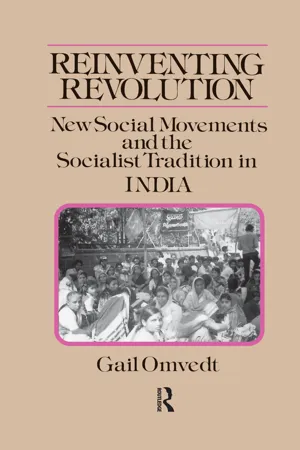
Reinventing Revolution
New Social Movements and the Socialist Tradition in India
- 368 pages
- English
- ePUB (mobile friendly)
- Available on iOS & Android
eBook - ePub
About this book
This study describes and analyses the new social movements that have arisen in India over the past two decades, in particular the anti-caste movement (of both the untouchables and the lower-middle castes), the women's liberation movement, the farmers' movement (centred on struggles arising out of their integration into a state-controlled capitalist market), and the environmental movements (opposition to destructive development, including resistance to big dam projects and the search for alternatives). Rooted in participant observation, it focuses on the ideologies and self-understanding of the movements themselves. The central themes of this book are the origin of movements in the socio-economic contradictions of post-independence India; their effect on political developments, in particular the disintegration of Congress hegemony; their relation to "traditional Marxist" theory and Communist practice; and their groping toward a synthesis of theory and practice that constitutes a new social vision distinct from traditional Marxism.
Information
Part I
Historical Background
1
The National Movement and the Roots of Socialism
We with our own hands have spread the coals beneath our feet,
We have run till we fainted on the path of our ideals,
We have never paused for rest, we have never looked behind,
We have let neither love nor fame be shackles to bind,
A single star before us, the burning coals beneath—
Shout victory, victory to the revolution! Shout victory!
Why, mother, do your eyes fill with tears? your future is bright,
The dawn of tomorrow comes out of the womb of the night,
Today it is our corpses that blaze upon the funeral pyre,
Out of that blaze will come revolution's leaders of tomorrow
Then the shackles on your feet will shatter with a clang,
Shout victory, victory to the revolution! Shout victory!
We have run till we fainted on the path of our ideals,
We have never paused for rest, we have never looked behind,
We have let neither love nor fame be shackles to bind,
A single star before us, the burning coals beneath—
Shout victory, victory to the revolution! Shout victory!
Why, mother, do your eyes fill with tears? your future is bright,
The dawn of tomorrow comes out of the womb of the night,
Today it is our corpses that blaze upon the funeral pyre,
Out of that blaze will come revolution's leaders of tomorrow
Then the shackles on your feet will shatter with a clang,
Shout victory, victory to the revolution! Shout victory!
—Nationalist song by "Kusumagraj," Marathi
THE "REVOLUTION" referred to in this song, one inspiring many generations of youth, is the nationalist one—the most famous of India's "social movements." It was this movement that gave birth to the main trend of socialism in India, and when the "Hindu" definition of Indian identity came to overshadow nationalism it also affected the socialist movement. Nationalism, however, was not the only movement of its time in India; there were others, movements of middle and low castes, peasants and tribals often defining themselves in ways contradictory to and often in opposition to those of the national movements. These also helped to give birth to a socialist tradition, one that is only beginning to flower in the new social movements of the 1970s and 1980s. This chapter, then, will examine the preindependence roots of both "old" and "new" social movements, "traditional" and "alternative" socialism.
“Swaraj Is My Birthright”
In 1885 a British civil servant, Allan Hume, helped a group of English-educated Indians to form an organization that he hoped would prove an effective mediating agency between the British and the vast empire they ruled. But this organization, aspiringly named the Indian National Congress, went beyond Hume's expectations, and beyond the expectations of the polite and moderate Indians who gathered for its early three-day sessions of political debate and the passing of resolutions; it went from demanding more scope for Indians in governing the empire to asking that the empire itself be scrapped. Within two decades the Congress had come under control of the group called "Extremists" who were attempting mass contact and mobilization campaigns, who had contacts with dedicated bands of youthful bomb-throwers, and whose rhetoric was moving away from the polite accusation that imperial rule was "un-British" to the forthright claim of B. G. Tilak that "Swaraj is my birthright, and I will have it."
The term raj or rajya means "rule, regime, kingdom" and is widely used in Indian languages, so that swaraj (self-rule), Hindu raj (Hindu rule, regime of Hindus), Ram-rajya (the regime of Ram), gram raj (village rule), kisan-mazdur raj (the rule of peasants and workers) and Bali-rajya (the kingdom of Bali or regime of Bali) came to describe varying versions of an ideal society. When Tilak used the term swaraj or "self-rule," he changed the framework of debate completely; the Congress simply had to add a small adjective, purna swaraj, "full independence," to signify its radical opposition to foreign rule. It did so only in 1929—forty-four years after its founding—but by then its sessions were mass events marked by huge rallies and backed by growing struggles of workers and peasants throughout the country; its membership was in the hundreds of thousands, and beyond it lay more radical organizations. For "terrorism" had also developed in India, from small sectarian bands of bomb-throwers to efforts at mass organizing. Bhagat Singh, the most famous of these early revolutionaries, had led a group that united activists from many parts of India. It had an open youth organization along with its underground activities, and with the name "Hindustan Socialist Republican Army" it proclaimed its goal of a total change in society. The youthful hero (only twenty-three at the time of his death) proclaimed himself an atheist and a socialist and declared at his trial,
Revolution is the inalienable right of mankind. Freedom is the imprescriptible birthright of all. The labourer is the real sustainer of society.... To the altar of this revolution we have brought our youth as incense, for no sacrifice is too great for so magnificent a cause. We are content, we await the advent of revolution. Inquilab Zindabad!1
Swaraj was not only anti-imperialist; it was giving birth to socialism. The dominant socialist tradition in India arose out of this fervent nationalism of the Indian intelligentsia.
Even more ominous to the British than the development of militant opposition by this English-educated elite was the fact that the masses of people themselves were moving to make the same kind of linkage. Tribal peasants may have had little connection with Congress leaders, may even have directed their first struggles against local moneylenders and bureaucrats—but it was British armies they came up against, and they were even readier than the elite to assert their rights to freedom. Nontribal peasants were slower to pick up the meaning of freedom, accustomed as they were to centuries of looting, known as rule, by Indian rulers and feudatories, but they also fought exploitation, and some linked with the Congress in resisting landlord depredations or the state's imposition of land revenue and the destruction of their forests. And a new class was growing in the textile and jute factories in the cities, freed from the bondage of village toil only to be subordinated to a new brutal capitalist regime; they were restlessly stirring.
When Tilak, who had been given the title of lokmanya, "honored by the people," was sentenced by the British to a six-year sentence in the Andaman Islands in 1908, this working class, predominantly textile workers crowded into the heart of Bombay, expressed their nationalism by going on a massive six-day strike—though Tilak himself had never been associated with workers' struggles, though his followers were reluctant to involve them in nationalist organizing. It was an event noticed by Lenin:
In India the street is beginning to stand up for its writers and political leaders.... The proletariat has already developed to conscious political mass struggle, and that being the case, the Russian-style British regime in India is doomed! ... There can be no doubt that the age-old plunder of India by the British and the contemporary struggle of all these "advanced" Europeans against Persian and Indian democracy, will steel millions, tens of millions of proletarians in Asia to wage a struggle against their oppressors which will be just as victorious as the Japanese. The class-conscious European worker now has comrades in Asia.2
It was not, of course, to be so simple—and not only because of the ambiguous pro-imperialist role of the European "class-conscious" worker.
Swaraj or Hindu Raj?
There was, first of all, the problem of the "class" status of the Indian intelligentsia, leaders of the national movement. They were not only English-educated professionals or "petty bourgeoisie"; they were drawn from Indian landlord and feudal bureaucratic sections, and they almost overwhelmingly opposed land reforms that would deprive landlords of their rights. Although many Congress members were to lead tenant struggles in the twentieth century, although some Congress committees (but not the full Congress) adopted resolutions for the abolition of landlordism, and although Congressmen could get fairly enthusiastic about struggles against land revenue by peasants who were opposing the bureaucracy rather than Indian landlords, the fact remained that the main body of Congress resisted, from beginning to end, any radical change in land tenure or production relations. The remark of Tilak himself (a brahman whose caste provided the main landlords of the coastal districts of Maharashtra) in this respect was revealing, "Just as the government has no right to rob the moneylender and distribute his wealth among the poor, in the same way the government has no right to deprive the [landlord] of his rightful income and distribute the money to the peasant. This is a question of rights and not of humanity."3
Similarly, though theories of economic nationalism were formulated and the "drain" of wealth from India was questioned, the drain from the villages upward to the capitalist or bureaucratic elite was never confronted.
There was much more. India was not simply a land of economic divisions, of workers, peasants, landlords, petty bourgeois. It was what Communists were to call a "multinational" country—a subcontinent with over a dozen major languages (and, unlike Europe, with different scripts) and with the varying ethnic identities that went along with these languages. It was an ancient land that had seen the incursions of varying racial groups for a period of over four thousand years of "civilization"—invasions, settlements, migrations, from both its northwestern and northeastern land routes and from the seas as well, bringing Aryans, Dravidians, Austro-Asiatics, Sino-Tibetans, Arabs, Turks, and finally Europeans. All of this had resulted in a precolonial tributary society advanced in its productivity and complexity, prosperous, often brilliant but diverse and inequalitarian; and the essence of the diversity was expressed, on the one hand, in varying religious traditions and, on the other, in the caste system.
Caste is a non-Indian term with a Portuguese derivation that is used to translate two Indian words, varna and jati. Jati means the named groups that are ranked in local hierarchies, intermarry and interdine only among themselves, and follow a traditional occupation. Varna is the ideological classification of these groups. Its meaning has changed from the Vedic to the post-Vedic period, but it is now generally understood as including four hierarchically ranked groups: the brahmans, who were not only priests and intelligentsia but also administrators and very often landlords and bureaucrats, and who were considered at the top of the hierarchy of purity and pollution; the kshatriyas or rulers and warriors; the vaishyas or merchants and businessmen; and the shudras, peasant and artisan toilers whose job was to serve all the others.
Besides these were the outcastes, untouchables, the lowest of all, who performed tasks both laborious and polluting (carrying away dead animals, keeping the village clean, the most menial agricultural labor, and service to village dominant castes and bureaucrats); these most frequently lived in separate settlements outside the village itself. All castes were in some sense "untouchable" to those of higher rank, since what marked the system was the fact that people "exchanged bread and daughters" (roti-beti-vyavahar), that is, intermarried and interdined only within the boundaries of the caste or subcaste, while people of higher rank would take only uncooked food or water from those of lower rank. But the untouchables were the most excluded, most clearly set aside. And finally there were the "tribes," groups of forest dwellers, shifting cultivators or peasants on high lands who maintained more egalitarian traditions. Broadly speaking, by British rule the tribes constituted 7 percent (but occupied 40 percent of the land, a proportion gradually reduced throughout the decades); the "untouchables" about 17 percent; the shudras about 60 percent, and the top three varnas (brahmans, kshatriyas, and vaishyas) about 15 percent of the population classed as "Hindu."
But what was Hindu? The official definition of the rightist Vishwa Hindu Parishad (Universal Hindu Conference), which has risen to prominence in the 1980s, is that Hindu includes all who are not members of one of the major world religions, that is, it classifies tribals, Sikhs, sometimes Buddhists and Jains, and members of dissenting sects as Hindus. This is a definition with which most Indians and many scholars would agree; at any rate the term "Hindu" is most frequently used as describing a community posed in contrast to "Muslim" and "Christian." Yet there are problems with this use of the term.
A very large section of tribals, Buddhists, Sikhs, Jains, and members of other "sects" (e.g., the Veerasaivas of Karnataka) not only disagree today that they are Hindu, but in many cases have never known that they were being called Hindu or have been seen as opposites and enemies of Hindus. Historically also, it makes most sense to see India as a terrain of many religions, sometimes competing, sometimes uneasily coexisting; of these, Buddhism and Jainism arose earliest, while what is today known as Hinduism was only gradually consolidated out of the myriad of traditions, crystallized as a religion based on appeals to the Vedas and to the authority of brahmans. In fact, Buddhism and Jainism remained dominant in large areas of the country until the sixth to tenth centuries A.D. and were only displaced by conquest and imposition of brahmanic Hinduism as a state-supported dominant religion. Even then, vast numbers of the lower-class peasantry and toilers continued to follow indigenous deities that were only absorbed into the "Hindu pantheon" by brahmanic interpretations that they usually ignored; and while they were subordinated to the caste system and thus to brahman authority (while their more powerful members gained brahman acquiescence to their position as kings and feudatories), large numbers of these lower classes later became Muslim converts. Islam itself had a long and creative history in the subcontinent, and many of the devotional sects that arose in later times, expressing partly popular resistance to caste hierarchy, did so syncretizing Hindu and Islamic themes.
Hindu has thus been a constructed and contested identity, and a major feature of British rule was the effort of high-caste elites to reconstruct this identity, in effect to create the inclusive Hinduism that is known today, that centers around figures such as Rama and Krishna and the Bhagavad Gita, that claims the whole mythologies of the Puranic traditions as deriving ultimately from a brahmanic, Vedic, and Sanskritic core, that incorporates and yet subordinates all the various "subaltern" traditions—and that is posed in radical contrast to such "non-Indian" religions as Islam and Christianity. This was a "Hindu revivalism" that became quite a powerful trend by the end of the nineteenth century, overwhelming the earlier traditions of high-caste social reform and castigating them as pro-Western.
This Hindu revivalism gained easy acceptance by nationalist elites. The Congress included Parsis and some Muslims, but its majority were not only Hindus but high-caste Hindu males, for the most part brahmans. When they chose to appeal to the masses on the basis of "Indian traditions," they chose the symbols of this high-caste Hindu revivalism, and these were symbols that depicted Muslims as enemies and the brahmans as the natural leaders of society. Tilak again was a good example—coming from the caste of chitpavan brahmans who had been rulers in the immediate pre-British period in Maharashtra, notorious for considering all nonbrahmans as shudras and attempting to keep down the untouchables. He may have been called lokmanya and declared to be the "leaders of telis and tambolis" (two low castes), but both he and his followers assumed that it was only high castes who should be respected and followed as leaders: for telis and tambolis themselves to go into political office was unheard of and even laughable.
Swaraj was a fairly innocent word that even Muslims could accept (especially when it was joined with the Persian-derived slogan, inquilab zindabad). But it was given a Hinduistic reading. Novels depicted the fighters of "mother India" as opposing Muslim rulers; Tilak himself helped to publicize the interpretation of Shivaji—a famous seventeenth century king who had led peasants against both Hindu feudal lords and Muslim generals—as the founder not simply of swaraj but of Hindu raj, fighting Muslims. Western racism helped this process when the "Aryan theory," originated by German orientalists, was adopted by the high-caste elite. In this theory, which saw Indian civilization as derived from Indo-European Sanskrit-speaking invaders, the Vedic tribes, the "twice-born" upper castes, were seen as descended from the Aryans, the lower shudras, untouchables, and tribals from dark-skinned non...
Table of contents
- Cover
- Half Title
- Series Title
- Title
- Copyright
- Contents
- List of Tables
- Poem: "Comrade"
- Introduction
- Part I: Historical Background
- Part II: Emergence of the New Movements, 1972-1985
- Part III: Responses, System and Antisystem, 1975-1985
- Part IV: Toward a New Vision, 1985-1991
- Conclusion
- Notes
- Glossary
- Bibliography
- Index
Trusted by 375,005 students
Access to over 1.5 million titles for a fair monthly price.
Study more efficiently using our study tools.
Frequently asked questions
Yes, you can cancel anytime from the Subscription tab in your account settings on the Perlego website. Your subscription will stay active until the end of your current billing period. Learn how to cancel your subscription
No, books cannot be downloaded as external files, such as PDFs, for use outside of Perlego. However, you can download books within the Perlego app for offline reading on mobile or tablet. Learn how to download books offline
Perlego offers two plans: Essential and Complete
- Essential is ideal for learners and professionals who enjoy exploring a wide range of subjects. Access the Essential Library with 800,000+ trusted titles and best-sellers across business, personal growth, and the humanities. Includes unlimited reading time and Standard Read Aloud voice.
- Complete: Perfect for advanced learners and researchers needing full, unrestricted access. Unlock 1.5M+ books across hundreds of subjects, including academic and specialized titles. The Complete Plan also includes advanced features like Premium Read Aloud and Research Assistant.
We are an online textbook subscription service, where you can get access to an entire online library for less than the price of a single book per month. With over 1.5 million books across 990+ topics, we’ve got you covered! Learn about our mission
Look out for the read-aloud symbol on your next book to see if you can listen to it. The read-aloud tool reads text aloud for you, highlighting the text as it is being read. You can pause it, speed it up and slow it down. Learn more about Read Aloud
Yes! You can use the Perlego app on both iOS and Android devices to read anytime, anywhere — even offline. Perfect for commutes or when you’re on the go.
Please note we cannot support devices running on iOS 13 and Android 7 or earlier. Learn more about using the app
Please note we cannot support devices running on iOS 13 and Android 7 or earlier. Learn more about using the app
Yes, you can access Reinventing Revolution by Gail Omvedt in PDF and/or ePUB format, as well as other popular books in Politics & International Relations & Feminist Literary Criticism. We have over 1.5 million books available in our catalogue for you to explore.