- 370 pages
- English
- ePUB (mobile friendly)
- Available on iOS & Android
eBook - ePub
About this book
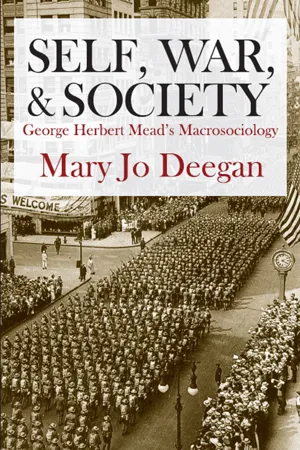
George Herbert Mead (1863-1931) is a founding figure in the field of sociology. His stature is comparable to that of his contemporaries Emile Durkheim and Max Weber. Mead's contribution was a profound and unique American theory that analyzed society and the individual as social objects. As Mead saw it, both society and the individual emerged from cooperative, democratic processes linking the self, the other, and the community. Mary Jo Deegan, a leading scholar of Mead's work, traces the evolution of his thought , its continuity and change. She is particularly interested in the most controversial period of Mead's work, in which he addressed topics of violence and the nation state. Mead's theory of war, peace, and society emerged out of the historical events of his time, particularly World War I. During this period he went from being a pacifist, along with his contemporaries John Dewey and Jane Addams, to being a strong advocate for war. From 1917-1918 Mead became a leader in voicing the need for war based on his theory of self and society. After the war, he became disillusioned with President Woodrow Wilson, with Americans' failure to support mechanisms for international arbitration, and with the political reasons for American participation in World War I. He returned to a more pacifist and co-operative model of behavior during the 1920s, when he became less political, more abstract, and more withdrawn from public debate. The book includes Deegan's interpretation of Mead's early social thought, his friendship and family networks, the historical context of America at war, and the importance of analysis of violence and the state from Mead's perspective. She also provides illustrative selections from Mead's work, much of which was previously unpublished.
Information
Part 1
Introduction
1
George Herbert Mead on Self, War, and Society: The Genesis of the International Self and a World Community
“War fever is a virulent disease, and people fired by propaganda may do things and say things foreign alike to character and to principles.” (Wald 1933, 287)
“Revolution has been incorporated into the constituted form of government itself. And this has involved a revolution itself, for such an institutionalizing of revolution has been no less revolutionary with reference to revolution itself than it has been with reference to fixed forms of government.” (Mead 1915a, reading 3C here)
“Warfare is an utterly stupid method of settling differences of interest between different nations.” (Mead 1929b, reading 10D here)
George Herbert Mead created a profound and unique American theory that analyzed society and the individual as social objects. Both society and the individual emerged from cooperative, democratic processes between the self, the other, and the community. Both were learned and the ideal process of learning, especially for children and youth, was education which should be available to everyone. Mead employed scientific theory in order to improve society through the generation of “working hypotheses” (Mead 1899b) or the more sweeping process of “social reconstruction,” a major theme in Mead’s writings on war (see also Campbell 1992, 23-37). His writings, especially the essays published during his lifetime, are permeated with the development of theoretical concepts, such as the “self” and the “generalized other,” which have direct impact on historically based, politically engaged, human behavior. In this book, I examine the close relationship between Mead’s work and writings on democracy, the self, international mindedness, peace, the citizen, war, and society.
Most sociological textbooks categorize Mead as a “microsociologist,” a theorist definitively concerned with face-to-face and small group interactions. Mead’s writings and political commitments that focused on the meaning of war, peace, citizenship, and democracy unequivocally refute such interpretations (See also Mead 1999, 2001). Mead is both a “micro” and “macro” sociologist, fundamentally committed to the avoidance of dichotomized analyses. Some sociologists (especially Deegan 1988, 1992, 1999, 2001; Deegan and Burger 1978; Habermas 1985/c. 1987; Shalin 1987, 1988) have long recognized Mead’s large-scale, international approach, but this is a minority perspective within the discipline of sociology.
Mead was a “classical theorist in sociology” who started publishing and teaching in the early 1890s and his life was affected profoundly by World War I (hereafter referred to as WWI). Because of the posthumous publications of four of his books in the 1930s (Mead 1932, 1934, 1936, and 1938), and sociologists’ emphasis on Mind, Self, and Society published in 1934,1 Mead is misclassified, again, as a theorist who emerged during that decade. He is labeled a “contemporary theorist,” therefore, and he is often compared to theorists of the 1930s or 1940s, such as Robert E. Merton, Talcott Parsons, and Alfred Schutz who worked and taught in the generations after his death. These more contemporary theorists asked questions that did not exist for Mead. The emergence of pragmatism, and Mead’s role in it and his ideas should be compared instead to those of his contemporaries: Jane Addams, John Dewey, Émile Durkheim, Charlotte Perkins Gilman, and Max Weber.
Mead devoted a considerable portion of his life to the analysis of conflict and cooperation, and their connection to democracy, social reconstruction, and international relations. The study of war and peace loomed so large in his social thought that he should be considered one of the most significant American male sociologists in this area. He frequently discussed these topics in Chicago, particularly from 1915 until 1920, a period immediately before the United States entered WWI in 1917 and two years after the war ended in 1918.
America’s entry into the Great War fundamentally challenged Mead’s social thought, as it did that of his friends and colleagues John Dewey and Jane Addams. Prior to the war the three friends created an extraordinary American theory of human action and meaning. The men’s ideas were called “Chicago pragmatism” (James, 1904) and Addams’ approach is called “feminist pragmatism” (Deegan 1988, 1999; Siegfried 1991). Before the war there was a different emphasis on gender and political action in these two approaches, but the fundamental definitions of the self, the other, democracy, and education were held in common (Deegan 1999).
During the war, however, their commonality was fractured and strained. Mead and Dewey became noted speakers and authors in defense of the war; they supported the power of the state to use violence. Addams became a noted speaker and author in opposition to the war: she repeatedly challenged the power and wisdom of the state to use violence. She actively resisted the war and advocated non-violence, arbitration, and co-operation between nations. She became the most famous, international leader of women who opposed the war. She based this activity on a number of American positions: on William Lloyd Garrison’s non-resistance, her family’s heritage as Hicksite Quakers, and most importantly, women’s values and culture. In the 1920s, and the cool aftermath of a return to rational thought, Mead and Dewey came to accept Addams’ position, but only after a deep and painful struggle to understand war’s impact on their thought and practices (Deegan 1988, 1991, 1999, 2001; Rucker 1969, Seigfried 1998).
Dewey’s war-time arguments, usually shared with Mead, are the subject of great controversy (e. g., Bourne 1964; Chatfield 1970; Diggins 1981; Ryan 1995). Mead’s ideas, in stark contrast, are virtually unexamined. Mead’s ideal model for social change during these years closely followed the one institutionalized by most Europeans in their national welfare states, particularly by the Fabian socialists who were popular in England between 1890 and 1930. This model was shared with most of the early2 men and women of the Chicago school of sociology, established at the University of Chicago; and the Hull-House school of sociology, established at the social settlement of that name, and with his colleagues in philosophy, especially Dewey, with whom he co-founded Chicago pragmatism (Deegan 1988, 1999, 2002b; James 1904; Rucker 1969). By documenting and emphasizing Mead’s pragmatic theory and action on worldwide issues, I reveal the macrosociological dimensions of Mead’s theory and thereby open discussion and debate on the importance of these Meadian perspectives today when Americans are once more in the throes of war and state-sponsored violence.
Mead’s writings on war and peace include his critiques of other theorists of the state, such as Thomas Hobbes, Jean-Jacques Rousseau, and Karl Marx. Mead directly connects their analyses with his theory of democracy. A large segment of this book, chapters 6-8, contains Mead’s unpublished essays written during the war. I believe he delivered these often lengthy pieces as lectures in his course on “The Intellectual Background to the War” which he offered in the spring of 1918. He often typed his classroom lectures, and these formal notes became the basis for much of his posthumous books and articles. Occasionally he wrote his war lectures by hand and parts of them are illegible. I indicate problems in deciphering these notes by the use of bracketed words that are my best estimates of the meaning of the passages. These previously unpublished essays, then, comprise a significant, working manuscript where he developed his ideas on self, war, and society during war-time, the most volatile period for any citizen writing on war and peace (Addams 1922/1960). Mead’s passions ran high and his emotional response permeates his writings. He stepped away from this fervor in the postwar years when he struggled to articulate what he firmly believed in the aftermath of state aggression.
Mead’s corpus spans almost five decades, from the late 1880s until his last posthumous book based primarily on his work in the classroom in the late 1920s. The “early Mead” writings prior to 1921 have been systematically understudied; and when this early work has been studied, it has been misinterpreted usually as “fragmented” and “less serious” than his posthumous books. As I have documented in five other books, however, including three books discussing Addams and pragmatism (Deegan 1987b, 1988, 2002b) and two books comprised primarily of Mead’s (1999, 2001a) writings, Mead was an engaged political activist with a complicated theory of democracy and applied sociology. “Early Mead” is an exciting classical theorist of macro-sociology whose writings directly address issues surrounding many contemporary problems and their amelioration.
This book, therefore, is my third book focusing on the writings of the “early Mead,” and it complements David L. Miller’s (1982) edited book on The Individual and the Social Self which also draws heavily from Mead’s work during this era. There are, therefore, four books on “early Mead” that should be combined with the four posthumous books on “late Mead” to invigorate new research and social thought about the impact of a major intellectual. Most contemporary sociological analyses of Mead interpret him as an abstract, apolitical, small-group theorist whose ideas emerged after the classical era of sociological theory. Their work needs serious revision.
Not only was Mead an “expert” on war and peace, especially during and immediately after WWI, but his personal and professional life was shaped dramatically by the war. His family and friends were intrinsically part of the world at war. The greatest personal sacrifice emerged from his family situation: his only son Henry served in the military and was wounded and his daughter-in-law Irene Tufts Mead served as a caretaker for French children orphaned by the violence (“5 Women Sent by Chicago Will Save War Babies” 1917). Professionally, Mead focused his philosophy and views of society on war and state violence. The meaning of war and its impact on his social thought is the core topic of this book. This work is in many ways unique to the period of war, because these analyses broke with many of his prewar and postwar ideas about international peace. To employ a Meadian explanation, his theory emerged in response to the war. But in many other ways, there is a deep continuity in his ideas before and after the war. Ironically, his emphasis on many of these continuous themes was muted often in his posthumous books finished by his philosophy students. Examining his ideas on self, war, and society restores the balance of concerns shaping his social thought and practices and his serious attendance to national and international processes.
Mead’s life and thought were surrounded by “the world of Chicago pragmatism,” a large network of academicians, students, activists, family, friends, and the community and educational organizations in which they implemented their ideas. This vast interconnecting group and associated institutions were anchored at the University of Chicago but included other people, cities, and academic institutions such as William James at Harvard University in Cambridge and Charles H. Cooley at the University of Michigan in Ann Arbor. This complex network sometimes supported and sometimes challenged his work on war and peace. Mead’s theory of the self and the other was the foundation for his unique contribution to Chicago pragmatism as an intellectual enterprise and is the beginning of our entree into his world and, more specifically, his approach to war and peace. This story does not begin in Chicago, however, but in Boston and Germany.
Mead’s Formative Experiences in Germany, 1888-1891
In 1887, Mead entered Harvard University as a graduate student where he studied for a year with Josiah Royce, the Christian neo–Hegelian. He then switched from a philosophy major to the study of physiological psychology influenced by the work of William James (1907), a former student of Wilhelm Wundt. Gary Cook argues that Mead left Harvard before completing his studies because of a summer infatuation with William James’ sister-in-law, an insightful invalid who spent her life in a sickroom (A. James 1934). James thought this relationship was unsuitable, and he strongly suggested that Mead begin his doctoral studies in Germany (Cook 1993, 15-19). James’ (1910/1991) analysis of the need to channel aggression into a “moral substitute for war” inspired Mead to ask similar questions during and after WWI (see chapters 3 and 10 here).
Mead followed his mentor’s advice and moved to Leipzig, Germany to study under Wilhelm Wundt in the winter of 1888–1889. He transferred after one semester to the University of Berlin where he studied under the psychologists Wilhelm Dilthey, J. Ebbinghaus, and F. Paulsen, and under the socialist Gustav Schmoller. With Dilthey as his doctoral advisor, Mead asserted that the psychology of the child’s early moral development was the most important field of research, and he planned to translate a volume of articles on this subject (Joas 1985, 19). Although Mead did not complete this project, his commitment to the study of play and early childhood is evident. The young scholar also built strong ties with German life and education; he combined both scientific and romantic values which drew on this culture. Mead’s strong attraction to German life and ideas and his familiarity with its faults provided an emotional dimension to his dramatic and aggressive response to WWI decades later.
Henry Northrup Castle, Mead’s best friend and undergraduate roommate at Oberlin College, joined Mead in Germany, deepening their already intense tie. Henry’s sister and George’s future bride, Helen Castle, was studying in Germany as well, and the three friends roomed with a woman named Frau Steckner. Henry fell in love with Frieda Steckner, their landlady’s daughter, and they married in 1889. Henry’s young wife Frieda, then the mother of their infant daughter Dorothy, died tragically in 1891 when she was thrown from her carriage by a runaway horse. Henry and Helen experienced profound grief following Frieda’s death, and Helen later claimed that George “saved her life or reason” in the aftermath of the tragedy (H. C. A. Mead, Henry 1938, lxxix). On 1 October 1891 George and Helen were married in Berlin. Germany was the incubator for this welding of family, mind, and heart.
Mead had been depressed by Frieda’s death, too. He immediately left Berlin after his wedding, without completing his doctorate, after receiving an offer from Dewey to join the faculty at the University of Michigan. From 1891 to 1894, Mead taught at the University of Michigan, alongside Dewey, who had been a student of G. Stanley Hall, who was, in turn, a former student of James and Wundt. Thus both Mead and Dewey were influenced by German scholarship through James and Wundt. German philosophy, therefore, was Mead’s intellectual home at the start of his professional life. He continued this international allegiance until 1917 when he became an advocate for the American participation in WWI and a strong critic of German values and institutions.
Chicago and the Emergence of Pragmatism
The vast and complex connections between Chicago pragmatists created a world emerging from intellectual and emotional bonds; including men and women, home and academy, children and adults, politics and ideas, community ritual and everyday life. Chicago pragmatism arose in a distinctive American setting and era; in the city of Chicago at the dawn of the twentieth century. Chicago was booming then, industrially and commercially, in the middle of the Midwestern prairie at the southern terminus of Lake Michigan. Immigrants from Europe poured into this exploding metropolis seeking new life, employment, and the promise of social equality. Immediately prior to, during, and after WWI, African Americans moved from the South to Chicago in large numbers, drawn by its promise of jobs, racial tolerance, and education. Chicago’s social scientists were amazed and impressed by the city’s dynamic growth and by the opportunity to develop a new profession in the midst of such changes. They were enthused by the abundant opportunities to create new communities and new definitions of behavior. They literally saw humans create a new society as a result of their rapidly changing, emerging city. 3
They needed new ideas to explain this new reality. They rejected earlier theories of biological and/or economical determinism, and they started from the assumption that people generate other people. The biological basis for human action emerged from flexible impulses. Although aggression and self-defense were important primal impulses, parenting, sociality, neighborliness, and cooperation with others were strong and usually dominant impulses drawing individuals into peaceful social actions and interactions. Consequently, Chicago pragmatists held that people control human action and behavior, and the primary mechanism creating their control resides in socially constructed meanings. Chicago’s early sociologists assumed that people are flexible in their values and attitudes. Thus these scholars and activists hypothesized that changing the definition of a given behavior could generate a new social pattern of behavior (e. g., Mead 1899b, 1934; Addams 1907, 1909, 1910; Thomas 1923). Their theory of human behavior is called Chicago pragmatism, and it is related directly to feminist pragmatism, the theory I employ here which places a primary emphasis on women’s freedom, their values, social justice, and the welfare state.4
The World of Chicago Pragmatism, 1894-1920
Mead’s entrance into the world of Chicago pragmatism emerged primarily from the core people in Chicago surrounding him: his family — his wife Helen, his sisters-in-law Harriet Castle and Mabel Wing Castle; his best friend and brother-in-law Henry Northrup Castle, and his son Henry and his daughter-in-law Irene Tufts Mead. It also included his friendships with John Dewey, his closest colleague and friend, and his wife Alice Chipman Dewey, who...
Table of contents
- Cover
- Half Title
- Title Page
- Copyright Page
- Dedication
- Table of Contents
- Preface
- Part 1: Introduction
- Part 2: Mead’s Writings before America Entered World War I
- Part 3: Mead’s Published Writings after America Entered World War I
- Part 4: Mead’s Unpublished Writings after America Entered World War I: Teaching His Formal Ideas on War and Peace
- Part 5: The Chicago City Club and Mead’s Writings during and Immediately Post-World War I
- Part 6: Mead’s Writings on War Post-World War I
- Part 7: Conclusion
- Bibliography
- Subject Index
- Name Index
Trusted by 375,005 students
Access to over 1.5 million titles for a fair monthly price.
Study more efficiently using our study tools.
Frequently asked questions
Yes, you can cancel anytime from the Subscription tab in your account settings on the Perlego website. Your subscription will stay active until the end of your current billing period. Learn how to cancel your subscription
No, books cannot be downloaded as external files, such as PDFs, for use outside of Perlego. However, you can download books within the Perlego app for offline reading on mobile or tablet. Learn how to download books offline
Perlego offers two plans: Essential and Complete
- Essential is ideal for learners and professionals who enjoy exploring a wide range of subjects. Access the Essential Library with 800,000+ trusted titles and best-sellers across business, personal growth, and the humanities. Includes unlimited reading time and Standard Read Aloud voice.
- Complete: Perfect for advanced learners and researchers needing full, unrestricted access. Unlock 1.5M+ books across hundreds of subjects, including academic and specialized titles. The Complete Plan also includes advanced features like Premium Read Aloud and Research Assistant.
We are an online textbook subscription service, where you can get access to an entire online library for less than the price of a single book per month. With over 1.5 million books across 990+ topics, we’ve got you covered! Learn about our mission
Look out for the read-aloud symbol on your next book to see if you can listen to it. The read-aloud tool reads text aloud for you, highlighting the text as it is being read. You can pause it, speed it up and slow it down. Learn more about Read Aloud
Yes! You can use the Perlego app on both iOS and Android devices to read anytime, anywhere — even offline. Perfect for commutes or when you’re on the go.
Please note we cannot support devices running on iOS 13 and Android 7 or earlier. Learn more about using the app
Please note we cannot support devices running on iOS 13 and Android 7 or earlier. Learn more about using the app
Yes, you can access Self, War, and Society by Mary Jo Deegan in PDF and/or ePUB format, as well as other popular books in Social Sciences & Social Theory. We have over 1.5 million books available in our catalogue for you to explore.