eBook - ePub
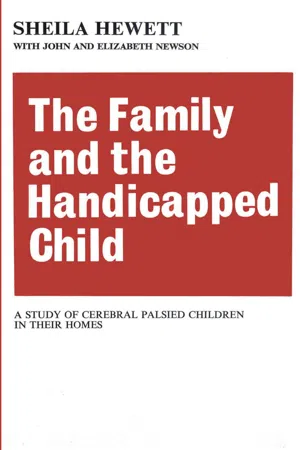
The Family and the Handicapped Child
A Study of Cerebral Palsied Children in Their Homes
- 240 pages
- English
- ePUB (mobile friendly)
- Available on iOS & Android
eBook - ePub
The Family and the Handicapped Child
A Study of Cerebral Palsied Children in Their Homes
About this book
This book describes an inquiry into the upbringing of young cerebral palsied children. Following the precedent set by John and Elizabeth Newson in their studies of normal children at home; Sheila Hewett visited the mothers of 180 spastic children and obtained their personal accounts of their experiences.There is considerable literature on handicapped children in which the adverse effects of their presence in the family are emphasized. This study is the first to present, not evidence provided by professional people, but that of a large number of mothers of all social classes who have children with all degrees of handicap. They tell in their own words how they meet the problems and anxieties of everyday life and how they strive to maintain the norms of family living in spite of their very real difficulties. A measure of their success is provided by a number of comparisons with the families of normal children.Hewett's nursing experience combined with a social science training and personal experience of parenthood contributed a useful background for this research. Resulting as it does from close collaboration with the Newsons, her work provides an important extension of the main work of the Child Development Research Unit in Nottingham. It will help all those who work with handicapped children to achieve a better understanding of the families to whom they offer their specialist knowledge. To the general public it offers an opportunity to gain insights into a situation, which calls for their support and acceptance but not their pity. For the parents of handicapped children themselves it provides a much-needed opportunity to make their views known and to see that they are not alone in the difficulties, which they face with such stoicism and resourcefulness.This book's last aim has been achieved by using the now extensive information about the upbringing of normal children obtained from Nottingham mothers in the United Kingdom, by John and Elizabeth Newson.
Information
1
Chapter 1: Origin And Constitution Of The Sample; Research Methods
The first problem to be solved when undertaking a project in the field of social research is that of identifying and contacting the people from whom it is necessary to obtain information—in other words, first find your sample. In the absence of any readily available comprehensive list of children known to be cerebral palsied, the Spastics Society, who commissioned the work, allowed us to use the register of children which has been compiled at the Society’s Family Help Unit in Nottingham. From this source we obtained the names and addresses of all the cerebral palsied children known to the Society who had been born in 1957 or later and were living at home with their parents in the East Midlands area—an area which included Lincoln-shire, Nottinghamshire, Derbyshire. Leicestershire, Northamptonshire and Rutland. A total of 180 interviews was included in the final analysis. There is no means of knowing how many children who might have been eligible for inclusion in the sample were not on this register1, and it must be emphasized that this work is not based on a sample randomly drawn from a known population. It is the nearest approach to a 100% sample that could be obtained. However, despite the impossibility of obtaining an ideally constituted sample, the East Midlands survey proved to be representative both in its distribution according to social class (using the Registrar General’s Classification of Occupations), severity of handicap and other characteristics that one would expect to appear in a sample of children with cerebral palsy. Fortunately, there was no serious distortion of the sample through losses caused by mothers’ refusal to be interviewed or by failure to make contact but, sadly, we have to report that some children died during the period that interviews were taking place, who would otherwise have been included. A detailed account of this sample and a description of the methods used to collect and analyse the data follows.
The East Midlands sample
When the project was first planned, it had been hoped that it would be possible to contact and interview 200 mothers of children aged 7 years and under. In practice it was not possible, within the time limit set, to complete more than 180 interviews that could be included in the final analysis. This was because we had originally thought that all interviewing could be restricted to within a 30-mile radius of Nottingham, and coverage of the much greater distances that proved to be necessary was very time-consuming; and also because some interviews were completed with mothers of children who had in fact gone away to boarding school or other residential institutions. Only children who were still being cared for entirely by their parents or who were at boarding school from Monday morning to Friday evening were considered eligible for inclusion. It was felt that the latter group, 4 children in all, were still in the care of their parents for a large enough proportion of the year for parents to feel that they were not really ‘away’ as they would have been in an ordinary boarding school Twenty-two children aged 8 were also included and one child had just had his 9th birthday. The numbers of children of each age are given in Table 1.I
TABLE 1.I Ages of children at time of interview
| 1 | 2 | 3 | 4 | 5 | 6 | 7 | 8 | ||
| Age | yr.+ | yrs.+ | yrs.+ | yrs.+ | yrs.+ | yrs.+ | yrs.+ | yrs.+ | Total |
| Number | 4 | 14 | 17 | 20 | 29 | 34 | 39 | 23* | 180 |
* Including 1 child aged 9 yrs. 1 month.
Losses
Only one mother was unwilling to be interviewed. She told the interviewer that she could see no point in answering a lot of questions that had already been asked by other people. There were also two ‘oblique’ refusals, so described because although the mothers did not refuse outright to be seen, they always found the time suggested inconvenient. As they lived 30 and 60 miles from Nottingham respectively, and had each occasioned one fruitless journey, it was decided not to persist in trying to include them. These 3 mothers constituted a refusal rate of 2%. The total number of interviews lost, including refusals but excluding deaths, was 15 (8%) and with deaths included, was 24, (12%). A loss rate of 10% is to be expected in survey work and is generally considered to be tolerable, in particular when losses are well distributed and are not concentrated in any one category or age group. Details of all losses are set out in Table 1.II.
TABLE 1.II Losses
| Reason | Number |
| Child’s death | 9 |
| Moved out of area | 7 |
| Direct refusals | 1 |
| Oblique refusals | 2 |
| Contacted but no interview because of language problems | 3 |
| Non-contacts because of mother’s serious illness | 2 |
| Total | 24 |
Demographic details of the sample
There were rather more boys than girls in the sample, 98 (54 %) and 82 (46 %) respectively. Fourteen of the children (8 %) were members of twins. Illingworth1 quotes evidence from various sources of similar findings in other studies of cerebral palsy.
The children were members of families with a size range from 1 to 10 children. The most usual number of children was 2 (28%). There were 31 ‘only’ children (17%), 6% more than occurred in a sample of 700 normal 4-year-olds. This percentage remains unchanged when children under 4 are excluded. Forty-three (24%) were eldest children, 5 % more than occurred in the same sample of normal 4-year-olds.2 These differences are not large enough to be statistically significant and the majority of mothers were still young enough to be capable of having further children (80 % of them were under 40 years old at the time of interview). There appeared to be no evidence that mothers of cerebrally palsied children tend to be older than those with normal children only, after allowing for the fact that 70% of the East Midlands children were 5–8 years old and would therefore tend to have more mothers in the older age ranges than would the normal 4-year-olds.
In 13 instances, the family included adults other than the parents living in the house. Only one of these was a lodger, the rest being relatives, mainly of the mother. Fifteen families included brothers or sisters older than 18 years who were still living at home.
Three of the children had been adopted and one was being fostered.
Thirty-nine mothers had a history of miscarriages, stillbirths and/or other children with physical disability. These are listed below:
- Older child with dislocated hip.
- Older child mentally retarded.
- Older child with slight heart lesion and one miscarriage before birth of spastic child.
- Older child with asthma, all 3 sibs described as ‘slow’ at school by their mother.
- Older child with congenital heart disease.
- Older child with congenital hip deformity.
- Younger child with ‘hole in heart’ (Mother’s description), one miscarriage.
- Twin child of below average intelligence and ? epilepsy.
- One older child with ? epilepsy and another described as ‘slow’ at school. One miscarriage before birth of spastic child.
- Older child with poor sight. All children (3) born prematurely. One baby (born before spastic child) died at 3 days old.
- Younger child with suspected heart condition, one baby (born after spastic child) stillborn.
In addition:
- 10 mothers had had 1 miscarriage.
- 2 mothers had had 2 miscarriages.
- 1 mother had had 3 miscarriages.
- 2 mothers had had 4 miscarriages.
- 1 mother had had 5 miscarriages.
- 4 mothers had had 1 stillborn child.
- 1 mother had had 1 stillborn child and the twin of her spastic child had died after 1 day.
- 1 mother had had twins of which the spastic child had survived, the other being stillborn.
- 5 mothers had had babies who died within a week or in infancy— 1 of these children had a heart condition, another was blind and handicapped after being jaundiced; the latter died at 17 months.
- 1 mother had had 1 ectopic pregnancy.
Thus, 27 mothers (15 %) had a history of miscarriages and/or stillbirths. Illingworth1 cites a somewhat higher proportion found by Hopkins et al. who reported that 134 mothers out of 656, or 20 %, had histories of miscarriages and stillbirths.2
Mothers were not asked for accounts of the births of their spastic children (although these often were given during the interview) for two reasons: first, such accounts were irrelevant to the main purpose of the study and second, even had birth histories been relevant, events remembered after a lapse of to 8 years would have been of dubious accuracy and value.
About three-quarters of all the mothers were not in paid employment. Of the remaining 46, 35 were able to work part- time outside the home, 8 worked part-time at home and 1 worked full-time at home as a Local Authority foster-mother. Two mothers were working full-time outside the home; one of these was not married and worked in a factory while the maternal grandmother cared for her child, the other was the proprietress of a shop with living accommodation attached, so that she was only technically away from home when working.
These figures are compared in the table below (Table 1 .III) with the numbers of mothers who were out at work in the Newsons’ sample (op. cit.).
TABLE 1.III Working mothers
| Normal 4-year-olds (Nottingham) | Normal17-year-olds (Nottingham) | East Midlands C.P. sample2 | |
| N=700 | N=700 | N=180 | |
| Not working | 72% | 56% | 74% |
| Part-time at home | 4% | 6% | 4% |
| Full-time at home | 1% | — | 1% |
| Part-time out | 19% | 33% | 20% |
| Full-time out | 4% | 5% | 1% |
| 100% | 100% | 100% |
1 The report of the 7-year-old stage of the normal child survey, from which these figures are taken, is not yet published.
2 The abbreviation ‘C.P.’ is for cerebral palsied, a term which is a little more precise than the more commonly used ‘spastic’. The meaning and use of these terms are discussed in Chapter 2, pp. 30–38 and in the glossary (Appendix II).
The fathers of the children were in the main in the kinds of employ...
Table of contents
- Cover Page
- Title Page
- Copyright Page
- Table of Contents
- Acknowledgements
- Tables
- Introduction
- 1. Origin And Constitution Of The Sample; Research Methods
- 2. ‘What Is Cerebral Palsy?’ Difficulties Of Diagnosis And Explanation
- 3. Practical Aspects Of Day-To-Day Living
- 4. The Effects Of Handicap On Patterns Of Family Life
- 5. Family And Community
- 6. Education, Training And Day-Care
- 7. Who Will Help?—The Family And The Social Services, Statutory And Voluntary
- 8. Some Special Problems
- 9. The Impact Of Handicap-Some Final Comments
- Appendix I. A note on the Spastics Society
- Appendix II. A glossary of terms commonly used in discussions of cerebral palsy
- Appendix III. Guided interview schedule
- List of References
- Index
Trusted by 375,005 students
Access to over 1.5 million titles for a fair monthly price.
Study more efficiently using our study tools.
Frequently asked questions
Yes, you can cancel anytime from the Subscription tab in your account settings on the Perlego website. Your subscription will stay active until the end of your current billing period. Learn how to cancel your subscription
No, books cannot be downloaded as external files, such as PDFs, for use outside of Perlego. However, you can download books within the Perlego app for offline reading on mobile or tablet. Learn how to download books offline
Perlego offers two plans: Essential and Complete
- Essential is ideal for learners and professionals who enjoy exploring a wide range of subjects. Access the Essential Library with 800,000+ trusted titles and best-sellers across business, personal growth, and the humanities. Includes unlimited reading time and Standard Read Aloud voice.
- Complete: Perfect for advanced learners and researchers needing full, unrestricted access. Unlock 1.5M+ books across hundreds of subjects, including academic and specialized titles. The Complete Plan also includes advanced features like Premium Read Aloud and Research Assistant.
We are an online textbook subscription service, where you can get access to an entire online library for less than the price of a single book per month. With over 1.5 million books across 990+ topics, we’ve got you covered! Learn about our mission
Look out for the read-aloud symbol on your next book to see if you can listen to it. The read-aloud tool reads text aloud for you, highlighting the text as it is being read. You can pause it, speed it up and slow it down. Learn more about Read Aloud
Yes! You can use the Perlego app on both iOS and Android devices to read anytime, anywhere — even offline. Perfect for commutes or when you’re on the go.
Please note we cannot support devices running on iOS 13 and Android 7 or earlier. Learn more about using the app
Please note we cannot support devices running on iOS 13 and Android 7 or earlier. Learn more about using the app
Yes, you can access The Family and the Handicapped Child by Elizabeth Newson in PDF and/or ePUB format, as well as other popular books in Politics & International Relations & Politics. We have over 1.5 million books available in our catalogue for you to explore.