eBook - ePub
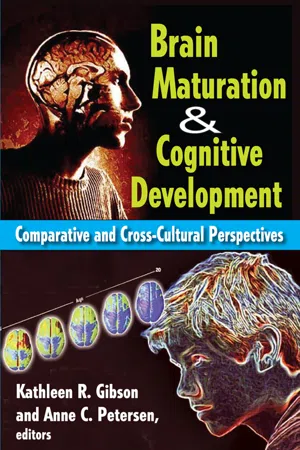
Brain Maturation and Cognitive Development
Comparative and Cross-cultural Perspectives
- 390 pages
- English
- ePUB (mobile friendly)
- Available on iOS & Android
eBook - ePub
About this book
This volume adopts a unique, multidisciplinary approach to the study of the development of the human brain and early behavior. It includes chapters by researchers from several disciplines whose work addresses specific aspects of brain-behavioral interactions in development. The chapters provide strong evidence that the development of both brain and behavior is a response to biological and environmental variations.Language is also discussed, and provides a useful example of biosocial development because linguistic and brain functions and development can be examined under controlled conditions of both genetic and environmental deprivation. Research in this area has produced particularly exciting results pointing to the universality of language capacity among humans and illuminating the processes by which language competence develops.Brain Maturation and Cognitive Development provides new views in the understanding of human nature and present new, biosocially oriented research directions that are unique in their focus.
Information
PART I
INTRODUCTION
Chapter 1
Introduction
Kathleen R. Gibson and Anne C. Petersen
Scientists and laymen alike have long debated issues pertaining to the development of the human brain and behavior. Historically, for instance, many Americans have considered that education is best given very early. Thus, the Puritans considered it both possible to teach 2 year olds to read the Bible and essential to do so to ensure the salvation of their souls in the advent of premature death (Vinovskis, 1983). More recently, proponents of early education have argued that young brains are more malleable and more receptive to learning than older brains. Thus, children from economically depressed areas may attend Head Start programs, while the more affluent attend expensive private nursery schools.
Throughout American history, however, the concept of early education has also had its detractors. During the nineteenth century, prominent educators rebelled against the Puritan practice of teaching very young children to read on the grounds that early reading leads to brain damage and insanity (Vinovskis, 1983). More recently, Americans have been warned that early schooling is unnecessary and may lead to frustration and anxiety (Elkind, 1987).
Lying at the core of these arguments is a basic scientific issue—what are the developmental relationships between brain and behavior? Does the 2–7-year-old brain have the cognitive capacity of the adult brain? Can the 2 year old really be taught to read? Older children and adolescents, after all, possess brains of greater histological and chemical maturity than younger ones. Moreover, periods of hormonal maturation such as adolescence may impact rather dramatically on brain function (Wittig and Petersen, 1979). Perhaps, then, some educational experiences are beyond the mental capacity of young children. On the other hand, perhaps critical neurological periods exist. Possibly, certain skills should be taught by 3 or 4 years of age or they will never be learned? Issues of brain–behavior developmental relationships also lie at the heart of other long-standing debates such as which is more important, nature or nuture?
This book consists of a collection of articles that attempt to examine neurological and cognitive maturation from the biosocial science perspective. This perspective suggests that social and physical environments can influence biological development and, in turn, biological development influences behavior. This interactive perspective represents a fundamental change from earlier assumptions that biology is fixed and that only behavior is plastic.
The biosocial approach examines interactions between behavior, evolution, and biological maturation from the multidisciplinary perspectives provided by cultural and biological anthropologists, zoologists, psychologists, sociologists, and neuroscientists. Each discipline has its own unique perspective to bring to bear on these issues. For instance, comparative anatomical data suggest that although mammalian species differ in the timing of their growth cycles and of their neurobehavioral maturation (Gould, 1977), similar neural maturational sequences and events characterize all species (Gibson, this volume; Jacobson, 1978). Thus, although experiments that would help to unravel some of the complexities of behavioral–brain interactions cannot be performed in humans, animal work can provide useful data and theory.
In addition, diverse animal species provide their own natural experiments pertaining to biology and behavior. For instance, biologists once argued vociferously about the relative importance of instinct versus learning in the genesis of animal behavior. Zoologists now claim, however, that in the animal kingdom, instincts are learned (Hailman, 1964) and learning is instinctive (Gould and Marier, 1987). If this is so in animals, should we expect sharp nature versus nuture distinctions in the genesis of human behavior?
Although animal data indicate that instinct and learning interact in all species, they also indicate that individual species possess species-characteristic behavioral and neurological patterns that serve to differentiate them from other taxa. This suggests that in animals critical aspects of neural and behavioral development may be canalized (Waddington, 1956; Fishbein, 1976; Wilson, 1978). That is, species members may share sets of genes programmed to interact with the succession of environments (both internal and external) normally encountered during development in a manner that ensures that structures mature in a normative fashion and in a proper time frame. In other words, in animals, species-characteristic environmental events may channel genetically programmed development in appropriate directions. Thus, developmental regularities displayed by members of a given species reflect not only species-wide similarities in the genome, but also species-wide similarities in environmental experience.
By examining humans from cross-cultural, historical, and cross-species perspectives, it is possible to determine whether some human behaviors are similarly canalized, that is, to determine whether there are universals of human neural and behavioral maturation characteristic of humans growing up in all cultures. Further, comparative perspectives can help provide insights into the types of stimulation that have been the norm for humans throughout their evolutionary history and, thus, are likely to be essential for healthy human development.
Even though all animal species are characterized by species-typical behaviors, individual species members also differ in many behavioral traits. The same, of course, is true for humans. The science of behavioral genetics has helped us to unravel the nature of behavior–genetic interactions in the genesis of individual differences in animals. As delineated by Plomin and Ho, the maturing science of human behavioral genetics is also rapidly developing new methods for analyzing genetic and environmental interactions in the production of behavioral diversity in the human species.
Biosocial science is a young discipline. Its tenets are only beginning to be applied to neural development. Thus, this volume will provide few definitive answers to the provocative questions which plague developmental psychologists and neurologists. It is hoped, however, that it will begin to place human behavior in a new perspective and to encourage others to investigate the two-way interactions which exist between behavior and biology.
Section I. Principles and Regularities of Neural Development
Neural maturation is a long and complex process involving many morphological and physiological parameters. Each region of the brain is initially populated with neurons. Once formed and in place, neurons sprout axons and dendrites. Later, they establish functional synaptic contact with other neurons and develop the chemical and physical properties essential for impulse transmission.
Synaptogenesis is the earliest morphological sign of potential transneuronal impulse transmission. Characteristically, young brains overproduce synapses. As a result, a period of major synaptic pruning follows synaptogenesis (Changeaux, 1985; Huttenlocher, 1979; Huttenlocher, et al., 1982). Presumably, only those synapses that have actually functioned survive. A study of synaptogenesis in five areas of the rhesus monkey brain indicated that synaptic density evidences synchronous changes in all cortical areas and layers (Rakic et al., 1986).
After establishing synaptic function, neurons experience a lengthy period of maturation before gaining full adult functional efficiency and flexibility. During this time, major changes occur in dendritic and axonal morphology. Initially, dendrites are short, tubular, and unbranched. With growth they elongate and develop a tree-like branching structure. These changes enable a neuron to receive impulses from diverse and distant sources. This branching also results in increased versatility and complexity of neuronal function because each dendritic branch represents a “decision point” with respect to the propagation of impulses (Scheibel, this volume). According to Scheibel’s work and that of Conel (1937–1969), dendritic arborization patterns exhibit different temporal patterns in different cortical regions.
In parallel with these dendritic changes, many axons acquire a myelin sheath. When present, this sheath confers major functional advantages. Myelinated fibers fire more rapidly and with greater functional specificity than unmyelinated ones. They have lower thresholds to stimulation and shorter refractory periods. Hence, they can fire more frequently and with less presynaptic stimulation (Bishop and Smith 1964). The cortex exhibits regional differences in time of myelination in both human and rhesus monkey (Conel, 1939–1967; Gibson, 1970, this volume; Flechsig, 1920).
In addition to these neuronal changes, the functional development of the nervous system requires the maturation of neural supporting structures such as glial cells and blood vessels. Hence, although functional potential as illustrated by synaptogenesis may be present quite early, the achievement of mature function involves the development of an entire complex of synapses, dendrites, myelin, glial cells, and blood supply.
Modern theories suggest that the brain functions by means of parallel distributing processing mechanisms. The strength and numbers of cortical connections are the most critical elements underlying the efficiency of such mechanisms (Rumelhart et al., 1987; McClelland et al., 1987). This suggests that myelination and maturing synaptic function play fundamental roles in maturing human memory, intelligence, and language skills.
The first section of the book focuses on brain maturation from these and other perspectives of relevance to the biosocial framework. In the first article, Gibson presents data indicating that the myelination of neural pathways follows a specific sequence that is similar in many species. Thus, the neural developmental sequence appears to be strongly canalized by genetic and environmental interactions that are common to many vertebrates. In both monkeys and humans neural myelination occurs over lengthy periods of time, at least for three and one-half years in the rhesus monkey and at least to adolescence in the human. Thus, at later ages, more pathways are myelinated and functioning effectively, and older children have more neural support for their behavior. These regularities of developmental sequence provide clear support for theories that the developing intelligence of human children is based, in part, on maturing neural function. In contrast, myelination data provide no support for views that the human brain is altricial at birth or neotenous in adulthood.
These cross-species regularities of myelination sequence suggest that some aspects of neural maturation are hierarchical in nature. In rats, rhesus monkeys, and humans, brain stem areas begin to myelinate in advance of cortical areas and, within the neocortex, primary motor and sensory areas begin to myelinate in advance of association areas. Neural maturation is nonhierarchical, however, in that many areas and tracts have protracted periods of myelination. As a result, some brainstem regions, such as the reticular system, myelinate more slowly than some cortical tracts such as the internal capsule. Also, all cortical areas have some myelin before any cortical area is completely myelinated and before certain slowly myelinating regions of the brain stem have completed their myelination. Thus, neural models must account for developmental overlap and interactions between neural regions. The developmental picture provided by myelination data is similar to that provided by PET scans (Chugani and Phelps, 1986; Chugani et al., 1987), but appears to differ from the synchronous pattern of synaptogenesis (Rakic, et al., 1986). Reasons for these apparent differences are discussed.
Plomin and Ho review findings pertaining to the genetic control of neuro-physiological and neurochemical parameters within modern human populations. Although they primarily emphasize behavioral differences among modern humans, rather than behavioral universais, their findings accord with basic tenets of the biosocial approach. Biology, like behavior, is plastic, and shared environment can account for many behavioral and developmental similarities among members of specific populations. Specifically, Plomin and Ho provide data indicating that individual variation in neurochemistry and neurophysiology may be environmentally induced rather than a result of genetic variation. Similarly, not all brain–behavior interactions are under direct genetic control and not all developmental similarity results from shared genes.
In many underdeveloped countries and economically disadvantaged groups, nutritional deprivation is among the most pressing biosocial factors affecting brain and behavioral development. Morgan and Gibson focus on the interactions of nutritional and environmental deprivation on brain development. They point out tha...
Table of contents
- Cover
- Half Title
- Title Page
- Copyright Page
- Table of Contents
- List of Contributors
- Acknowledgments
- Preface
- Part I. Introduction
- Part II. Principles and Regularities of Neural Development
- Part III. Primate and Human Behavioral Development from a Biosocial Perspective
- Part IV. Biosocial Sciences and the Neurology of Language
- Index
Trusted by 375,005 students
Access to over 1.5 million titles for a fair monthly price.
Study more efficiently using our study tools.
Frequently asked questions
Yes, you can cancel anytime from the Subscription tab in your account settings on the Perlego website. Your subscription will stay active until the end of your current billing period. Learn how to cancel your subscription
No, books cannot be downloaded as external files, such as PDFs, for use outside of Perlego. However, you can download books within the Perlego app for offline reading on mobile or tablet. Learn how to download books offline
Perlego offers two plans: Essential and Complete
- Essential is ideal for learners and professionals who enjoy exploring a wide range of subjects. Access the Essential Library with 800,000+ trusted titles and best-sellers across business, personal growth, and the humanities. Includes unlimited reading time and Standard Read Aloud voice.
- Complete: Perfect for advanced learners and researchers needing full, unrestricted access. Unlock 1.5M+ books across hundreds of subjects, including academic and specialized titles. The Complete Plan also includes advanced features like Premium Read Aloud and Research Assistant.
We are an online textbook subscription service, where you can get access to an entire online library for less than the price of a single book per month. With over 1.5 million books across 990+ topics, we’ve got you covered! Learn about our mission
Look out for the read-aloud symbol on your next book to see if you can listen to it. The read-aloud tool reads text aloud for you, highlighting the text as it is being read. You can pause it, speed it up and slow it down. Learn more about Read Aloud
Yes! You can use the Perlego app on both iOS and Android devices to read anytime, anywhere — even offline. Perfect for commutes or when you’re on the go.
Please note we cannot support devices running on iOS 13 and Android 7 or earlier. Learn more about using the app
Please note we cannot support devices running on iOS 13 and Android 7 or earlier. Learn more about using the app
Yes, you can access Brain Maturation and Cognitive Development by Anne Petersen in PDF and/or ePUB format, as well as other popular books in Psychology & Cognitive Psychology & Cognition. We have over 1.5 million books available in our catalogue for you to explore.