eBook - ePub
World Yearbook of Education 2010
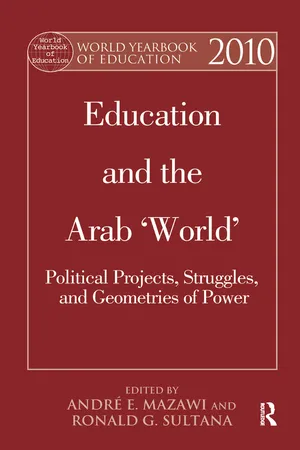
Education and the Arab 'World': Political Projects, Struggles, and Geometries of Power
- 400 pages
- English
- ePUB (mobile friendly)
- Available on iOS & Android
eBook - ePub
World Yearbook of Education 2010
Education and the Arab 'World': Political Projects, Struggles, and Geometries of Power
About this book
The World Yearbook of Education 2010 volume, Education and the Arab 'World': Political Projects, Struggles, and Geometries of Power, strives to do justice to the complex processes and dynamics behind the world of Arab education. Western interest in all things ?Arab? has greatly increased over the course of the decade, but this interest runs the risk of forgetting that the Arab world is positioned within wider contexts of regional, geopolitical, and global processes. This volume examines Arab education in a range of contexts ? regional, diasporic, and trans-national ? to better understand how the field of Arab education is formed through local, regional, geopolitical and global engagements and resonances. In doing so, contributors from a range of disciplines open critical conversations about the intersections of history, culture, geopolitics, policy, and education. The World Yearbook of Education 2010 offers new conceptual and empirical approaches that deal with some of the often-neglected aspects of the study of Arab education: contested political projects; struggles towards emancipation, recognition and liberation; and a larger concern for social justice, equity, and political inclusion. Andr?lias Mazawi is associate professor in the Department of Educational Studies at the University of British Columbia, Vancouver, BC, Canada. He is also an associate fellow at the Euro-Mediterranean Centre for Educational Research at the University of Malta.Ronald G. Sultana is professor in the Department of Education Studies at the University of Malta, where he also leads the Euro-Mediterranean Centre for Educational Research. He is the founding editor of the Mediterranean Journal of Educational Studies.
Information
1 Editorial Introduction
Situating the ‘Worlds’ of Arab Education: Critical Engagements
1 Presentations and Representations
When the Series Editors of the Routledge World Yearbook of Education invited us to submit a proposal to edit a volume on education in the Arab region, we felt that this was an honour and an opportunity—but above all else, a responsibility. Probably never more than in the last decade has Western interest in all things ‘Arab’ and ‘Muslim’ been as searching, and as insistent. The gaze on the ‘orient’ (whose orient?, and where does this lie?—the dis-oriented might well ask), with all the complex issues that this raises, and which have been so well articulated by Edward Said (1978), is a double-edged sword. For, on the one hand, it invites knowledge and understanding of the ‘Other’, but also the distancing and objectification of this same ‘Other’ as a subaltern through/in academic discourses and methodological articulations. It also runs the risk of thinking of the ‘Arab World’ as somehow distinct, a world apart, a space of exceptionalism, lying somewhere ‘out there’, forgetting the great lessons of history that teach us that cultures are part of the great web of competing meanings—and of ‘modes of being’ (Mouffe, 2005)—that constitute intimately and inextricably linked human societies. And linked this world certainly is, and has been well before the concept of ‘globalization’ became the catchword that seeks to describe—but perhaps more insidiously to justify—the flows of trade, of people, of ideas around the globe. Insidious, because like tides, the terms we use can serve to both mask and reveal the ebb and flow of ascendant and falling powers, and the flotsam and jetsam they leave behind. Equally, as Brighenti (2007), to whom we return later, has suggested, we are cognizant that the terms we use can also serve to delimit the ‘features of visibility’ that allow or prevent the voice of the ‘Other’ from being heard and seen, in brief, from ‘manifesting’ itself. Thus, we realize that the making of our disciplinary fields and methodological approaches, as well as our locations as authors and editors, can lead us to view the ‘Arab region’ as a set of geographically delimited spaces which negate the complex processes and dynamics which underpin the field of education in a wide range of contexts of practice, whether those located within the region proper or those which emerge as part of its interactions and convergences beyond it. This has been a major priority for us to attend to, in terms of capturing these imbricated realities that form and inform in many ways the field of education in its local, regional, geopolitical and global engagements and resonances.
Our approach to the shaping of this volume has been intensely personal, and as intensely political and collective. It is profoundly shaped by two and a half years of engagement with initially over eighty potential contributors, living across five continents. They all enabled our initial framings and their underlying assumptions to shift as the project of the volume gradually materialized and the final list of authors determined. We can now state that this edited collection has opened for us all multifaceted conversations and new conceptual and empirical horizons of engagement that touch on some of the neglected questions regarding education in the Arab region, the projects it serves, the equity with which it is accessible, and its relations to broader issues of social justice and political inclusion.
In diverse ways, we are both ‘of/in’ the region, and yet ‘outside’ of it. Our personal and larger histories are powerfully intertwined with its ever-shifting and mutating borders and borderlines, whether political or cultural; those imposed, negotiated or which crystallized and built up in fluid forms of construction.
André was born in Jaffa, an ancient harbour town on the shores of the Mediterranean, part of the state of Israel following the 1948 Palestinian Nakba. A Palestinian Arab, his family originates from the city of Nazareth in Galilee, and from there, over two centuries backward in time, his ancestral genealogy stretches to Al-Mazzeh, now incorporated as part of Syria’s capital, Damascus, and to Duma, a locality to its north-east. For him, the engagement with this volume is an attempt to reflect on a history of colonization and political fragmentation; a history that radically transformed the institutional, social, political and economic underpinnings of education across the region and its intersections with constructions of citizenship and of nation-states.
Ronald was born in Malta, an ancient harbour island 1900 kilometres west of Jaffa, independent of British colonial rule since 1964, and previously subject to layers of European powers which, since 1090, had wrested what has come to be perceived as the ‘bulwark of Christianity’ from Arab and Muslim hands. An island, therefore, at the geographical crossroads of history, whose hybrid ancestry reveals itself in a local patois, half Arabic, half Italian—a member of the European Union, yet classified as one of the Arab states by UNESCO. For Ronald, this volume is part of his personal, professional and political engagement in the search for roots, and the cultivation of a sense of self within broadening circles of overlapping communities. Writing about this odyssean journey, Ronald recently recalled how he had been schooled by a British colonial education into thinking of himself “as white, as European, as Christian, and indeed as almost English … though not quite” (Sultana, 2008, p.15), only to experience a splintering of identity when, travelling through the region, he discovered that Tunisians and Moroccans could understand most of what he told them when he spoke Maltese and that there were areas in Jerba, Rabat, Beirut, Jaffa, Naples, Valencia, Alexandria or Tripoli which evoked his own childhood in villages in Malta and Gozo: “those smells, those colours, those flat-roofed houses, those women talking to each other as they hung the family clothes to dry on rooftops, the sprawl of bodies, those hot nights with windows and doors ajar at cleverly calculated angles to catch the remotest of cool breezes, those scrawny cats running down dark, winding yet comforting alleyways …” (Sultana, 2008, p. 16). Another story, then, that speaks about bordered/bothered identities, difficult to pin down, gifted with the burden of multiperspectival uncertainties that makes its bearers ever without a home, always ‘out of place’.
Shifting sands, therefore … and one can hardly be blamed for wondering whether an edifice can be soundly built on a foundation such as this. And yet this is an appropriate metaphor for our project, which we took in hand not as rock-solid ‘experts’ but rather as keen students of a field that needs to be cautiously, carefully and tentatively approached, not to ring it round with defining boundaries and to stake a claim to it as much as to appreciate its contours, its valleys, hills and ravines, building on the efforts of other scholars—located in different times and spaces—who have engaged with this task before us. Our desire, therefore, was to facilitate sensitive, multifaceted portrayals by authors who knew well the lie of the land, and who could write passionately, sincerely and even lovingly about it, but who never lost that critical edge of discernment and analysis that comes from a deep-seated discomfort with final, finished and totalized narratives that purport to know it all, and to frame it all.
Such portrayals—at least from our perspectives as editors—were not meant to constitute the object of a ‘western’ gaze, a window on the potentially exotic. Elements of that are certainly there, and unavoidably so, partly due to our own geo-cultural locations, but also to those of the publishing vehicle that brings this collection of chapters to readers. The volume is, after all, written in English, and produced and marketed by an international publishing house based in the UK, with offices in the US, Australia and Singapore, and for whom the term ‘Arab World’—as a geographic space/gaze of recognized reference—absolutely needed to figure in the main title of the book, despite our position to the contrary. As editors, however, we were clear from the start that one of our major aspirations was to put together a volume that would also be read by educators in the very spaces that are the focus of our collective attention. Authors were therefore encouraged to write their chapters keeping in mind that every effort would be made to translate the volume into Arabic, following the English version. In many cases, this, in itself, served to introduce an interesting tension in the way issues were articulated, as authors grappled with the challenge of how to present thoughts, viewpoints and evaluations which could be meaningful to, and resonate with, diversely located readers. At the same time, neither did we avoid the complexities, tensions, and difficulties associated with engaging authors operating in diverse geographical locations, cultural frameworks, political régimes, institutional settings, and academic and linguistic traditions. Navigating the intricacies associated with such a diverse congregation of academics, researchers and policy makers meant engaging not only the linguistic diversity of the region, but also having some authors initially engage the project in the language they felt most comfortable writing in. This offered us the opportunity to problematize questions discussed by Paul Ricoeur (2006a) in On Translation. Ricoeur observes that the problem of translation is one of interpretation, a hermeneutic question in the most fundamental sense of the word. As such, it cannot be reduced exclusively to challenges facing translation from one language to the other. What he calls ‘internal translation’, that is, “translation within the same linguistic community” (p. 24), also raises equally considerable methodological and epistemic challenges in terms of how ‘explanations’ or ‘reformulations’ “try to say the same thing in another way” (p. 25). In line with Ricoeur, as editors, the fundamental issue at stake in this project is not one of translation strictu sensu. Rather, it is one of generating ‘understandings’ into ‘foreign’ or ‘Other’ texts-in-contexts, in ways which, in the words of Richard Kearney’s (2006) introduction to Ricoeur’s book, “translate our own wounds into the language of strangers and retranslate the wounds of strangers into our own language [so] that healing and reconciliation can take place” (p. xx).
Taken from this perspective, our ambitions and hopes for the volume are not to put together a collection of chapters that claim comprehensive thematic coverage as much as to make forays into areas in ways that generate new insights and new understandings, helping to render their complexities in engaging and theoretically sophisticated ways. A major challenge was therefore to identify authors who would engage with the task as we had articulated it. In the majority of cases, the papers presented here have been especially written for the volume, with original research, in English. Two chapters were ultimately translated from French, once written. A few authors have drawn on previously published material, reworking this, however, into a new chapter that fitted within the underpinning rationale of the project.
Our choices were guided by a desire for contributions that, by all means, showed mastery over the content area covered, but also a probing and restless intellect that asked new questions—or at least revisited old questions in ways that troubled and unsettled received wisdom. This partly explains why, while we have some of the leading and established scholars in the area, we also feature newer names, young researchers who are considering their academic débuts, and who are doing exciting, cutting-edge and engaged work in/on the region within different contexts of practice.
Some of the questions raised in the chapters are being asked by academics, researchers and policy makers living and working in the region, but who have not let familiarity numb them into intellectual comfort zones that, from our point of view, is a contradiction in terms. Others, while being from the region, are, for a range of different reasons, living outside of it—permanently, intermittently or provisionally. For many of them, now working in North America or Europe, the exercise of reflecting on home truths in ‘exile’, as it were, provides them with an opportunity to refract phenomena through complex, multilayered lenses, where distance not only makes the heart grow fonder, but also makes the insights potentially sharper and keener. Yet others travelled to the region, for whatever reason, allowing themselves to be unsettled and decentred, but not deterred from their quest to understand the meaning-making efforts of fellow humans in different parts of the land, teetering uneasily between the need to make the strange familiar, and the familiar strange.
Voice, therefore, was important to us in making our final selection of authors, not only in terms of gendered, located identities, but also in terms of the perspectives and frames through which topics were apprehended. Rather than thematic coverage, what we hoped for—and to an extent succeeded in obtaining—was a range of theoretical and methodological tools that serve to provoke thought, open a field up to fresh insights and new conversations, and generate novel research questions. There is, of course, an engagement with some of the key themes that one would expect to be addressed in a volume such as this, themes that are approached with an eye on the simultaneity, interconnectedness and interpenetration of what has come to be called the ‘global’ and the ‘local’. Such themes not only provide us with the substantive knowledge that we need to make inroads in better understanding the dynamics of educational policy and practice in the region, but also indicate how particular aspects of this knowledge lend themselves to being uncovered through the use of particular research methodologies.
Voice was also important for another reason. We wished to avoid closed and mono-vocal narratives, which would essentialize representations of education, trapping them in homogeneous discourses that reproduce the positions of power, and which are already in effect. Here, the choice of voices allowed us to include narratives related to educational policies and practices that make it difficult for issues to be defined by a ‘single-valence reference’ recognizing, along with Jacques Derrida, and in the words of Bleich (2008), “the immovable embeddedness of language in the total political context” (p. 512).
Many of the chapters rely on qualitative data—in itself quite unusual in a region where education often tends to be represented and analysed in quantitative terms, with number toting often reinforcing a sense of ‘deficit’ in terms of such ‘indicators’ as the number of girls without access to schooling, the performance of students in international assessment exercises, the number of Nobel prize winners based in the region’s universities, and so on. Some of the chapters take us into schools and classrooms, providing rare ethnographic insights into the interactional dynamics that both reflect and shape social relations in the wider context. Many chapters make good use of interview material—and in one case, online discussion forums—in order to reveal perspectives and to give voice to social actors whose views are not often heard in the region, let alone beyond. Teachers, children and young people feature particularly prominently in this collection.
The representation and analysis of a range of textual materials is also used to good effect by several authors in this collection. This includes the use of autobiographies and diaries—which provide us with striking and original insights into a range of issues—and of newspapers, which capture the way some of these issues are articulated and fought over in the public sphere. It also includes in-depth and close analyses of policy and legal documents, as well as of school textbooks—their contents, design, and the annotations left on the margins by students. Some of the authors in this collection use case studies to good effect, especially when the focus on the particular opens up a door to a deeper understanding of the broader societal dynamics in which the local is inextricably enmeshed. Similar insights are sometimes generated through a careful use of comparative methods, which are particularly apt at showing how what seems to be particularly contingent in spatial and temporal terms is in fact a regional—or even global—phenomenon, indicative of wider and deeper and interlocked patterns that reveal the inexorable ubiquity of power. This wide-ranging use of research methods resonates with Sholkamy’s (2006) call “for a critical consideration of the relations of knowledge production in the Arab world” by creatively exploring ways which boost “the viability of multidisciplinary research” in the social sciences (p. 21). The methodological spectrum present in the book is therefore indicative of the authors’ creativity in reflecting on their multiple and often contradictory locations, as researchers, in relation to social and political action and to pedagogic practice, identifying new sites of research, and engaging new ways through which data collection and analysis could be undertaken. From our point of view as editors, we believe that this methodological spectrum helps readers better understand how texts—and their performative articulations—give form not only to consciousness, but also to the contexts in which such consciousness of self and others is developed.
What brings all these contributions together is the operative word ‘critical’: authors in this volume write from a variety of disciplinary and/or professional backgrounds, as anthropologists, sociologists, media and cultural studies scholars, educators, lawyers, playwrights, policy researchers and policy makers; a gamut indicative of the epistemic standpoints involved in articulating interdisciplinary explorations of ‘education’. The authors do not shy away from the arduous, uncomfortable—and in this region as much as (if not more than) elsewhere, often perilous—task of ‘speaking truth to power’. Using a range of theoretical approaches, they strive to live up to a tradition in scholarly work that sees intellectual activity not as value-free or distant, but rather as a way of engaging with the world as it is, in order to imagine—and strive for—a world as it could and ‘should’ be.
Theoretical lenses, therefore, help the authors negotiate the challenging task of apprehending phenomena from both an ‘insider’s’ and an ‘outsider’s’ point of view, and to occupy that liminal/luminal space reserved for those who are ‘in’ the world, but not ‘of’ it, ‘insiders-outsiders’ (Banks, 1998). Intellectual activity, therefore, becomes the preserve not of ‘academics’ as much as of those who have the courage to stand both within and outside of society and its institutions, to actively disturb a status quo that works against the principle of social justice. Critical theory, critical hermeneutics, discourse analysis, comparative studies, policy sociology, critical multiculturalism, postcolonial studies, post-structuralism, social anthropology, historical and critical ethnography, political economy, cultural studies, critical legal studies … one and all provide the sharp conceptual and methodological tools that prise open a range of educational phenomena in the region, in the hope that a deeper understanding of issues leads to the reconstruction of educational structures and practices.
2 The Arab ‘Region’ as a ‘Spatial Analytic’
The ‘shifting sands’ of identities, cultures, belongings and locations outlined above are indicative of the difficulties to capture the varied ways in which the Arab region is referred to from the standpoint of competing narrational locations by the authors of the various chapters. These di...
Table of contents
- Cover
- Half Title
- Title Page
- Copyright Page
- Dedication
- Table of Contents
- List of Tables
- Contributors
- Series Editors’ Introduction
- Acknowledgements
- 1 Editorial Introduction: Situating the ‘Worlds’ of Arab Education: Critical Engagements
- Part I Contested Policyscapes
- Part II Re-calling Voices
- Part III Suspended Visibilities
- Part IV Knowledge Imaginaries
- Part V Geopolitical Predicaments
- Index
Trusted by 375,005 students
Access to over 1.5 million titles for a fair monthly price.
Study more efficiently using our study tools.
Frequently asked questions
Yes, you can cancel anytime from the Subscription tab in your account settings on the Perlego website. Your subscription will stay active until the end of your current billing period. Learn how to cancel your subscription
No, books cannot be downloaded as external files, such as PDFs, for use outside of Perlego. However, you can download books within the Perlego app for offline reading on mobile or tablet. Learn how to download books offline
Perlego offers two plans: Essential and Complete
- Essential is ideal for learners and professionals who enjoy exploring a wide range of subjects. Access the Essential Library with 800,000+ trusted titles and best-sellers across business, personal growth, and the humanities. Includes unlimited reading time and Standard Read Aloud voice.
- Complete: Perfect for advanced learners and researchers needing full, unrestricted access. Unlock 1.5M+ books across hundreds of subjects, including academic and specialized titles. The Complete Plan also includes advanced features like Premium Read Aloud and Research Assistant.
We are an online textbook subscription service, where you can get access to an entire online library for less than the price of a single book per month. With over 1.5 million books across 990+ topics, we’ve got you covered! Learn about our mission
Look out for the read-aloud symbol on your next book to see if you can listen to it. The read-aloud tool reads text aloud for you, highlighting the text as it is being read. You can pause it, speed it up and slow it down. Learn more about Read Aloud
Yes! You can use the Perlego app on both iOS and Android devices to read anytime, anywhere — even offline. Perfect for commutes or when you’re on the go.
Please note we cannot support devices running on iOS 13 and Android 7 or earlier. Learn more about using the app
Please note we cannot support devices running on iOS 13 and Android 7 or earlier. Learn more about using the app
Yes, you can access World Yearbook of Education 2010 by AndreElias Mazawi in PDF and/or ePUB format, as well as other popular books in Education & Education General. We have over 1.5 million books available in our catalogue for you to explore.