![]()
Chapter 1
Social Systems and Their Environments
Introduction to the Systems Idea
The term system is of Greek origin. The word itself is a combination of syn (together) and histanai (to set). Systems analysts such as J. G. Miller (1955, 1978) claim that things or events, at all levels of complexity, can be viewed as wholes—that a common analytical model can be used to describe the human body, a person, a family, a group, an organization, a neighborhood, a community, a region, a country, an international arrangement (like the European Union, NATO), earth, our solar system, even the universe. As Olsen wrote in 1968:
A social system is a model of a social organization that possesses a distinct total unity beyond its component parts, that is distinguished from its environment by a clearly defined boundary, and whose subunits are at least partially interrelated within relatively stable patterns of social order. Put even more simply, a social system is a bounded set of interrelated activities that together constitute a single social entity.
A system implies an entity whose parts are seen to make up an orderly and complex totality in accordance with some underlying set of rules. However, this orderliness is the product of the analyst’s mind rather than an empirical fact. Warren (1963) summarizes that a system is defined as the relationships among units “which endure through time” and engage in roles “within an enduring pattern of interactions.” To put the matter humorously, a systems outlook tends to makes a “mesh” out of everything.
Of course, this book focuses on human social systems and on their implications for the people-helping professions. Eventually, you should be able to use systems analysis to describe a diversity of social processes or interactions that happen regularly in specific parts of your workload. Since human beings interact and grow within a variety of surrounding environments, a systems-derived person-environments model seems appropriate for social work intervention. This will become clear as you examine some of the ways in which people interact with their family environments; non-kin environments; and community, national, and regional or international environments.
People as the Focus
Social work scholars like Coulton (1981), Engel (1980), or Germain (1973) emphasize that the object of professional intervention can be a single person, a social collectivity (such as the Red Cross organization), or a wide-ranging environment (such as a metropolitan region or a rain forest). In short, social system analysts perceive their model as equally applicable to the smallest micro and the broadest macro social units.
This chapter focuses on the relationships between individual persons (as systems) and the complex external world (often other systems) which make up the environment. Furthermore, you will note that people are not only the product of their environment but, through interacting with it, are also capable of influencing or changing their external settings.
The Individual as a System
Every human being is an “organized complexity” worthy of systems analysis. Within the skin of the biological body, the system includes at least the skeletal, assimilatory, respiratory, eliminatory, endocrine, emotional, and nervous subsystems (i.e., components) — all in dynamic interaction. Within this body (an “open” system, which is defined in the next chapter), information is communicated by means of the genes, the senses, electrical impulses, intuition, etc., and many simultaneous feedback channels. Psychosomatic medicine recognizes many cross-boundary interactions between the body’s physical-emotional condition and real or imagined threats within its physical-social environments.
Any analysis of an individual person as a system must also take into account what lies beyond that person’s boundary. Moos (1976) speaks for many ecologists when he defines environment as including geography, historical perspectives, society, culture, organizations, architecture, weather, noise levels, and even Utopian thought. Natural, social, and constructed things or events in the environment can be stressful, inhibiting, challenging, or freeing for specific individuals. Moos’s emphasis on human free will rather than on deterministic external forces is refreshing. For the purposes of this book, a multienvironmental model is favored and is elaborated below.
The human body takes in energy (food) from its environment and converts it into cells, tissues, organs, and other matter for self-repairs. All these dynamics mirror a steady-state or growth condition, with continuous inputs contributing to a person’s well-being and to other person-systems in the environment. Nonbiological elements such as dreams, thought, memory, willpower, and consciousness contribute to the coherence of this remarkable life form. In an environment that is neither barren nor polluted, a baby will grow from infancy to maturity, from dependency to self-fulfillment, and from relative simplicity to increasing complexity.
A Person-Environment Model
It is impossible to describe the full complexity of person-environment interactions without resorting to some kind of systems model. As mentioned above, all human beings find themselves within a multiplicity of nearby and distant environments. The following six-layer model is based on the work of Baker (1975), Capelle (1979), Engel (1980), Gotteschalk (1975), and Hall (1966) and is proposed as relevant to everyone. Potentially, all persons interact with elements of the following environments:
- A nuclear family or multigenerational tribe/clan
- A participatory environment or reference group
- A local or municipal community
- A culture, society, or nation
- The international scene
- The cosmos
In any systems analysis, each of these six environments can also be examined as a system, and they all influence, and/or are influenced by, the others. In fact, social workers often have to help their clients deal with the consequences of changes which have taken place in near or distant environments.
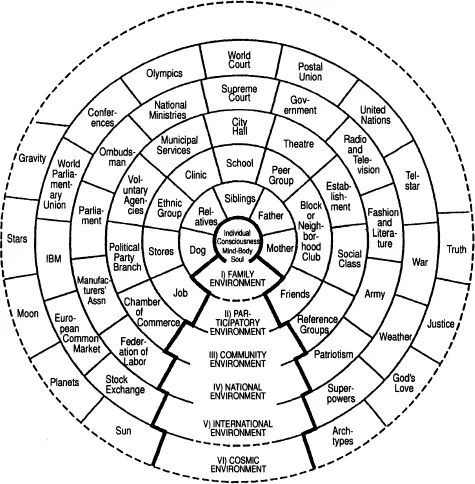
The multienvironment model is shown in Figure 1.1. Normal human beings have close family ties (Circle I), and are nurtured by this primary environment. They also participate personally in a range of local (or local branches of) social collectivities such as villages, neighborhoods, schools, factories, recreation centers, stores, health clinics, banks, etc. Even if people are not involved personally with one of these units, awareness of its importance gives them a feeling of belonging (Circle II). In both circles, people experience important primary relationships (e.g., with peers/friends during the first years of life). The importance of job-related friendships, for example, is not sufficiently appreciated by societies when making universal policies for retirement or fighting inflation through enforced disemployment.
Figure 1.1. The Six Environments
Some components of the community environment (Circle III) also lend themselves to primary relationships, but these tend to favor elitist people. If you are a member of the local establishment, you are likely to know the mayor, be a patron of the museum, serve on the executive board of a political party, be invited to join civic agency boards, or act as one of the decision makers in the chamber of commerce. Many studies show that if you are a member of the impoverished lower class, your community involvements may well be much more limited.
The national and international environments (Circles IV and VI), although often the locus of important policy decisions regarding social service standards, are both remote for the average citizen. However, young adults in many parts of the world are finding that one of the serious tension-causing realities of today is the decreasing match between ethnic-cultural-linguistic identity (“people-hood”) and legal-political-national boundaries (“country”). At the other end, multinational corporations are making national boundaries obsolete.
A common result of feeling cut off from your roots is to identify with a political ideology, become a devotee of some cult, join a hippie commune, engage in fanatic antiestablishment violence, make demands for territorial independence, give fundamentalistic support to some new school or technique of healing, or scapegoat others. Although they appear to be negative, these activities actually help to build a feeling of participation among otherwise disconnected individuals, and seem much less painful (to each of them) than suffering anomie (Fromm 1941).
If your ethnic group is among the stigmatized minorities, national and international issues tend to assume low priority while survival gets primary attention. Only especially intact persons (and some senior professionals) are involved in, say, the national office of an agency serving the blind, the entertainment media, government, commercial sports (or the Olympics), the European Common Market, Interpol, a World Mental Health Congress, or the Board of IBM.
Perhaps you are wondering why the cosmic environment (Circle VI) is included. Every human being is affected by (the consequences of) the pull of gravity, sunspots, or great ideas (in the Platonic sense). The moon’s impact on the tides, or the behavior of lovers, is well known. Today, the possibility that the full moon causes a rise in the incidence of hot-line telephone calls for help was studied by Lieber (1978). Also, a number of therapeutic approaches, such as those using meditation or yoga, emphasize the importance of being in harmony with the energies of the universe (Turner 1979).
According to this analysis, each of the environments in the model can contribute to (or hinder) a person’s development and, in turn, can be influenced by this growing person. In order to help a client in distress, you may well have to intervene at many levels—as will be clarified.
The Family As Environment
In accordance with the model, the family is a person’s first, and no doubt most significant, environment. Children raised by wolves can function as animals, but remain imperfect human beings. In fact, Portmann (1965) contends that human children emerge from the mother’s physiological womb too soon (especially when compared to the newborn of other mammals).
He goes on to underscore the significance of the next nine months in “the social womb” of the family. In this womb, babies learn to sit, stand erect, trust, talk, walk, and even learn the rudiments of abstract thinking. This se...