- 437 pages
- English
- ePUB (mobile friendly)
- Available on iOS & Android
eBook - ePub
About this book
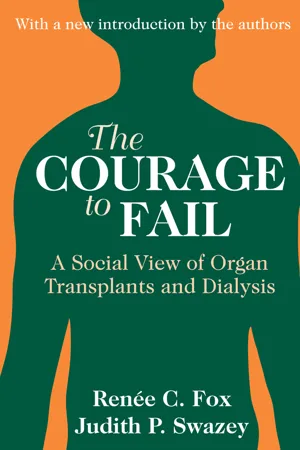
The title of this profound work conveys the bold, uncertain, and often dangerous adventure in which medical professionals and their organ transplant and dialysis patients are engaged. Built around a series of case studies, The Courage to Fail is the product of collaborative first-hand research concerned with various social phenomena generated by transplantation and dialysis. The authors examine the individuals involved and the workings and atmosphere of some of the medical centers in which these forms of therapy have been developed. They examine ""gift-exchange"" dimensions of transplantation: the transcendent and tyrannical aspects of the ""gift of life"" that transplants entail for donors and recipients-and for medical professionals as well. They also analyze the dilemma of uncertainty inherent in medicine, which occurs with particular force in the development of such experimental techniques.Since publication of the original edition, the authors have continued to follow social and medical developments surrounding organ transplants and dialysis. In their new introduction, they discuss transplantation as a gift of life, how and when death occurs, efforts to procure more organs, and organ replacement and issues of equity. This book will be of interest to physicians, medical students, medical sociologists, and anyone interested in the history of and issues surrounding organ transplantation and dialysis.
Information
1
Patterns in Therapeutic Innovation: Transplantation
1
Gift Exchange and Gatekeeping
The donor who offers a part of his body for transplantation is making an inestimably precious gift. The acutely ill patient who receives the organ accepts a priceless gift. The giving and receiveing of a gift of enormous value, we believe, is the most significant meaning of human organ transplantation. This extraordinary gift exchange, moreover, is not a private transaction between the donor and the recipient. Rather, it takes place within a complex network of personal relationships that extends to the families, the physicians, and all the members of the medical team who are involved in the operation. Within the network of these relations, a complex exchange occurs through which considerably more than the organ itself is transferred.
The development of transplantation has created options that did not previously exist for warding off death, saving life, demonstrating an ultimate kind of concern for another person, and expressing transcendent meaning. At the same time, organ transplantation takes place under circumstances that impose constraints upon the persons involved, and within an interactive framework that structures the situation for them in ways that limit and bind as well as open and free. The freedom to give or to receive an organ is neither absolute nor random. These freedoms are mediated and governed by the norms of gift exchange, on the one hand, and by an at once biological, psychological, and sociological screening process that we refer to as "gatekeeping" on the other.
In his classic anthropological work The Gift, Marcel Mauss pointed out that although gift exchange is an expressive set of acts through which something symbolic and interpersonal as well as material is transmitted, it is not totally spontaneous. Rather, it is structured by a triple set of norms: the obligations to give, to receive, and to repay, which Mauss defined as "symmetrical and reciprocal" (Mauss 1954). By this he meant that under certain socioculturally defined circumstances, an individual or a group is supposed to offer a gift to a particular person. In turn, the person (or persons) to whom the gift is proffered is expected to accept it. The recipient is then under social and moral pressure eventually to balance out the exchange by giving the donor something of equivalent worth. Failure to live up to any of these entwined expectations produces disequilibrium and social strain that affects the donor, the recipient, and those closely associated with them.
Looked at in a certain way, the donation of an organ is one of the most dramatic and supreme forms of gift giving extant in contemporary society. It has not yet reached the point of institutionalization where it is obligatory, or even considered to be an ordinary act. Nonetheless, organ donation is impelled as well as regulated by the norms of gift exchange of which Mauss wrote.
The obligations to give and receive that animate and structure organ transplantation are not inexorable or automatic. They are usually triggered when the physician first suggests to a patient, and his family that a transplant might be considered. Self-screening and medical-team screening processes are then set into motion. In kidney transplantation, for example, the patient must first reach at least a tentative decision about whether he wishes to receive an organ. At the same time, his relatives are passing through the first phases of a parallel process, appraising themselves and each other as possible candidates for the live donation presumed to offer the patient his best chance of life.1 Concurrently, the medical team is beginning to exercise their gatekeeping functions. They launch a series of procedures designed to test not only tissue compatibility but also the physical and psychological eligibility of donor and recipient to undergo and withstand organ exchange.
If, from these multiple points of view, no suitable live donor is found, the medical team may suggest a cadaver transplant. Screening for cadaver donations (which occurs in all organ transplants except those of live-donor kidneys) involves tissue typing, the consent of the donor or his next of kin, determination of the occurrence and cause of the donor's death, and the acquiescence of the recipient.
We have called these screening processes "gatekeeping" because they allow only certain individuals to give or receive an organ. Their goal is to optimize the patient's chances for survival and to offer him as enduring, active, and meaningful a posttransplant life as possible without undue physical, psychic, or social harm to himself, the donor, or their families. The transplant team recognizes that being willing and able to give an organ has important emotional, social, and spiritual meaning for many individuals and family groups. And so an implicit secondary goal of these screening processes is not unduly to deprive such persons of the opportunity to act as donors and to protect them (as well as the recipient in cases where a live-donor transplant is being considered) against psychic injuries if the medical team decides they are not eligible to give an organ.
At the same time, because physicians realize that close relatives of the patient are subject to a great deal of social and psychological pressure to offer a kidney, they feel themselves to be under a "great moral obligation . . . not to persuade . . ., or . . . over-persuade" a family member to do so (United Nations Economic and Social Council 1970). Physicians have used the term "moral blackmail" to conceptualize a subtle but very powerful form of organ extortion that can inadvertently result from their zealousness. This appreciation of the extraordinary pressures upon family members to donate an organ, and physicians' emphasis on their responsibility not to reinforce or exploit these pressures, is analogous to what Francis Moore has described as the ideal "posture of 'informed consent' in therapeutic innovation." It is "not a matter of trying safely and sanely to explain to a volunteer what is going to be done," he has written, "but rather the much more difficult task of explaining alternatives to a worried patient who wishes, above all else, to have the experiment carried out on him" (F. Moore 1970, p. 366).
C. H. Fellner and S. H. Schwartz have contended that "the medical profession looks upon the motivation of the living organ donor with distrust and suspicion," partly because they are skeptical of the "altruism" of the potential donor's motivation and hold it in "disrepute." Transplant teams, Fellner and Schwartz argue, are unduly concerned about the psychopathology that may impel certain individuals to volunteer, especially those unrelated to the recipient. Physicians' misgivings about the true motivation of the live donor may, in fact, be largely a projection of their own guilty reluctance to "inflict irreversible damage on a healthy person" (Fellner and Schwartz 1971). Although this point of view is psychologically suggestive, we feel that it underestimates the role that the clinical insights and ethical sensitivity of transplant team members play in what Fellner and Schwartz would consider their overly cautious and suspicious attitudes toward live volunteer donors.
Some of the fundamental sources of the medical profession's disquietude about the "true" motives that account for live organ donation and the "real" meaning of such an act have been most clearly expressed in the form of arguments for and against the use of living donors who are unrelated to the recipient. Such a gift raises what Abram has called the "psychological dilemma": "Is donating such an organ a 'gift' ... to save another's life based on completely unselfish motivation, or is it based on masochism and unresolved guilt?" (Abram 1972, p. 54). Even more fundamentally, the question involves physicians' collective "view of human nature" (Sadler and Davidson 1971, p. 99). Do they individually and as a professional group have "faith in the altruistic principle," and in the more than occasional capacity of "ordinary people" to act with "healthy altruism derived from genuine moral concern" (Bevan 1971)? Or have they thrown "altruism into disrepute" (Fellner and Schwartz 1971) through their failure to believe that many people are capable of giving of themselves to suffering others, even to the point of offering one of their organs to a "stranger"?2
When an organ transplantation seems appropriate, then, a number of persons in different statuses and roles participate in deciding whether a transplant will be carried out, what type it will be, who the donor will be, and so on. Because so many people share in this decision, no individual is totally free to give or receive an organ. But it is also true that a dying patient is not absolutely free to refuse a transplant now that this alternative exists. He is perhaps especially constrained to accept one when a member of his own family offers such a gift. Correlatively, as the act of organ donation becomes more institutionalized, we are all increasingly subject to social pressures to make this kind of gift. In those cases where one is faced with a dying relative whose life could possibly be saved by a live organ donation from a family member, the Maussian "obligation to give" is maximized.
The final gatekeeper in organ exchange is the physician. Acting on behalf of the transplant team, the patient, and possible donors and their relatives, as well as for himself, he makes the ultimate judgment. The physician's role here is as sociological and moral as it is medical. He acts as mediator and interpreter in the complex social system called into play by the transplantation situation. In this capacity, he weaves his way back and forth among the patient, candidate donors, their families, and the wide range of specialists who constitute the transplantation team. His role here is like that of the superior of a religious order who, in the name of higher ethical and spiritual values, controls what gifts can be offered and received by the members of the community he represents.3 The physician is not free to abnegate his responsibility, nor may he exercise it arbitrarily or coercively, He must base his decision on biomedical, psychological, and sociological criteria that are acceptable within his profession.
In certain respects, the physician is under pressure to decide in favor of an organ transplantation. He is propelled toward it by his own professional and personal motivation to do everything possible to save the life of his dying patient, as well as by the strong desire of the patient's family. He is also pushed in this direction by his role as a clinical investigator with the responsibility to advance medical knowledge and technique as well as to care for patients. And the desire of some research physicians to "pioneer" and to be recognized for their trailblazing contributions may act as an inducement to perform transplantations.
Counterbalancing these factors that "push" a physician toward the transplant option are a number of "pull" factors that tend to deter him from it. The "pull" factors may include his medical opinion that the patient's condition is not serious enough to warrant transplantation, or that the risks attending the procedure outweigh its possible benefits; failure to obtain the necessary quality of consent from either the prospective recipient or donor; the medical and moral conviction that he should not prolong the patient's suffering through the use of these heroic means; and his reluctance to be judged irresponsible or flamboyant by his peers.
In sum, the option of organ transplantation is set down in a matrix of interacting persons—the prospective recipient, candidate donors, the members of their families, the physician and his professional colleagues—who together constitute a small but intricate social system that facilitates organ transplantation in some ways and impedes it in others.
The Gift and Its Implications: Five Cases
The following cases were gathered in the course of our participant observation with two groups engaged in kidney transplantation. They will be focal to our analysis of the gift-exchange and gatekeeping aspects of transplantation.
Mrs. Amico
When we first heard the renal transplant team, discuss Mrs, Amico,4 they seemed to feel that her psychological problems, particularly her extreme depression, ruled her out as a kidney recipient. The medical team was trying to "straighten her out physiologically" to see what kind of psychological improvements might be effected. Dr, Emerson, an internist, pointed out to the team that "it is hard to evaluate Mrs. Amico's depressed state in terms of eligibility for a transplant, because disease, debility, and the fear of death can tip someone over into a state of psychological disturbance." In addition to her being "a tough emotional problem—almost suicidally depressed," Dr. Emerson was afraid that Mrs. Arnica's cardiac problems would preclude her being a kidney recipient. Dr. Richards, the surgeon who headed the transplant team, described Mrs. Amico as a "domineering person" who had married late in life after a successful career. Since no potential family donor was known, Dr. Richards told the group, Mrs. Amico would have to go on chronic dialysis to stay alive until a cadaver donor might be found; and once this was done "we would be stuck with her—for we could not tell her 'we're sorry, but this Thursday we don't think you can keep your dialysis appointment.'"
Eventually, Dr. Emerson got Mrs. Amico to admit that a related donor did exist—her father. But Mrs. Amico did not want her father to give her a kidney. She could not bear to be indebted to him for such a gift. When the father came to the hospital for donor-compatibility tests, he was described by Dr. Richards as a "sixty-seven-year-old fossil, in training to be a donor by dieting, and so forth." The psychiatrist working with the transplant team told the group that he hoped nothing would preclude the father's serving as a donor, for the act would be "the high point of his life," the first time he and his daughter had ever been close. When Mrs. Amico learned how much her father really cared for her, she was deeply moved. This reconciliation between Mrs. Amico and her father, who turned out to be a "reasonably good tissue match," provided the solution for the transplant team. Mrs. Amico was finally placed on the transplant "ready list." Dr. Richards noted in group rounds that "Mrs. Amico was the closest the group had come to turning a patient down for emotional reasons; but now I'm glad we accepted her, because she seems to be accepting the rigors of treatment so well." After her transplant, Mrs. Amico had a series of continuing medical complications, including being "on the thin edge" in terms of her cardiac condition. She died several months after receiving her father's kidney.
Billy Watson
Billy was introduced to the renal transplant team as "a ten-year-old boy, 42 inches tall and weighing 48 pounds." Billy has nine siblings, ages four to fourteen years. When his parents were first approached about the possibility of a transplant for Billy, "they reacted in an irrational way, but since then have come to realize that he is failing rapidly. He has had three hospitalizations for heart failure, has had to withdraw from school, and is suffering from advanced renal insufficiency." The presenting physician noted that Billy was felt to be too young and small for chronic dialysis, given its retarding effects on growth and development. The medical problems in his case were described as "very interesting," presenting the transplant group with the question of whether they could achieve a "successful" transplant with such a small child.
Billy was evaluated for more than two months by the transplant team, and during this time members of the team, singly and in group meetings, expressed their anguish over how to resolve the case. Billy's mother proved to be the best donor in terms of tissue compatibility. She wanted passionately to save Billy's life by giving him one of her kidneys, but the medical team felt reluctant to encourage or even permit a mother with responsibility for nine other children to subject herself to the immediate and longterm risks of a live organ donation. Dr. Richards once said that Mrs. Watson's zealous desire to help Billy, irrespective of the consequences for herself and her family, was analogous to the biblical parable of the one stray sheep. Mrs. Watson told the team that the other children were aware of Billy's critical illness, and that in many ways he was the family favorite. The transplant team's social worker was worried about the strength of Mr. and Mrs. Watson's marriage, and about how much support the parents could give each other and Billy throughout the transplant experience. Mrs. Watson seemed to be using the kidney donation as a tool to manipulate her relationship with her husband, for she implied to the social worker that she would get a divorce if she did not prove to be a suitable donor and Mr. Watson would not volunteer. Dr. Emerson stated, with respect to this problem, that "if we think for nonmedical reasons that she won't be a good donor, we will tell her the tests are no good. Billy is so sick we don't have time to procrastinate much longer. I'm afraid we'll be damned if we do and damned if we don't in this case."
After Billy's case had been discussed for over a month, we asked Dr. Emerson whether transplantation had closed off a physician's option: that of deciding not to treat a young child like Billy, but rather letting him die in a relatively short time from the fatal course of his disease. Dr. Emerson replied. "We've kind of created a monster we don't know how to handle. The mother has pushed us into doing a transplant on Billy. It's our responsibility to handle this [to accept or not accept such a case]. The physician is beginning to see laymen who ask, 'Why are you keeping my eighty-nine-year-old mother alive?' but this is a very different thing from asking, 'Why are you keeping my little Billy alive?'" In a group meeting, Dr. Emerson stated, "I honestly don't know if Mrs. Watson will be used if the group is not in some sort of moral accord on having her serv...
Table of contents
- Cover
- Half Title
- Title
- Copyright
- Contents
- Introduction to the Transaction Edition
- Preface to the Second Edition
- Preface to the First Edition
- Acknowledgments
- Part 1 Patterns in Therapeutic Innovation: Transplantation
- Part 2 The Courage to Fail Ethos
- Part 3 Patterns in Therapeutic Innovation: Dialysis
- Part 4 Changing Perspectives on Transplantation and Dialysis
- Notes
- Appendix: A Sociological Portrait of the Transplant Surgeon
- Bibliography
- Index
Trusted by 375,005 students
Access to over 1.5 million titles for a fair monthly price.
Study more efficiently using our study tools.
Frequently asked questions
Yes, you can cancel anytime from the Subscription tab in your account settings on the Perlego website. Your subscription will stay active until the end of your current billing period. Learn how to cancel your subscription
No, books cannot be downloaded as external files, such as PDFs, for use outside of Perlego. However, you can download books within the Perlego app for offline reading on mobile or tablet. Learn how to download books offline
Perlego offers two plans: Essential and Complete
- Essential is ideal for learners and professionals who enjoy exploring a wide range of subjects. Access the Essential Library with 800,000+ trusted titles and best-sellers across business, personal growth, and the humanities. Includes unlimited reading time and Standard Read Aloud voice.
- Complete: Perfect for advanced learners and researchers needing full, unrestricted access. Unlock 1.5M+ books across hundreds of subjects, including academic and specialized titles. The Complete Plan also includes advanced features like Premium Read Aloud and Research Assistant.
We are an online textbook subscription service, where you can get access to an entire online library for less than the price of a single book per month. With over 1.5 million books across 990+ topics, we’ve got you covered! Learn about our mission
Look out for the read-aloud symbol on your next book to see if you can listen to it. The read-aloud tool reads text aloud for you, highlighting the text as it is being read. You can pause it, speed it up and slow it down. Learn more about Read Aloud
Yes! You can use the Perlego app on both iOS and Android devices to read anytime, anywhere — even offline. Perfect for commutes or when you’re on the go.
Please note we cannot support devices running on iOS 13 and Android 7 or earlier. Learn more about using the app
Please note we cannot support devices running on iOS 13 and Android 7 or earlier. Learn more about using the app
Yes, you can access The Courage to Fail by Judith P. Swazey in PDF and/or ePUB format, as well as other popular books in Medicine & Health Care Delivery. We have over 1.5 million books available in our catalogue for you to explore.