- 363 pages
- English
- ePUB (mobile friendly)
- Available on iOS & Android
eBook - ePub
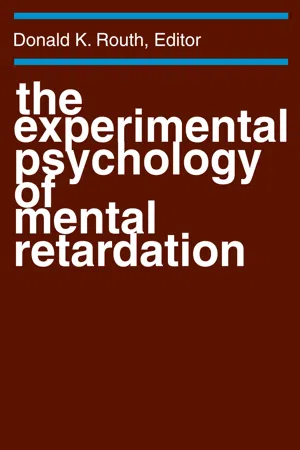
The Experimental Psychology of Mental Retardation
About this book
The renaissance in the field of mental retardation since World War II has been expressed both in research and in renewed practical concern for the plight of the retarded. The 1958 monograph by Masland, Sarason, and Gladwin entitled Mental Subnormality: Biological, Psychological, and Cultural Factors was one spur, if not the only one, to much of the behavioral research which emerged in the late 1950's. Similarly, the Handbook of Mental Deficiency, edited by Norman Ellis and published in 1963, gave theoretical direction to many studies in the years following its appearance.The present book and the symposium on which it is based are an attempt to continue this tradition by presenting theory-based, programmatic research in mental retardation, aimed at the scientific understanding of the psychological processes involved. The final chapter attempts to draw some of the implications of this research for the practical assessment and remediation of retardation.The experimental work reported in this book generally uses rather traditional laboratory tasks, for example, classical conditioning or discrimination learning. But the interest is in underlying processes rather than in such apparent trivia as whether the child blinks his eyelid or which of two stimulus objects he selects. Thus, this book is oriented around the psychological processes of interest, namely learning, attention, memory, language, thinking, and emotion, and concludes with a section on the relationship between these processes and the biological aspects of retardation.
Information
1
Donald K. Routh
The Experimental Study of the Retarded Child
The use of the skills of the experimental psychologist to study the difficulties of the retarded child is not new. In fact, as far back as the eighteenth century, Itard (1962) studied experimentally the reactions of the so-called wild boy of Aveyron, in part to examine the hypothesis of the British Empiricists that the mind is formed through the senses. Itard’s procedures were not so different from those used in the contemporary laboratory:
I succeeded sometimes in interesting him in amusements which had connection with his appetite for food. Here is one, for example, which I often arranged for him at the end of the meal when I took him to dine with me in town. I placed before him without any symmetrical order, and upside down, several little silver cups, under one of which was placed a chestnut. Quite sure of having attracted his attention, I raised them one after the other excepting that which covered the nut. After having thus shown him that they contained nothing, and having replaced them in the same order, I invited him by signs to seek his turn. The first cup under which he searched was precisely the one under which I had hidden the little reward due him (pp. 20-21).
Though it is hoped that this type of experimental approach to retardation will have practical implications, this may be true only in the long run. It is well to recall that Itard’s experimental work did prepare the way for the later more practical contributions of his student, Seguin, and of Seguin’s student, Montessori.
The experimental study of the retarded child begins with the observation that his behavior differs in systematic ways from that of the normal child—even when the precaution of matching for MA is taken. For some radical empiricists, this might be the end of the search, but for the authors of the chapters in this book, a major argument concerns whether these differences are inherent. Zeaman expresses this inherent-noninherent distinction by way of a computer analogy: a computer has control features, which are easily changed by “programming,” and structural features, such as machine access time or size of core storage, which cannot be changed so easily (Chapter 4). Milgram expresses a similar distinction by reminding us of the linguist’s preference for speaking of competence versus performance (Chapter 6). Competence in this case is the internalized model of the language that every speaker carries around, and performance is the actual fallible expression of language under constraints of memory, distractions, and the like. In a sense, Zigler states the null hypothesis for the whole group when he maintains that there are no inherent differences between the retardate and the normal child of the same MA, any observed differences being due to noninherent experiences of the retarded child such as excessive failure or social deprivation (Chapter 7).
The experimental work reported in this book generally uses rather traditional laboratory tasks, for example, classical conditioning or discrimination learning. But the interest is in underlying processes rather than in such apparent trivia as whether the child blinks his eyelid or which of two stimulus objects he selects. Thus, this chapter is oriented around the psychological processes of interest, namely learning, attention, memory, language, thinking, and emotion, and concludes with a section on the relationship between these processes and the biological aspects of retardation.
Learning
According to the commonsense view, the retarded child’s basic problem is that he learns slowly. In the laboratory this is not the case, at least not in any general way. Ross and Ross report that in classical conditioning, information overload must be introduced to demonstrate a performance decrement on the part of the retardate (see Chapter 3). Given optimal conditions, the retardate does quite well. One need not find this surprising, since most lower organisms that have been studied also demonstrate efficient learning, given appropriate circumstances.
Zeaman’s various models of discrimination learning also show that the retardate’s difficulty is not with acquisition in the sense of the rate parameters (thetas) for either attentional or instrumental responding. A study at the University of Iowa (Ullman, 1970) has confirmed again the lack of a difference between the final slopes of the backward-learning curves (Hayes, 1953) of MA-matched normals and retardates in discrimination learning.
If it is true that the retardate’s acquisition process is normal, the possibilities for Skinnerian-type engineering seem quite hopeful.
Attention
The well known hypothesis of Zeaman and House (1963) that the retarded child attends to the wrong things in a discrimination-learning situation still stands but is no longer viewed as crucial. Zeaman argues that, since the direction of the retardate’s attention is so easy to change in the laboratory (for example, by transfer tasks of various kinds), it is merely a control or “programmable” aspect of his behavior rather than a structural one (Chapter 4). Having satisfied himself that it is possible for a child to attend simultaneously to many aspects of a stimulus (for example, its form, color, size), Zeaman now wonders whether the retardate might not have an excessively limited breadth of attention. That is, it is possible that the retardate is less able than the normal child to use multiple redundant aspects of the stimuli in solving problems.
Zeaman is in a sense leaving behind the critics of his original hypothesis, though some of the criticisms of his original position apply to his new position as well. For example, Zigler criticized the first Zeaman hypothesis as a possible artifact of the use of only institutionalized retarded children. Work at the University of Iowa tends to support the Zeaman position against this kind of a critique. Ullman (1970) investigated the role of the number of relevant stimulus dimensions in the discrimination learning of 96 normal and mentally retarded children (mean IQs 98 and 59 respectively; MA approximately 6 for both groups), 12 subjects from each IQ group being assigned to conditions with either 1, 2, 4, or 8 relevant dimensions. As predicted from Zeaman and House’s (1963) theory, an inverse relationship was found between the number of relevant dimensions and the number of errors made by both normals and retardates. Using a log transform of raw error scores, it was found that these noninstitutionalized retardates did more poorly than their MA-matched normal controls. The generality of the retardate discrimination learning deficit was seen to generalize to community special-class retardates.
Zigler and various of his associates (Achenbach and Zigler, 1968; Sanders, Zigler, and Butterfield, 1968; Turnure and Zigler, 1964) have presented an alternative interpretation of attentional differences between normals and retardates. According to this interpretation, the normal child and the retarded child are inherently the same in their attentional processes (taking MA into consideration), but the retardate often experiences excessive failure when relying on his own cognitive processes. When presented with repeated tasks beyond his MA capacity, the retardate learns to rely on “external” cues for solving problems, including cues provided by other people.
Drotar (1968), in a master’s thesis done at the University of Iowa, replicated some of the findings of Turnure and Zigler (1964) with respect to the retardate’s “outer-directedness.” In Drotar’s experiment, each child was asked to assemble two jigsaw puzzles. While the child assembled the first of these puzzles, the experimenter either assembled a puzzle also (either the child’s second puzzle or another one) or sat unoccupied. In all three of these conditions, the retardates glanced at the experimenter significantly more than did the MA-matched normals. The retardates also experienced a performance decrement on the first puzzle, relative to normals, when the experimenter was assembling another puzzle. The effects of these manipulations on the performance of the second puzzle were in the predicted direction, but were not significant.
Drotar’s (1970) doctoral dissertation, did not support predictions made from Zigler’s formulation. Briefly, Zigler had stated that the retarded child was more likely tc look about for “external” cues to help him solve problems than was a normal child. Drotar distinguished two ways in which a cue could be external to the problem: the instructions might not mention the stimulus, or the stimulus might be physically distant from the task stimuli. Thus, in a two-choice discrimination-learning situation resembling that of Achenbach and Zigler (1968), Drotar varied both the instructional reference to the external cue (a small pen light) and the spatial locus of this cue (either a part of the stimulus objects or on a back board six inches away), and provided a control condition with no external cue. Subjects were normal kindergarten and first-grade children and special-school retardates of equivalent MA (approximately 6). With no external cue present, retardates and normals performed similarly. When the external cue was not only present but also correlated with reinforcement (relevant), the performance of retardates and normals was facilitated equally, regardless of instructions or spatial locus of the cue. But when the pen light was only randomly related to reinforcement, and thus truly external to the problem, retardates suffered a significant decrement relative both to normals and to their own performance under no-cue conditions, regardless of the instructions they had received or the locus of the external cue. In other words, the retardates had trouble in disengaging their attention from a cue that turned out not to be relevant to the problem’s solution.
Though the Drotar (1970) results give no support to Zigler’s position, they are also no comfort to the Zeaman and House (1963) position. The retardates’ difficulty could not be a simple matter of direction of attention, since the normals were able to use the pen-light cue when it was, in fact, relevant. If anything, the retardates in the random-cue condition were attending to too many stimulus aspects, if one prefers the breadth-of-attention notion. So far as I am aware, no one else has suggested that retardates might be deficient in their ability to withdraw attention from irrelevant stimuli, though such a “disattention” deficit has been suggested as characteristic of schizophrenics (Cromwell and Dokecki, 1968).
Memory
Workers in mental retardation have shared in the renewal of interest in memory processes among experimental psychologists. Ellis (1963) stimulated much discussion with his application of Hull’s (1952) notion of a stimulus trace to retardate memory deficits. Briefly, Ellis hypothesized that in the retarded, because of weakened CNS integrity, both the amplitude and the duration of the stimulus trace were diminished.
Hayes (1969), working at the University of Iowa, attempted to test Ellis’s hypothesis that changes in the intensity of the environmental stimulus and in the degree of delay required before response might differentially facilitate retardate performance in short-term memory. Subjects were normal and retarded children (Mean IQs of 102 and 63 respectively), matched, as Ellis’s theory required, for CA (approximately 9 years) rather than MA. A digit recall task was administered by tape recorder, permitting variation in the aural intensity level (55 vs. 90 db.) of the items as well as in the length of the recall interval (0 vs. 8 sec). During the 8-sec. delay interval, a color-naming task was introduced to prevent rehearsal. Though the normals’ performances were superior to those of the retardates, the two groups had parallel retention functions, and the intensity variable had no significant effect on the performance of either group. In discussing his results, Hayes questioned whether different effects might have been obtained with a task using physical rather than meaningful stimuli, since Hull’s concepts of molar-stimulus trace and stimulus-intensity dynamism applied only to physical, relatively non-symbolic stimuli.
The data presented by Ross and Ross at the symposium suggesting a retardate deficit in trace conditioning are in agreement with Hayes’s interpretation of the Ellis theory (see Chapter 3). Ross and Ross prefer a slightly different hypothesis; namely, that of slower recruitment of the stimulus trace in the retarded. They too are interested in the relationship of retardate performance to CNS integrity. The classical conditioning paradigm seems an ideal arena for the study of the question of a retardate stimulus-trace deficit.
Memory phenomena are also becoming a matter of interest in the study of discrimination learning. Zeaman found that one of the side effects of changing to a miniature experiment format using multiple concurrent discrimination problems was the appearance of proactive and retroactive inhibition effects (Zeaman and House, 1963). In fact, it has been possible to demonstrate in discrimination learning many of the retention phenomena previously found only in the domain of verbal learning, for example, the Pi-release phenomenon and effects of the similarity of the intervening material.
Zeaman’s newest model contains a number of retention parameters that he believes are good candidates for a relationship with intelligence. He postulates a rehearsal process that occurs in a buffer storage device. It is possible that the retardate might have a reduced buffer size, that is, might be unable to rehearse, say, more than one thing at a time. Others have, of course, suggested a retardate deficit in the use of rehearsal strategies, but for them (for example, Spitz, Ellis) the rehearsal process is conceptualized as a verbal one, at least implicitly so. Zeaman, since he has obtained rehearsal-like effects in nonverbal retarded subjects, feels that rehearsal might also be nonverbal or ikonic.
Another parameter in the Zeaman model that might relate to intelligence is the one for rate of decay. This notion is clearly similar to the stimulus trace concepts discussed above, though the formal model seems to permit predictions that are more quantitative.
Finally, Zeaman suggests that the retardate might have a “rigid” bias for retaining old information in the buffer at the expense of new material that otherwise might be rehearsed. Many will no doubt be reminded of the previous concepts of rigidity that have been put forward in explanation of retardate behavior. Among these are Luria’s (1961) concept of pathological inertia and Goldstein’s (1942-43) and Lewin’s (1935) concepts of rigidity.
Language
The view that the retarded child suffers from a verbal deficit or from defective linguistic control of his nonverbal behavior is historically related to the attempt to explain all cognition in terms of language processes. As Milgram points out, the cognition-equals-language position has had many advocates, being associated with names such as Pavlov, Vygotsky, and Luria in Russia and Watson and H. H. and T. S. Kendler in America (see Chapter 6). The works alluded to in O’Connor’s presentation at this symposium, including the O’Connor and Hermelin (1963) book, are consistent with the suggestion of a retardate deficit in the linguistic control of cognition, if only in the case of mongoloid subjects (see Chapter 2).
Such a deficiency in cognition seems important; in fact my interest in the field of mental retardation began with the question of retardate deficits in verbally acquired distinctiveness of cues. Wischner and several of his students at the University of Pittsburgh began working with Weigl conditional discrimination problems (Gerben and Wischner, 1965; Routh and Wischner, 1970). Basically, their research involved the discrimination of multidimensional junk objects, with the color of the background tray varying between trials. In trials when the background was one color, one stimulus was correct; whenever the background was a different color, the other stimulus was correct. The first obstacle was that few of the subjects (normal and retarded children with MAs between 9 and 11) could learn this difficult type of problem at all. Patterson (1962) developed pretraining procedures in which the subject learned different nonsense syllable names for the different background trays, reasoning from the Miller and Dollard (1941) hypothesis of acquired distinctiveness of cues that this might be helpful. Patterson found that these procedures facilitated normal children’s solutions of Weigl problems, and Hall (cited in Routh and Wischner, 1970) replicated Patterson’s results with retardates. Subjects who were not pretrained did poorly in both the Patterson and Hall stu...
Table of contents
- Cover Page
- Title Page
- Copy Right Page
- Content Page
- Preface
- 1 The Experimental Study of the Retarded Child
- 2 The Experimental Contribution to Learning Problems in the Retarded
- 3 Classical Conditioning and Intellectual Deficit
- 4 One Programmatic Approach to Retardation
- 5 The Channel Capacity of Educable Mental Retardates
- 6 Cognition and Language in Mental Retardation: Distinctions and Implications
- 7 The Retarded Child as a Whole Person
- 8 Experimental Approaches to the Clinical Psychology of Mental Retardation
- Indexes
Trusted by 375,005 students
Access to over 1.5 million titles for a fair monthly price.
Study more efficiently using our study tools.
Frequently asked questions
Yes, you can cancel anytime from the Subscription tab in your account settings on the Perlego website. Your subscription will stay active until the end of your current billing period. Learn how to cancel your subscription
No, books cannot be downloaded as external files, such as PDFs, for use outside of Perlego. However, you can download books within the Perlego app for offline reading on mobile or tablet. Learn how to download books offline
Perlego offers two plans: Essential and Complete
- Essential is ideal for learners and professionals who enjoy exploring a wide range of subjects. Access the Essential Library with 800,000+ trusted titles and best-sellers across business, personal growth, and the humanities. Includes unlimited reading time and Standard Read Aloud voice.
- Complete: Perfect for advanced learners and researchers needing full, unrestricted access. Unlock 1.5M+ books across hundreds of subjects, including academic and specialized titles. The Complete Plan also includes advanced features like Premium Read Aloud and Research Assistant.
We are an online textbook subscription service, where you can get access to an entire online library for less than the price of a single book per month. With over 1.5 million books across 990+ topics, we’ve got you covered! Learn about our mission
Look out for the read-aloud symbol on your next book to see if you can listen to it. The read-aloud tool reads text aloud for you, highlighting the text as it is being read. You can pause it, speed it up and slow it down. Learn more about Read Aloud
Yes! You can use the Perlego app on both iOS and Android devices to read anytime, anywhere — even offline. Perfect for commutes or when you’re on the go.
Please note we cannot support devices running on iOS 13 and Android 7 or earlier. Learn more about using the app
Please note we cannot support devices running on iOS 13 and Android 7 or earlier. Learn more about using the app
Yes, you can access The Experimental Psychology of Mental Retardation by Donald K. Routh in PDF and/or ePUB format, as well as other popular books in Psychology & History & Theory in Psychology. We have over 1.5 million books available in our catalogue for you to explore.