eBook - ePub
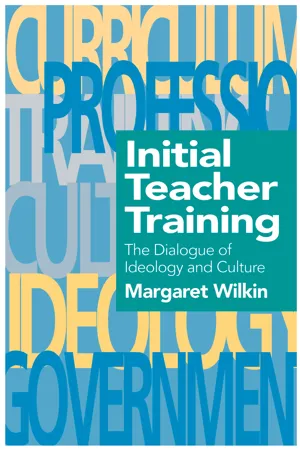
Initial Teacher Training
The Dialogue Of Ideology And Culture
- 228 pages
- English
- ePUB (mobile friendly)
- Available on iOS & Android
eBook - ePub
Initial Teacher Training
The Dialogue Of Ideology And Culture
About this book
This text provides an account of the relationship between successive British governments and the profession of initial teacher training since the 1960s. In the 1970s, the Robbins Report led to the introduction of a curriculum which both structurally and substantively represented the ideology of the day: social democracy. More recent government initiatives have re-created training in market image.; Currently, this relationship is seen as one-sided, the government apparently dominating the curriculum through a series of legislative measures. The author, however, suggests that a long-term view of this relationship may reveal a different picture - that the relationship is interactive and beneficial to both sides, and can therefore be regarded as a dialogue.
Information
1 The Nature of Ideology and of Ideological Practices
Introduction
Although the three-dimensional presentation of ideology outlined above was derived from only a common sense reflection on the characteristics and activities of a range of governments which are generally deemed to be of an ideological nature, it is considered to be an appropriate and adequate framework for the analysis of the qualities and practices of such governments. Before it can be used, however, such a common sense framework needs to be expanded and developed theoretically and that is the purpose of this chapter. It is to explore in turn some of the relevant theoretical assumptions subsumed by each of these three dimensions or themes. Re-presented in a generalized theoretical form, these are:
(i) | Ideological belief (above: the conspicuous articulation of a system of fundamental beliefs) |
(ii) | Ideological implementation (above: intervention in institutions in accordance with those beliefs) |
(iii) | Ideological achievement (above: acceptance by the target group of those beliefs) |
Ideological Belief
Ideology will be defined quite simply initially, and then by the extrapolation and development of themes, this definition will be developed into a comprehensive account of the concept.
Ideology is the set of principles which govern the policies of political parties.
This definition associates ideologies with political parties only on the grounds that to use the term more broadly to encompass any social group which wishes to introduce change in social practices, renders the concept so inclusive as to lose explanatory power (Eagleton, 1991). When the term is used so freely it fails to ‘distinguish between the kinds of action or projects which ideology animates’ (Thompson, 1984, p. 4). Second this definition attributes equivalence to all parties whether of the Right or the Left. It implies that all parties whether in power or in opposition must be ideological in order to function effectively. Ideologies are those images of the desired state of affairs which are held by society’s leaders. They are the necessary rationale which provides the basis and justification of political activity. This use of the term covers ‘sets of factual and moral propositions which serve to posit, explain and justify ends and means of organized social action, especially political action … According to this conception, ideology is as inseparable from politics as politics from ideology’ (Seliger, 1977, p. 1). Without principles on which to base legislation and which show continuity over time, a political party will lack direction and force. Where this is the case, political life for the public will be contradictory and cynicism or alienation is more likely than allegiance to be the prevailing mood.
The recognition that all governments are ideologically driven raises the question of how ideology may be interpreted, whether it should be presented as description or as critique (Thompson, 1990; Barrett, 1991). The former position portrays ideology as a weltanschauung which is peculiar to a particular social elite in a given historical period. Over time one ideology will succeed another, making way for a new ‘conception of the world that is implicitly manifest in art, in law, in economic activity and all manifestations of individual and collective life’ (Gramsci, 1971, p. 328). From this point of view the generation, implementation and demise of ideologies is a recurring social event, and ideology is a neutral social fact. The alternative perspective associates ideology with the unilateral maintenance of power through illusion or mystification. As one of the principal exponents of this position, Althusser (1971) holds that the ruling elite manipulates the consciousness of the public through the major social institutions of society: education, the church and the trade unions. It may also exert direct control through the army, the law and the police. For Althusser, ideology is materially represented in education — the school is saturated with the reigning ideology — it being here that the next generation is inducted into the skills and attitudes which will ensure the survival of capitalist society. Althusserian theory thus encourages the analysis of educational practice for the purpose of diagnosing the presence of ideology, not only in overt and obvious locations such as the teaching of selected subjects, but also in less conspicuous symbolic forms. An important weakness of critical theories of ideology, in which ideology is represented as some sort of distortion of thought or false consciousness is their failure to explain a lack of political awareness on the part of the general public. The populace is portrayed as subject to perceptual influence and control and yet remains unaware of this and of the means by which this is achieved. On rational grounds such claims for the power of ideology can be challenged. The diversity of experience, outlook and life style across subordinate groups makes it most unlikely that everyone would be equally receptive to ideological manipulation through the agencies of the state, for the reality and therefore the relevance of any one ideology would vary across individuals. ‘Explaining why an individual holds ideological beliefs is a matter of analysing social processes, not of diagnosing intellectual error or individual pathology’ (Callinicos, 1987, p. 139).
The approach adopted in this study draws on both the analytic traditions mentioned above. Each has its roots in Marxism and Barrett (1991) regards them as the poles of a continuum. A review of recent political history in the UK suggests that ideologies supersede each other over time. But it is also apparent that they are represented materially and symbolically in our social institutions and patterns of social behaviour and that despite the qualification above, the means by which this is achieved and the extent to which it is the case may not always be recognized by members of the general public. The conclusion of this study will be that the initial teacher training system in England and Wales has been used for the dissemination of alternative ideologies during the 1960s and the 1980s and 1990s. This must be apparent to large sections of this particular population, but one of the sociologist’s tasks is to look beyond the more obvious demonstrations of ideological representation and try to disclose those that are less immediately perceptible.
Within the original definition of ideology as the principles which govern the policies of political parties, there is an acknowledgement that ideologies are located only in the major areas of social life. Policies are the expression of a government’s intentions for a social group if not for the nation. As manifestations of that government’s values and principles, they may cover economic activity, education, defence, morality or domestic affairs that concern large numbers of the population. The minutiae of personal behaviour is of little consequence ideologically unless that behaviour has relevance for national concerns. An elite which is seeking to establish or maintain — without force — its ideology as the governing value system, can operate only through exhortation and through changes to the major institutions in which all participate. By declaration on the one hand and on the other by suffusing institutions with its beliefs and priorities to the extent that the social environment of members of the public is reconstructed in its favour, the party in power will hope to reach the mass of the people and convince them of the value and relevance of its outlook on life and its rules for living.
The notion of ‘policy’ implies dominance, the enforcement of priorities, of particular modes of behaviour or certain forms of relationship which will reflect the values and beliefs of the governing elite. According to Gramsci (1971):
The State is the entire complex of practical and theoretical activities with which the ruling class not only justifies and maintains its dominance, but manages to win the active consent of those over whom it rules … (p. 244)
Despite the forceful tone of this passage, the State is not unassailably dominant (it ‘manages to win’…). It has to justify its position and work at gaining the support of the mass of the people. Ideology is thus process as well as substance, and this process is the exercise of political power. The concepts of power and domination are intrinsic to the notion of government, the aim of government being to demonstrate the wisdom of its preferred practices and attitudes and through a variety of means induce as many members of society as possible to adopt them. If, as MacIntyre (1973) says: a ‘central feature of any ideology is an account of the relationship between what is the case and how we ought to act, between the nature of the world and that of morals, politics and other guides to conduct’ (p. 484), then ‘how we ought to act’ within the context of active politics is inseparable from attempts to impose one interpretation of social conditions over another. Thus ideology must necessarily be associated with the use of power and with the process of establishing (or trying to establish) and maintaining dominance. The many ways in which dominant elites encourage or facilitate or even enforce commitment to their beliefs is a rich area of study and some of the strategies used for this purpose will be considered below. But the analysis of a society in which those at the top try to persuade those below them to agree the worth and share the values of their particular vision of the world also requires a consideration of the way in which the prevailing ideology relates to the belief systems of the mass, since there can be no assumption that we all share the particular commitments of the elite. The nature of this relationship is an aspect of ideological theory which intrigued Gramsci and which is a major theme of this study. Achieving coincidence between the belief systems of the state and of the individual is unproblematic for Althusser for whom it is an automatic process achieved by means of ‘interpellation’ — the sudden and unquestioning conversion of the individual to ideological commitment. Here ideology is a structure which is external to individuals and which constitutes them. It is an imaginary representation of something ‘out there’, and since it is introjected as a totality in an uncritical manner, there is a high degree of coincidence between the external vision of the world or the ideology of the dominant elite and the internal vision of the citizen. Personal ideology represents in imagination the external ideology.
In Gramscian theory on the other hand, this relationship is highly complex. Gramsci’s subject is an active human agent and the relationship between the individual and the external world is dialectical. For Gramsci ‘concrete experience is the essential raw material of human reflection. But the products of this reflection then proceed to modify the social reality from which they emerge’ (Femia, 1981, p. 132). Since the individual responds to reality, the ideology (or ‘conception of the world’ or ‘philosophy’ as Gramsci prefers to call it) emanating from the state or the elite, which in all its manifestations is part of the environment of the mass of the people, is not reproduced in toto by members of the subordinate class either in thought or action as it is for Althusser, but is acted upon by them and hence modified. MacIntyre (1973) also acknowledges both ideological effect and the independence of the individual. For members of a social group, ideology only ‘partially defines for them their social existence … Its concepts are embodied in, and its beliefs presupposed by some of these actions and transactions the performance of which is characteristic of the social life of that group’ (p. 484). Although ideologies become embodied in the way of life of the group, they do not totally dominate the thoughts and practices of that group, their reception being qualified by the terms ‘partially’ and ‘some’. This qualification allows for the distinction between ideology and the wider belief system or culture of the group. It is also interesting that MacIntyre here identifies the importance of ideological input being ‘presupposed’ by the social characteristics of the group, a matter which will be considered in the next section.
Gramsci elaborates this distinction between two forms of ideology or ‘philosophy’. There is a world view which ‘expresses itself in a very elaborate form and at a high level of abstraction … or else it is expressed in much simpler forms as the expression of “common sense” which presents itself as the “spontaneous philosophy” of the man in the street but which is a popular expression of higher philosophies’ (Mouffe, 1979, p. 186). There is thus both continuity and disjuncture between the philosophy (the ideology) of the ruling group and the so-called ‘spontaneous philosophy’ of the majority of the people. The ideology of the people or the group is a modified version of that of the ruling elite. For both Gramsci and MacIntyre then, the ideology of the elite or government is only partially absorbed. It does not ‘take over’ the behaviour, values and patterns of action of the individual or the group, but becomes embedded in the wider, common sense (Gramsci) or culture (MacIntyre) of that group.
Gramsci’s theory of knowledge is difficult to interpret. Knowledge consists of layers each of which is associated with a characteristic mode of thinking. Terms are used interchangeably and his definitions are unclear. He equates ‘spontaneous philosophy’ (i.e. the people’s modified version of the dominant ideology) with ‘common sense’ but elsewhere he suggests that this philosophy is contained within common sense (1971, p. 323). This suggests that spontaneous philosophy is a part — but only a part — of a whole internalized corpus of knowledge which he refers to as ‘common sense’ and which he regards as a ‘collective noun’ (ibid, p. 325). It can be argued that Gramsci’s term ‘common sense’ has affinity with the notion of culture and can be equated with it where culture is defined in the anthropological sense as consisting of the stable patterns of activity within a group or community and the organized system of knowledge and beliefs according to which individuals structure their experience and perceptions. In everyday life this equation is commonplace. We talk of a familiar pattern of behaviour being ‘only common sense’ or ‘what everyone knows’. Yet if further thought were given to the matter, it would become clear that ‘common sense’ is not always so common. Gramsci wbuld restrict common sense further and limit it to specific groups, for he clearly states that ‘every social stratum has its own common sense and its own good sense … Common sense is … continually transforming itself, enriching itself with scientific ideas and with philosophical opinions which have entered ordinary life. “Common sense” is the folklore of philosophy and is always half way between folklore properly speaking and the philosophy, science and economics of the specialists …’ (ibid, p. 326). Common sense is therefore not widespread common sense. Its social location is restricted thus rendering it akin to a sub-culture. It is structured and unlike folklore lodged in reality and relatively rational. It evolves over time absorbing a range of ideas and so transforms itself. These ideas include political philosophies. Common sense is the repository of philosophy (i.e. ideology). It is also as Mouffe (1979, p. 186) an authority on Gramsci puts it, the expression of the ‘communal life of a social bloc’. Elsewhere in discussing the distinction between philosophy and common sense ‘in order to indicate more clearly the passage (of the state) from one moment to the other…’Gramsci argues: ‘It is a matter therefore of starting with a philosophy which already enjoys a certain diffusion, because it is connected to and implicit in practical life, and elaborating it so that it becomes a renewed common sense possessing the coherence and the sinew of individual philosophies. But this can only happen if the demands of cultural contact with the “simple” are continually felt’ (1971, p. 330, emphasis added). Here Gramsci is making the same point as MacIntyre (above) about the nature of ideological intervention. He notes the need for an ideology to coincide with the perspective of the target group in some way and this can only be achieved if there is a continuous awareness by the elite of the culture of the subordinate group. Culture is therefore the domain of ideological intervention. Yet on other occasions, he suggests that it is common sense which contains residues of previous ideologies and moreover contains ‘intuitions of a future philosophy’ (Gramsci, 1971, p. 324). This last comment is particularly interesting since it is one conclusion of this study that in the 1970s, the sub-culture of initial training became accessible to the introduction of the ideology of Thatcherism through its own internal developmental processes. It is concluded then that for Gramsci, the terms common sense and culture can be used interchangeably and this seems to be confirmed by Hall (1981).
The representation of ideology as a duality which is found in Gramsci is also supported theoretically by several modem writers, although how each ideological form relates to the other is not always indicated. For example, Giddens (1979) distinguishes between ideology as discourse and ideology as lived experience, and for Therborn (1980) ideology ‘includes both every day notions and experiences and elaborate intellectual doctrines; both the consciousness of social actors and the institutionalized thought-systems and discourses of a given society’ (p. 2). This duality has also been demonstrated empirically. According to Femia (1981) who rev...
Table of contents
- Cover
- Half Title
- Title Page
- Copyright Page
- Table of Contents
- Acknowledgments
- Introduction
- 1 The Nature of Ideology and of Ideological Practices
- 2 The 1960s: The Robbins Report and the Ideology of Progress
- 3 The 1970s: Loss of Ideological Contact
- 4 The 1980s: Advent of a New Ideology
- Coda: The Early 1990s
- Conclusion
- Appendix
- References
- Index
Trusted by 375,005 students
Access to over 1.5 million titles for a fair monthly price.
Study more efficiently using our study tools.
Frequently asked questions
Yes, you can cancel anytime from the Subscription tab in your account settings on the Perlego website. Your subscription will stay active until the end of your current billing period. Learn how to cancel your subscription
No, books cannot be downloaded as external files, such as PDFs, for use outside of Perlego. However, you can download books within the Perlego app for offline reading on mobile or tablet. Learn how to download books offline
Perlego offers two plans: Essential and Complete
- Essential is ideal for learners and professionals who enjoy exploring a wide range of subjects. Access the Essential Library with 800,000+ trusted titles and best-sellers across business, personal growth, and the humanities. Includes unlimited reading time and Standard Read Aloud voice.
- Complete: Perfect for advanced learners and researchers needing full, unrestricted access. Unlock 1.5M+ books across hundreds of subjects, including academic and specialized titles. The Complete Plan also includes advanced features like Premium Read Aloud and Research Assistant.
We are an online textbook subscription service, where you can get access to an entire online library for less than the price of a single book per month. With over 1.5 million books across 990+ topics, we’ve got you covered! Learn about our mission
Look out for the read-aloud symbol on your next book to see if you can listen to it. The read-aloud tool reads text aloud for you, highlighting the text as it is being read. You can pause it, speed it up and slow it down. Learn more about Read Aloud
Yes! You can use the Perlego app on both iOS and Android devices to read anytime, anywhere — even offline. Perfect for commutes or when you’re on the go.
Please note we cannot support devices running on iOS 13 and Android 7 or earlier. Learn more about using the app
Please note we cannot support devices running on iOS 13 and Android 7 or earlier. Learn more about using the app
Yes, you can access Initial Teacher Training by The Research Unit Margaret Wilkin Educational Researcher,Margaret Wilkin Educational Researcher, The Research Unit, Homerton College, Cambridge. in PDF and/or ePUB format, as well as other popular books in Education & Education General. We have over 1.5 million books available in our catalogue for you to explore.