Learning about ICT has all sorts of benefits for young people with SEN but for anyone planning a course, knowing where to start can be difficult. This manual is packed full of practical know-how. It includes: 36 planned sessions ready to deliver; Which hardware software to get and how best to use it and Time-saving photocopiable and downloadable resources.
- 128 pages
- English
- ePUB (mobile friendly)
- Available on iOS & Android
eBook - ePub
About this book
Information
Section 1
Introduction
Chapter 1: Taking the viewpoint of the learner
Chapter 2: Breaking down tasks – differentiation and grading
Chapter 3: Understanding stress and anxiety
Chapter 4: Special issues
References for Section 1
Appendices for Section 1
Introduction
If you are like us, you probably hate reading introductions – you want to get to the main part of the book. Therefore, we have kept this introduction short and have only included the essential information to show where we are coming from in relation to our ideas.
Who is the book for?
This book has been developed for use by professionals working with adults who have special needs. These professionals are likely to include teachers from the adult education or further education sectors, trainers, occupational therapists, technical instructors and others from the health sector. For simplicity, we have mainly used the term ‘trainer’ in the book, but please substitute your own title as you read if this is easier.
For anyone beginning their career, the book will be valuable because it provides them with instant lesson plans and easy-to-use resources. For professionals in training, there is a theory base, with clear explanations.
For all professionals, we hope the book will really make things easy: just take whatever resources you need from the accompanying disk. If you are a tutor and a college requires you to produce session plans, you should be able to simply cut and paste ours or just print them off and send them in. We want to make your life as easy as possible.
Please send us any feedback so that future editions of the book will be better and more useful. This can be done via the publisher and their website, www.fultonpublishers.co.uk.
So what are ‘special needs’?
‘Special needs’ is a concept that means different things to different people, depending on your professional background and the accepted language in your particular part of the world. If you are from a teaching background, you may be more familiar with the phrase ‘special educational needs’, which is often abbreviated to SEN. If you are from a health background, you may be more used to ‘disability’ or ‘mental health needs’. We have chosen ‘special needs’ to encompass all of these ideas but with a focus on the cognitive aspects of disability.
For the purposes of this book, ‘special needs’ will refer to:
The needs which people have that inhibit or prevent them from learning, understanding and solving problems because of cognitive factors or other psychological issues.
The commonly accepted disabilities and health issues that either cause or are linked with various special needs can be categorised as follows:
• learning disabilities (called intellectual disabilities or ‘mental retardation and sometimes ‘developmental disability’ in the USA and other countries, and formerly called ‘mental handicap’ in the UK), such as Down’s syndrome
• brain damage, caused by physical damage, chemical damage, drug misuse or brain degeneration
• cognitive interruption of learning performance caused by the symptoms of mental illnesses, such as schizophrenia, bipolar disorder, post-traumatic stress disorder or severe depression.
A common feature of these three categories is that they relate to a developmental frame of reference, where a person’s cognitive capacity has either not developed fully or where this has been reduced or impaired, permanently or temporarily, by damage or illness. Knowing about the developmental aspect of learning can help tailor session planning to the learner. More will be written on this issue later, in Chapter 1.
These conditions will be explored in relation to adults aged 16 or over. Although many of the concepts in this book will be applicable to children and adolescents, many already available texts directly relate to the very specific needs of this group and formal diagnoses.
What the book does not cover
This book does not directly address the needs of people with dyslexia, or other similar conditions that affect the ability to process language, because there are very specific issues faced by these groups. It is recognised that some people with other cognitive disabilities will sometimes have a concurrent dyslexia or similar issue and the reader is referred to books specifically on that subject.
The book does not deal with anyone with a (non-cognitive) physical disability either, as separate information is generally available for this group on adaptation of ICT equipment for their use.
Some groups of older adults (i.e. over 70) do have specific needs related to age or age-related cognitive disability, such as the needs arising from the ageing process as well as from disorders such as dementia, but these issues are best dealt with in their own right in a separate text.
It is likely, however, that some of the exercises in this book will be equally applicable to these groups, and we would leave that decision up to the trainer or user of this manual.
What the book contains
Our primary aim is to present a book that is practical in the way it shows that, with the right approach, every adult in society can learn to use a computer, even if only to a small extent, to enhance their experience of life. It just depends on how you, as a trainer, approach this.
Furthermore, as trainers, teachers or therapists; we have an obligation, both moral and legal, to teach people from all walks of life, in order to maximise their potential and encourage them back into education and promote lifelong learning.
This book contains practical information for trainers and therapists based on the experience of the authors.
Structure
The book is divided into 3 sections:
• Section 1 is about theory and we hope it has been presented in an easy-to-read way
• Section 2 contains session plans, schemes of work and training tips that are free to photocopy or reproduce by teachers or those using them in the course of their training work (further resources are available on the accompanying CD-ROM)
• Section 3 contains information that may be useful such as addresses, legislation, ICT examinations and qualifications, equipment and software, and internet links.
Accompanying CD-ROM
The accompanying disk contains 36 session plans, including tutor notes, schemes of work and ready-to-use resource materials. There are 12 session plans each for three different groups.
Using this book
The book is designed to be ‘dipped into’ rather than being read from cover to cover before use. Experienced tutors and trainers will be able to go directly to the section containing schemes of work and session plans and to the disk. Some readers may wish to read the theory section and others may want to look quickly at various sections to refer to information on a particular issue, such as assessment or information on different cultures.
Finally, we would like to thank you for buying the book and we hope it will really help you in your work and ultimately benefit the learner.
1
Taking the viewpoint of the learner
Perhaps one of the most important and useful approaches to teaching people with special needs is for the trainer to place the learner at the centre of the learning or therapeutic experience. Many trainers will do this instinctively and therapists often follow a person-centred practice philosophy. We have called this concept ‘learner centredness’.
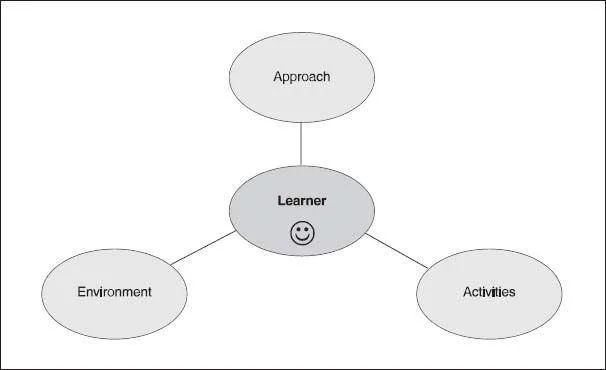
‘Learner centredness’ relates to tailoring the learning experience to the learner. This is particularly important in teaching people with special needs as each individual will have their own unique needs, and their abilities are influenced by their illness or disability. This concept has been discussed extensively follow...
Table of contents
- Cover
- Half Title
- Title Page
- Copyright Page
- Table of Contents
- Contents of the CD-ROM
- About the authors
- Foreword (Woody Caan)
- Foreword (Maggie Fletcher)
- Acknowledgements
- Preface
- SECTION 1
- SECTION 2
- SECTION 3
- Glossary and terms
- Selected bibliography
- Index
Trusted by 375,005 students
Access to over 1.5 million titles for a fair monthly price.
Study more efficiently using our study tools.
Frequently asked questions
Yes, you can cancel anytime from the Subscription tab in your account settings on the Perlego website. Your subscription will stay active until the end of your current billing period. Learn how to cancel your subscription
No, books cannot be downloaded as external files, such as PDFs, for use outside of Perlego. However, you can download books within the Perlego app for offline reading on mobile or tablet. Learn how to download books offline
Perlego offers two plans: Essential and Complete
- Essential is ideal for learners and professionals who enjoy exploring a wide range of subjects. Access the Essential Library with 800,000+ trusted titles and best-sellers across business, personal growth, and the humanities. Includes unlimited reading time and Standard Read Aloud voice.
- Complete: Perfect for advanced learners and researchers needing full, unrestricted access. Unlock 1.5M+ books across hundreds of subjects, including academic and specialized titles. The Complete Plan also includes advanced features like Premium Read Aloud and Research Assistant.
We are an online textbook subscription service, where you can get access to an entire online library for less than the price of a single book per month. With over 1.5 million books across 990+ topics, we’ve got you covered! Learn about our mission
Look out for the read-aloud symbol on your next book to see if you can listen to it. The read-aloud tool reads text aloud for you, highlighting the text as it is being read. You can pause it, speed it up and slow it down. Learn more about Read Aloud
Yes! You can use the Perlego app on both iOS and Android devices to read anytime, anywhere — even offline. Perfect for commutes or when you’re on the go.
Please note we cannot support devices running on iOS 13 and Android 7 or earlier. Learn more about using the app
Please note we cannot support devices running on iOS 13 and Android 7 or earlier. Learn more about using the app
Yes, you can access ICT for young people with SEN by Nicole Taylor,John Chacksfield in PDF and/or ePUB format, as well as other popular books in Education & Computer Science General. We have over 1.5 million books available in our catalogue for you to explore.