eBook - ePub
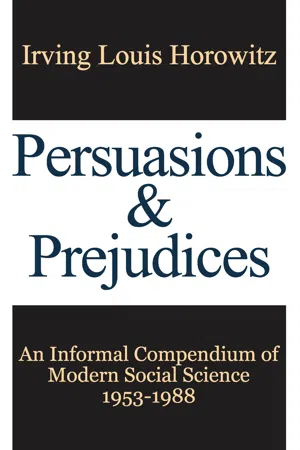
Persuasions and Prejudices
An Informal Compendium of Modern Social Science, 1953-1988
- 577 pages
- English
- ePUB (mobile friendly)
- Available on iOS & Android
eBook - ePub
Persuasions and Prejudices
An Informal Compendium of Modern Social Science, 1953-1988
About this book
Review essays and statements written for special occasions may reveal as much about the writer as those written about; this is the presumption undergirding this collection of thirty-five years of criticism and commentary by Irving Louis Horowitz. For this volume, he selected his comments on famous, near famous, and infamous sociologists, political scientists, and assorted literary figures in between. Taken as a whole, this volume will surprise and delight readers who are acquainted with Horowitz's other works as well as those who are interested in the people he writes about.The book covers notable social scientists, from Arendt to Zetterberg, and such major figures in between as Becker, Bell, de Jouvenel, Mills, Parsons, Solzhenitsyn, and more than eighty others who have had an effect on the contemporary social and political landscape. Each is critically examined, sometimes positively, other times negatively. Horowitz was a major figure in his own right, and his writing here displays the kind of refreshing frankness experts will expect and the general reader will appreciate.The underlying assumption behind the volume, giving its disparate parts a unified characteristic, is that together these observations on others amount to a general perspective on social science held by the author. Whether his larger ambition is accepted or disputed, there is no doubt that the volume provides a standard against which to measure the literary quality of writing in the world of professional social research.
Information
Part I Philosophical Antecedents to Social Theory
1
Sense and Structure in Social History*
Gerardo L. Baendel
More than a century ago, in 1845 to be precise, Marx described German historiography as “a series of ‘thoughts’ which devour one another and are finally swallowed up in self-consciousness.” This is so much the present status of the theory of history in Hispanic American letters, that while one might challenge Marx’s appraisal in terms of mid-nineteenth century Germany, there can be little argument that it characterizes contemporary historiadores. The very imbalance of materials, the mountainous literature in the philosophy of history vis-á-vis the relative paucity of useful studies in historical subjects as such, leads one to the irritating (but accurate) conclusion that Latin pensadores are more concerned with blue printing than with making history.
This is admittedly a harsh reading of the intellectual climate, but one that is not intended as a blanket generalization. Indeed such a judgment could not possibly cover such excellent theorists of history as José Luis Romero of Argentina, Antonio Gomez Robledo of Mexico, Gilberto Freyre of Brazil, and Arturo Ardao of Uruguay, among others. Nonetheless, there remains a strongly dominant tendency in Hispanic American historiography to follow fashionable European currents. Philosophic novelties rapidly find their way into historical discourses. Positivism, neo-Thomism, Spiritualism, Hegelianism, were some of the earlier rages. At present there is a powerful tendency to weave French existentialism into the historical fabric. So insistent has this last-mentioned tendency become in recent years, that the Uruguayan educator-philosopher Vaz Ferreira was moved to say that there was more agony (literary at least) over the consequences of the Second World War in South America, where not a shot was fired, than in the battle fronts of Europe.
To be sure, the idols of the pensadores have dramatically shifted since the conclusion of hostilities in 1945. The prewar period was dominated by an existentialism of the Right—by Spengler, Dilthey, and Heidegger. The postwar period is dominated by an existentialism of the Left—by Merleau-Ponty, Sartre, and Camus. The “victorious” French have replaced the “defeated” Germans in the affections of the pensadores. That the shift has been more verbal than real is indicated by the fact that the fundamental tenets of the leisurely Hispanic American Weltanschauung have remained fully intact.
The North American intellectual nourished on a steady diet of Pan-americanism must be startled by the nearly complete absence of any serious consideration of U.S. contributions to the study of history. With the exception of Toynbee, the same statement can be made of English efforts. And given the architectonic nature of Toynbee’s work, this exception very definitely proves the rule. Leaving aside the reasons for this disregard, which must necessarily include the shortcomings of historical theory in the English-speaking world, such exclusion effectively narrows the scope of Hispanic-American considerations of alternative models for the study of history. Thus, in the three books under consideration, Rama makes only a passing reference to Becker’s efforts (despite the fact that Becker’s work and Beard’s classic texts are available in good Spanish translations) and Baendel makes only a few bibliographical references to American studies in religious history. This neglect, I should add, is not due to any linguistic failings, since each of these authors has a more than adequate command of the English language.
The disregard of American or English works is matched by an overwhelming attention to French and German materials, mainly of a late nineteenth- century vintage, which gives an archaic touch to the volumes. There is Baendel’s “discovery” of the analogies between the Testaments and the philosophy of history, Rama’s declaration of the Nietzschean objections to history as a destroyer of social action and human morality as the last word on the subject, and Dujovne’s restatement of the crisis-in-culture theme as occasioned by the rise of modern science and technology. What complicates a judicious consideration of these studies is that, considered strictly from the perspective of recent contributions to the philosophy of history, they are prosaic and pedestrian. Yet, from a Hispanic American perspective, they symbolize the actual state of affairs motivating the historiadores.
The scope and content of these books differ. Carlos Rama, one of Uruguay’s best-known sociologists, examines history first in its relation to other literary and scientific disciplines, and then examines such problem areas of historiography as concept formation, periodization, and the cognitive status of findings. Baendel of the University of Chile correlates eschatological doctrines and the circular and linear theories of history to which they give rise. Léon Dujovne, Professor of Philosophy at Buenos Aires University, sets for himself the more modest goal of analyzing from a humanistic standpoint the theories of history advanced by Nietzsche, Spengler, Jaspers, Bergson, and Toynbee.
Given the different thematic orientations of these works, their core of consensus is surprising, especially since they were produced in obvious independence of each other. They concentrate on essentially the same range of European writings. And each volume represents a work of commentary rather than an attempt at fresh, positive insights into the problems examined. (Dujovne and Rama seem more aware of this self-imposed limitation than does Baendel.) Each work has the discomforting feeling of starting in heaven and going upwards. From the philosophy of history, these scholars move variously into the history of the philosophy of history (Rama), the religious impulse of the philosophy of history (Baendel), and the meta-philosophic criticism of theories of history (Dujovne).
There is an absence of biographical information on the figures examined; an absence of the possible social or scientific motivations of men like Spengler, Bergson, or Croce; consideration of what these theorists of history were for or against politically and economically (i.e., concretely). Thus, even when these authors voice criticisms, they convey arid formalism. Croce’s familiar objections to a scientific history are presented with the standard references to Croec’s mistakes—but without an historical accounting of Croce’s passionate defense of liberalism in the face of the fascist alternative of Tentile and the marxist alternative of Gramsci. Jaspers’ refuge in the intuitions of humanity and self-reflection of individuals is duly noted and criticized—but without considering Jasper’s acute analysis of the historical causes and consequences of German nazism, and more recently, without regard for his keen analysis of the dangers of thermonuclear war in a world of conflicting nationalisms. After all, at least some of the theoretical differences between Jaspers and his existentialist mentors must be explained by the differing responses to concrete circumstances. The posture of individual heroism in military battle might have been a suitable notion for a nineteenth-century romantic, but the disappearance of the distinction between combat and noncombat zones and military and civilian personnel necessarily changes the contents of the heroic vision—rationalist or irrationalist.
Paradoxically, the common deficit of these three volumes have is their lack of historicity. They are, to put it bluntly, static. Baendel moves from a consideration of ancient Hebraic and Christian texts to a hurried and unclear examination of philosophers of history proper. Dujovne’s work makes a textual analysis of several major figures that is quite independent of their social moorings, or for that matter, of each other. Rama takes a rambling canvass of the opinions of the major figures in the theory of history, without any discernible purpose. There is a sense of irresolution and indecision in these efforts. Baendel has no clear idea of where theology leaves off and history begins; Dujovne shows a similar lack of awareness as to where the philosophy of history ceases and social theory commences, and Rama’s book, which potentially has the stuff of a serious accounting, ranges so superficially over standard texts that the reader is caught in an endless chain of quotations, paraphrases, and asides.
These volumes well illustrate the dilemmas of the historiadores. Having established standards for living the life of ideas and eschewing the life of labor, they remain confronted by a growing demand for the products of the latter and an expanding supply of the former. Thus they attempt to capture the historical muse, in the hope that providence will provide what the historiador cannot—an advanced, modern form of industrial life in an intellectual climate of precapitalist techniques and postcapitalist ideologies. Unfortunately, these studies in the theory of history do little to remove the suspicion that even the most adept pensadores (which these men can justifiably claim to be) are ensnared by this double-bind of traditionalism and futurism. The inconclusive and indecisive nature of these works reflect the larger oscillations in Hispanic-American intellectual history—a history that can examine past and future trends in the traditional manner of grand theory, but that has yet to settle accounts with the historical present.
* Gerardo Leisersohn Baendel, Estructura Y Sentido de la Historia: Según la Literatura Apocaliptica (Santiago de Chile: Ediciones de la Universidad de Chile, 1959), pp. 147.
León Dujovne, La Filosof ía de la Historia, de Nietzsche a Toynbee (Buenos Aires: Ediciones Galatea Nueva Vision, 1957), pp. 204.
Carlos M. Rama, Teoría de la Historia: Introducción a los Estudios Históricos, (Buenos Aires: Editorial Nova, 1959), pp. 238.
From History and Theory: Studies in the Philosophy of History, vol. 2, No. 1 (1962), pp. 85–9.
2
Science and Society in the Enlightenment*
Denis Diderot
In his book, Aram Vartanian aims to examine concretely the huge debt the philosophers of the Enlightenment owed to the physics of Descartes, by unfolding the organic connection of Diderot’s materialism to the scientific materialism of Descartes. Vartanian chose these two figures as the highest expression of French philosophy in the seventeenth and eighteenth centuries respectively. What Marx asserted in his Holy Family, Vartanian proves by referring to the literature of the Enlightenment—that by sharply differentiating the realms of nature and God Cartesian dualism opened the pathway, not simply to the metaphysical-teleological reaction of Malebranche, but more profoundly to the revolutionary materialism of LaMettrie, Buffon, Holbach, and Diderot. In Descartes, materialism and idealism, naturalism and supernaturalism coexist. The demands of the eighteenth century bourgeoisie and agrarian democratic forces revolutionized Cartesianism, making consistent with the material facts of natural and social existence. In the meantime, the ancient regime purged Descartes of his materialist physics and wrapped about itself the mantle of his metaphysics of doubt. The author contends that no such bifurcation existed in Newtonian philosophy, which had erected on its physics the metaphysics of a deus ex machina and primum mobile. Descartes’ assertion that the concept of matter is in and of itself sufficient cause to explain the natural world, did not require, and in fact rejected, any supernatural interference in the functioning of nature. But the reasons why LaMettrie and Diderot responded more readily to Cartesian than to Newtonian science do not necessarily follow from Vartanian’s observation. For Holbach saw similar problems in Newton as in Descartes—and feared the broad adoption of a mechanistic science without shedding the theistic shell.
Vartanian’s main thesis is that Descartes’ natural philosophy “culminated in the ideology of Diderot and certain of his contemporaries.” This view was culled from a review of both great and obscure Enlightenment philosophies. The author states in his preface: “In tracing the evolution of materialist science from its Cartesian sources to Diderot . . . a definite method has been observed. This is to give the fullest scope and weight to the testimony and other materials provided by actual eyewitnesses and participants, even when these latter are no longer remembered on their own merits.” This approach, whatever its shortcoming, gives a solidity to Diderot and Descartes often lacking in other works on the Encyclopedic movement. In examining historically how Cartesian rationalism and mechanistic biology affect the concept of man as the most complex physical and physiological machine, Vartanian has performed a service by helping to reconstruct the forces shaping French materialism. In certain respects, Vartanian has done for Descartes what E.A. Burtt did for Newton in The Metaphysical Foundations of Modern Science, but without quite the same command of intellectual context that Burtt exhibits.
Nonetheless, in his anxiety to reveal the link between Cartesian physics and the Enlightenment, Vartanian tends to negate the twofold derivation of Encyclopedic naturalism. Those who had a predilection for natural philosophy were more indebted to Descartes and Gassendi than to Bacon and Newton. At the same time, those oriented to social theory, such as Rousseau, Voltaire and Helvetius, responded less to the rigors of Cartesianism than to the English empirical tradition of Bacon, Hobbes, and Locke.
Vartanian tends to overlook that the deep concern and skill of English utilitarianism in questions of social theory appealed to all philosophers who understood the barrenness of a revolution in philosophy without a revolution in social practice. For this reason, Holbach, Buffon, Condillac, and Diderot owed a great deal to the social currents derived from English constitutional theory. Nor can Vartanian justifiably claim that this sort of social analysis is outside his intent. The philosophy of the Enlightenment, and particularly of militant anticlericalism, was in Diderot’s words “full of humanity.” The application of philosophy to the needs of society qualitatively differentiated Diderot and his associates from Descartes and the seventeenth century evolution of mechanics. By striving to show the harmonic lineage from Descartes to Diderot, however, Vartanian creates distortions that are a disservice to the view of both Descartes and Diderot. For example, that Diderot was not only a revolutionary philosopher but a philosopher of the French Revolution apparently falls outside the purview of this study in the history of ideas. Yet it is this social fact rather than philosophical doctrine that can best explain both the identity and difference between Diderot and Descartes.
* Aram Vartanian, Diderot and Descartes: A Study of Scientific Naturalism in the Enlightenment, (Princeton: Princeton University Press, 1953), pp. 336.
From Science and Society, vol. 18, no. 2 (1954), pp. 185–86.
3
The Pre-History of the Sociology of Knowledge*
Wilhelm Dilthey
Dilthey’s place in modern intellectual history is securely planted, interestingly enough, no less in Latin America than in his native Germany. Dilthey’s prominence as a historian and philosopher of culture has steadily increased, despite the fact that the romantic Weltanschauung that gave birth to his style of work has long ceased to function. It is surprising that little interpretive literature exists on Dilthey’s social theories, since the real core of Dilthey’s novelty inheres in his ambitious redefinition of the character and structure of social science vis-a-vis philosophy and physics. In this aspect, Dilthey no less than Simmel or Durkheim must be viewed as a pioneer in giving sociology new vistas, albeit bottled in old solutions.
In the body of his work, Dilthey acknowledged no sociology other than the sociology of knowledge, that is, a sociology of human understanding and feeling. The human sciences, Geisteswissenschaften, differed from the natural sciences, Naturwissenschaften, precisely because all human creations involved consciousness of direction. Nature exists, but only man lives. This distinction between the human and the physical is the most basic one in Dilthey’s works. Embellished, altered to meet different issues, this inheritance from his early writings on Schleiermacher never leaves the center of the stage in Dilthey’s intellectual drama.
Dilthey’s contribution to the sociology of knowledge proceeded from a critique of sociological method as it was originally formulated by Auguste Comte. It was essentially a repudiation of the reductionism entailed by “social physics”, which erroneously translated of the Geisteswissenschaft into a Naturwissenschaft—the human sciences into a natural science. “My polemic against sociology concerned the stage in its development which was characterized by Comte, Schäffle, Lillenfeld. The conception of it which was contained in their works was that of a science of the common life of men in society, including among its objects also law, morality, and religion.
Sociology could not be a theory of the forms which psychical life assumes under the conditions of relationships between individuals. Dilthey believed this role of the psyche to be the key to the social sciences in contradistinction to the physical sciences. “My rejection of sociology applies to a science which aims at comprehending everything which happens de facto in human society in a single science. The principle underlying this synthesis would be that what happens in human society in the course of its history must be comprehended in the unity of one and the same object.” But this objection to unified science has d...
Table of contents
- Cover Page
- Half Title
- Title Page
- Copyright
- Dedication
- Contents
- Preface
- Introductory Essay
- Part I Philosophical Antecedents to Social Theory
- 1 Sense and Structure in Social History
- 2 Science and Society in the Enlightenment
- 3 The Pre-History of the Sociology of Knowledge
- 4 Staking Present Claims on Past Icons
- 5 On the Social Theories of Fascism
- 6 On Power and Statecraft
- 7 Public Affairs and Private Lives
- 8 History and Society in Retrospect
- 9 Rationalism and Irrationalism in History
- 10 Means and Ends in Nationalism
- 11 Marxian Myths and Pragmatic Dragons
- 12 Utility Theory as Social Theory
- 13 Phenomenological Social Science
- 14 Closed Societies and Open Minds
- 15 Science, Religion and Natural Philosophy
- Part II Development and Change
- 16 Politics, Labor and Development
- 17 Misanthropism as Conservatism
- 18 Democracy and Development in a One-Party State
- 19 Taking Lives and Developing Societies
- 20 The Rise and Fall of Counter Insurgency
- 21 Massification, Mobilization and Modernization
- 22 A Naive Sophisticate
- 23 Schisms and Chasms in International Affairs
- 24 Reactionary Immortality
- 25 Middle Classes and Militarism in Latin America
- 26 Prophecy and Postindustrial Myths
- 27 Modernization as Abstract Expression
- 28 Intellectuals and Social Change
- 29 Personal Values and Social Change
- 30 Martyrdom and Vietnam
- 31 Isolation, Intervention and World Power
- 32 Multinational Parochialism
- 33 Power and Change in an Industrial Context
- 34 The Politics of Urban Research
- 35 Anthropological Sociology
- 36 Militarism and Development
- 37 Class, Race and Pluralism
- Part III Ethnicity and Religiosity
- 38 Manners, Civility and Civilization
- 39 Liquidation or Liberation?
- 40 First Amendment Blues
- 41 Community and Polity
- 42 Bodies and Souls
- 43 Ethnicity as Experience
- 44 Documenting the Holocaust
- 45 Eclecticism in Search of an American Theology
- 46 The Politics of Genocide
- 47 Jewish History and American Destinies
- 48 The Jews and Modern Communism
- 49 Jewish Soul on Ice
- 50 Anti-Semitic Linchpins
- Part IV Social Research as Ideology and Utopia
- 51 Sociological Pragmatism
- 52 Behavioral Science as Ideology
- 53 Social Contexts of Thought
- 54 The Rise and Fall of Practically Everything
- 55 Law, Order and the Liberal State
- 56 Is There an American Power Elite?
- 57 Bureaucratic Illusions
- 58 American Virtues / Washington Vices
- 59 Social Psychology in a Dismal Decade
- 60 Political Troubles and Personal Passions
- 61 The Warring Sociologists
- 62 Culture of Sociology and Sociology of Culture
- 63 Is the Future an Extension of the Present?
- 64 The Banality of Culture
- 65 An American Rorschach Test
- 66 A Postscript to a Sociological Utopian
- 67 Personal Values and Social Class
- 68 The Iconoclastic Imagination
- 69 Malevolence and Beneficence in State Power
- 70 Sociological Disinformation
- 71 A Funeral Pyre for America
- 72 Political Pluralism and Democratic Power
- 73 Sociology for Sale
- Part V The Ethical Foundations of Political Life
- 74 Open Societies and Free Minds
- 75 Tribune of the Intelligentsia
- 76 Privacy, Ethics and Social Science Research
- 77 From Ideological Ends to Moral Beginnings
- 78 Is a Science of Ethics Possible?
- 79 The Responsibilities of Sociology
- 80 The Tragedy of Triumphalism
- 81 The Two Cultures of Policy
- 82 Counterrevolutionary Values or National Interests?
- 83 Knowledge for Democracy
- 84 Revolution, Retribution and Redemption
- 85 Social Theory as Revolutionary Virtue
- 86 Visions of Revolution and Values of Europe
- 87 Knowledge and Its Values
- About the Author
- Index
Trusted by 375,005 students
Access to over 1.5 million titles for a fair monthly price.
Study more efficiently using our study tools.
Frequently asked questions
Yes, you can cancel anytime from the Subscription tab in your account settings on the Perlego website. Your subscription will stay active until the end of your current billing period. Learn how to cancel your subscription
No, books cannot be downloaded as external files, such as PDFs, for use outside of Perlego. However, you can download books within the Perlego app for offline reading on mobile or tablet. Learn how to download books offline
Perlego offers two plans: Essential and Complete
- Essential is ideal for learners and professionals who enjoy exploring a wide range of subjects. Access the Essential Library with 800,000+ trusted titles and best-sellers across business, personal growth, and the humanities. Includes unlimited reading time and Standard Read Aloud voice.
- Complete: Perfect for advanced learners and researchers needing full, unrestricted access. Unlock 1.5M+ books across hundreds of subjects, including academic and specialized titles. The Complete Plan also includes advanced features like Premium Read Aloud and Research Assistant.
We are an online textbook subscription service, where you can get access to an entire online library for less than the price of a single book per month. With over 1.5 million books across 990+ topics, we’ve got you covered! Learn about our mission
Look out for the read-aloud symbol on your next book to see if you can listen to it. The read-aloud tool reads text aloud for you, highlighting the text as it is being read. You can pause it, speed it up and slow it down. Learn more about Read Aloud
Yes! You can use the Perlego app on both iOS and Android devices to read anytime, anywhere — even offline. Perfect for commutes or when you’re on the go.
Please note we cannot support devices running on iOS 13 and Android 7 or earlier. Learn more about using the app
Please note we cannot support devices running on iOS 13 and Android 7 or earlier. Learn more about using the app
Yes, you can access Persuasions and Prejudices by Irving Horowitz in PDF and/or ePUB format, as well as other popular books in Social Sciences & Social Theory. We have over 1.5 million books available in our catalogue for you to explore.