- 332 pages
- English
- ePUB (mobile friendly)
- Available on iOS & Android
eBook - ePub
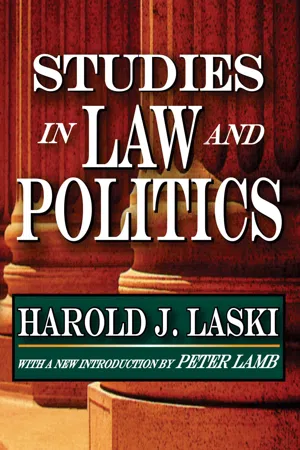
Studies in Law and Politics
About this book
The essays that comprise Studies in Law and Politics are by and large academic. But Laski had a purpose in addition to the purely scholarly: he was eagerly pursuing possibilities for social and political change. Laski sought tirelessly for opportunities to act on those possibilities and, as is the case throughout his work, his academic and political purposes have no clear boundary between them.Studies in Law of Politics was published at a crucial juncture in Laski's ideological metamorphosis. During this period he had become increasingly worried that socialists might not be able to achieve the growth of working-class power. Although the essays contained in the volume cover a wide range of topics, and a wide span of time since the mid-1920s, he brought them into unity by a common approach. Though he does not make his unifying premise immediately evident to his readers, he clearly meant to chart the growth of power of those who had previously been without influence. His goal also was to identify the problems facing growth in a highly modernized society.Studies in Law and Politics reveals Laski's growing realization that the road to socialism might be more difficult than what he had believed when he wrote his pluralist works. The book reflects the mind of a thinker who was not content to write exclusively as an academic or a political activist. His view was that, while progressive reforms have been achieved in the past, they are not easily accomplished, and obstacles to further reforms should not be underestimated. This sober work offers much insight into Laski's intellectual development, as well as the times about which he wrote.
INTRODUCTION TO THE TRANSACTION EDITION
Peter Lamb
WHEN a collapsed lung brought about the premature death of Harold Laski in 1950, at the age of fifty-six, he was widely recognized as one of the most prolific and controversial political thinkers of his times. He was, furthermore, well-known in the United Kingdom, the United States, and many other countries around the world for his work as a socialist political activist on the left wing of the British Labour Party. Throughout his adult life he pursued these academic and political activities in tandem in a frantic schedule, which contributed to the ill health that would eventually prove fatal. Undertaking these different activities concurrently would, he hoped, serve two interrelated purposes: in his scholarly writings he would shed light on some of the most pressing problems of modern society, along with their causes, whilst as a political activist he would contribute to the solution of those problems.
Readers who select and peruse works that Laski wrote at different points in his life will notice that, in the course of conducting his interconnected political and academic activities, his views on the understanding, planning, and action required to bring about social change were not firmly fixed. As his ideological position gradually changed, so did his analysis and prescriptions. The publication of Studies in Law and Politics in 1932 came at a very noteworthy moment in this development of his thoughts and recommendations for action. It was a moment at which he was becoming increasingly convinced that Marxism, of which he had previously been sharply critical, helped provide some crucial answers to the economic, social, and political problems that his world was facing.
Although one cannot always distinguish clearly between the academic and political purposes in Laski’s work, with some of his works actually straddling the two categories, the essays that comprise Studies in Law and Politics fall by and large into the academic. Nevertheless, there are indications in these essays that Laski had a purpose in addition to the purely scholarly, with one eye eagerly seeking possibilities for social and political change that his studies might reveal. He sought tirelessly for opportunities to act on those possibilities and, as is the case throughout his work, the academic and political purposes in his writings in this volume had no clear boundary between them.
After the publication of Studies in Law and Politics, Laski continued to produce many books, articles, and reviews from his position as a scholar. In the 1930s and even more so in the 1940s, however, the writings he produced primarily as a political activist became far more prominent in his output than had earlier been the case. Moreover, even his more academic writings began to take on a more distinct element of political activism. Laski would not have considered this observation significant. For him, political action and political thinking were two aspects of one and the same role he held as a socialist intellectual.
Laski’s Dual Role
By no means an ivory tower academic, Laski has been described as both a “public intellectual” and a “public philosopher.”1 These descriptions can be seen to relate in turn to the two aspects of his dual role. In the case of his status as a public intellectual, by means of his political activity he became one of the most influential figures on the left wing of the Labour party.2
Nevertheless, the Labour leadership did not always welcome Laski’s work within his party; and this was particularly the case in the war years of the 1940s. Among the senior politicians of the party who were certainly not favorably disposed to Laski’s interventions, Ernest Bevin was especially hostile to what in his view was interference and meddling in party decision-making procedures by the intelligentsia—a category in which he specifically included Laski.3 Party leader Clement Attlee also found Laski’s interventions rather irritating. Perhaps, most famously, Laski attempted from his position as party chairman in the 1940s to assert the authority of the National Executive Committee (NEC) over the Parliamentary Labour Party (PLP) during the period of wartime coalition government. He insisted that Attlee, in his position as Labour parliamentary leader, must get approval from within the party for any decisions made at the Potsdam conference, to which Conservative Prime Minister Winston Churchill had invited Attlee. In response to Laski’s demands At-tlee stressed that the PLP was neither answerable to nor directed by the NEC. Moreover, Attlee added that the leadership of the PLP had discretion to act so long as this did not contravene a decision made at the party conference. Any decisions he might make in connection to Potsdam did not, he implied, constitute such a contravention.4
Notwithstanding this uneasy relationship with his party leadership, Laski’s pamphleteering, his public speaking, his contributions to conferences and his various other political activities helped inspire the democratic socialist reforms introduced by the post-war Labour government of the mid-to-late 1940s.5 The party’s anonymously published 1942 report The Old World and the New Society, which had a huge impact on Labour thinking and policy-making at this time, is a case in point.6 Shortly after Laski’s death the Labour general secretary Morgan Phillips acknowledged that Laski’s mind was the moving spirit behind the production of that influential statement of policy.7
In the case of the other aspect of his dual role—that of academic and scholar—perhaps the label “public philosopher” does not fully capture the breadth of Laski’s work. In the words of his former student Ralph Miliband: “The books, essays, pamphlets and articles which flowed from his pen ranged over a wide field of history and jurisprudence, political theory, social philosophy and public administration.”8 Even this does not cover every field on which he taught and published. He was, for example, a scholar of British and American politics. Furthermore, he was one of the pioneering writers in the decades between the world wars whose work on politics transcended state boundaries and thus helped develop International Relations as an academic discipline.9
A clearly distinguishable feature of Laski’s work was his tendency, in his contribution to the various topics and fields within the study of politics, law, and international relations, to incorporate a socialist message. The link was thus formed between this aspect of his role and that of activist in the cause of progressive social change. This approach was summarized very well in a lecture he delivered less than two months before his death, in which he agreed with people who held two connected beliefs. The first of these beliefs was “that the first task of learning and scholarship is not research for its own sake, but the achievement of a profounder knowledge of men’s relation to nature.”10The second belief was that there “was no other way in which to discover the questions we should ask in the hope of transforming Man from a rebel against a harsh and unfriendly universe into a master of its forces, and thus into that self-mastery that is one of the essential conditions of a free society.”11 For many years his writings had been inspired by these two beliefs, as he sought to play a part in the introduction of that free society—a society that in his view would need to be an egalitarian one. For him, freedom was inseparable from equality.12 He passionately believed, moreover, that a genuinely free society, characterized by self-mastery, would be a socialist society. As Miliband put it: “For a period of some twenty-five years, Laski contributed more to the discussion of the meaning and challenge of Socialism than any other English Socialist.”13
Laski’s scholarly expertise earned him the revered Chair of Government at the London School of Economics in 1926—a position he held until his death. Holding this prestigious position did not, however, mean that Laski could avoid strong, incisive, and well-argued criticism during his lifetime. As will be illustrated later in this introduction, some of that criticism came from very influential political thinkers. Notwithstanding this criticism, however, his voluminous contribution to the various fields within the study of politics was in his own time hugely influential in academic circles, in addition to the political circles mentioned above. For example, among the many students he influenced who would later become prominent political scientists and political theorists in their own right was C.B. Macpherson, who acknowledged that he had been under Laski’s spell in the 1930s and 1940s.14 Miliband, as we have already seen, was another scholar who acknowledged the power of Laski’s writing and teaching. Laski’s broader influence was acknowledged soon after his death by his fellow socialist intellectual John Strachey. Reflecting on his colleague’s work over several decades, Strachey declared that Laski’s major achievement had been to articulate the problems and anxieties of his generation.15
The Demise of Laski’s Reputation
Interest in Laski’s work soon began to fade away after his death. His reputation as a political thinker came under potent attack in the early years of the Cold War. The impetus was set in 1950 when Carroll Hawkins published an article claiming that, in the way he addressed the problem of liberty versus authority, Laski threatened the very existence of constitutional government and thus always “failed the liberal democrat.”16 This was not the first time Laski had been criticized on such grounds. George Catlin and Ernest Barker had expressed similar views in Laski’s own lifetime.17 Hawkins’s article was, though, significant in that its focus was exclusively on Laski. In attempting to marry the liberal themes of his pluralist and modified pluralist phases to Marxism , Hawkins suggested, Laski made the liberal force of his ideas “fundamentally secondary to the force of an intolerant absolute doctrine.”18
In another influential critique written soon after Laski’s death, Max Beloff suggested that Laski’s influence over more than thirty years could be summed up by calling that period “The Age of Laski.”19 Although Beloff was impressed by Laski’s early pluralist political philosophy, he expressed the belief that the quality of Laski’s work suffered when its author embraced Marxism.
Most prominent among critics in the assault that followed was Herbert Deane, who in 1955 published his lengthy and very unfavorable study of Laski’s political ideas. Its main theme being the charge of inconsistency, Deane’s book left the impression that Laski’s thought was muddled and almost worthless.20 Deane’s study was undoubtedly thorough, painstakingly analyzing a wide range of Laski’s works from his well-known books to relatively obscure articles. Nevertheless, one might question whether Laski could have achieved the prestige that he did had his political thought not been more significant than Deane implied it was.
Laski should not escape blame for the assessments made by writers such as Hawkins and Deane. Many of the books Laski wrote in the later part of his career, after the publication of Studies in Law and Politics, leave the impression of having been written rather hastily. Some of these later writings seem to have had little in the way of proper planning or revision, perhaps reflecting Laski’s effort to fulfill all the duties that he set for himself. Even Kingsley Martin, who was for many years his friend and colleague on the British left, conceded that this was so.21 As a result, Laski’s important ideas in some of his books of the 1930s and 1940s can easily be overlooked as readers endure their often rather draft-like quality.
The looseness of his writing and his sometimes rather inconsistent use of political concepts certainly convey the impression that the breadth of Laski’s activities prevented him from realizing his potential as a political philosopher. One commentator, writing many years after Laski’s death, stressing that being an intellectual is not the same as being an academic or scholar, suggested that an intellectual “yearns to overcome the passivity of the professoriate...” If scholars nee...
Table of contents
- Cover Page
- Title Page
- Copyright Page
- Contents
- Introduction to the Transaction Edition
- Preface
- I. The Age of Reason
- II. Diderot
- III. The Socialist Tradition in the French Revolution
- IV. The Problem of a Second Chamber
- V. The State in the New Social Order
- VI. The Political Philosophy of Mr. Justice Holmes
- VII. The Technique of Judicial Appointment
- VIII. The Personnel of The British Cabinet 1801-1924
- IX. Judicial Review of Social Policy
- X. Procedure for Constructive Contempt
- XI. Law and The State
- XII. Justice and The Law
- Index
Trusted by 375,005 students
Access to over 1.5 million titles for a fair monthly price.
Study more efficiently using our study tools.
Frequently asked questions
Yes, you can cancel anytime from the Subscription tab in your account settings on the Perlego website. Your subscription will stay active until the end of your current billing period. Learn how to cancel your subscription
No, books cannot be downloaded as external files, such as PDFs, for use outside of Perlego. However, you can download books within the Perlego app for offline reading on mobile or tablet. Learn how to download books offline
We are an online textbook subscription service, where you can get access to an entire online library for less than the price of a single book per month. With over 1.5 million books across 990+ topics, we’ve got you covered! Learn about our mission
Look out for the read-aloud symbol on your next book to see if you can listen to it. The read-aloud tool reads text aloud for you, highlighting the text as it is being read. You can pause it, speed it up and slow it down. Learn more about Read Aloud
Yes! You can use the Perlego app on both iOS and Android devices to read anytime, anywhere — even offline. Perfect for commutes or when you’re on the go.
Please note we cannot support devices running on iOS 13 and Android 7 or earlier. Learn more about using the app
Please note we cannot support devices running on iOS 13 and Android 7 or earlier. Learn more about using the app
Yes, you can access Studies in Law and Politics by Harold Laski in PDF and/or ePUB format, as well as other popular books in Law & Jurisprudence. We have over 1.5 million books available in our catalogue for you to explore.