- 220 pages
- English
- ePUB (mobile friendly)
- Available on iOS & Android
eBook - ePub
About this book
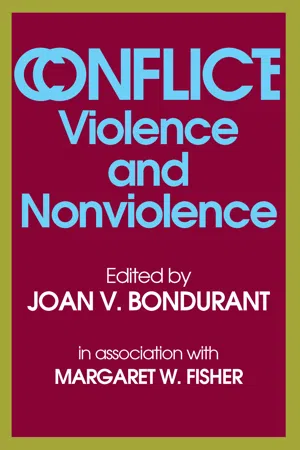
Focusing on central issues in the study of conflict and conflict resolution, this volume sets forth the views of eminent scholars on the forms, uses, and limitations of violence, nonviolence, and symbolic violence. Joan V. Bondurant, as editor of this compilation, defines the important issues, places the often contradictory contributions into perspective, and calls for a new conceptual framework within which workable techniques for the active conduct of conflict can be fashioned.Each of the carefully chosen contributions deal with the most familiar modes of nonviolence--pacifism and civil disobedience. Several experts raise basic questions about pacifism, point out new developments in today's peace movements, and discuss vital topics such as the political implications of the pacifist position, revolution as political change, and the risks of engaging in civil disobedience. For example, H. L. Niebury contradicts popularly held opinion that ""violence settles nothing,"" and argues that the threat of violence induces flexibility and stability in democratic institutions. In ""Violence and the Process of Terror,"" E. V. Walter gives a critical view of the limits of irrational violence and underscores the need to uncover the psychological mechanisms that account for the effectiveness of terror. Exploring the differences between symbolic violence and creative conflict, Ernest Jones details his unique investigation into revolutionaries' styles and their respective degrees of destructiveness.Bondurant concludes with an elaboration of the Gandhian technique of satyagraha to show that, in most instances, nonviolence is actually symbolic violence and that familiar nonviolent techniques cannot meet contemporary imperatives. Ideally suited to a wide range of readers, Conflict: Violence and Nonviolence can be especially useful in studies of politics and political and social philosophy.
Information
IV Is There an Alternative to Violence?
9 Fractionating Conflict
ROGER FISHER
This paper is not concerned with debating whether major conflicts of interest exist between countries; it is concerned with dealing with them. It does not suggest that any one country has complete control over the formulation of international conflict issues but that each country has a measure of control. It does not suggest that it is always wise to fractionate conflict into little issues but that it is often wise to do so. Actions affecting the size of an issue should be undertaken consciously, with the advantages and disadvantages in mind. Little study has been devoted to the criteria and methods by which a country should formulate and expand or contract issues in controversy. Arms are used only over issues. Perhaps more important than the field of arms control is the field of "issue control."
The way in which a country wishes to carry on a dispute must be judged in light of the nation's objectives. The United States' basic objectives are: first, to win each dispute with another country, and second, to avoid war and develop a fair way of settling such disputes—objectives which are somewhat inconsistent. While the United States would like to win each dispute, it is not seeking a world in which any one country wins every dispute. Internationally as well as domestically, our government is simultaneously interested in winning each case and in promoting the rule of law—a regime in which the government does not always win. It is interested in winning disputes and in settling them peacefully. No absolute priority can be established between these two objectives; both need to be kept in mind in each dispute. It is against these objectives that the process of formulating and fractionating conflict issues must be judged.
There are, perhaps, an infinite number of ways in which international issues might be sliced. For a first approximation, it may be useful to consider five dimensions which measure the size of a conflict issue:
1. The parties on each side of the issue
2. The immediate physical issue involved
3. The immediate issue of principle
4. The substantive precedent which settlement will establish
5. The procedural precedent which settlement will establish.
With respect to each of these, there is a certain amount of choice as to how big or small the issue is made. Although these variables are not wholly independent, they will serve as a basis for exploring different ways in which conflict issues may be increased or decreased in size.
PARTIES ON EACH SIDE OF THE ISSUE
In traditional international law, the nation is considered as the proper unit to represent the interests of a citizen who is injured. In some circumstances, the nation is held responsible for wrongs committed by its citizens.
Disputes between people ruled by different governments need not be treated as intergovernmental disputes. Disputes between groups in different states within the United States are rarely treated as interstate disputes. Among nations, even actions by government officials are often deliberately treated as though the government itself were not involved.
There are advantages in downgrading a dispute and in treating it as one between individuals, or at least as one in which the other government is not involved. As long as disputes are considered in this way, there is little chance of war.
Treating disputes as cases between individuals or groups rather than nations has the further virtue of establishing cross-cutting conflicts. In such conflicts, the opponents in one controversy are not identical with the opponents in another. On the international scene today, Yugoslavia and Poland have helped this country understand that our disputes with the Soviet Union and our disputes with communism are not always the same thing. By identifying more accurately our opponent in certain Far East situations as "China" rather than as "communism," we may find that we have reduced the size of our opponent and also that on occasion we have an ally in the Soviet Union.
There are often, however, conveniences in treating a single government as the responsible opponent in what would otherwise be a mass of unrelated problems. A simple overall solution may be possible only by considering matters on a government-to-government basis. Using one dispute as leverage on another, as discussed below, often requires a preliminary step—that of treating as governmental two disputes which otherwise would be considered to involve different groups or individuals.
Defining the parties to a dispute is thus a basic way of making disputes bigger or smaller.
IMMEDIATE PHYSICAL ISSUE INVOLVED
Any particular conflict can be thought of as having a certain minimum size in factual or physical terms. This is measured by the inconsistency between the physical events desired by the two adversaries.
There are two ways of expanding the physical size of an issue: first, by defining more broadly the subject matter in dispute; second, by bringing in different subjects which are related only because the parties are the same.
It seems clear that if a subject is too narrowly defined, there will be little possibility of a bargain. The narrower the point, the more likely it is that a change will benefit one party only. It would seem desirable to expand the subject until it is large enough for a bargain which benefits each, if not to the same extent, at least to some degree. As a general rule, enlargement of the issue beyond that point is unwise.
The immediate issue under discussion between two sides may be expanded by coupling one dispute with another. Here the connection is made not by broadening the definition of the subject matter but by recognizing that two matters involve the same parties. The considerations involved in coupling one dispute with another deserve more study. If the joining of problems is made as an offer, the process seems constructive, facilitating agreement: "I will let you have what you want in the X dispute if you will let me have what I want in the Y dispute." Coupling disputes in this way may increase the chances of agreement.
Even here, however, shifting the nature of the dispute—from a narrow subject matter to one in which the only common denominator is the parties involved—tends to bring up all possible issues in the relationship and may do more harm than good. It encourages the unfortunate "overall confrontation" described earlier. The joining of issues as leverage or bargaining currency, even when constructively looking toward a negotiated agreement, tends to shift the focus away from the merits of a problem and to put relative bargaining power in issue.
One way to improve the relationship between two adversaries may be to treat different subjects as separate issues. At roughly every other stage in the escalating process, each party has that option and should be aware of it.
It seems important to distinguish talking about an additional issue by way of a counteroffer, as discussed above, from taking action on an otherwise unrelated matter by way of pressure. When pressure produces counterpressure, the escalating process is much like that by which limited hostilities grow into all-out war. As is the case with limited war, the more unrelated the action of one country is to the action taken by the other, the more difficult it is to find a boundary to the conflict.
To be strong and effective, a country apparently needs principles and needs to adhere to them. Principles can be flexible, however, and the extent to which they are involved in a particular controversy can be limited in two ways. The first is by recognizing that we can be loyal to our principles without insisting that our opponents be disloyal to theirs. To arouse the maximum support of our own people, we often identify a dispute as a conflict of principle, in which one principle or the other must yield. We do this also as a form of committal strategy in which we strengthen our negotiating position by tying our own hands and making it harder to back down. If we wish to win a controversy, it would seem wiser to say that the solution we seek is not only consistent with our principles but is also consistent with those of our adversary—at least if properly construed and applied. By insisting that our adversary can come along without abandoning his principles, we make it easier for him to do so. In this way a country can remove an issue of principle from a controversy without in any sense abandoning its principles. If another country is prepared to accept a physical solution which we regard as consistent with our principles, no principle of ours requires that it first accept some generalized statement of what it is doing.
The second way of limiting the extent to which principle is involved in a controversy is to recognize the difference between principle and the application of principle. In almost every dispute, there are conflicting principles involved. In a lawsuit, each side urges that a different principle should be the controlling one. Litigation may simply determine that, in this case, the principle does not properly apply. The same determination can be reached through negotiation; to do so is not to be disloyal to principle.
Recognizing where possible that a dispute involves a question of the application of principle rather than the central principle itself should make it possible to decrease the stakes. Nonetheless, in every controversy, a certain minimum amount of principle is involved. The size of a controversy may be measured in terms of both the substantive and procedural precedents which its resolution will set.
SUBSTANTIVE PRECEDENT WHICH SETTLEMENT WOULD ESTABLISH
In almost every conflict each side is thinking not only of how much it would lose immediately if it yielded a point but also of how much it would lose by way of precedent. The impact of a precedent depends upon its strength and its scope. To the extent that these can be controlled, the size of the matter in conflict can be changed.
The scope of a precedent is always somewhat ambiguous. In political affairs, as in the legal system, ambiguity permits a nice accommodation between consistency and flexibility as new circumstances arise. The minimum scope of a precedent is determined by that which cannot reasonably be distinguished from it. Additional scope may be established by what is said before and during the resolution of an issue. The language used by one or both sides may turn a simple case into a test case. Significant possibilities exist for limiting the size of a conflict by limiting the precedent. If the parties agree that a controversy is a test case which will decide a broad category of issues, the scope of the precedent is thereby enlarged.
PROCEDURAL PRECEDENT WHICH SETTLEMENT WOULD ESTABLISH
A close relationship exists between the substantive issue involved and the procedural precedent established by reaching an agreement. To the extent that a settlement is substantively sound, it can be justified "on its merits"; the fact that concessions were made will have limited effect. If both parties have made some concessions, the effects are likely to be in balance. If one party has made all the concessions, the Munich situation obtains. The effects of such a concession need to be examined in terms of their influence on each party and on third states. The lessons learned from Munich deserve more study than they have received.
The first lesson—that a country may not succeed in pacifying another by yielding to its purportedly last demands—has been thoroughly absorbed. In fact, appeasement has become such a bad word that there is little attempt to identify situations in which it might be politically effective.
The second lesson of Munich is that the party to whom the concession has been given may think that a procedural precedent has been established and may seek further concessions in the same way. Having discovered that the British would not fight over one issue, Hitler apparently assumed that they would not fight over a comparable issue. Third states may have reached the same conclusion.
The third lesson of Munich, however, is that Hitler was wrong. Governments, like individuals, are tolerant to a degree. They will cooperate with others on a give-and-take basis, but unless concessions are reciprocal, it is less likely, rather than more, that additional concessions will be made. Of course, if a country gives up territory or arms of substantive importance, it may become weaker through concessions. The Munich example, however, suggests that the effect of a procedural precedent on a country that yields has been widely exaggerated. It suggests that the famous "slippery slope" goes uphill, not down.
FRACTIONATION OF DISPUTES
When considering only the "procedural" objective of the United States—to avoid war and to improve the method of settling international differences—it appears that the practice of fractionating conflict issues is definitely to our interest. Separating issues into their smallest components and dealing with them one at a time reduces the risk of war significantly.
Fractionating conflict should avoid the stalemate that comes from a nation-to-nation confrontation in which neither country feels that it can make any concession without losing part of an overall war. To the extent that issues are decided separately, there is an increased chance that they are decided on their merits, that is, in light of their particular facts and circumstances. In this sense, agreements reached might be objectively better. Piecemeal settlement also recognizes that everything cannot be done at once and permits progress in certain areas while other matters are being worked out.
No general statement, of course, can be made that either fractionating a conflict issue or enlarging it will always be better for a country from the point of view of winning the matter in dispute.
Coupling one issue with another may be useful as a form of pressure. If one country has sufficient power for effective arm twisting, the desired substantive result may be accomplished. Such substantive gain must be weighed against the procedural loss which deciding disputes on the basis of superior power involves. There are other limitations on the pressure technique. When dealing with an opponent who has the opportunity to escalate a conflict issue by throwing in counterleverage and coun-terthreats, the tactic can backfire.
Even when one country of superior power is applying pressure in large quantities, the effectiveness of that pressure is likely to depend upon keeping the issue on which it is focused small. The effectiveness of pressure is increased by keeping the objective narrow and making it easy for the adversary to back down.
The coupling technique may also be a useful way of winning one dispute at the expense of another. If an issue that is likely to be lost anyway is on the table, a country may be able to retrieve something by coupling that dispute with one on which the adversary might yield. If an issue that a country strongly desires to win is on the table, perhaps it can be bought by coupling it with a "loser."
Similarly, expanding the subject matter under dispute may make it possible to work out an agreement in which we win something. Negotiating the allocation of a single radio frequency between several countries would be difficult. There would be more likelihood of success if the subject were broadened to include enough frequencies so that each country would get at least one. Finally, if it is already clear that one side is going to win in a particular conflict situation, the larger the terms in which the issue can be defined, the more that side will win.
These instances indicate that fractionating a conflict situation —insisting that the issues be dealt with separately and in their narrowest possible scope—may not always ...
Table of contents
- Cover Page
- Half Title
- Title Page
- Copyright Page
- Preface
- Contents
- The Search for a Theory of Conflict
- I Familiar Modes of Nonviolence
- II Forms and Uses of Violence
- III Symbolic Violence or Creative Conflict?
- IV Is There an Alternative to Violence?
- V Epilogue
- Index
Trusted by 375,005 students
Access to over 1.5 million titles for a fair monthly price.
Study more efficiently using our study tools.
Frequently asked questions
Yes, you can cancel anytime from the Subscription tab in your account settings on the Perlego website. Your subscription will stay active until the end of your current billing period. Learn how to cancel your subscription
No, books cannot be downloaded as external files, such as PDFs, for use outside of Perlego. However, you can download books within the Perlego app for offline reading on mobile or tablet. Learn how to download books offline
Perlego offers two plans: Essential and Complete
- Essential is ideal for learners and professionals who enjoy exploring a wide range of subjects. Access the Essential Library with 800,000+ trusted titles and best-sellers across business, personal growth, and the humanities. Includes unlimited reading time and Standard Read Aloud voice.
- Complete: Perfect for advanced learners and researchers needing full, unrestricted access. Unlock 1.5M+ books across hundreds of subjects, including academic and specialized titles. The Complete Plan also includes advanced features like Premium Read Aloud and Research Assistant.
We are an online textbook subscription service, where you can get access to an entire online library for less than the price of a single book per month. With over 1.5 million books across 990+ topics, we’ve got you covered! Learn about our mission
Look out for the read-aloud symbol on your next book to see if you can listen to it. The read-aloud tool reads text aloud for you, highlighting the text as it is being read. You can pause it, speed it up and slow it down. Learn more about Read Aloud
Yes! You can use the Perlego app on both iOS and Android devices to read anytime, anywhere — even offline. Perfect for commutes or when you’re on the go.
Please note we cannot support devices running on iOS 13 and Android 7 or earlier. Learn more about using the app
Please note we cannot support devices running on iOS 13 and Android 7 or earlier. Learn more about using the app
Yes, you can access Conflict by Margaret Fisher in PDF and/or ePUB format, as well as other popular books in Politics & International Relations & Political Philosophy. We have over 1.5 million books available in our catalogue for you to explore.