eBook - ePub
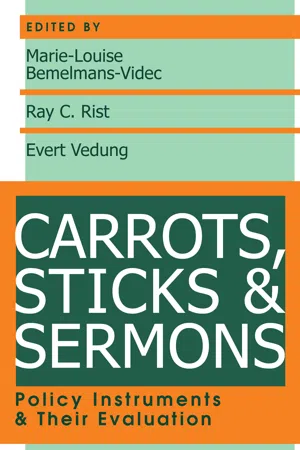
Carrots, Sticks and Sermons
Policy Instruments and Their Evaluation
- 280 pages
- English
- ePUB (mobile friendly)
- Available on iOS & Android
eBook - ePub
Carrots, Sticks and Sermons
Policy Instruments and Their Evaluation
About this book
The literature on policy strategies, instruments, and styles is impressive. Still, a complex variety of theoretical and conceptual approaches and analytical tools hamper a good overview. Carrots, Sticks, and Sermons proposes such a framework for the field and clearly shows how public policy instruments are classified, packaged, and chosen, while highlighting the role evaluation plays in the instruments-choice process.Carrots, Sticks, and Sermons offers a comprehensive analysis of categories and typologies of policy instruments. It classifies sticks, carrots, and sermons - or, more specifically, regulation, economic means, and information. Readers are offered a comparative perspective of evaluation practice in foreign contexts. Special attention is paid to the examples of Sweden, the Netherlands, Belgium, England, Canada, the United States, and the Republic of Korea. As such, this volume crosses language barriers that stand in the way of dispersing research results among the international community of theoreticians and practitioners. As nations become increasingly interdependent, problems of implementation and evaluation of policy choices will become issues of increasing gravity.Carrots, Sticks, and Sermons provides insights into the traditional and current practice of policy and program evaluation in various contexts. The book's theory of comparative public policy will produce understanding and guidance in designing better policies. It will be of wide interest to those in the fields of public policy, particularly policy design, policy implementation, policy evaluation, comparative politics, and economics.
Information
Part I
Typology of Instruments
1
Policy Instruments: Typologies and Theories
Evert Vedung
The major shortcoming of current implementation research is that it focuses on the wrong unit of analysis, and that the most important theoretical breakthrough would be to identify a more fruitful unit on which to focus analysis and research. In particular, rather than focusing on individual programs, as is now done, or even collections of programs grouped according to major “purpose,” as is frequently proposed, the suggestion here is that we should concentrate instead on the generic tools of government action...that come to be used, in varying combinations, in particular public programs... [T]e development of ..a systematic body of knowledge about the alternative tools of public action is the real “missing link” in the theory and practice of public management.
—Lester M. Salamon, Rethinking Public Management, 1981
Conceptions of Policy Instruments
Public policy instruments are the set of techniques by which governmental authorities wield their power in attempting to ensure support and effect or prevent social change. It has been rightly asserted that policy instruments should be carefully selected and honed to become the finely tuned means which are needed to achieve those very ends that the public authorities are pursuing. Effective and legitimate programs for environmental protection, housing, and agriculture will probably involve unique mixes of several policy instruments. For policymakers it is crucial to have a good overview of the generic forms of these instruments, because the issue of choosing the appropriate combination is one of the most intricate and important in strategic political planning.
Nowhere in the international literature on policy analysis and public administration is to be found a uniform, generally embraced classification of policy instruments. There are presently a plethora of classifications of policy instruments.
In this chapter, I shall illustrate this conceptual diversity by providing a few samples from the ample smorgasbord of classifications. Yet the purpose is more far-reaching. The chapter aims to suggest a parsimonious and fruitful classification of policy instruments. There cannot, however, be one universal categorical scheme on any topic. The search for universality is futile, even counterproductive. There must be numerous classifications varying with theoretical and practical perspective. In this chapter, however, I shall choose only one scheme and explore it from various angles.
The Choice Versus Resource Approach
Basically, there are two pairs of fundamental approaches to taxonomy in the literature: the “choice versus resource approach” and the “maximalist versus minimalist approach.” In the choice versus resource approach, the question is whether instruments ought to be classified from the viewpoint of the basic choices that government can make (the choice of “doing nothing” included), or whether classification ought to be predicated on the situation that government has already decided to do something, and that the categories are categories for the resources that the government can then use. This distinction was noted in an interesting paper by Michael Howlett (1991: 3f.), although I have substituted “choice approach” for his “continuum approach.” In the maximalist versus minimalist approach, the controversy is whether to provide a long list of all possible policy instruments or to create two or three fundamental types under which all specific kinds of policy instruments can be categorized.
The choice approach can be illustrated by a fourfold classification drawn from Charles W. Anderson’s textbook Statecraft. His categorization departs from a common theme in the literature: the degree of coercion exercised by government toward the subjects of control. In talking about moving along “the continuum from freedom to control” or deciding upon “how much events will be controlled and regulated by government authority, and how much they will be left up to the voluntary initiatives of individuals and their spontaneous adaption to the acts of others,” Anderson himself seems to imply that there is a voluntary-mandatory principle of sorts underlying his scheme. However, his classification is a categorization of broad government choices more than a categorization of government tools, because one of the alternatives is doing nothing. Writes Anderson:
When we face a public problem, there are really only four sorts of things that we can do about it... Which we will decide to employ depends largely on how much freedom and how much compulsion we think as appropriate in the particular situations.
- Market mechanisms. We can let the outcome depend on what individuals decide to do, without any interference or direction from government.
- Structured options. We can create government programs...that individuals are free to use or not as they see fit.
- Biased options. We can devise incentives and deterrents, so that individuals will be guided, voluntarily, toward the desired ends of public policy.
- Regulation. We can directly control, setting up constraints and imperatives for individual action, backed by the coercive powers of government.
These four possibilities, in their many permutations and combinations, are the basic tools of the trade of statecraft.
Anderson’s classes appear to run the gamut from complete freedom from government intervention to complete government coercion. The freedom extreme of the continuum suggests that government does not interfere at all, but leaves all decisions to the consumers in the marketplace. The next position implies that policymakers provide options which did not previously exist. In this case, the outcome will depend on the voluntary choices of individuals. However, policymakers specify what the alternatives will be. Third, in a program of biased options, the policymaker structures incitements and impediments to guide individuals in the direction of the objectives of the public policy. The individual is still free to defy the wishes of the policymakers, but does so at a price. The fourth possibility reflects the other extremity of the scale. Government decides which actions will be permitted to or required from the individual and which will not. Freedom of choice is defined and delimited by statutes, rules, and regulations (Anderson 1977: 56–71).
Undeniably, Anderson’s classification taps something important as far as government choices goes. Since Max Weber, the degree of compulsion to be used in a control situation has been heralded as the crucial issue in decisions on public policy. It is an indisputable strength in Anderson’s typology that it pays heed to this idea.
Yet his typology does create problems, of which I shall address just one: market mechanisms. The problem of market mechanisms is equated with government noninterference, but do-nothing is not identical to leaving everything to the market. There are other alternatives to public intervention than markets, the most important of which are civil society and households. The family is the paradigm case of households. Typical cases of civil society are the neighborhood, social networks, and voluntary associations. Such communities fulfill numerous roles in every society. They make cooperation on an informal basis possible outside the market and the households, and they provide the foundation for the emergence and maintenance of social norms (Karlsson 1993: 76ff).
Most importantly, however: is governmental noninterference really a government tool? It is a policy choice that governments have, and of course a very important choice at that. We can also refer to it as a public policy strategy. But is it reasonable to call it a tool or an instrument? At this point I shall reserve the tool concept for the situation when governments have decided to actively take action. And before tools can be used, governments have a choice between intervention and nonintervention, and the latter may be divided into “market mechanisms,” “civil society,” and “households.” This approach would neither make nonintervention identical to “market mechanisms” nor make market mechanisms a choice on a par with the government interventionist alternatives. The suggested elaboration of the Anderson typology is illustrated in figure 1.1.
Figure 1.1
The Amended Anderson Typology of Basic Policy Choices
The Amended Anderson Typology of Basic Policy Choices

The choice approach would comprise the government- nonintervention as well as the government-intervention branch of the classification tree whereas the resource approach would include only the options within the government-intervention branch.1
The Maximalist Approach
While maximalist and minimalist approaches might be applied within both the choice and the resource approach, the present discussion will be limited to their application within the resource approach. The subsequent sections will then be predicated upon the situation that government has decided to intervene.
The minimalist approach engenders the search for a few, preferably two or three categories, into which all available instruments could be pigeonholed. In the maximalist approach long lists of instruments are provided, but little effort is made to arrange the instruments into smaller or larger groups. figure 1.2 provides two cases of the maximalist approach, one with sixteen and the other with fourteen instruments.2
Figure 1.2
Examples of the Maximalist Approach to the Classification of Policy Instruments
Examples of the Maximalist Approach to the Classification of Policy Instruments

The most comprehensive list I have come across in the literature is the one compiled by E.S. Kirschen and his associates (1964). In his famous nine-country comparative study of economic policies, he came up with sixty-three different instruments (see Howlett 1991). Lists like Kirschen’s provide extensive overviews of a wide range of possible options. (Please see Appendix I at the end of this chapter.) The major problem with them is their lack of structure and organization. However, Kirschen and his associates did apply their scheme to a vast amount of comparative data. Their list is also more sophisticated than usually quoted, because they divided the instruments into several subgroups.
The Minimalist Approach
The simplest classification is the twofold classification into affirmative-negative or promoting-restraining policy tools. Policy tools, it is maintained, might be formulated either in the negative to prohibit or deter an action, or in the positive to prescribe or encourage an action. They could be used to promote something that the controller deems desirable or restrain or inhibit something undesirable (Bernard 1939: 13f.8).
An example of this is the dual categorization of penalties and incentives proffered by Brigham and Brown in Political Implementation: Penalties or Incentives? (1980: 7, 9ff.) This distinction, they argue, has its roots in conventional dual divisions between the carrot and the stick, rewards and punishments, and benefits and costs. Incentives include grants, tax exemptions, and facilitative measures (not just those based on money). Penalties, on the other hand, are sanctions that involve unpleasant consequences imposed by a legally constituted authority for violation of the law. In figure 1.3, their and other unadorned minimalist dichotomies are portrayed.
Figure 1.3
The Minimalist Approach—Twofold Classifications of Governance Tools
The Minimalist Approach—Twofold Classifications of Governance Tools

A major merit of this and similar twofold schemes is their outstanding simplicity and parsimony.3 Another virtue is their supposedly theoretical fruitfulness. We might assume that addressees react differently to penalties and incentives. The use of penalties represses the energies of the persons controlled and creates a spirit of alienation in their relationship to the controller. The use of incentives, on the other hand, offers the persons controlled an objective which they are made to believe worth achieving, which may produce a mood of cooperation and mutual trust. Negative controls decrease policy legitimacy and acceptability while positive controls increase it (see ch. 5).
Yet these frugal schemes also generate some persistent difficulties. The Brigham and Brown categorization provides no explicit pigeonhole for the transfer of knowledge, education, counselling, persuasion, propaganda, and other techniques based on argumentation and persuasion. Yet, we all know that provision of information is a major concern of governments in post-industrial societies. And by itself, information seems to involve neither penalties nor incentives. It accommodates plain knowledge, normative appeals, emotional persuasion, or recommendations for action.
On the other hand, communication programs could be either against something or for something, that is, they might be either negative or affirmative. They might propagate that something should not be done or that something should be done. From this angle, it seems that moral suasion with some difficulties might fit into the twofold schemes. However, it does not seem entirely appropriate to squeeze moral suasion to the effect that the receivers ought to refrain from doing something under the “penalty” heading.
There is a second problem with these dichotomies. We may very well ask whether it is justified to place economic costs in the same category as punishments and negative sanctions. Regulatees are punished or subjected to negative sanctions because they have broken a government rule, but economic costs such as taxes on oil, perfume, and tobacco are inflicted upon consumers just because they buy these products, although no violation of a rule is involved. Third, while costs and grants are referred to different categories, we may very well maintain that they should belong to the same, involving the taking away or giving out of material assets of various kinds. It might be argued, then, that each of the two classes contain elements that are too different. On the other hand, this argument might be countered by making divisions within the two major categories. Here it will be argued, however, that a threefold classification is more fruitful.
The Etzioni Threefold Classification
An appropriate starting point for the elaboration of a threefold classification can be found in Amitai Etzioni’s widely acclaimed work A Comparative Analysis of Complex Organizations. Having initially defined power as “an actor’s ability to induce or influence another actor to carry out his directives or any other norms he supports,” Etzioni sets out to differentiate between three kinds of power, referred to as coercive, remunerative, and normative. States Etzioni (1975: 5ff.):
Power differs according to the means employed to make the subjects comply. These means may be physical, material, or symbolic.
Coercive power rests on the application, or the threat of application, of physical sanctions such as infliction of pain, deformity, or death; generation of frustration through res...
Table of contents
- Cover Page
- Title Page
- Copyright Page
- Contents
- Introduction: Policy Instrument Choice and Evaluation
- Part I Typology of Instruments
- Part II Choice and Context
- Contributor
- Index
Trusted by 375,005 students
Access to over 1.5 million titles for a fair monthly price.
Study more efficiently using our study tools.
Frequently asked questions
Yes, you can cancel anytime from the Subscription tab in your account settings on the Perlego website. Your subscription will stay active until the end of your current billing period. Learn how to cancel your subscription
No, books cannot be downloaded as external files, such as PDFs, for use outside of Perlego. However, you can download books within the Perlego app for offline reading on mobile or tablet. Learn how to download books offline
Perlego offers two plans: Essential and Complete
- Essential is ideal for learners and professionals who enjoy exploring a wide range of subjects. Access the Essential Library with 800,000+ trusted titles and best-sellers across business, personal growth, and the humanities. Includes unlimited reading time and Standard Read Aloud voice.
- Complete: Perfect for advanced learners and researchers needing full, unrestricted access. Unlock 1.5M+ books across hundreds of subjects, including academic and specialized titles. The Complete Plan also includes advanced features like Premium Read Aloud and Research Assistant.
We are an online textbook subscription service, where you can get access to an entire online library for less than the price of a single book per month. With over 1.5 million books across 990+ topics, we’ve got you covered! Learn about our mission
Look out for the read-aloud symbol on your next book to see if you can listen to it. The read-aloud tool reads text aloud for you, highlighting the text as it is being read. You can pause it, speed it up and slow it down. Learn more about Read Aloud
Yes! You can use the Perlego app on both iOS and Android devices to read anytime, anywhere — even offline. Perfect for commutes or when you’re on the go.
Please note we cannot support devices running on iOS 13 and Android 7 or earlier. Learn more about using the app
Please note we cannot support devices running on iOS 13 and Android 7 or earlier. Learn more about using the app
Yes, you can access Carrots, Sticks and Sermons by John McCormick,Ray Rist, Marie-Louise Bemelmans-Videc,Ray Rist,Evert Vedung,Marie‑Louise Bemelmans‑Videc,Ray C. Rist in PDF and/or ePUB format, as well as other popular books in Politics & International Relations & Comparative Politics. We have over 1.5 million books available in our catalogue for you to explore.