- 596 pages
- English
- ePUB (mobile friendly)
- Available on iOS & Android
eBook - ePub
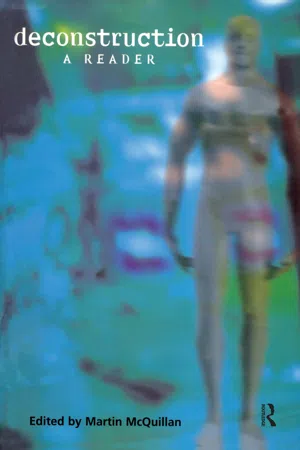
Deconstruction: A Reader
About this book
Philosophers 'do' 'it', literary critics 'do' 'it', even architects, poets, painters 'do' 'it'. It can involve the concepts of capital, politics, and justice. So what, after all, is deconstruction? Deconstruction: A Reader makes an answer to this question available in the only way possible - by offering a selection of breathtaking range and depth of essential texts. With more than sixty selections by fifty contributors, including nine pieces by Jacques Derrida, this is the ultimate anthology of deconstructive reading, demonstrating that deconstruction is vivid, surprising, varied, and true to the text.
Information
Part 1
Avant la Lettre
1.1
From Capital
The Fetishism of the Commodity and its Secret
A commodity appears at first sight an extremely obvious, trivial thing. But its analysis brings out that it is a very strange thing, abounding in metaphysical subtleties and theological niceties. So far as it is a use-value, there is nothing mysterious about it, whether we consider it from the point of view that by its properties it satisfies human needs, or that it first takes on these properties as the product of human labour. It is absolutely clear that, by his activity, man changes the forms of the materials of nature in such a way as to make them useful to him.
The form of wood, for instance, is altered if a table is made out of it. Never-theless the table continues to be wood, an ordinary, sensuous thing. But as soon as it emerges as a commodity, it changes into a thing which transcends sensuousness. It not only stands with its feet on the ground, but, in relation to all other commodities, it stands on its head, and evolves out of its wooden brain grotesque ideas, far more wonderful than if it were to begin dancing of its own free will.1
The mystical character of the commodity does not therefore arise from its use-value. Just as little does it proceed from the nature of the determinants of value. For in the first place, however varied the useful kinds of labour, or productive activities, it is a physiological fact that they are functions of the human organism, and that each such function, whatever may be its nature or its form, is essentially the expenditure of human brain, nerves, muscles and sense organs. Secondly, with regard to the foundation of the quantitative determination of value, namely the duration of that expenditure or the quantity of labour, this is quite palpably different from its quality. In all situations, the labour-time it costs to produce the means of subsistence must necessarily concern mankind, although not to the same degree at different stages of development.2 And finally, as soon as men start to work for each other in any way, their labour also assumes a social form.
Whence, then, arises the enigmatic character of the product of labour, as soon as it assumes the form of a commodity? Clearly, it arises from this form itself. The equality of the kinds of human labour takes on a physical form in the equal objectivity of the products of labour as values; the measure of the expenditure of human labour-power by its duration takes on the form of the magnitude of the value of the products of labour; and finally the relationships between the producers, within which the social characteristics of their labours are manifested, take on the form of a social relation between the products of labour.
The mysterious character of the commodity-form consists therefore simply in the fact that the commodity reflects the social characteristics of men’s own labour as objective characteristics of the products of labour themselves, as the socio-natural properties of these things. Hence it also reflects the social relation of the producers to the sum total of labour as a social relation between objects, a relation which exists apart from and outside the producers. Through this substitution, the products of labour become commodities, sensuous things which are at the same time suprasensible or social. In the same way, the impression made by a thing on the optic nerve is perceived not as a subjective excitation of that nerve but as the objective form of a thing outside the eye. In the act of seeing, of course, light is really transmitted from one thing, the external object, to another thing, the eye. It is a physical relation between physical things. As against this, the commodity-form, and the value-relation of the products of labour within which it appears, have absolutely no connection with the physical nature of the commodity and the material [dinglich] relations arising out of this. It is nothing but the definite social relation between men themselves which assumes here, for them, the fantastic form of a relation between things. In order, therefore, to find an analogy we must take flight into the misty realm of religion. There the products of the human brain appear as autonomous figures endowed with a life of their own, which enter into relations both with each other and with the human race. So it is in the world of commodities with the products of men’s hands. I call this the fetishism which attaches itself to the products of labour as soon as they are produced as commodities, and is therefore inseparable from the production of commodities.
As the foregoing analysis has already demonstrated, this fetishism of the world of commodities arises from the peculiar social character of the labour which produces them.
Objects of utility become commodities only because they are the products of the labour of private individuals who work independently of each other. The sum total of the labour of all these private individuals forms the aggregate labour of society. Since the producers do not come into social contact until they exchange the products of their labour, the specific social characteristics of their private labours appear only within this exchange. In other words, the labour of the private individual manifests itself as an element of the total labour of society only through the relations which the act of exchange establishes between the products, and, through their mediation, between the producers. To the producers, therefore, the social relations between their private labours appear as what they are, i.e. they do not appear as direct social relations between persons in their work, but rather as material [dinglich] relations between persons and social relations between things.
It is only by being exchanged that the products of labour acquire a socially uniform objectivity as values, which is distinct from their sensuously varied objectivity as articles of utility. This division of the product of labour into a useful thing and a thing possessing value appears in practice only when exchange has already acquired a sufficient extension and importance to allow useful things to be produced for the purpose of being exchanged, so that their character as values has already to be taken into consideration during production. From this moment on, the labour of the individual producer acquires a twofold social character. On the one hand, it must, as a definite useful kind of labour, satisfy a definite social need, and thus maintain its position as an element of the total labour, as a branch of the social division of labour, which originally sprang up spontaneously. On the other hand, it can satisfy the manifold needs of the individual producer himself only in so far as every particular kind of useful private labour can be exchanged with, i.e. counts as the equal of, every other kind of useful private labour. Equality in the full sense between different kinds of labour can be arrived at only if we abstract from their real inequality, if we reduce them to the characteristic they have in common, that of being the expenditure of human labour-power, of human labour in the abstract. The private producer’s brain reflects this twofold, social character of his labour only in the forms which appear in practical intercourse, in the exchange of products. Hence the socially useful character of his private labour is reflected in the form that the product of labour has to be useful to others, and the social character of the equality of the various kinds of labour is reflected in the form of the common character, as values, possessed by these materially different things, the products of labour.
Men do not therefore bring the products of their labour into relation with each other as values because they see these objects merely as the material integuments of homogeneous human labour. The reverse is true: by equating their different products to each other in exchange as values, they equate their different kinds of labour as human labour. They do this without being aware of it. Value, therefore, does not have its description branded on its forehead; it rather transforms every product of labour into a social hieroglyphic. Later on, men try to decipher the hieroglyphic, to get behind the secret of their own social product: for the characteristic which objects of utility have of being values is as much men’s social product as is their language. The belated scientific discovery that the products of labour, in so far as they are values, are merely the material expressions of the human labour expended to produce them, marks an epoch in the history of mankind’s development, but by no means banishes the semblance of objectivity possessed by the social characteristics of labour. Something which is only valid for this particular form of production, the production of commodities, namely the fact that the specific social character of private labours carried on independently of each other consists in their equality as human labour, and, in the product, assumes the form of the existence of value, appears to those caught up in the relations of commodity production (and this is true both before and after the above-mentioned scientific discovery) to be just as ultimately valid as the fact that the scientific dissection of the air into its component parts left the atmosphere itself unaltered in its physical configuration.
NOTES
Source: Karl Marx, Capital, tr. Ben Fowkes (New York: Vintage, 1977), voi. 1, ch. 1, sect. 4, pp. 163-7.
1 One may recall that China and the tables began to dance when the rest of the world appeared to be standing still - pour encourager les autres. ‘To encourage the others’. A reference to the simultaneous emergence in the 1850s of the Taiping revolt in China and the craze for spiritualism which swept over upper-class German society. The rest of the world was ‘standing still’ in the period of reaction immediately after the defeat of the 1848 Revolutions.
2 Among the ancient Germans the size of a piece of land was measured according to the labour of a day; hence the acre was called Tagwerk, Tagwanne (jurnale, or terrajurnalis, or diornalis), Mannwerk, Mannskraft, Mannsmaad, Mannshauet, etc. See Georg Ludwig von Maurer, Einleitung zur Geschichte der Mark-, Hof-, usw.Verfassung, Munich, 1854, p. 129 ff.
See: Jacques Derrida, Spectres of Marx: The Work of Mourning, the State of the Debt, andthe New international, tr. Peggy Kamuf (London and New York: Routledge, 1994).
Jacques Derrida, ‘Marx & Sons’, in Michael Sprinkner(ed.), Ghostly Demarcations: A Symposium on Jacques Derrida’s Spectres of Marx, (London: Verso, 1999). 1.2
1.2
‘A Note Upon the“Mystic Writing Pad’”
If I distrust my memory - neurotics, as we know, do so to a remarkable extent, but normal people have every reason for doing so as well - I am able to supplement and guarantee its working by making a note in writing. In that case the surface upon which this note is preserved, the pocket-book or sheet of paper, is as it were a materialized portion of my mnemic apparatus, which I otherwise carry about with me invisible. I have only to bear in mind the place where this ‘memory’ has been deposited and I can then ‘reproduce’ it at any time I like, with the certainty that it will have remained unaltered and so have escaped the possible distortions to which it might have been subjected in my actual memory.
If I want to make full use of this technique for improving my mnemic function, I find that there are two different procedures open to me. On the one hand, I can choose a writing-surface which will preserve intact any note made upon it for an indefinite length of time - for instance, a sheet of paper which I can write upon in ink. I am then in possession of a ‘permanent memorytrace’. The disadvantage of this procedure is that the receptive capacity of the writing-surface is soon exhausted. The sheet is filled with writing, there is no room on it for any more notes, and I find myself obliged to bring another sheet into use, that has not been written on. Moreover, the advantage of this procedure, the fact that it provides a ‘permanent trace’, may lose its value for me if after a time the note ceases to interest me and I no longer want to ‘retain it in my memory’. The alternative procedure avoids both of these disadvantages. If, for instance, I write with a piece of chalk on a slate, I have a receptive surface which retains its receptive capacity for an unlimited time and the notes upon which can be destroyed as soon as they cease to interest me, without any need for throwing away the writing-surface itself. Here the disadvantage is that I cannot preserve a permanent trace. If I want to put some fresh notes on the slate, I must first wipe out the ones which cover it. Thus an unlimited receptive capacity and a retention of permanent traces seem to be mutually exclusive properties in the apparatus which we use as substitutes for our memory: either the receptive surface must be renewed or the note must be destroyed.
All the forms of auxiliary apparatus which we have invented for the improvement or intensification of our sensory functions are built on the same model as the sense organs themselves or portions of them: for instance, spectacles, photographic cameras, trumpets.1 Measured by this standard, devices to aid our memory seem particularly imperfect, since our mental apparatus accomplishes precisely what they cannot: it has an unlimited receptive capacity for new perceptions and nevertheless lays down permanent - even though not unalterable - memory-traces of them. As long ago as in 1900 I gave expression in The Interpretation of Dreams 2 to a suspicion that this unusual capacity was to be divided between two different systems (or organs of the mental apparatus). According to this view, we possess a system Pcpt.-Cs., which receives perceptions but retains no permanent trace of them, so that it can react like a clean sheet to every new perception; while the permanent traces of the excitations which have been received are preserved in ‘mnemic systems’ lying behind the perceptual system. Later, in Beyond the Pleasure Principle (1920g...
Table of contents
- Cover Page
- Title Page
- Copyright Page
- Contents
- Acknowledgements
- A map of this book
- Introduction: Five strategies for deconstruction
- Part 1: Avant la lettre
- Part 2: Opening Remarks
- Part 3: Philosophy
- Part 4: Literature
- Part 5: Culture
- Part 7: Psychoanalysis
- Part 8: Politics
- Part 10: The work of mourning
- Part 11: Closing statements
- Bibliography 1: Jacques Derrick
- Bibliography 2: Key publications of contributing authors
- Index
Trusted by 375,005 students
Access to over 1.5 million titles for a fair monthly price.
Study more efficiently using our study tools.
Frequently asked questions
Yes, you can cancel anytime from the Subscription tab in your account settings on the Perlego website. Your subscription will stay active until the end of your current billing period. Learn how to cancel your subscription
No, books cannot be downloaded as external files, such as PDFs, for use outside of Perlego. However, you can download books within the Perlego app for offline reading on mobile or tablet. Learn how to download books offline
Perlego offers two plans: Essential and Complete
- Essential is ideal for learners and professionals who enjoy exploring a wide range of subjects. Access the Essential Library with 800,000+ trusted titles and best-sellers across business, personal growth, and the humanities. Includes unlimited reading time and Standard Read Aloud voice.
- Complete: Perfect for advanced learners and researchers needing full, unrestricted access. Unlock 1.5M+ books across hundreds of subjects, including academic and specialized titles. The Complete Plan also includes advanced features like Premium Read Aloud and Research Assistant.
We are an online textbook subscription service, where you can get access to an entire online library for less than the price of a single book per month. With over 1.5 million books across 990+ topics, we’ve got you covered! Learn about our mission
Look out for the read-aloud symbol on your next book to see if you can listen to it. The read-aloud tool reads text aloud for you, highlighting the text as it is being read. You can pause it, speed it up and slow it down. Learn more about Read Aloud
Yes! You can use the Perlego app on both iOS and Android devices to read anytime, anywhere — even offline. Perfect for commutes or when you’re on the go.
Please note we cannot support devices running on iOS 13 and Android 7 or earlier. Learn more about using the app
Please note we cannot support devices running on iOS 13 and Android 7 or earlier. Learn more about using the app
Yes, you can access Deconstruction: A Reader by Martin McQuillan in PDF and/or ePUB format, as well as other popular books in Philosophy & Literary Criticism Theory. We have over 1.5 million books available in our catalogue for you to explore.