eBook - ePub
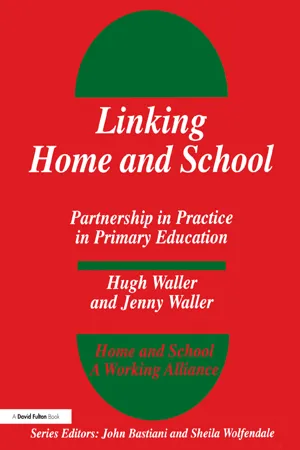
Linking Home and School
Partnership in Practice in Primary Education
- 128 pages
- English
- ePUB (mobile friendly)
- Available on iOS & Android
eBook - ePub
Linking Home and School
Partnership in Practice in Primary Education
About this book
A guide to complement the theory on effective home/school links, this work outlines proven and tested initiatives that have evolved over a decade within one primary school. There is an accompanying rationale for each of the strategies and proposals considered.
Information
1 Setting the scene
An overview
The main aim of this book is to offer practical suggestions for strengthening links between home and school. In order to achieve this aim, we need to examine the relationships between the key players – the parents and teachers.
Now that schools are more accountable it is not surprising to find ‘partnership with parents’ featuring as a key element within the external inspection process overseen by the Office for Standards in Education (OFSTED). Underpinning this is the recognition that effective links between home and school are decisive factors in judging pupils’ learning and educational success.
The book focuses on one primary school, Moordown St John’s CE Primary School in Bournemouth, of which one of the authors is the head teacher. It charts the development of links between home and school, underpinning examples with research methodology to show how both are inextricably intertwined. While in no way providing a ‘blueprint’ to be copied wholesale elsewhere, we trust our practice provides pointers for readers to consider within their own institutions.
Why our school?
Moordown St John’s was the location for the work developed and described here. The initiatives we shall be outlining are nothing spectacular and are probably mirrored in many schools around the country. The notion of examining this subject from the ‘case study’ perspective is not a new one, as books by Wolfendale (1989 and 1992a) testify. However, this book offers a deliberate, practical emphasis to complement other works, including those published in this ‘Home and School – A Working Alliance’ series.
Outlining the book’s rationale
Wolfendale (1995) contends that home–school links rest on a number of provable assumptions:
… that parents are experts on their own children … that parental skills and expertise can be constructively utilised in parallel with teachers’ knowledge and skills … that teachers’ morale and output is enhanced by parental cooperation … [and] … that children benefit from the home–school coalition. (15)
These sentiments are substantiated within the ensuing chapters and the changing profile of this ‘partnership’ relationship is explored. The White Paper ‘Better Schools’ (DES 1985) recognised parents as contributors to the education of their children:
After the child has started school … parent and school become partners in a shared task for the benefit of the child. The school discharges its part of the task more effectively if it can rely upon the cooperation and support of the parent. (59: 197)
However, as we shall explore in the next chapter, this notion has been widened. The current trend in ensuring a proactive partnership lies in ‘empowering’ parents. Throughout the book, salient research evidence is offered to substantiate school practice and to underpin the methodology. Implicit in this are the factors that affect home–school relations, including their maintenance and extension.
Much recent educational legislation has had a significant influence on links between home and school. Twenty years ago the Taylor Committee’s report (1977) portrayed partnership as a right, in that every parent could:
expect a school’s teachers to recognise his status in the education of his child by the practical arrangements they make to communicate with him and the spirit in which they accept his interest. (43)
Since then successive Education Acts have sought to formalise this partnership. However, as Heale et al. (1993) contend, ‘legislation cannot bring about an effective partnership’ (4.3) – a view we repeatedly stress throughout this book.
Scope of this book
To set our book in context, a situational overview of the school is offered in Chapter 2. In examining the notion of ‘parental partnership’ from several perspectives, we believe it is a process meriting consideration in any school-based reappraisal of current practice. To this end, in-service activities and resources for use with staff and governors are offered as possible ways forward. The inclusion of ‘master’ (OHT) sheets enables the reader to create overhead projector transparencies for use within their school or college.
Parental partnership is, by its very nature, an evolving process and the succeeding chapters look at the school’s practice from different perspectives. Chapter 3 focuses on ways of strengthening links with home immediately prior to school entry, while Chapter 4 charts the development of a starting-school profile, now available in a published format (Brito and Waller 1992a). Parental partnership in the area of special educational needs is fully explored in Chapter 5. Extensively trialled examples of user-friendly and readable parental guides are introduced in this chapter, along with the complete framework of an activity workshop for parents, staff and governors. Chapter 6 reflects upon the role of parents in providing feedback to assist in reviewing school practice. Using the external audit mechanism, a number of methodological approaches are systematically examined. Again in-service materials are offered, along with some proven practical survey instruments that can easily be applied in the reader’s school. Chapter 7 explores ways in which a school’s image can be effectively projected through the sharing of curricular and organisational practice. Samples of parental leaflets, along with a workshop example, again feature in this chapter to illustrate the importance of effective communication. In certain instances some of the leaflets can be customised for a particular school, while others can be adapted. The final chapter offers a critical review of recent developments in linking home and school.
Implicit throughout the book is a recognition of the factors governing change and how these have been and are being managed. We would not wish to present the view that all is achieved without discontent and problems.
The Oxford Large Print Dictionary (1995) defines ‘partnership’ as a ‘working relationship between two parties towards a mutual goal’. From the educational perspective we find the definition offered by Cunningham and Davis (1985) particularly useful in this context. Partnership, they say, is:
a relationship in which the professional serves the parents by making appropriate expertise available to them … it is one of complementary expertise since the expert knowledge of the parent … complements what the professional has to offer. (150–51)
The transition from preschool to compulsory schooling is one of the most important changes to occur in a child’s life, having the potential to make or break the relationship between home and school. It is for this reason that we give it particular emphasis in this book.
2 A closer look at Moordown St John’s CE Primary School
An overview
This book portrays an evolving partnership developed between a school and its parent community. By their very nature the initiatives have been developmental. Some, taking the analogy of the parable of the sower, have faded into history, while others have blossomed and flourished.
What Moordown St John’s School, a Church of England primary school in Bournemouth, has achieved is nothing monumental. Neither is this book offering a prescription for the one and only way to develop effective home–school links. The success of ‘parent partnership’ initiatives around the country lies in their richness and diversity, a cause for true celebration. It is hoped that readers will take from this publication the ‘seeds’ of one or more ideas and, in turn, allow them to germinate and develop into a scheme that is relevant and pertinent to their particular situation and circumstance.
As this book focuses upon a particular school, background information is offered to inform the reader. This then permits a balanced assessment of the initiatives as they are explained in more detail.
School portrait
Moordown St John’s is a large church primary school in Bournemouth. It is located within the densely populated residential district of Moordown on the northern outskirts of the town. Since 1 April 1997 it is one of around 40 maintained schools falling under the aegis of the newly created Bournemouth Education Directorate, having previously been part of the Dorset Education Authority.
Originally founded in 1878, it started out providing education for senior girls and infants. Over the years there have been many changes and extensions to the buildings, the latest being a massive re-development in 1994–5. The school currently caters for just over 500 boys and girls of primary age, 4 to 11. The staffing complement is as follows:
• Head teacher
• Deputy head teacher, who is non-class based and has overall responsibility for curriculum management
• 14 other class teachers
• Learning Support department comprising three part-time teachers offering assistance, both in-class and on a group withdrawal basis, in the areas of literacy, mathematics and behaviour
• Classroom support staff numbering six at present, with additional specialist assistants for the Reception Year; added to this there are a few Special Educational Needs support assistants with specifically assigned roles within the school, who are funded by the local education authority
• Administrative staff
• Team of lunchtime supervisory assistants
• Caretaker and cleaning staff.
The school’s voluntary aided status allows the Governing Body to appoint the staff. In this way the school governors are able to ensure that all of the staff support the principles of a church school. These are reflected not only in religious education and daily worship but also by applying Christian standards to all aspects of the life and work of the school. There is also a very close association with the parish church of St John’s Moordown, providing opportunities for contact with the local Christian community. The school also enjoys close and meaningful links with the residential and business communities in the locality.
A philosophical perspective
For well over a decade Moordown has recognised that its parents should have a clearer understanding of what it is aiming to do for their children and why. Effective communication with parents, as Currie and Bowes (1988) contend, is ‘a two way process involving a sharing of ideas’ (196). Figure 2.1 illustrates how this may come about.
This philosophy is rooted both in practical experience and in the findings of successive research studies, among them that of Tizard et al. (1981). All have demonstrated the positive gains in children’s learning when parents are actively involved in the education of their child. Tizard et al.’s work offers a clear mandate for schools to work with their parents as partners and to share knowledge and information so as to achieve mutual understanding (117–21).
Sharing expertise
Over the years school policy and practice has rightly placed emphasis on parental participation, this acting as a corn...
Table of contents
- Cover
- Title Page
- Copyright Page
- Table of Contents
- Foreword
- Notes
- Acknowledgements
- 1 Setting the scene
- 2 A closer look at Moordown St John’s CE Primary School
- 3 Strengthening preschool links: hand in hand to school
- 4 A starting-school profile at the point of entry
- 5 Contributing to the Special Educational Needs assessment process
- 6 Parental feedback as a catalyst for change
- 7 Sharing curricular and organisational practice
- 8 Evaluating recent initiatives in promoting home–school links
- Bibliography
- Index
Trusted by 375,005 students
Access to over 1.5 million titles for a fair monthly price.
Study more efficiently using our study tools.
Frequently asked questions
Yes, you can cancel anytime from the Subscription tab in your account settings on the Perlego website. Your subscription will stay active until the end of your current billing period. Learn how to cancel your subscription
No, books cannot be downloaded as external files, such as PDFs, for use outside of Perlego. However, you can download books within the Perlego app for offline reading on mobile or tablet. Learn how to download books offline
Perlego offers two plans: Essential and Complete
- Essential is ideal for learners and professionals who enjoy exploring a wide range of subjects. Access the Essential Library with 800,000+ trusted titles and best-sellers across business, personal growth, and the humanities. Includes unlimited reading time and Standard Read Aloud voice.
- Complete: Perfect for advanced learners and researchers needing full, unrestricted access. Unlock 1.5M+ books across hundreds of subjects, including academic and specialized titles. The Complete Plan also includes advanced features like Premium Read Aloud and Research Assistant.
We are an online textbook subscription service, where you can get access to an entire online library for less than the price of a single book per month. With over 1.5 million books across 990+ topics, we’ve got you covered! Learn about our mission
Look out for the read-aloud symbol on your next book to see if you can listen to it. The read-aloud tool reads text aloud for you, highlighting the text as it is being read. You can pause it, speed it up and slow it down. Learn more about Read Aloud
Yes! You can use the Perlego app on both iOS and Android devices to read anytime, anywhere — even offline. Perfect for commutes or when you’re on the go.
Please note we cannot support devices running on iOS 13 and Android 7 or earlier. Learn more about using the app
Please note we cannot support devices running on iOS 13 and Android 7 or earlier. Learn more about using the app
Yes, you can access Linking Home and School by Hugh Waller,Sheila Wolfendale,Jenny Waller in PDF and/or ePUB format, as well as other popular books in Education & Early Childhood Education. We have over 1.5 million books available in our catalogue for you to explore.