- 270 pages
- English
- ePUB (mobile friendly)
- Available on iOS & Android
eBook - ePub
About this book
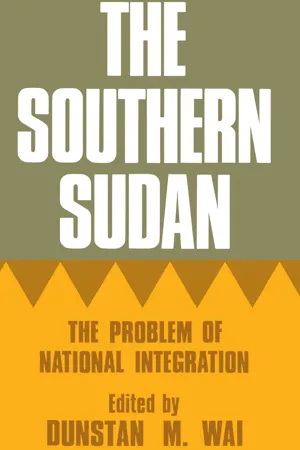
First Published in 1972. The purpose of this book is to further understand the problems of the Southern Sudan, which have often been unfairly equated with the prevalent problems of national integration facing post-Colonial Africa. For greater understanding of the history and the contemporary manifestations of the conflict between North and South in the Sudan, the focus here is upon the generic aspects of this problem.
Information
1
The Southern Sudan:
The Country and the People
Dunstan M. Wai
Position
The Democratic Republic of the Sudan is the largest country in the continent of Africa. It extends from Latitude 3½°N on the border with the Republic of Uganda at Nimule to Latitude 23°N on the Red Sea Coast just north of Halaib and from Longitude 21¾°E to Longitude 38½°E. It is 1,070 miles (1,722 km) from west to east and 1,245 miles (2,003 km) from north to south. It covers an area of 967,500 square miles, approximately 8.3% of the entire area of the continent of Africa.
The Southern Sudan is that part of the country which lies south of Latitude 10°N and extends as far south as Kajo-Kaji and Nimule on the Uganda border. It consists of the three provinces of Upper Nile, Bahr el Ghazal and Equatoria. The area of the Southern Sudan is about 250,000 square miles, just over one-fourth of the total area of the Republic. The boundaries of Southern Sudan and the neighbouring countries of Ethiopia, Kenya, Uganda, Zaire and the Central African Republic were arbitrarily drawn by the imperial powers that colonized the Sudan and her neighbours. Thus one finds that some tribes in the Southern Sudan spill over the border into the neighbouring countries.
Climate
The climate of the Sudan may be described as tropical continental. But whereas the country merges into desert in the north, it runs into an equatorial belt (rainy climate) in the south. One could say that the climatic regime in the Southern Sudan lies between the tropical and the equatorial. When the north wind blows over the Southern Sudan, there is, however, a dry season lasting for about three months. But although the expected rains at this time are often less than 1.2 inches, the humidity is quite high. The season between January and 15th March is the hottest of the year, the mean daily temperature in Juba in February and March being 84.2°F and 84.6°F respectively. August is the coolest month and in Juba there is a mean daily temperature of 77.5°F. This gives an annual range of 7.2°F in Juba, much less than Khartoum's 18.7°F.
The rainy season lasts for five to eight months in the south and for one to three months in certain parts of Northern Sudan. August is the rainiest month in the whole country. In the south, the annual total rainfall exceeds 40 inches but in some areas lengthy periods with little rain may be recorded. There are some local rainfall variations; for example, Eastern Equatoria receives an annual rainfall which is scanty for the latitude: whereas Yambio in the midst of the plateau in the west receives a rainfall amounting to 51 inches, Torit further east in the same latitude, receives 40 inches, and Kapoeta in the north-east receives only 32 inches.
The Physical Features
The diminution of rainfall eastwards is matched by changes in vegetation and soils and this also accounts for the variability in tribal economies, ranging from those that are basically agricultural, to agricultural mixed with pastoral, and then finally to predominantly or exclusively pastoral economies. Close to the borders of Uganda and the Congo, there are hills and plateaux which have been systematically moulded by the weathering and denudation processes characteristic of high temperatures and frequent rainfall. The region shows a clear dendritic drainage pattern and there is also a deep mantle of weathered rock and soil. Professor Lebon has conveniently divided the Southern Sudan into two principal vegetational zones: the deciduous high woodland savanna and swamp grasslands extending from 5°N to 10°N and the modified tropical rain forests of the southern borderlands which extend roughly from 3½°N to 5°N. The Toposa area in Eastern Equatoria, is however, on the whole "grassland alternating with stands of Acacia mallicera" resembling thorny scrub and therefore does not fall within the two zones. South of Malakal is the floating swampy papyrus vegetation and this is known as the Sudd area. The highest mountains in the south are the Imatong and Dongotona — about 4,500 feet. The vegetation on both these mountains is degraded tropical rainforest.
Communications
Communications and transport are not highly developed in the Southern Sudan. Rivers provide the major system of communications and there is a steamer line between Juba and Kosti linking the north and the south. A railway line has also been extended from Western Sudan to Wau in Bahr el Ghazel, and Sudan Airways has recently increased its flights to the Southern provincial headquarters of Malakal, Juba and Wau. Roads have been developed but they are rough and difficult to use during the rainy season.
Economic Viability
The Southern Sudan is potentially an agricultural country. Shifting cultivation is widely practised and crops such as maize, dura, duldam, groundnuts, cassava, simsim, sweet potatoes and beans are grown. Cotton, tobacco, coffee, rice and sugar cane could be developed on a large scale and some areas have cocoa, tea and sisal. Hunting and fishing are two of the main activities of the people. Some of the fish is sold. Cattle are reared mainly by the Nilotes and it was estimated as early as 1954 that the number of cattle in the Southern Sudan was 2,397,150 and the number of sheep and goats 12,562,100.
Some minerals such as copper, gold and iron ore have been discovered. But although the Southern Sudan is an economically viable area, these riches have not been exploited. The cash economy has been retarded by the long distances from the main markets, and the lack of efficient means of transportation. Most of the traders are from the northern part of the country with a few Greek and Syrian merchants. It was not the intention of the colonial and independent governments (until 1969) to encourage and assist the Southern Sudanese to participate in commerce. The main exports from the south are simsim, groundnuts, timber, peppers, hides, skins, honey, gum and ginned cotton, mangoes and other fruits, coffee, sugar and cattle. Manufactured goods and fuel are the main imports. The recent fighting, however, has made the south dependent on the north, and even grain which could be grown in the south is now brought from the north. Yet on the whole, the south is potentially an agriculturally wealthy area.
The People of the Southern Sudan
Whereas the Northern Sudanese defy any distinct racial classification, the inhabitants of the Southern Sudan are undoubtedly Negroid Africans. They may be divided into three main groups: the Nilotes, the Nilo-Hamites and the Western Sudanic tribes. These groups in turn have their sub-divisions and the total number of tribes and sub-groups in the whole of the Southern Sudan is reckoned to be 572. But the ethnic heterogeneity in the area should not be exaggerated, as all these tribes have a shared feeling of belonging to the Southern Sudan and consider themselves as "one people" of the area.
The Nilotes comprise the Dinka, Nuer, Shilluk, Anuak, Burun, Bor Balanda, Jur, Shilluk Luo and Acholi. The Dinka form the largest single tribe, numbering over a million, and occupy a larger area than any other tribe in the Southern Sudan. They are divided into a number of sub-tribes, for example, the Cic, Bor, Aliab, Agur, and Atot. Most of the Nilotes have an absorbing interest in cattle, which have been given a position of reverence in their customs and traditions.
The Nilo-Hamites have been divided into three major groups based allegedly on cultural affinities and apparent relationships. The Southern Sudanese Nilo-Hamites fall into the northern group and these are the Bari, Mundari, Nyangwara, Pojulu, Kakwa, Kuku, Nyepu, Lokoya, Luluba, Latuko, Lopit and the Ligo. This group may further be divided into three groups based on traditional cultural traits and relationships between them. One group constitutes the Bari, Mundari, Nyangwara, Pojulu, Kakwa, Nyepu and Kuku; the second group is composed of the Lokoya and Luluba and the third group comprises the Latuko and the Lango. The central Nilo-Hamites are represented by the Toposa, Donyiro, Jiye and Turkana but of these the Toposa live only in the Southern Sudan in the Kapoeta district, north of the Didinga hills, while the others spill over the borders. The main occupation of the Nilo-Hamites is cultivation, with some pastoralism. They attach great importance to the existence of rain-chiefs and rain-making.
In the extreme south-west of the country, are the Sudanic tribes who are composed of the Azande (they are actually a group of tribes rather than a single people), the Ndogosere group, the Moru-Madi and the Bongo-Baka groups. The Ndogo-Sere group live near Wau while the Moro-Madi group is divided linguistically into three sub-groups: the Moru, who occupy the Meridi and Amadi districts; the Avukaya and the Kaliko, who live in Yei District, extending into the Congo and Uganda; and the Madi, who inhabit the Opari and Nimule areas spilling over into Uganda. Some of these tribes keep a few animals but the Azande are exclusively cultivators.
References
K. M. Barbour, The Republic of the Sudan: A Regional Geography (London, 1961).
J. H. G. Lebon, Land Use in Sudan (London, 1965).
2
The Southern Sudan Question*
Abel Alier
It is perhaps proper to ask the question: What is the problem of the Southern Sudan? What is the Southern Question? I could answer it in a few lines but this would diminish its complexity and one would not be in a position to judge for oneself what ought to be done, or what has been done, to solve it. Some of the aspects of this problem are historical, others are cultural and yet others are economic. Some of it has become psychological. But the problem was essentially one of neglect by the British administration between 1898 and 1952 to develop the Southern Sudan.
To get a total view it is necessary to focus attention on a summary of the past and recent history of the Southern Sudan. Three distinct historical phases are relevant to this topic. First, the Turco-Egyptian activities and the Mahdia in the Southern Sudan; second, the British re-occupation of the Southern Sudan and finally, post-independence rule of the Southern Sudan.
I. The Turco-Egyptian Activities and the Mahdia in the Sudan
Looking briefly into the first phase, we notice that the first important foreigner to visit the Southern Sudan was an official of the Turco-Egyptian Government, one Captain Selim. He penetrated the Sudd and reached Gondokoro for the second time during his visit in about 1841. His mission was to explore the country for commerce and for strategic spots that could be useful in times of occupation of the Southern Sudan and further exploration into the source of the Nile in East and Central Africa. The idea came from Mohamed Ali, Viceroy of Turkey in Egypt, whose imperial ambitions to obtain colonies in Africa could not have been less than those of his contemporaries in Belgium and Britain. Selim's sojourn was followed by increased visits to the Southern Sudan, all arranged by the Khartoum Government and aimed at collecting ivory and other available wealth to enhance the dwindling resources of the Egyptian treasury. This effort was later improved upon, and on to the scene came people like Baker, Gordon and Emin. With the news of opportunities for commerce in the Southern Sudan spreading to the Northern Sudan, Europe and what is the present Middle East, the merchant class came into the South. The rush made ivory scarce, so slavery and cattle raiding became handy substitutes. Rivalry sprang up between the merchants and the Government. Several merchants attempted to establish pseudo-governments within their trading domains. At the time of the appearance of the Egyptian Government agent and the merchant, the missionary, too, came on to the scene. This was the period of Christian zeal to preach the word of God to the heathen and make the native soft and submissive, for easy colonial management. What then was the reaction of the Southern Sudan to this sudden and unceremonious appearance of the foreigner? What was the attitude of the different foreigners towards the people of the Southern Sudan; in other words, what was the opinion of the people of the Northern Sudan, the Turco-Egyptians, the missionary, and the British like Baker and Gordon, and other Europeans? There is abundant evidence that this attitude was not complimentary and it is, I think, well summarized by a distinguished British commentator who stands high in the esteem of those Sudanese who know him: Mr. K. D. D. Henderson. He describes so precisely the attitude of different foreigners towards the people of the Southern Sudan:
"One thing they shared, a common contempt for the Southerner as an inferior being, coupled with complete indifference to his religious ideas, ethics and standard of behaviour, his social and tribal pattern."1
What reaction did the Southerner have to the foreigner in 1841 and subsequently? When Captain Selim arrived among the Shilluk and later on among the Dinka and Cic near Shamba in Bahr el Ghazal Province, he was welcomed courteously, and with a great deal of curiosity, and supplied with plenty of food according to the orders of the Reith (Shilluk King), and the Dinka chiefs respectively. But none of these tribal leaders gave Captain Selim audience since his mission was obscure and he did not perhaps match the high social status of these tribal leaders!
Again, neither Baker nor Gordon found sufficient co-operation among the Bari, Lokoya, Latuko and Dinka Bor to make their plans for administration, and settlement in the Southern Sudan a success. Both Baker and Gordon were compelled by circumstances to steal cattle. There was thus a definite and calculated resistance against them and their successors, and this resistance at times made the tribes overlook inter-tribal feuds. The same reaction and resistance applies to the Mahdia rule. One reads, for instance, of the Nuer annihilation of Arab forces near Tonj in 1895, or of the Mahdist forces recovering from their defeat at the hands of the Dinka.
In short, then, it may be said that five significant trends are noticeable between 1841 and 1898. First, the main concern of the foreigner in the Southern Sudan was trade, either in ivory or slaves. His second preoccupation was to secure a free waterway to the heart of East and Central Africa. Lord Cromer, British representative in Cairo, expressed the position as follows:
"Although I somewhat regret to say so, we cannot on purely humanitarian ground afford to lose sight of the main British and Egyptian interest... That interest as I have frequently stated, appears to me to be that both banks of the Nile from Lake Albert Nyanza to the sea, should be in British or Anglo-Egyptian hands. The good government of the wild tribes in the interior, even the possession of districts which may be commercially productive, are, relatively speaking, of minor importance."2
Third, the period is characterized by the lack of a government presence with effective control over the Southern Sudan. This applies both to the Turco-Egyptian and the Mahdist periods. Fourth, a definite clash of cultures, beliefs and general ways of life of the foreigners on the one hand and the Southern people on the other intensified the conflict between the two groups. Fifth, there was unremitting resistance by the people of the Southern Sudan to foreign influence. This resistance was a reaction against the slave trade, plundering property, stealing animals and burning dwellings, the occupation of land contrary to local customs and beliefs and introduction and the imposition of alien customs and beliefs into tribal life.
II The Anglo-Egyptian Colonial Rule and the Southern Sudan
The second phase in the brief history relevant to this is the period between 1898 and 1952. The Sudan was reconquered and the sole task of the British in the Southern Sudan was to establish law and order. Unlike the Northern Sudan, which had accepted defeat and its implications and felt, wisely, that it was a better policy, or at least a convenient one, to settle and develop economically and oscially, the Southern Sudan continued to defy British authority. Mr. Duncan, writing in 1956 after serving in posts in the Sudan political service in different parts of the country, said in defence of the British and the Northern Sudan and in justification of the backwardness of the Southern Sudan, that the Southerner lagged behind the Northerner, not because the British did not work for him, but because of the "obstinacy of his forebears".3
Mr. Duncan meant what he said and a brief account of some events in the Southern Sudan and some inner thoughts of the Southerner bear him out rather well. For instance, and to mention only a few clashes between condominium administration and some tribes and personalities in the Southern Sudan: in 1912, the Anuak in Upper Nile Province killed 47 soldiers including five officers; in 1919 the Aliab Dinka in Bahr El Ghazal killed Governor Chauncey Stigand; in 1927 the Nuer killed their District Commissioner, Mr. Vere Ferguson; and as recently as 1941 Mr. Wilson, District Commissioner of Tonj, was severely wounded with a spear by one of his subjects in the district; up to 1933 the Baris still entertained the happy belief that the foreigner who was building Juba would disappear just as his predecessor who built Gondokoro, Rejaf and Mongalla had left Bari land. To the Bari, the supposedly temporary huts the tribe occupied were in fact more permanent than the grandiose building of the foreigner. The foreigner, whatever buildings he put up, was there only temporarily and could have no legitimate claim over Bari land. This might be regarded as a very simple, unsophisticated expression of a vain optimist, but I believe it is one that clearly and truthfully expresses an entrenched resentment against a guest who did not come to his host's home with clean hands. The facts of history generated this resentment and rejection.
May one not concl...
Table of contents
- Cover
- Title
- Copyright
- Contents
- Notes on the Contributors
- Introduction
- 1 THE SOUTHERN SUDAN: The Country and the People
- 2 THE SOUTHERN SUDAN QUESTION
- 3 ARABISM, AFRICANISM, AND SELF-IDENTIFICATION IN THE SUDAN
- 4 THE BLACK ARABS IN COMPARATIVE PERSPECTIVE: The Political Sociology of Race Mixture
- 5 ON ECONOMICS AND REGIONAL AUTONOMY
- 6 CAN SECESSION BE JUSTIFIED? The Case of the Southern Sudan
- 7 THE BORDER IMPLICATIONS OF THE SUDAN CIVIL WAR: Possibilities for Intervention
- 8 THE EDUCATION OF SOUTHERN SUDANESE REFUGEES
- 9 POLITICAL TRENDS IN THE SUDAN AND THE FUTURE OF THE SOUTH
- Epilogue
- Appendices
- Index
Trusted by 375,005 students
Access to over 1.5 million titles for a fair monthly price.
Study more efficiently using our study tools.
Frequently asked questions
Yes, you can cancel anytime from the Subscription tab in your account settings on the Perlego website. Your subscription will stay active until the end of your current billing period. Learn how to cancel your subscription
No, books cannot be downloaded as external files, such as PDFs, for use outside of Perlego. However, you can download books within the Perlego app for offline reading on mobile or tablet. Learn how to download books offline
Perlego offers two plans: Essential and Complete
- Essential is ideal for learners and professionals who enjoy exploring a wide range of subjects. Access the Essential Library with 800,000+ trusted titles and best-sellers across business, personal growth, and the humanities. Includes unlimited reading time and Standard Read Aloud voice.
- Complete: Perfect for advanced learners and researchers needing full, unrestricted access. Unlock 1.5M+ books across hundreds of subjects, including academic and specialized titles. The Complete Plan also includes advanced features like Premium Read Aloud and Research Assistant.
We are an online textbook subscription service, where you can get access to an entire online library for less than the price of a single book per month. With over 1.5 million books across 990+ topics, we’ve got you covered! Learn about our mission
Look out for the read-aloud symbol on your next book to see if you can listen to it. The read-aloud tool reads text aloud for you, highlighting the text as it is being read. You can pause it, speed it up and slow it down. Learn more about Read Aloud
Yes! You can use the Perlego app on both iOS and Android devices to read anytime, anywhere — even offline. Perfect for commutes or when you’re on the go.
Please note we cannot support devices running on iOS 13 and Android 7 or earlier. Learn more about using the app
Please note we cannot support devices running on iOS 13 and Android 7 or earlier. Learn more about using the app
Yes, you can access The Southern Sudan by Dunstan M. Wai in PDF and/or ePUB format, as well as other popular books in Politics & International Relations & African History. We have over 1.5 million books available in our catalogue for you to explore.