- 317 pages
- English
- ePUB (mobile friendly)
- Available on iOS & Android
eBook - ePub
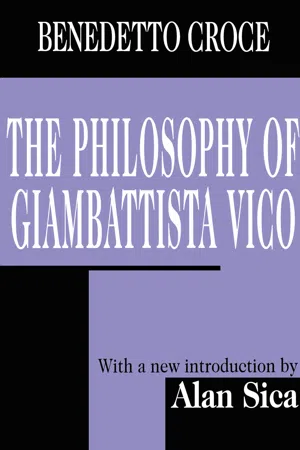
The Philosophy of Giambattista Vico
About this book
With a new introduction by Alan Sica. Giambattista Vico (1668-1744) is often regarded as the beleaguered, neglected genius of pre-Enlightenment Naples. His work-though known to Herder, Coleridge, Matthew Arnold, and Michelet-widely and deeply appreciated only during the twentieth century. Although Vico may be best known for the use James Joyce made of his theories in Finnegans Wake, Croce's insightful analysis of Vico's ideas played a large role in alerting readers to his unique voice. Croce's volume preceded Joyce's creation of "Mr. John Baptister Vickar" by a quarter century. During the last 25 years Vico's ideas about history, language, anti-Cartesian epistemology, and rhetoric have begun to receive the recognition their admirers have long claimed they deserve. Increasing numbers of publications appear annually which bear the stamp of Vico's thinking. Even if he is not yet so renowned as some of his contemporaries, such as Locke, Voltaire, or Montesquieu, there are good reasons to believe that in the future he will be equally honored as a cultural theorist. As a theorist of historical process and its language, there is no more innovative voice than his until the twentieth century-which explains in part why such figures as Joyce and R.G. Collingwood freely drew on Vico's work, particularly his New Science, while creating their own. If Vico was Naples' most brilliant, if uncelebrated, citizen prior to the Enlightenment taking hold in Southern Italy, then Croce (1866-1952) is surely the city's most important thinker of modern times, and the single indispensable Italian philosopher since Vico's death. When a genius of Croce's interpretative prowess, evaluates the work of another, it is inevitable that an explosive mixture will result. A great virtue of this book is its fusion of Croce's unique brand of idealism and aesthetic philosophy with Vico's epistemological, ethical, and historical theories. If Vico's theory of cyclical changes in history, the corsi e ricorsi, remains fruitful, it might be argued that Croce's evaluation of his countryman' ideas represented the next turn of the philosophical wheel toward enlightenment.
Information
CHAPTER XX
CONCLUSION I VICO AND THE LATER DEVELOPMENTS OF
PHILOSOPHICAL AND HISTORICAL THOUGHT
THE reader need not expect that having brought our exposition to a close we shall add a verdict upon Vico’s work, or what is known as an “ appreciation of it. If the verdict has not already emerged as a result of the exposition itself, or as identical with it, if description and criticism have been not one and same, the fault lies either with ourselves or with the reader’s lack of attention ; and in either case it cannot now be repaired by ornamental additions or redundant repetitions,
We confess also that we feel no sympathy with the chapters commonly placed at the conclusion of critical works upon philosophers and narrating the later history of their ideas. For if these “ ideas “ are understood in an extrinsic sense, in their influence upon society and culture, such a review may indeed have a value of its own,1 but is foreign to the history of philosophy properly so called : if on the other hand they are considered as real and living philosophical ideas, their later history amounts to neither more nor less than the history of subsequent philosophy, and there is no reason for appending it to a study of one philosopher rather than another. Any other method implies the uncritical theory that ideas are something solid and crystallised, like precious stones handed on from one generation to another, whose shape and glitter can always be recognised unaltered in the new diadems they compose and the new brows they adorn. But in reality ideas are nothing but the unremitting thought of man, and transmission for them is nothing less than transformation.
It is nevertheless a fact that no one has written on Vico without feeling a need of casting his eyes over later years and noting the resemblances and analogies between the Neapolitan philosopher’s doctrines and those of fifty or a hundred years after. And further, we ourselves, in spite of the antipathy we admittedly feel, and the methodical criteria we professedly employ, yet recognise now the same necessity. Why is this ? Because Vico in his own day passed for an eccentric and lived as a recluse ; because the later development of thought was almost entirely untouched by his direct influence ; because even to-day, though well enough known in certain restricted circles, he has not taken the place he deserves in the general history of thought. How then can we show the manner in which his doctrines, true or false, respond to the deepest needs of the mind, more simply than by recording the similarity of the ideas and attempts which later appeared in such profusion and intensity as to stamp their individuality upon the philosophical and historical labours of a whole century ? And even if after our intrinsic examination of his thought this comparison with the facts of later history seems unnecessary, it will at least be granted that if our discourse like any other must have its rhetorical conclusion, no peroration occurs more naturally than one consisting in a rapid review of subsequent philosophy and philology and emphasising their points of contact with the thought of Vico.
We might even adopt the method by which he compares the second barbarism with the first, and present the later history of thought as a “ reflux “ of Vico’s ideas. In the first place his criticism of Descartes’ immediate knowledge recurs, together with his conversion of the true with the created, in the speculative movement beginning with Kant and Hegel and culminating in the doctrine of the identity of truth and reality, thought and existence. His unity of philosophy and philology recurs in the vindication of history against the scepticism and intellectualism of the eighteenth century due to Cartesianism ; in the à priori synthesis of Kant which reconciles the real and the ideal, experience and the categories ; and in the historical philosophy of Hegel, the greatest exponent of nineteenth-century historical tendencies. This unity of philosophy and philology, a unity with Vico sometimes confused and impure in method, recurred in its faulty aspects also in the Hegelian school ; so that this mental tendency might with justice be entitled “Vicianism.” The limitation which Vico tried to impose on the value of mathematics and exact science recurred, as did his criticism of the mathematical and naturalistic conception of philosophy, in Jacobi’s critique of Spinozistic determinism and Hegel’s of the abstract intellect ; and in the case of mathematics in particular Dugald Stewart and others recognised that its validity lay not in the postulates but in the definitions, and the “ fictions “ of which Vico speaks reappear in the modern terminology of the philosophy of these sciences. His poetical logic or science of the imagination passes into Aesthetic, so ardently studied by the philosophers, literary men and artists of Germany in the eighteenth century, brought by Kant into great prominence by his criticism of the Leibnitian doctrine of intuition as confused conception, and further advanced by Schelling and Hegel, who place art among the pure forms of the mind and so approach the position of Vico. Romanticism too, especially in Germany but also more or less in other countries, was Vician, emphasising as it did the original function of the imagination. His doctrines of language recurred when Herder and Humboldt treated it not in-tellectualistically as an artificial system of symbols, but as a free and poetic creation of the mind. The theory of religion and mythology abandoned the hypotheses of allegory and deception, and with David Hume recognised that religion is a natural fact, corresponding to the beginnings of human life in its passionate and imaginative state ; with Heyne, that mythology is “ symbolic speech,” a product not of arbitrary invention but of necessity and poverty, of the “ lack of words/’ which finds expression “in comparisons with things already known ” (per rerum iam turn notarum similitudines); and with Ottfried Miiller, that it is impossible to understand mythology without entering into the very heart of the human soul, where we maysee its necessity and spontaneity. Religion was regarded no longer as something extraneous or hostile to philosophy, as a piece of stupidity or of deception practised by the unscrupulous upon the simple, but according to Vico’s own doctrine as a rudimentary philosophy ; so that the whole content of reasoned meta» physic was already to a certain extent implicit in poetical or religious metaphysič. Similarly, poetry and history were no longer kept distinct or set face to face to destroy each other ; and as one of the great inspirers of the new German literature, Hamann (who in many ways resembles Vico in tendency, though unequal to him in mental power), had already foreseen when he uttered the warning, “ if our poetry is worthless, our history will become leaner than Pharaoh’s kine,” a breath of poetry revived the historical study of the nineteenth century ; once colourless, it became picturesque : once frigid, it regained warmth and life. The criticism of Hobbes* and Locke’s utilitarianism, and the affirmation of the moral consciousness as a spontaneous sense of shame and a judgment entirely free from reflection reappeared in full panoply with the Critique of the Practical Reason ; and that of their social atomism and consequent contractualism in Hegel’s Philosophy of Right. The liberty of conscience and religious indifferentism professed and inculcated by the publicists of the seventeenth century were negated as a philosophical doctrine ; and a nation without God seemed to Hegel, as it did to Vico, a phenomenon not to be found in history and existing only in the gossip of travellers in unknown or little-known lands/ Carrying on the work of the Reformation, which Vico could neither gicisp nor truly appreciate, the idealistic philosophy of Germany aimed not at exterminating religion, but at refining it, and at giving philosophy itself the spiritual value of religion. The certitude, the hard certitude which Vico distinguished from truth in the sphere of law, formed the subject of thought from Thomasius to Kant and Fichte and so on to the most recent writers, who have sought even if they have never found the distinctive criterion of the two forms ; all or nearly all show a vivid consciousness of what is called “ constraint” or “ compulsion/’ a fact which had been almost forgotten in the old superficial and rhetorical moral theory. The historical school of law, in its reaction against the abstract revolutionary and reformatory tendencies of the eighteenth century, was bound to recall Vico’s polemic against the Platonic or Grotian theory of an ideal republic or a natural law above and outside history and serving as a standard for history, and to recognise with Vico that law is correlative to the whole social life of a people at a given moment of its history and capable of being judged only in relation to it ; a living and plastic reality, in a continual process of change like that of language. Finally, Vico’s providence, the rationality and objectivity of history, which obeys a logic different from that attributed to it by the fancies and illusions of the individual, acquires a more prosaic name, but without c...
Table of contents
- Cover Page
- Half title
- Title Page
- Copyright
- Dedication
- Contents
- Introduction to the Transaction Edition
- Preface
- Translator’S Note
- I Vigors Theory of Knowledge : First Phase
- II Vigors Theory of Knowledge : Second Phase
- III Internal Structure of the New Science
- IV The Imaginative Form of Knowledge (Poetry and Language)
- V The Semi-Imaginative Form of Knowledge (Myth and Religion)
- VI The Moral Consciousness
- VII Morality and Religion
- VIII Morality and Law
- IX The Historical Aspect of Law
- X Providence
- XI The Law of Reflux
- XII Metaphysics
- XIII Transition to History : General Character of Vico’s Treatment of History
- XIV New Principles for the History of Obscure and Legendary Periods
- XV Heroic Society
- XVI Homer and Primitive Poetry
- XVII The History of Rome and the Rise of Democracy
- XVIII The Return of Barbarism : The Middle Ages
- XIX Vico and the Tendencies of Contemporary Culture
- XX Conclusion I Vico and the Later Developments of Philosophical and Historical Thought
Trusted by 375,005 students
Access to over 1.5 million titles for a fair monthly price.
Study more efficiently using our study tools.
Frequently asked questions
Yes, you can cancel anytime from the Subscription tab in your account settings on the Perlego website. Your subscription will stay active until the end of your current billing period. Learn how to cancel your subscription
No, books cannot be downloaded as external files, such as PDFs, for use outside of Perlego. However, you can download books within the Perlego app for offline reading on mobile or tablet. Learn how to download books offline
Perlego offers two plans: Essential and Complete
- Essential is ideal for learners and professionals who enjoy exploring a wide range of subjects. Access the Essential Library with 800,000+ trusted titles and best-sellers across business, personal growth, and the humanities. Includes unlimited reading time and Standard Read Aloud voice.
- Complete: Perfect for advanced learners and researchers needing full, unrestricted access. Unlock 1.5M+ books across hundreds of subjects, including academic and specialized titles. The Complete Plan also includes advanced features like Premium Read Aloud and Research Assistant.
We are an online textbook subscription service, where you can get access to an entire online library for less than the price of a single book per month. With over 1.5 million books across 990+ topics, we’ve got you covered! Learn about our mission
Look out for the read-aloud symbol on your next book to see if you can listen to it. The read-aloud tool reads text aloud for you, highlighting the text as it is being read. You can pause it, speed it up and slow it down. Learn more about Read Aloud
Yes! You can use the Perlego app on both iOS and Android devices to read anytime, anywhere — even offline. Perfect for commutes or when you’re on the go.
Please note we cannot support devices running on iOS 13 and Android 7 or earlier. Learn more about using the app
Please note we cannot support devices running on iOS 13 and Android 7 or earlier. Learn more about using the app
Yes, you can access The Philosophy of Giambattista Vico by Benedetto Croce,Peter F. Drucker in PDF and/or ePUB format, as well as other popular books in Filosofia & Storiografia. We have over 1.5 million books available in our catalogue for you to explore.