- 275 pages
- English
- ePUB (mobile friendly)
- Available on iOS & Android
eBook - ePub
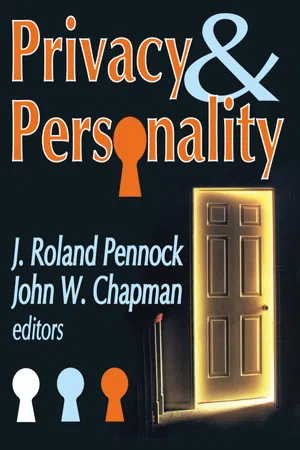
Privacy and Personality
About this book
Like many concepts, privacy has a commonly accepted core of meaning with an indefinite or variable periphery. Some would wish to enlarge the core. It would be pointless to attempt to establish a definition by way of introduction to a series of essays that themselves provide no single definition. But the themes of freedom, justice, rational choice, and community always seem to appear in any discussion of privacy. Privacy is a penultimate good. Perhaps, in certain usages--such as autonomy--it is an ultimate good, desirable for its own sake and grounded on nothing more final. Of course, the right of privacy may sometimes be asserted to conceal illegal or immoral acts. When that occurs, it appears to be put to an instrumental use. But, insofar as we justify such claims, it is not because they prevent the detection of immorality or violations of the law. Rather, at least in the case of illegal acts, it is because the means being challenged themselves violate privacy.The individual control-human dignity foundation for privacy, is closely related to personality. Privacy provides relief from tension and opportunity for the development of intimate relations with others. All of us have standards of behavior that are higher than we can maintain at all times, and these standards are widely shared in the society in which we live. If we do not observe them we are likely to be criticized, or we fear that we shall be, and we suffer also from loss of self-esteem. Whether in some final sense the concept of privacy is culture bound is impossible to establish, in the absence of any known society in which elements of privacy are not to be found.
Information
1
PRIVACY, FREEDOM, AND RESPECT FOR PERSONS
When your mind is set on mating
It is highly irritating
To see an ornithologist below:
Though it may be nature-study,
To a bird it’s merely bloody
Awful manners. Can’t he see that he’s de trop!*
INTRODUCTION
If two people retire to the privacy of the bushes, they go where they expect to be unobserved. What they do is done privately, or in private, if they are not actually seen doing it. Should they later advertise or publish what they were about, what was private would then become public knowledge. Or they may have been mistaken in thinking their retreat private—they may have been in full view of passersby all the time. One’s private affairs, however, are private in a different sense. It is not that they are kept out of sight or from the knowledge of others that makes them private. Rather, they are matters that it would be inappropriate for others to try to find out about, much less report on, without one’s consent; one complains if they are publicized precisely because they are private. Similarly, a private room remains private in spite of uninvited intruders, for, unlike the case of the couple in the bushes, falsifying the expectation that no one will intrude is not a logically sufficient ground for saying that something private in this sense is not private after all.
“Private” used in this second, immunity-claiming1 way is both norm-dependent and norm-invoking. It is norm-dependent because private affairs and private rooms cannot be identified without some reference to norms. So any definition of the concept “private affairs” must presuppose the existence of some norms restricting unlicensed observation, reporting, or entry, even though no norm in particular is necessary to the concept. It is norm-invoking in that one need say no more than “This is a private matter” to claim that anyone not invited to concern himself with it ought to stay out of it. That is why the normative implications of “Private” on a letter or a notice board do not need to be spelled out.2
The norms invoked by the concept are not necessarily im- munity-conferring, however; one can imagine cultures, for instance, in which they would be prohibitive, where to say that someone had done something in private would be to accuse him of acting inappropriately—perhaps cutting himself off from a collective experience and cheating others of their right to share in it. Or again, “privacy” might apply mandatorily; that is, anything private ought to be kept from the knowledge of others. This is rather the sense of the somewhat old-fashioned phrase “private parts,” referring not to parts of the body that one might keep unseen if one chose, but to parts that one had a duty to keep out of sight. In our culture, sexual and excretory acts are private not merely in the sense that performers are immune from observation but also in the sense that some care ought to be taken that they are not generally observed. Thus, liberty to publicize, that is, to license scrutiny and publicity, whether generally or to a select public, is commonly but by no means necessarily associated with the right to immunity from observation.
The norms invoked by the concept of privacy are diverse, therefore, not only in substance but also in logical form; some grant immunities, some are prohibitive, some are mandatory. There may be cultures, indeed, with no norm-invoking concept of privacy at all, where nothing is thought properly immune from observation and anything may be generally displayed. It might still be possible, of course, to seek out private situations where one would not be observed, but it would never be a ground of grievance either that an action was or was not open for all to see or that someone was watching. But whatever the possible diversity, some privacy claims seem to rest on something a bit more solid than mere cultural contingency. The first objective of this paper is to explore the possibility that some minimal right to immunity from uninvited observation and reporting is required by certain basic features of our conception of a person.
THE GENERAL PRINCIPLE OF PRIVACY AND RESPECT FOR PERSONS
The umbrella “right to privacy” extends, no doubt, to other claims besides the claims not to be watched, listened to, or reported upon without leave, and not to have public attention focused upon one uninvited. It is these particular claims, however, that I have primarily in mind in this paper. It deals, therefore, with a cluster of immunities which, if acknowledged, curb the freedom of others to do things that are generally quite innocent if done to objects other than persons, and even to persons, if done with their permission. There is nothing intrinsically objectionable in observing the world, including its inhabitants, and in sharing one’s discoveries with anyone who finds them interesting; and this is not on account of any special claims, for instance, for scientific curiosity, or for a public interest in the discovery of truth. For I take as a fundamental principle in morals a general liberty to do whatever one chooses unless someone else has good reasons for interfering to prevent it, reasons grounded either on the freedom of others or on some other moral principle such as justice or respect for persons or the avoidance of needless pain. The onus of justification, in brief, lies on the advocate of restraint, not on the person restrained. The present question, then, is whether any moral principle will provide a quite general ground for a prima facie claim that B should not observe and report on A unless A agrees to it. Is there a principle of privacy extending immunity to inquiry to all human activities, to be overridden only by special considerations, like those suggested? Or is it rather that there is a general freedom to inquire, observe, and report on human affairs as on other things, unless a special case can be made out for denying it with respect to certain activities that are specifically private?
My strategy, then, is to inquire, first, whether anyone is entitled, prima facie, to be private if he chooses, irrespective of what he is about: would the couple in the bushes have grounds for complaint if they discovered someone eavesdropping on their discussion of, say, relativity theory? Second, whether or not such grounds exist, can any rational account be given (that is, an account not wholly dependent on conventional norms) of “private affairs,” the area in which uninvited intrusions are judged particularly inappropriate?
The former, more sweeping claim may appear at first sight extravagant, even as only a prima facie claim. Anyone who wants to remain unobserved and unidentified, it might be said, should stay at home or go out only in disguise. Yet there is a difference between happening to be seen and having someone closely observe, and perhaps record, what one is doing, even in a public place. Nor is the resentment that some people feel at being watched necessarily connected with fears of damaging disclosures in the Sunday papers or in a graduate thesis in social science. How reasonable is it, then, for a person to resent being treated much in the way that a birdwatcher might treat a redstart?
Putting the case initially at this rather trivial level has the advantage of excluding two complicating considerations. In the first place, I have postulated a kind of intrusion (if that is what it is) which does no obvious damage. It is not like publishing details of someone’s sex life and ruining his career. Furthermore, what is resented is not being watched tout court, but being watched without leave. If observation as such were intrinsically or even consequentially damaging, it might be objectionable even if done with consent. In the present instance, consent removes all ground for objection. In the second place, by concentrating on simple unlicensed observation, I can leave aside the kind of interference with which Mill was mainly concerned in the essay On Liberty, namely, anything that prevents people doing, in their private lives, something they want to do, or that requires them to do what they do not want to do.3 Threatening a man with penalties, or taking away his stick, are ways of preventing his beating his donkey; but if he stops simply because he is watched, the interference is of a different kind. He could continue if he chose; being observed affects his action only by changing his perception of it. The observer makes the act impossible only in the sense that the actor now sees it in a different light. The intrusion is not therefore obviously objectionable as an interference with freedom of action. It is true that there are special kinds of action—any that depend upon surprise, for example—that could be made objectively impossible merely by watching and reporting on them; but my present purpose is to ask whether a general case can be made out, not one that depends on special conditions of that kind.
Of course, there is always a danger that information may be used to harm a man in some way. The usual arguments against wiretapping, bugging, a National Data Center, and private investigators rest heavily on the contingent possibility that a tyrannical government or unscrupulous individuals might misuse them for blackmail or victimization. The more one knows about a person, the greater one’s power to damage him. Now it may be that fears like this are the only reasonable ground for objecting in general to being watched. I might suspect a man who watches my house of “casing the joint.” But if he can show me he intends no such thing, and if there is no possibility of his observations being used against me in any other way, it would seem to follow that I could have no further reasonable ground for objecting. Eliza Doolittle resents Professor Higgins’s recording her speech in Covent Garden because she believes that a girl of her class subject to so close a scrutiny is in danger of police persecution: “You dunno what it means to me. Theyll take away my character and drive me on the streets for speaking to gentlemen.”4 But the resentment of the bystanders is excited by something else, something intrinsic in Higgins’s performance, not merely some possible consequence of his ability to spot their origins by their accents: “See here: what call have you to know about people what never offered to meddle with you? . . . You take us for dirt under your feet, dont you? Catch you taking liberties with a gentleman!” What this man resents is surely that Higgins fails to show a proper respect for persons; he is treating people as objects or specimens—like “dirt”—and not as subjects with sensibilities, ends, and aspirations of their own, morally responsible for their own decisions, and capable, as mere specimens are not, of reciprocal relations with the observer. This failure is, of course, precisely what Eliza, in her later incarnation as Higgins’s Galatea, complains of too. These resentments suggest a possible ground for a prima facie claim not to be watched, at any rate in the same manner as one watches a thing or an animal. For this is “to take liberties,” to act impudently, to show less than a proper regard for human dignity.
Finding oneself an object of scrutiny, as the focus of another’s attention, brings one to a new consciousness of oneself, as something seen through another’s eyes. According to Sartre, indeed, it is a necessary condition for knowing oneself as anything at all that one should conceive oneself as an object of scrutiny.5 It is only through the regard of the other that the observed becomes aware of himself as an object, knowable, having a determinate character, in principle predictable. His consciousness of pure freedom as subject, as originator and chooser, is at once assailed by it; he is fixed as something—with limited probabilities rather than infinite, indeterminate possibilities. Sartre’s account of human relations is of an obsessional need to master an unbearable alien freedom that undermines one’s belief in one’s own; for Ego is aware of Alter not only as a fact, an object in his world, but also as the subject of a quite independent world of Alter’s own, wherein Ego himself is mere object. The relationship between the two is essentially hostile. Each, doubting his own freedom, is driven to assert the primacy of his own subjectivity. But the struggle for mastery, as Sartre readily admits, is a self-frustrating response; Alter’s reassurance would be worthless to Ego unless it were freely given, yet the freedom to give it would at once refute it.
What Sartre conceived as a phenomenologically necessary dilemma, however, reappears in R. D. Laing’s The Divided Self6 as a characteristically schizoid perception of the world, the response of a personality denied free development, trying to preserve itself from domination by hiding away a “real self” where it cannot be absorbed or overwhelmed. The schizoid’s problem arises because he cannot believe fully in his own existence as a person. He may need to be observed in order to be convinced that he exists, if only in the world of another; yet, resenting the necessity to be what the other perceives him as, he may try at the same time to hide. His predicament, like Sartre’s, may seem to him to arise not from the manner of his being observed, but to be implicit in the very relation of observer and observed.
Sartre, however, does not show why the awareness of others as subjects must evoke so hostile a response. Even if it were true that my consciousness of my own infinite freedom is shaken by my being made aware that in the eyes of another I have only limited possibilities, still if I am not free, it is not his regard that confines me; it only draws my attention to what I was able formerly to disregard. And if I am free, then his regard makes no real difference. And if there is a dilemma here, may I not infer from it that the Other sees me too as a subject, and has the same problem? Could this not be a bond between us rather than a source of resentment, each according the other the same dignity as subject?
It is because the schizoid cannot believe in himself as a person, that he cannot form such a bond, or accept the respectful regard of another. So every look is a threat or an insult. Still, without question, there are ways of looking at a man that do diminish him, that provide cause for offense as real as any physical assault. But, of course, that cannot be a reason either for hiding or for going around with one’s eyes shut. Yet it does suggest that if, like a doctor, one has occasion to make someone an object of scrutiny and study, or like a clinician the topic for a lecture, the patient will have grounds for resentment if the examiner appears insensible to the fact that it is a person he is examining, a subject to whom it makes a difference that he is observed, who will also have a view about what is discovered or demonstrated, and will put his own value upon it.
It would be a mistake to think that the only objection to such examination is that an incautious observer could cause damage to a sensitive person’s mental state, for that could be avoided by watching him secretly. To treat a man without respect is not to injure him—at least, not in that sense; it is more like insulting him. Nor is it the fact of scrutiny as such that is offensive, but only unlicensed scrutiny, which may in fact do no damage at all, yet still be properly resented as an impertinence.
I am suggesting that a general principle of privacy might be grounded on the more general principle of respect for persons. By a person I understand a subject with a consciousness of himself as agent, one who is capable of having projects, and assessing h...
Table of contents
- Cover
- Half Title
- Title Page
- Copyright Page
- Preface
- Introduction by J. Roland Pennock
- Contributors
- Table of Contents
- Chapter 1. Privacy, Freedom, and Respect for Persons
- Chapter 2. The Private and the Free: A Conceptual Inquiry
- Chapter 3. Privacy: Autonomy and Selective Disclosure
- Chapter 4. Privacy Is Not an Isolated Freedom
- Chapter 5. The Uses of Privacy in the Good Life
- Chapter 6. Secrecy versus Privacy: The Democratic Dilemma
- Chapter 7. Privacy in Comparative Perspective
- Chapter 8. On Privacy
- Chapter 9. Privacy and Autonomy
- Chapter 10. Privacy: One Concept or Many
- Chapter 11. Privacy: A Cultural View
- Chapter 12. Masks and Fig Leaves
- Chapter 13. Personality and Privacy
Trusted by 375,005 students
Access to over 1.5 million titles for a fair monthly price.
Study more efficiently using our study tools.
Frequently asked questions
Yes, you can cancel anytime from the Subscription tab in your account settings on the Perlego website. Your subscription will stay active until the end of your current billing period. Learn how to cancel your subscription
No, books cannot be downloaded as external files, such as PDFs, for use outside of Perlego. However, you can download books within the Perlego app for offline reading on mobile or tablet. Learn how to download books offline
Perlego offers two plans: Essential and Complete
- Essential is ideal for learners and professionals who enjoy exploring a wide range of subjects. Access the Essential Library with 800,000+ trusted titles and best-sellers across business, personal growth, and the humanities. Includes unlimited reading time and Standard Read Aloud voice.
- Complete: Perfect for advanced learners and researchers needing full, unrestricted access. Unlock 1.5M+ books across hundreds of subjects, including academic and specialized titles. The Complete Plan also includes advanced features like Premium Read Aloud and Research Assistant.
We are an online textbook subscription service, where you can get access to an entire online library for less than the price of a single book per month. With over 1.5 million books across 990+ topics, we’ve got you covered! Learn about our mission
Look out for the read-aloud symbol on your next book to see if you can listen to it. The read-aloud tool reads text aloud for you, highlighting the text as it is being read. You can pause it, speed it up and slow it down. Learn more about Read Aloud
Yes! You can use the Perlego app on both iOS and Android devices to read anytime, anywhere — even offline. Perfect for commutes or when you’re on the go.
Please note we cannot support devices running on iOS 13 and Android 7 or earlier. Learn more about using the app
Please note we cannot support devices running on iOS 13 and Android 7 or earlier. Learn more about using the app
Yes, you can access Privacy and Personality by Russell L. Ciochon,John W. Chapman in PDF and/or ePUB format, as well as other popular books in Computer Science & Cyber Security. We have over 1.5 million books available in our catalogue for you to explore.