- 272 pages
- English
- ePUB (mobile friendly)
- Available on iOS & Android
eBook - ePub
About this book
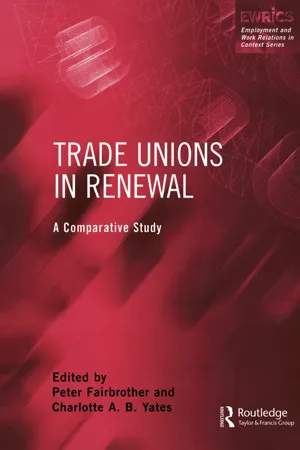
This comprehensive survey of continuity and change in trade unions looks at five primarily English-speaking countries: the USA, Canada, Australia, New Zealand and the UK. The authors consider the recent re-examination by trade union movements of the basis of union organization and activity in the face of a harsher economic and political climate. One of the impetuses for this re-examination has been the recent history of unions in the USA. American models of renewal have inspired Australia, New Zealand and the UK, while Canada has undergone a cautious examination of the US model with an attempt to develop a distinctive approach. This book aims to provide a thorough grounding for informed discussion and debate about the position and place of trade unions in modern economies.
1
UNIONS IN CRISIS, UNIONS IN RENEWAL?1
In many of the advanced economies, unions are in a situation of uncertainty and some disarray. This is particularly evident in the Anglo-American countries, namely the United States (USA), Australia, New Zealand (NZ), United Kingdom (UK) and, to a lesser extent, Canada. Union memberships are stagnant or declining and new workers are slow to join unions. These trends are in part a consequence of structural factors, in particular major changes in the labour market, involving the increased flexibility of labour, deregulation and a shift from manufacturing to services. In some countries they are also the result of broad political and cultural changes associated with growing ethnic, racial and cultural diversity of working populations and the failure of unions to adapt to these developments. Declining union memberships are also a consequence of the strategic responses of employers, governments and unions themselves to new competitive pressures and the declining legitimacy of social democratic ideas and strategic interventions. Employers in all five countries, albeit to varying degrees, have responded to the economic instability beginning in the early 1970s and continuing into the 1980s by shifting the balance of power in their favour, thus taking the opportunity either to rid their workplaces of unions or undermine union influence. Employers have been helped in these endeavours by governments choosing to restore economic competitiveness through the advancement of neo-liberal policies, in part aimed at restricting union political and economic influence. Further, many governments have abandoned Keynesian full-employment policies in favour of reducing inflation, deregulating labour markets, restricting union growth through changes to industrial relations institutions and eroding the welfare state.
For their part, unions have been caught unprepared by these political and economic shifts. Partially arising from their understanding of these changes as temporary setbacks to the post-World War II order, unions initially clung onto existing institutions and practices in the expectation that better days lay ahead. Faced with declining memberships and accelerated employer and government assaults on unions, articulated by some as a crisis of union representation (for example on Britain and the USA see Towers, 1997), many unions and national labour movements have recently undertaken a reassessment of their strategic responses to the current crisis. This reassessment has ushered in a period of rapid change for many unions, which are now experimenting with a host of new ideas and practices designed to rebuild their memberships and restore unions to a position of strength vis-à-vis employers and governments. In the five Anglo-American countries this strategic realignment by unions has in various measures included rationalization through mergers between unions, renewed emphasis on organizing the unorganized and in some cases experimentation with new forms of partnership between unions and employers.
This book examines the issue of union renewal in the five Anglo-American countries by focusing on national federations and individual union’s responses to organizing strategies, aimed both at increasing union memberships through organizing the unorganized and restoring union influence through internal reorganization and in some cases remobilization (activating existing members, facilitating member representation, promoting membership education and raising union consciousness). The book’s chapters are presented by country, but this introductory chapter aims to provide a comparative examination of some of the challenges, issues and debates about union renewal in these five countries.
Legacies of the past
The trade unions of each country are located in different industrial relations systems, which provide the context for the routinized relationships between trade unions, employers and the state. Over the past 100 years the union movements in each of these countries have struggled to establish themselves, often in the face of marked employer hostility, supported and at times encouraged by the state. By the mid-twentieth century the trade unions in each country were part of the political firmament, either as partners of labo(u)r parties (Australia, New Zealand and the UK) or working in alliance with progressive parties (Canada and to a more limited extent, the USA). The result was the emergence of institutionalized sets of relations between unions, employers and governments, premised on notions of responsible unionism but articulated in different forms depending largely upon the political and economic strength of organized labour in each country. These relations were often contentious, but it was not until the 1980s that these relationships were questioned and eventually challenged. So as to explore these relationships and provide an understanding for the contemporary moment, we look first at the past in each country, drawing out the interrelationships and parallels between them.
Australia, Canada, New Zealand, UK and the USA constitute a social, political and economic cluster that remains distinct from other advanced liberal and social democratic economies, such as mainland Europe. These states comprise economies linked together as part of the same broad trading group with a common language and predominance of liberal ideas. Perhaps not surprisingly, models of trade unionism and ties between labour movements also flourished at different points in their histories across these countries. Trade unions in Australia and New Zealand were modelled on British unions, with relatively close and ongoing informal links. Deepening economic ties between the USA and Canada led in the nineteenth century to the emergence of international unions representing workers in both the USA and Canada, which persist in influencing current trade union developments. Welfare state development in the post-World War II period also exhibited strong similarities across these five countries. All emerged as liberal welfare states with weak to moderate commitments to universalism, which informed the setting of benefits at low enough levels to enforce attachment to the paid labour market (Esping-Andersen, 1990). This tendency towards liberal welfare state development was at least in part a consequence of the limits to working-class organization and mobilization in these countries, which prevented the emergence of a more universalistic and transformative welfare state.
Despite the broad similarities in macro-economic and welfare policies, the legal regulation and juridical arrangements governing industrial relations differs between these five countries, with Canada and the USA following one model, Australia and New Zealand another, and the UK offering its own system. Both Canada and the USA developed a model of industrial relations in the 1930s and 1940s defined by a set of regulations, applied and adjudicated by government-appointed tribunals known as labour relations boards. Bona fide unions, defined as those that had collective bargaining as their primary focus, had to prove to their respective labour boards that the majority of workers in some portion of an enterprise, legally defined as a bargaining unit, supported representation by a particular union. Closed-shop provisions were rarely allowed outside the building trades, and in many US states were expressly prohibited. Thus union membership had to be built workplace by workplace. Once a union proved its majority status in a workplace, a process often fraught with conflict as a result of legal rights of employers to contest union recognition, the union was granted a certificate by the labour board. This certificate legally recognized the union as the exclusive bargaining agent for all workers in the bargaining unit, whether union members or not. Negotiations for a collective agreement were conducted between the employer and the certified union, most often at the enterprise level although some powerful unions forced more centralized company or sector-wide negotiations of a collective agreement. Strikes by unions and/or lock-outs by the employer became a primary means for increasing pressure on the opposing industrial party to negotiate an agreement, the result of which was often lengthy strikes/lock-outs, not uncommonly upwards of several weeks. Once a collective agreement was reached between the union and employer, this became a contract to which both parties were legally bound. Interim disputes over the application and interpretation of the contract were most often resolved through a grievance procedure. This workplace-based certification procedure encouraged the emergence of hundreds of unions and a decentralized bargaining system. (On the USA, see Tomlins, 1985; Goldfield, 1987; on Canada, see Jamieson, 1973; Cornish and Spink, 1994.) Yet, these complex legal-juridical procedures, combined with particular labour board practices, also encouraged the growth of large, industrial and public service unions.
Although the Canadian legislative framework was initially modelled directly on the US experience, the conclusion of World War II saw the ascendancy of right-wing political forces in the USA and their revision of industrial relations legislation, which curbed the rights of unions and enhanced those of employers (Tomlins, 1985). Thus, although similar, the two legislative systems were seen to have differential effects on the growth of the labour movement, with the US system restricting union growth and the Canadian system offering greater opportunity for expanded union membership (Card and Freeman, 1993). Only in the last ten years, have several Canadian provincial governments initiated changes to the industrial relations regime based on the US model.
Unions in the UK were similarly decentralized and focused on direct bargaining with employers, although the industrial relations system was quite distinct from that in the USA and Canada. What emerged in the UK, and was repeatedly defended by unions, was a voluntarist industrial relations system, which relied not on state regulation, but on the relative strength of unions and managers in the workplace for union recognition and bargaining outcomes. The consequence of this system was a highly decentralized union movement in which shop stewards and local union branches exercised considerable power, often with weak ties to the regional and particularly the national union. A further feature of this system was that multiple unions existed in workplaces, and workers in the same area often belonged to different unions. Agreements between the two parties were not legally binding, leading to both a more fluid process of collective bargaining and the greater likelihood of strikes or lock-outs by unions and employers in a bid to bolster their bargaining positions. The one exception to this pattern was in the highly unionized public sector, where a tradition of centralized unionism, reliant on state boards and cooperative employers, developed. Many of these unions were founded in the early twentieth century, but established themselves in the late 1940s and 1950s, with minimal forms of local representation, unlike their private sector counterparts (Carter and Fairbrother, 1999). From the 1970s onwards, as repeated Labour and Conservative governments targeted unions in both private and public sectors as a key factor in Britain’s economic woes, restrictions were placed on strikes, although broader institutional changes were limited (Bornstein and Gourevitch, 1984).
The Australian and New Zealand system of industrial relations developed around the turn of the twentieth century. In both of these countries, there developed an awards-based system of setting wages and working conditions through conciliation and arbitration. Governments, whether national as in the case of New Zealand, or at both the national and state (provincial or regional) level as in Australia, established state agencies whose task it was to regulate unions. Here unions applied for recognition through one of these state agencies and upon receiving this had exclusive jurisdiction over an entire segment of the workforce, whether they were union members or not. Unions served claims on employers, and, after negotiation with employers (successful or otherwise), the unions and employers registered these claims with arbitral bodies whose job it was either to impose an agreement or to recognize an agreement acceptable to both parties. The resulting award specified wage rates and various employment conditions (such as hours of work, or provisions for leave and vacation), which would cover an entire occupational grouping, industry or specified group of workers. Given the potential free-rider problem associated with this model of industrial relations, unions in both Australia and New Zealand relied upon de facto (Australia) and de jure (New Zealand) compulsory membership provisions within significant and leading awards for securing their memberships. For more powerful unions, awards acted as minimum standards, which were then supplemented with sectoral and/or local agreements. To reduce competition over wages and terms of employment, arbitral bodies used provisions in one award as the basis for inclusion of similar provisions in awards in other occupations or industries. As arbitral bodies both awarded and enforced awards, disputes between industrial parties tended to be resolved by these bodies. When unions did resort to strike action these were usually outbursts of short duration (a matter of days) and were designed to demonstrate the support of union memberships for their union’s bargaining position. Occupational unions became dominant and multi-unionism in one workplace was the norm. Under this system, hundreds of small unions developed with weak financial bases and memberships dependent upon arbitral award provisions. A number of analysts of unions in Australia and New Zealand have argued that unions grew as wards of the state rather than independent working-class organizations, dependent upon award provisions for membership and, in the case of New Zealand, direct state sponsorship for resources. (On Australia, see Howard, 1977; Wooden, 2000; on New Zealand, see Hince, 1993; Walsh, 1997.)
With the exception of the USA, all these countries have experienced significant changes to the legal and juridical framework governing their industrial relations systems in the last ten to fifteen years. In the case of the USA, labour law revisions restricting unions began as early as the late 1940s. Yet, what is important is the decisive and enduring influence that post-World War II industrial relations frameworks had on the development of union memberships, the relationship and strategic focus of leadership and members, and on union organization and activity. By examining the effects of national industrial relations frameworks on the growth and development of unions, we can begin to appreciate the different ways in which unions and labour federations in the five countries have approached strategic responses to a membership crisis that was evolving, particularly from the 1970s onwards.
The legislative frameworks under which unions grew in all these countries had long-term structural effects on the relationship between union leaders and members as well as unions and the state. The conciliation and arbitration systems of industrial relations in Australia and New Zealand delivered high union densities. The corollary was that union memberships in significant industries were not expanded through activist union strategies. Under these conditions, union leaders gained little experience with mobilizing activities centred on memberships and instead developed specialized arbitral skills and became preoccupied with procedural issues. Hince and Harbridge describe New Zealand union leadership as ‘in the hands of officials who were solid and accountable administrators, well versed in industrial law and the practices of conciliation and arbitration’ (as quoted in Harbridge and Honeybone, 1995: 3). Except for unions with more ardently left-wing leaderships committed to union democracy, unions typically developed with relatively passive and weak membership bases. Unions became characterized by a service relationship between leaders and members, whereby members looked to their unions for job protection, wage increases and regulations governing employment conditions. In both Australia and New Zealand, the relative brevity of strike duration in most industries, associated with and in part an objective of the conciliation and arbitration system (Hill et al., 1984, Chapter 10), reinforced this passivity, rarely requiring the mobilization of members for sustained periods of time. Unions looked to the state for membership protection and fair settlements with employers. This dependence on the state was even more acute in New Zealand where many unions were so small as to make their existence impossible outside the conciliation and arbitration system.
Once governments in Australia and New Zealand began stripping away their institutional and legislative support for unions, these organizations were ill-prepared to respond to declines in union membership. Weak membership attachments to unions, combined in New Zealand with the loss of compulsory membership provisions in 1991, contributed significantly to precipitous declines in union memberships. Unions had few existing structures and little or no recent historical experience to call on for rebuilding their membership base. Finally, unions had so long been ‘captured’ by their institutionalized relations with the state and employers, it took them some time to articulate strategies that lay outside dependence on a regime of state support.
Despite the differences between the volunta...
Table of contents
- Cover
- Half Title
- Title Page
- Copyright Page
- CONTENTS
- LIST OF TABLES
- LIST OF CONTRIBUTORS
- ACKNOWLEDGEMENTS
- LIST OF ABBREVIATIONS
- 1 Unions in crisis, unions in renewal?
- 2 The American labour movement and the resurgence in union organizing
- 3 You just can’t do it automatically: the transition to social movement unionism in the United States
- 4 Trade union innovation, adaptation and renewal in Australia: still searching for the holy membership grail
- 5 A near death experience: one union fights for life
- 6 From organizational breadth to depth? New Zealand’s trade unions under the Employment Contracts Act
- 7 A story of crisis and change: the service and food workers union of Aotearoa
- 8 The dilemmas of social partnership and union organization: questions for British trade unions
- 9 Rhetoric and reality: the adoption of the organizing model in manufacturing, science and finance
- 10 Strategic dilemma: the state of union renewal in Canada
- 11 The revival of industrial unions in Canada: the extension and adaptation of industrial union practices to the new economy
- 12 Social movement unionism: beyond the organizing model
- 13 Globalization, trade union organization and workers’ rights
- Index
Trusted by 375,005 students
Access to over 1.5 million titles for a fair monthly price.
Study more efficiently using our study tools.
Frequently asked questions
Yes, you can cancel anytime from the Subscription tab in your account settings on the Perlego website. Your subscription will stay active until the end of your current billing period. Learn how to cancel your subscription
No, books cannot be downloaded as external files, such as PDFs, for use outside of Perlego. However, you can download books within the Perlego app for offline reading on mobile or tablet. Learn how to download books offline
Perlego offers two plans: Essential and Complete
- Essential is ideal for learners and professionals who enjoy exploring a wide range of subjects. Access the Essential Library with 800,000+ trusted titles and best-sellers across business, personal growth, and the humanities. Includes unlimited reading time and Standard Read Aloud voice.
- Complete: Perfect for advanced learners and researchers needing full, unrestricted access. Unlock 1.5M+ books across hundreds of subjects, including academic and specialized titles. The Complete Plan also includes advanced features like Premium Read Aloud and Research Assistant.
We are an online textbook subscription service, where you can get access to an entire online library for less than the price of a single book per month. With over 1.5 million books across 990+ topics, we’ve got you covered! Learn about our mission
Look out for the read-aloud symbol on your next book to see if you can listen to it. The read-aloud tool reads text aloud for you, highlighting the text as it is being read. You can pause it, speed it up and slow it down. Learn more about Read Aloud
Yes! You can use the Perlego app on both iOS and Android devices to read anytime, anywhere — even offline. Perfect for commutes or when you’re on the go.
Please note we cannot support devices running on iOS 13 and Android 7 or earlier. Learn more about using the app
Please note we cannot support devices running on iOS 13 and Android 7 or earlier. Learn more about using the app
Yes, you can access Trade Unions in Renewal by Peter Fairbrother,Charlotte Yates in PDF and/or ePUB format, as well as other popular books in Business & Business General. We have over 1.5 million books available in our catalogue for you to explore.