- 379 pages
- English
- ePUB (mobile friendly)
- Available on iOS & Android
eBook - ePub
About this book
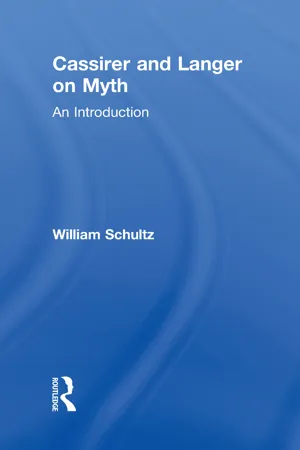
This book provides a detailed overview of the approach by two of the leading philosophical theorists of myth.
Information
PART I
Myth in Cassirer’s Philosophy of Symbolic Forms
CHAPTER 1
Myth in Cassirer’s Life and Career
An Overview of Cassirer’s Theory
“Ernst Cassirer belongs to the great tradition of classical philosophy,”
DIMITRY GAWRONSKY (SCHILPP 34).
This chapter overviews Cassirer’s extensive theory of myth because the number of writings and their difficulty would otherwise make its structure difficult to see without a long period of study. Also, it helps to orient readers who are unfamiliar with Cassirer’s work and technical terms. While in the case of any writer it would be important to understand the context of a particular theory, in Cassirer’s case it is especially important because it will be shown that he discusses myth in order to develop a broader philosophy, not the other way around. The information about his life does more than add some appealing color; it shows the reader how he came to be interested in myth, why he writes about modern myths in the way that he does (sometimes as if a stern prophet making a warning), and why he continued to be interested in it up until his death.
THE FORMATIVE YEARS
Sometimes a new idea comes to a brilliant thinker in a moment of insight, as Mrs. Toni Cassirer reports in My Life with Ernst Cassirer (my translation of Mein Leben mit Ernst Cassirer).One summer day in 1917, while going home from the University of Berlin, Ernst Cassirer walked through a streetcar doorway and stopped. Cassirer, 43, the philosopher with a high forehead made more prominent by the receding silver-grey hair, had studied human culture intensely for thirty years. Usually on these trips home he squeezed his way through the standing people, never himself attempting to take a seat, for there were many women with their children, older people, and war-injured men. He would stand and read a book despite the traffic, the voices, the pushing, the babies’ screams, the miserable lighting, the bad air. In the doorway this time, amid the pushing and the cacophany, he stopped. “Keep moving!” someone called. A moment passed. Someone asked, “Why did he stop?” The streetcar had to go. “Jawohl,” Cassirer said as he moved on through the standing people to a small space where, as usual, he held the bar with one hand and a book with the other. But this time he left his book unopened.
When he got home he told his wife Toni what had happened in the doorway. A plan had flashed before his mind’s eye, an explosion of insight. The doorway of the streetcar, it seemed, was the doorway to a whole system of philosophy which took Cassirer ten years to write, comprised three volumes, and formed the ground stone for a body of published works totalling 11,380 pages before his death and more is being published posthumously (Verene, “Vico and Cassirer” 7). Cassirer called his plan “the philosophy of symbolic forms.” As a preliminary definition, a “symbolic form” is a worldview or perspective made through a type of symbolism; the main “image worlds” (PSF II, 25) are myth, language, science, and art among others, to be discussed later. Though his ideas have not become popularized as have those of Joseph Campbell’s—probably because of their scholarly style, Cassirer’s ideas are fundamental to twentieth-century life, as we shall see at the end of this odyssey introducing his theory of myth.
Although the insight came suddenly and apparently easily, actually the groundwork for his Philosophy of Symbolic Forms was begun at least seven years earlier with the publishing of Substance and Function. In that work Cassirer criticized Georg Hegel, the nineteenth-century idealistic philosopher who thought he had found “absolute knowledge,” meaning in non-technical terms a set of concepts that have the same meaning and are valid throughout history.
Cassirer replaced the Hegelian permanent categories of experience with an historical set changing from culture to culture. Space, time, number, cause, self, and other categories would form different perspectives in different cultures. Hegel is wrong, Cassirer insisted, to claim that there can be unchanging categories, for then it becomes impossible to explain how they are used by changing human beings. A detailed technical discussion of the making of the mythic world view follows in subsequent chapters.
Cassirer changed the direction of philosophy by relativizing knowledge into specific historical forms; they are cultural or symbolic forms such as myth, language, science. This first building block was clearly stated in 1910, when Einstein was working on his theory of relativity in physics. The parallel may not be mere coincidence; the similarity in their trends of thinking reveals an underlying trend which began our twentieth-century culture.
Consider one particular similarity between the two theories. Einstein “relativized” space and time, though not completely, as he explained in his 1921 lecture in Hamburg: “According to the special theory of relativity, spatial coordinates and time still have an absolute character in so far as they are directly measurable by stationary clocks and bodies. But they are relative in so far as they depend on the state of motion of the selected inertial system” (ETR 446 ff). Thus, when Einstein wrote about the selected inertial system, he indicated the need to specify a system of reference for knowledge of nature.
Picture a selected inertial system as a train moving quickly. To a person ahead of it, the train sounds different from what it does to a person behind it, and when the train passes an individual, the difference becomes quite noticeable as the change in the pitch of the horn. The place where a person stands made a difference in the quality of the phenomenon. So, too, Einstein claimed, with time. Previously, scientists believed that time for a person in the train coincided with time for a person observing the train. Einstein relativized time by claiming that the measurement of time was a function of place, speed, and other factors. Yet, in the same stroke, Einstein universalized the notion of time by integrating it with these factors, whereas previously scientists distinguished time as a separate kind of property.
Cassirer’s philosophy also implicitly employed the idea of a system of reference, and that is tremendously important, for it allowed him to theorize about all knowledge while relativizing it into particular forms, as Einstein relativized time while integrating it with sound and other phenomena to theorize about the whole system. Space and time retained their absolute character for Cassirer as basic concepts in all modes of experience. Nevertheless, these concepts, and many more, are relative to the particular type of activity and its historical context.
Before a fuller discussion following this introduction, consider again the example of time. Every people in history has had a concept of time, though each has had a distinct conception. To the ancient Greeks, the people of 800 B.C. to 200 B.C., time was cyclical, festivals renewed the cycles of the heavens, and man gained some control over these cycles by invoking gods who partially transcended them. In our technological society time is linear. Festivals do not renew the cycles of the universe—they merely break the monotonous line of time measured by the punch card at the office. People do not partially control time through rites, rather it is time that controls people by compartmentalizing life into study time, work time, and play time. Science, too, he argues has yet another idea of time. And, what is more, besides the fact of differing senses of time, there is the fact of a pattern of forming all ideas in any culture or area of culture. Einstein integrated time with other notions, Cassirer claimed that space, number, and cause varied along with time and exhibited a similar pattern of changes. He claimed that people of different cultures have different senses of space, time, number, and everything else.
Einstein’s theories constituted a revolution. They put an end to very basic goals of inquiry, an end to attempts at defining concepts such as the ether, and replaced them with new ones, like the idea of space-time that altered the course of physics itself.
Cassirer’s theory of symbolic forms is likewise a revolution. Scholars in all fields have increasingly acknowledged the influence of Cassirer’s views, and Cassirer met some of the greatest minds of the twentieth century and some much-discussed intellectual figures point out the significance of Cassirer’s work. When Einstein gave the Hamburg lecture on the theory of relativity (1921), Cassirer was present. Cassirer talked to Einstein, asking him to clarify some ideas. Cassirer had already finished his own monograph, Einstein’s Theory of Relativity Considered from the Epistemological Standpoint. In it he discussed the theory not as an expression of the most true theory of space and time ever developed but rather as the most recent expression of the scientific way of thinking. Other modes of structuring space and time, such as through art or history, have an integral role in culture. Cassirer’s work emphasizes the importance of Einstein’s conclusions for Cassirer’s theory of knowledge.
Cassirer’s philosophy was as current and as revolutionary as Einstein’s physics. What made Cassirer’s work revolutionary was the new principle of unity which he sought and developed, a unity that relativized knowledge into cultural forms while allowing the philosopher to see their ultimate unity.
What was the unity of culture? Two years after the revolutionary insight on the streetcar, when Cassirer became a professor of philosophy at the University of Hamburg, he attempted to understand the unity of culture by studying its many subjects—as many as he could. He knew enough about science to write about Einstein and to talk with him, at a time when few scientists understood relativity. He knew classical opera well enough to hum melodies. He knew enough languages to sing the words of those operas in different tongues. He knew current stock exchange prices. He knew sports results. He delighted in the strategies of chess. It is not surprising that this versatile man was elected Rector of the University of Hamburg, a position requiring its holder to speak on many different subjects.
THE FIRST AND MOST DEVELOPED STAGE
These studies in so many fields led to Cassirer’s philosophical quest and to the first of three stages in his definition of myth. To realize the vision he had had on the streetcar, Cassirer began to write his three-volume system of philosophy, The Philosophy of Symbolic Forms (now four because of a posthumous volume). When not giving public lectures to large audiences, he studied intensely at the famous private library compiled by Avy Warburg, a library which amazed him because its uncommon association of subjects matched the uncommon association of cultural ideas Cassirer was currently developing.
Books on myth, art, and religion appeared next to each other, while it had been customary to regard myth and religion as very different phenomena. For example, Hegel considered religion to be very close in cultural development to his idea of absolute knowledge, but he hardly discussed myth—having begun his theory of knowledge on a level above myth, a level on which perception had alread superceded the mythical perception of things as emotive qualities. In the Warburgh Library linguistic studies appeared next to those in history. So too, the first volume of The Philosophy of Symbolic Forms presented language as a basic function of mind also required in historical studies. Language, Cassirer said, is representation; it builds up the world of intuition, the world of action, the common sense world of things with attributes. A word with its aggregate meanings reflects symbolically a thing with its attributes. The second volume presented a theory of myth as the first mode of human existence, from which art and religion develop. This theory of myth is highly original, for Cassirer viewed myth as having its own inner “logic”; a degree and type of coherence among conceptions and of correspondence between ideas and the world. It had been the traditional view to regard myths as fanciful creations like dreams or the ravings of mad men; as conscious products made up like fairy tales to have a moral; as nearly incoherent babblings, naive or mistaken stories to be rejected entirely. In contrast, Cassirer showed myth has an inner logic or form: all the ideas of mythical societies exhibit a pattern, or common way, of relating to each other. They interweave and relate to the world in the same way. The third volume, The Phenomenology of Knowledge (1929), differs from the preceding two volumes because it does not concentrate on one cultural phenomenon, though science is predominant. It discusses the long development throughout human civilization of myth into science or in more general terms the development of one cultural form into another.
THE SECOND AND THIRD STAGES
In the long, difficult third volume on the theory of knowledge, there are the second and third stages of his theory of myth. He postulates, again on the basis of much empirical cultural research, two very unique concepts, which change his understanding of myth. They are so unique that they have no correlates in a nonphilosophical vocabulary. This brief synoptic description introduces these ideas in their broadest context so as to make the detailed discussion in later chapters more understandable.
In the second stage of his theory of myth, he explains how myth has a permanent role throughout human civilization. In the first stage Cassirer extensively defines what myth is. This definition and the definition of other symbolic forms lead him to the conclusion that common sense and science develop beyond the ability of mythical thinkers. If myth developed into science, was myth completely left behind like the used fuel boosters jettisoned by a manned space capsule? Could there be a culture without myth? If so his idea of the necessary and universal role of each cultural form would be wrong. Yet science does know more about the world and in a more reliable way. The solution is to claim that some ability that was first present in myth continues beyond the primitive level of life and can be increased and changed. In more technical terms, myth’s function continues but its form is no longer the dominant or even exclusive ordering principle of experience. The idea of a universal function is somewhat subtle because Cassirer formulated it in a highly original and characteristically philosophical way—one in which myth played the key role. In the second stage of his theory, more than halfway through the three-volume magnum opus on culture, Cassirer concludes that myth cannot be overcome or eradicated from any culture completely (a view Tillich and Eliot have or religion).
In the third stage, at the end of his Philosophy of Symbolic Forms, Cassirer again makes a major conclusion about myth: it has in it an ideal of development that is also shared by science and other activities. True enough, the ideal is not exactly the same in primitive and modern society. He feels he must assert such a principle as a way to explain the continuity of civilization. Even in myth there are formed principles of unity which lead to even greater ones. It is a well documented fact that myths tend to merge and to lead to a single myth of the universe as in the preSocratic philosophers. Rather than believing that this fact shows the nascent scientific interest in myth, Cassirer interprets it to mean that the mythic way of unifying a world recurs again but at a higher level and in cooperation with other ones in post-primitive societies. Another way to say this is that the characteristic and abiding function of myth is capable of indefinite improvement. This idea is consistent with Susanne Langer’s notion that all ideas pass through a metaphorical stage before achieving a logical one, which only leads to new metaphors; this process is cyclical but progressive (See Philosophy in a New Key). The idea that explains the recurrence and progressive nature of myth is the “ideal limit.”
The ideal limit marks the third and final main stage in his theory of myth. At last it gives him, the philosopher, a total vision of human culture—past, present, and future. Human tendencies found in the first cultures are repeated, changed, and improved and will be more in the future. Cassirer’s theory of culture has universal principles which appl...
Table of contents
- Cover
- Half Title
- Title Page
- Copyright Page
- Dedication
- Table of Contents
- Abbreviations
- Preface
- Acknowledgments
- Part I. Myth in Cassirer’s Philosophy of Symbolic Forms
- Part II. Myth in Langer’s Philosophy of Human Feeling
- Selected Bibliography: Cassirer’s and Langer’s Philosophies of Myth
- Index
Trusted by 375,005 students
Access to over 1.5 million titles for a fair monthly price.
Study more efficiently using our study tools.
Frequently asked questions
Yes, you can cancel anytime from the Subscription tab in your account settings on the Perlego website. Your subscription will stay active until the end of your current billing period. Learn how to cancel your subscription
No, books cannot be downloaded as external files, such as PDFs, for use outside of Perlego. However, you can download books within the Perlego app for offline reading on mobile or tablet. Learn how to download books offline
Perlego offers two plans: Essential and Complete
- Essential is ideal for learners and professionals who enjoy exploring a wide range of subjects. Access the Essential Library with 800,000+ trusted titles and best-sellers across business, personal growth, and the humanities. Includes unlimited reading time and Standard Read Aloud voice.
- Complete: Perfect for advanced learners and researchers needing full, unrestricted access. Unlock 1.5M+ books across hundreds of subjects, including academic and specialized titles. The Complete Plan also includes advanced features like Premium Read Aloud and Research Assistant.
We are an online textbook subscription service, where you can get access to an entire online library for less than the price of a single book per month. With over 1.5 million books across 990+ topics, we’ve got you covered! Learn about our mission
Look out for the read-aloud symbol on your next book to see if you can listen to it. The read-aloud tool reads text aloud for you, highlighting the text as it is being read. You can pause it, speed it up and slow it down. Learn more about Read Aloud
Yes! You can use the Perlego app on both iOS and Android devices to read anytime, anywhere — even offline. Perfect for commutes or when you’re on the go.
Please note we cannot support devices running on iOS 13 and Android 7 or earlier. Learn more about using the app
Please note we cannot support devices running on iOS 13 and Android 7 or earlier. Learn more about using the app
Yes, you can access Cassirer and Langer on Myth by William Schultz in PDF and/or ePUB format, as well as other popular books in Philosophy & Literary Criticism. We have over 1.5 million books available in our catalogue for you to explore.