eBook - ePub
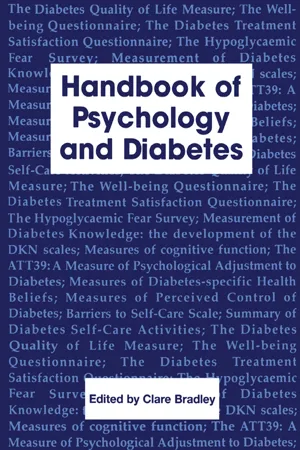
Handbook of Psychology and Diabetes
A Guide to Psychological Measurement in Diabetes Research and Practice
- 423 pages
- English
- ePUB (mobile friendly)
- Available on iOS & Android
eBook - ePub
Handbook of Psychology and Diabetes
A Guide to Psychological Measurement in Diabetes Research and Practice
About this book
This Handbook fulfils a pressing need within the area of psychological measurement in diabetes research and practice by providing access to material which has either been widely dispersed through the psychological and medical literature or has not previously been published.
Journal articles describing the psychometric development of scales have rarely included the scales themselves but this book includes copies of scales and a wealth of additional information from unpublished theses, reports and recent manuscripts.
You will find information about the reliability, validity, scoring, norms, and use of the measures in previous research presented in one volume.
The Handbook is designed to help researchers and clinicians:
· To select scales suitable for their purposes
· To administer and score the scales correctly
· To interpret the results appropriately.
Dr. Clare Bradley is Reader in Health Psychology and Director of the Diabetes Research Group at Royal Holloway, University of London.
Dr. Bradley and her research group have designed, developed and used a wide variety of measures of psychological processes and outcomes. Many of these measures have been designed and developed specifically for people with diabetes. Together with diabetes-specific psychological measures developed by other researchers internationally, these instruments have played an important part in facilitating patient-centred approaches to diabetes research and clinical practice.
Information
Subtopic
Health Care DeliveryIndex
PsychologySECTION 1
AN INTRODUCTION TO ISSUES AND CHOICES
CHAPTER 1
AN INTRODUCTION TO THE GUIDE TO PSYCHOLOGICAL MEASUREMENT IN DIABETES RESEARCH AND PRACTICE
Department of Psychology, Royal Holloway, University of London, Egham, Surrey, TW20 OEX, UK
REASONS FOR DEVELOPING AND USING DIABETES-SPECIFIC MEASURES
Designing and developing a new scale is costly in time and resources and is not a task to be undertaken lightly. There are arguments for using well-known generic measures in order to try and provide comparative data that might be used to make national health policies or local decisions about resource allocation. So why develop a diabetes-specific quality of life measure such as the DQOL described by Alan Jacobson and the DCCT research group in Chapter 5 or the Diabetes Treatment Satisfaction Questionnaire that I have described in Chapter 7? Why have we not used the ubiquitous SF-36 and other generic measures? In answering such questions it is worth considering why we don’t expect one set of physiological or biochemical outcome measures to be suitable for all patients regardless of the nature of their problems and treatments. Peak flow measures may be useful in asthma management but they have little or no relevance for diabetes management. Measures of blood glucose control will be of no value in asthma management. Neither measure would be relevant for people with arthritis where measures of mobility would be more useful. Similarly, where psychological processes and outcomes are concerned the same measure will not be equally relevant for patients with different disorders. The experience of pain is a central concern for people with arthritis but is not an issue for most people with insulin dependent diabetes for whom fear of hypoglycaemia may be a dominant concern. Thus when designing measures specifically for people with diabetes we can focus on those issues which are especially important for them and avoid irrelevancies that will cloud the picture. In this way we can produce diabetes-specific measures that have greater sensitivity than generic measures.
When we come to consider the measurement of well-being it might seem that the conditions of depressed mood, anxiety, energy and positive well-being (sub-scales in the Well-being questionnaire presented in Chapter 6) are of global relevance not just in diabetes but in other conditions and indeed they may well be. However, indicators of depression, anxiety, energy and positive well-being do not remain constant across all conditions. Many of the indicators of depression in the general population that are included in commonly used measures such as the Beck Depression Inventory (Beck et al., 1961) are likely to be confounded with symptoms of hyperglycaemia, hypoglycaemia or chronic complications in people with diabetes. Such symptoms include appetite disturbances, weight loss, tiredness, and loss of libido. With other conditions such as asthma or arthritis other symptoms, such as sleep disturbances, included in the Beck may be directly attributable to the physical disorder and may not be valid indicators of depression. Thus we need to consider not just the relevance of the mood state to be measured but the precise way in which it is being measured. Use of the same instrument with different populations cannot be assumed to be measuring the same psychological phenomenon. Chapter 16 considers appropriate ways of using questionnaires with new populations. Developing apparently generic measures of, for example, depression, with specific populations such as people with diabetes increases the likelihood that the instrument concerned will provide a valid measure of what it is intended to measure (depression) rather than unintentionally providing a proxy measure of metabolic control.
There is increasing recognition of the value of condition-specific measures and a rapidly expanding literature on health-related psychological measures. In 1987 McDowell and Newell wrote a valuable guide to a wide range of generic health status instruments. Other excellent texts followed with more specific purposes in view. Several of these have been specifically concerned with measurement of particular psychological constructs such as quality of life (e.g. Fallowfield, 1990; Spilker, 1990; Bowling, 1991; Walker and Rosser, 1993) or patient satisfaction (Fitzpatrick and Hopkins, 1993). Most of the quality of life texts devote specific chapters to consideration of quality of life measurement in specific diseases and conditions. Other books have been concerned with the measurement of a variety of constructs in a particular health-related setting such as primary care (Wilkin et al., 1992). A recent volume edited by McGee and Bradley (1994) focuses on quality of life in patients with end stage renal disease who depend on high technology medicine for their survival. That edited volume includes a substantial contribution from Welch reviewing the use of generic and disease-specific measurement instruments for use with patients with end stage renal disease. Some of the texts have included example items or sections from the instruments they review (e.g. Wilkin et al., 1992) or, most usefully of all, have reproduced measurement scales in their entirety (e.g. Fallowfield, 1990). In most cases the authors or contributors are users of scales or reviewers of such work rather than the designers and developers of such scales though there are notable exceptions including several of the well-known contributors to Walker and Rosser’s (1993) edited collection. The present Handbook is concerned with the measurement of a much wider range of psychological phenomena than the forerunners mentioned above. It also differs in having a specific focus on one disorder, diabetes, its management and complications. The contributors to the Handbook have been actively involved in diabetes research, designing, developing and/or using scales to measure the psychological issues they have been researching. The Handbook provides the means of pulling together the expertise gained during the 1980s and into the 1990s and provides access to the measures developed and associated information on their use.
THE PURPOSE OF THE HANDBOOK
Many of the scales relevant to diabetes are presented or referred to in this Handbook. Others may be discovered by a careful search of the literature. A new scale should be designed only as a last resort. It is important to make a thorough investigation of existing measures to avoid duplication of work. Measures may already be in use which serve the same purpose as your projected measure. When I started designing new measures in 1982 there was only a handful of psychologists involved in research in diabetes around the world, now there are hundreds of researchers at work and the chances of there already being a suitable measure are much greater. Available measures in your own language may not be quite appropriate for your purposes and may require adapting and thereafter treating as new instruments (see Chapter 16 on adapting scales and procedures and the limits of reliability and validity) but this is preferable to reinventing the wheel.
This Handbook is intended to facilitate access not only to the diabetes-specific scales presented here but also to the information concerning the reliability and validity of the scales and evidence for their suitability for different purposes. Chapter 2 by Todd and Bradley provides an introduction to psychometric design and development for those with little or no experience of the processes involved. The intention is to help readers to evaluate the information provided about the scales.
The scales described in detail in the Handbook chapters have been shown to satisfy criteria for many of the important aspects of reliability and validity outlined in Chapter 2. However, the process of developing scales is not a finite one. Information on some aspects of predictive validity may take years to collect and its measurement may only prove possible when a suitable study is funded for a different primary purpose and the study can also provide evidence concerning the predictive validity of the questionnaire. The task of design and development of the scales produced by my own research group has not until recently attracted funding in its own right but has been piggy-backed onto other studies evaluating new technologies, education or other management programmes for diabetes care. Scale developers may not have had resources specifically to support the development process and it may therefore not be surprising if information on some aspects of reliability or validity is patchy or non-existent. Sometimes the data are or were available but some potentially informative analyses have yet to be done. It will be interesting to see whether, for example, the Quality of Life scale described in Chapter 5 does factor naturally into the theoretically conceived subscales when the data are explored using factor analysis or whether such empirical testing identifies an alternative structure for the scales. In the meantime, the alpha coefficients of internal consistency for the current subscales provide support for the current scoring recommendations. Where all the scales in this Handbook are concerned, however, the development process is a continuing one. Many well-known and highly regarded questionnaires in general use (rather than specifically in diabetes research) cannot claim to have been subjected to most of the tests of reliability and validity addressed in this Handbook.
LAYOUT OF CHAPTERS
Contributors of chapters describing specific scales have been asked to follow a standard ordering of contents to help readers to find their way around the book and locate what they are looking for with greater ease. The scales themselves can always be found as the first figure presented in each chapter with additional figures showing any short form which might be available (as with Welch et al.s’ ATT19 short form of the ATT39 in Chapter 11) or parallel forms (as with the knowledge scales in Beeney et al.s’ Chapter 9). Two versions of the Health Beliefs and Perceived Control scales are provided in Chapters 12 and 13, one for insulin-treated and one for tablet-treated patients. The scheme outlined in Table 1 shows the ordering of headings that have, where possible, been followed in the chapters describing scales. Chapter 2 by Todd and Bradley provides information on the concepts of reliability and validity listed in Table 1 and associated methods of assessment.
Table 1 Guidelines to content organisation of Handbook chapters
INTRODUCTION | Describes the original purpose of the scale and the range of uses to which the scale has been put by users |
THE SCALE | |
Design | The latest version of the scale(s) is presented in a figure or figures. The design of the scale is described including any theoretical underpin and/or account of clinical observations/interview or other source material which influenced the design of the scales. |
Scoring | Details of the scoring procedures recommended. |
SCALE DEVELOPMENT | |
Subject Sample(s) and Procedures | Details are given of sample selection and sample(s) on which the measure has been developed. Details of administration procedures followed and instructions and information given to patients were also asked for here. Any written instructions given to subjects should be presented along with the scales themselves in the figure(s). |
Statistical Methods and Qualitative Judgements | The methods/criteria for determining which items were retained in the measure and which were dropped are outlined and referenced. |
Structure of Scale | Evidence for the structure of the scale might include some kind of factor analysis for multidimensional scales. |
Reliability | Includes Internal consistency: Test-retest reliability. |
Validity | Includes Face and Content validity: Concurrent validity: Construct validity: Predictive validity: Discriminant validity: Convergent validity: Extreme Groups validity. |
SHORT FORMS | Where available these are described and evaluated. |
DISCUSSION | Includes consideration of the limitations as well as the advantages of the measure. |
SUMMARY | Summarises the purpose of the measure and its scope and recommendations for future use. |
In addition to those aspects of reliability and validity listed in Table 1 there are several further criteria which can be useful in choosing between instruments and these include sensitivity to change, discriminatory power, and standardisation and norms.
Sensitivity to Change
If changes across time are a focus of interest of the study then a measure will only be useful if it is sensitive to the kind of changes that are expected to occur. Ceiling and floor effects can be important here. For example, use of a measure of depression in a study evaluating the use of Continuous Subcutaneous Insulin Infusion (CSII) pumps is likely to be too blunt an instrument to be sensitive to change following a period of CSII use. Depression scores will generally be low to begin with so there will be little room for improvement (a floor effect), only room for deterioration. The measure will therefore only serve to check that this specific psychological consequence (increase in depressed mood) will not follow CSII use. No psychological advantages of CSII use will be detectable with this measure. As shown in Chapters 5 and 6, measures of Positive Well-being, Energy and Satisfaction with Treatment proved to be far more sensitive to change than were measures of Depression and Anxiety in studies evaluating CSII pumps.
The chapter by Ryan draws particular attention to those tests of cognitive function that have proved sensitive to changes in diabetes control as well as to those tests that differentiated between extreme groups such as those with complications versus those without.
Discriminatory Power
A measure needs to achieve a good spread of scores. The measure will be useless if every respondent scores the same. There are, however, limits to the spread that will give meaningful results. Generally it has been found that respondents can hold in mind up to nine categories when they are marking or rating a scale. More intelligent subjects are generally able to make use of a greater number of categories than less intelligent subjects. The scales presented in the Handbook mostly use five or six-point scales with seven-point scales being the maximum and four-point scales the minimum. Four-point scales when combined to form a scale varying from 0 to 36 as with the Depression, Anxiety and Positive Well-being subscales of the Well-being Questionnaire presented in Chapter 6 provide a much greater spread of scores than would be obtained with the separate items though the skewed distributions of the Depression subscale in particular will limit the discriminatory power.
Standardization and Norms
Norms are sets of scores from clearly defined samples and the procedures for obtaining these scores constitute the test standardization. If norms are available it is possible to interpret the scores of individuals meaningfully. However, norms are only as useful as the appropriateness and size ...
Table of contents
- Cover
- Half Title
- Title Page
- Copyright Page
- Dedication
- Table of Contents
- List of contributors
- Preface
- Section 1: An Introduction to Issues and Choices
- Section 2: Quality of Life, Well-being and Satisfaction Measures
- Section 3: Knowledge and Cognitive Function
- Section 4: Measures of Attitudes and Beliefs
- Section 5: Measures of Behaviour and Composite Measures
- Section 6: Use and Abuse of Psychological Measures
- Appendix: Additional measures including recently developed and newly designed scales
- Author Index
- Subject Index
Trusted by 375,005 students
Access to over 1.5 million titles for a fair monthly price.
Study more efficiently using our study tools.
Frequently asked questions
Yes, you can cancel anytime from the Subscription tab in your account settings on the Perlego website. Your subscription will stay active until the end of your current billing period. Learn how to cancel your subscription
No, books cannot be downloaded as external files, such as PDFs, for use outside of Perlego. However, you can download books within the Perlego app for offline reading on mobile or tablet. Learn how to download books offline
Perlego offers two plans: Essential and Complete
- Essential is ideal for learners and professionals who enjoy exploring a wide range of subjects. Access the Essential Library with 800,000+ trusted titles and best-sellers across business, personal growth, and the humanities. Includes unlimited reading time and Standard Read Aloud voice.
- Complete: Perfect for advanced learners and researchers needing full, unrestricted access. Unlock 1.5M+ books across hundreds of subjects, including academic and specialized titles. The Complete Plan also includes advanced features like Premium Read Aloud and Research Assistant.
We are an online textbook subscription service, where you can get access to an entire online library for less than the price of a single book per month. With over 1.5 million books across 990+ topics, we’ve got you covered! Learn about our mission
Look out for the read-aloud symbol on your next book to see if you can listen to it. The read-aloud tool reads text aloud for you, highlighting the text as it is being read. You can pause it, speed it up and slow it down. Learn more about Read Aloud
Yes! You can use the Perlego app on both iOS and Android devices to read anytime, anywhere — even offline. Perfect for commutes or when you’re on the go.
Please note we cannot support devices running on iOS 13 and Android 7 or earlier. Learn more about using the app
Please note we cannot support devices running on iOS 13 and Android 7 or earlier. Learn more about using the app
Yes, you can access Handbook of Psychology and Diabetes by Clare Bradley in PDF and/or ePUB format, as well as other popular books in Psychology & Health Care Delivery. We have over 1.5 million books available in our catalogue for you to explore.