eBook - ePub
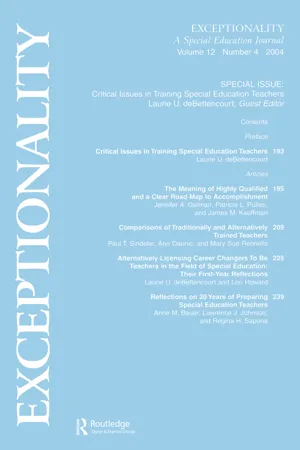
Critical Issues in Training Special Education Teachers
A Special Issue of exceptionality
- 56 pages
- English
- ePUB (mobile friendly)
- Available on iOS & Android
eBook - ePub
Critical Issues in Training Special Education Teachers
A Special Issue of exceptionality
About this book
First Published in 2005. This is Volume 12 in the Exceptionality series with the focus of Critical Issues in Training Special Education Teachers. This title features guest editor Laurie U. deBettencourt. The articles in this issue of Exceptionality discuss several issues relevant to special education teacher training: the meaning of highly qualified teachers, especially in the area of special education; the comparison of traditionally and alternatively trained special education teachers; and the reflections of alternatively trained first-year special educators. In addition, this issue provides a reflection of the past 20 years of preparing special education teachers as alternatives to traditional teacher preparation develop.
Information

Articles
The Meaning of Highly Qualified and a Clear Road Map to Accomplishment
Jennifer A. Gelman, Patricia L. Pullen, and James M. Kauffman
Curriculum, Instruction, and Special Education University of Virginia
The reauthorization of the Elementary and Secondary Education (No Child Left Behind) Act is questioned with reference to the requirement that every state ensure that all special education teachers are highly qualified and are receiving high-quality professional development. The conclusion is that the act lacks clear definitions, realistic goals, and clear steps to accomplishment. A road map of specific steps and appropriate definitions and goals are recommended.
On January 8, 2002, the reauthorization of the Elementary and Secondary Education Act (ESEA), also called the No Child Left Behind (NCLB) Act, was signed into law. The bill covers many aspects of education policy, but one area of particular interest to the special education community is the requirement that every state ensure that all special education teachers are highly qualified and are receiving high-quality professional development (ESEA, 2001, Section 1119). These are worthy goals, and reaching them has been attempted for decades. Unfortunately, we have never been able to attain them. Now, with the implementation of NCLB, these goals are supposed to become realities (Cochran-Smith, 2002; U.S. Department of Education & Office of Postsecondary Education, 2003).
NCLB offers a definition of highly qualified, and steps are highlighted to implement high-quality professional development. However, the definition and the steps are far from clear and specific. In fact, as others have pointed out, the NCLB requirements appear to be narrow, inadequate, and based primarily on pretense (Berry, Hoke, & Hirsch, 2004; Rebell & Hunter, 2004). Furthermore, the demands of NCLB do not focus on systemic reform but defer to state ideas of what constitutes highly qualified (Brownell, Hirsch, & Seo, 2004). Part of the problem is that although NCLB purports to set standards for students and teachers, the standards are really up to the 50 states.
Without clear and specific definitions and steps, it is impossible to achieve any goal, worthy as it may be. We outline what we believe should be the definition of a highly qualified special educator. In addition, we offer a road map of specific steps to accomplish high-quality professional development.
The History of Failed Attempts
The message from NCLB is not a new one. For decades, the United States has worked to improve public schools. Dozens of reports on public education have described the poor quality of public schools, and much of the blame has been placed on teachers and teacher educators. Yet, are teachers and teacher educators the ones to blame? Have past attempts given teachers and teacher educators the tools to improve the quality of public schools? History shows that efforts designed to produce better outcomes for public education have lacked long-term commitment, dedicated follow through, specific steps to achieve goals, and appropriate resources (Futrell, 2000). Moreover, teaching and the education of teachers have not been based on reliable evidence about what works and what does not (Hirsch, 1996).
In 1968, the National Institute for Advanced Study in Teaching Disadvantaged Youth published Teachers for the Real World (B. O. Smith, 1969), which proposed the development of different teacher preparation. The goal was for public schools, universities, and communities to work together to provide more effective teacher preparation. The report generated discussion, but no specific steps for implementation followed (Futrell, 2000). Its fate was similar to that of previous attempts to reform teacher education (Goodlad, 1990).
In 1980, the National Teacher Corps proposed an outline for reforming teacher education, including a complete change in the program of professional preparation (B. O. Smith, Silverman, Borg, & Fry, 1980). Yet, only a small number of universities became involved in this educational reform. The lack of university commitment to teacher education led to failure (Futrell, 2000).
The National Commission on Excellence in Education made an attempt in 1983 to improve education with its report entitled A Nation at Risk. This report called for a commitment of support and resources to education. Although the goals were appropriate, the lack of follow through made them impossible to achieve (Goodlad, 1990).
Head Start, a studied reform, offered promise due to the evidence found from other countries that had implemented early-intervention programs. The Head Start program failed to adopt knowledge-based curricula, though, which were used in these other studied programs. Due to the failure to follow other successful programs with fidelity, the benefits of an additional reform were extremely disappointing (Hirsch, 1996).
The 1990s started with a new educational reform in President George H. W. Bush’s State of the Union speech. The first President Bush called for every student to enter school ready to learn. High schools were to increase the graduation rate to 90%, and the United States was to be rated first in the world in math and science. These goals were to be accomplished by the year 2000. However, the lofty goals lacked direction and steps for action. Once again, reform failed to bring education what it desperately needed.
Throughout history many ambitious reforms have been proposed. Despite the various attempts, researchers have found a lack of significant difference in teacher education programs since the 1930s. Surprisingly, the series of disappointments has not led education experts to question why so many attempts to reform are not succeeding. Reluctance and inability to sustain efforts have created failure in spite of good intentions. Without commitment, a realistic plan, and proper resources, the quality of education will remain poor (Futrell, 2000; Goodlad, 1990; Hirsch, 1996).
Why Do We Keep Attempting to Accomplish These Goals?
With dozens of failed attempts to increase the quality of teachers and professional development, one may question the point of continued efforts to accomplish these goals. Research has shown that highly effective teachers increase student achievement more than ineffective teachers and that teachers’ knowledge influences student outcomes. It also suggests that if every classroom had an effective teacher, students would exhibit higher academic achievement (Kaplan & Owings, 2003).
The results of a study examining whether certified teachers affect student performance more than undercertified teachers have clear implications for education reform (Laczko-Kerr & Berliner, 2002). Many teachers are now trained in alternative programs instead of traditional certification programs. Due to the lack of standards in alternative programs, teachers from these programs are entering the field of education with little or no experience in the classroom, poor skills in content areas, and inadequate self-confidence. In short, teachers from alternative certification programs are entering the field undercertified. The data comparing certified and undercertified teachers in reading, math, and language arts indicated that students of undercertified teachers did not perform as well as students of certified teachers (Laczko-Kerr & Berliner, 2002).
A relation between the basic skills of teachers and student achievement has been found. When students have an effective teacher for at least 3 years, achievement scores have increased more than 50 points in math and 35 points in reading (on a 100-point scale) on standardized tests. Students in classrooms with the least effective teachers have shown close to no academic growth. Therefore, consecutive years with effective teachers can increase student outcomes in low-achieving, middle-achieving, and high-achieving students (Kaplan & Owings, 2003).
A teacher’s content knowledge has been linked to improved student outcomes. In a study of the effects of teacher’s content knowledge, findings revealed that students achieved more when instructed by teachers who had a college major or minor in the subject area in which they taught (Kaplan & Owings, 2003).
In addition, researchers have compared the effects of in-field and out-of-field teaching. In-field teachers have a major or minor in the area of content they are teaching, but out-of-field teachers do not. Studies have indicated that in-field teaching produces greater student achievement than out-of-field teaching. Similar research evidence has been found as well with the comparison of teachers with and without a master’s degree. Students of teachers with a master’s degree outperformed students of teachers without a master’s degree (Laczko-Kerr & Berliner, 2002).
Although a teacher’s content knowledge has been linked to increased student achievement, research has shown that these skills alone will not produce greater gains for students. A successful teacher has a background in effective teaching methods, and these teaching methods cannot be learned on the job (Laczko-Kerr & Berliner, 2002).
In addition to content knowledge, experience has been linked to successful teaching. Fieldwork experiences offered by teacher preparation programs are powerful. Research suggests that fieldwork may be the most valuable force offered by teacher education (Laczko-Kerr & Berliner, 2002).
Another element linked to greater student outcomes is education coursework. One of the strong predictors of teaching effectiveness found by researchers is education coursework (Kaplan & Owings, 2003). Some researchers have found education coursework to be a better predictor than content knowledge (Laczko-Kerr & Berliner, 2002). These findings, along with the findings from many other studies, have revealed the importance of the continuation of attempts to make every teacher highly qualified.
Of course, every finding and every conclusion has its exceptions. True, some teachers poorly prepared by the criteria we have discussed (i.e., a degree in the subject they are teaching, preparation to teach) will be highly successful, and some who have been well prepared by those criteria will fail. However, using outliers (those clearly atypical) to draw conclusions is not an intelligent decision (Kauffman, 2002).
The Ambiguous Nclb Definition of Highly Qualified
Due to the research evidence on the effects of high-quality teachers, NCLB has mandated that every teacher be highly qualified by the end of the 2005–2006 school year. The spirit and the intent of the act are easy to agree with, but the definition of highly qualified must be analyzed (U.S. Department of Education & Office of Postsecondary Education, 2003).
There are many elements of the NCLB definition of highly qualified teachers that lack clarity and specificity. One requirement for elementary, middle, and secondary teachers is to “be fully licensed or certified by the state” (Education Commission of the States [ECS], 2003). There is no information on what defines full state certification. Is this different from standard certification? If so, how is it different? Without this information, progress toward this ambiguous requirement cannot be measured (ECS, 2003; see also Rebell & Hunter, 2004).
Another requirement of NCLB is that teachers “not have any certification or licensure requirements waived on an emergency, temporary or provisional basis” (ECS, 2003). What will happen to teachers who do not meet this requirement? Will they be forced to stop teaching? There will be teachers who do not meet this requirement. How will school districts respond to this reality? NCLB does not explain (ECS, 2003).
A third requirement for new and existing teachers is to “have at least a bachelor’s degree and pass a state test demonstrating subject knowledge and teaching skills” (ECS, 2003) in all subjects taught. The state test for demonstrating subject knowledge and teaching skills must be rigorous. The meaning of a rigorous state test is not clarified. Traditionally, states have been given the power to determine minimum passing scores. Therefore, each state has different expectations regarding what a teacher should know. Should different states have different requirements for becoming highly qualified? From the description of NCLB requirements needed to be highly qualified, states continue to have the control over determining a passing score. Therefore, each state can have a different interpretation of what score on any test defines highly qualified. In Minnesota, the teacher basic skills test ...
Table of contents
- Cover
- Preface
- Articles
Trusted by 375,005 students
Access to over 1.5 million titles for a fair monthly price.
Study more efficiently using our study tools.
Frequently asked questions
Yes, you can cancel anytime from the Subscription tab in your account settings on the Perlego website. Your subscription will stay active until the end of your current billing period. Learn how to cancel your subscription
No, books cannot be downloaded as external files, such as PDFs, for use outside of Perlego. However, you can download books within the Perlego app for offline reading on mobile or tablet. Learn how to download books offline
Perlego offers two plans: Essential and Complete
- Essential is ideal for learners and professionals who enjoy exploring a wide range of subjects. Access the Essential Library with 800,000+ trusted titles and best-sellers across business, personal growth, and the humanities. Includes unlimited reading time and Standard Read Aloud voice.
- Complete: Perfect for advanced learners and researchers needing full, unrestricted access. Unlock 1.5M+ books across hundreds of subjects, including academic and specialized titles. The Complete Plan also includes advanced features like Premium Read Aloud and Research Assistant.
We are an online textbook subscription service, where you can get access to an entire online library for less than the price of a single book per month. With over 1.5 million books across 990+ topics, we’ve got you covered! Learn about our mission
Look out for the read-aloud symbol on your next book to see if you can listen to it. The read-aloud tool reads text aloud for you, highlighting the text as it is being read. You can pause it, speed it up and slow it down. Learn more about Read Aloud
Yes! You can use the Perlego app on both iOS and Android devices to read anytime, anywhere — even offline. Perfect for commutes or when you’re on the go.
Please note we cannot support devices running on iOS 13 and Android 7 or earlier. Learn more about using the app
Please note we cannot support devices running on iOS 13 and Android 7 or earlier. Learn more about using the app
Yes, you can access Critical Issues in Training Special Education Teachers by Laurie U. deBettencourt in PDF and/or ePUB format, as well as other popular books in Education & Education General. We have over 1.5 million books available in our catalogue for you to explore.