eBook - ePub
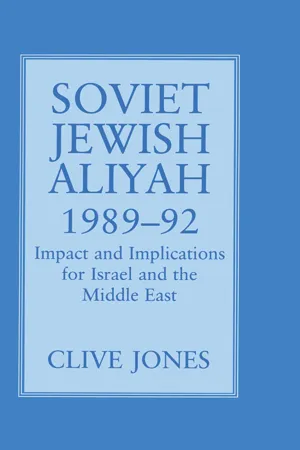
Soviet Jewish Aliyah, 1989-92
Impact and Implications for Israel and the Middle East
- 254 pages
- English
- ePUB (mobile friendly)
- Available on iOS & Android
eBook - ePub
About this book
This book provides new insights into a period of fundamental change in Israel and the Middle East. It explains how the Israeli government failed to effectively handle the integration of new emigres from the Soviet Union, and how it alienated traditional Likud supporters among Oriental Jews in Israel. Clive Jones's argument is that, by placing its ideological commitment to the retention of the West Bank above other priorities, the Likud leadership made itself beholden to the United States for financial assistance which was then denied. The resulting fundamental change in the composition and orientation of the Israeli political leadership has had a major influence on the course of the Arab-Israeli peace process.
Information
1
Soviet Jewish Aliyah 1989–1992: An Introduction
Between October 1989 and June 1992, over 400,000 Jews left the former Soviet Union for the State of Israel. A comparable wave of migration would be the movement of 50 per cent of the population of France to the United States over a four-year period.1 The very magnitude of this exodus affected superpower relations, American-Middle Eastern relations, Middle Eastern relations themselves, and the internal political equilibrium of Israel as a nation-state. To this end, this book is an examination of the political impact of Soviet Jewish migration as a transnational flow, how it complicated the decision-making of key actors, helped redefine Israel’s domestic political agenda, and, by extension, the approach of the Jewish State towards regional peace. This approach demonstrates clear linkages between developments in domestic politics and the implementation of foreign policy by a state élite: in this case, the Likud dominated National Unity government of Yitzhak Shamir. The use of the term transnational to describe the process of migration is deliberate, not least because it widens the remit of what has traditionally been understood to constitute such activity.
Emerging in response to the perceived movement towards greater global interdependence throughout the 1960s and early 1970s, the transnational debate concentrated on the role of non-state actors in eroding the hegemony of states as the dominant actors in world affairs. While the role of economic organizations such as international banks and multinational corporations in this debate elicited the most interest, other examples of transnational activity included cross-border contacts among groups and individuals, and the permeability of borders through the revolution in telecommunications.2 Writing in the winter 1992 edition of Millennium, however, M.J. Peterson argued that the study of transnationalism in international politics had been somewhat constrained, since the ‘empirical work seldom went beyond proving the existence of such activity’.3
Transnationalism: The Influence of Society and Societal Actors
Peterson has sought to widen the scope of transnational activity to include the role of ‘societal actors’ in the study of international politics. Set within a domestic environment these include the activities of individuals, companies, interest and social pressure groups, and their effect upon state behaviour. As Peterson explains:
These societal actors have significant effects on the flow of material resources, know-how and ideas around the world, and cannot be ignored in any full account of international relations. At the same time, they co-exist and interact with states. A sound understanding of world politics depends on understanding the different types of societal actors operating transnationally, the various relations that can exist between them and states, and the sort of tactics they adopt in their efforts to influence states.4
In short, while continuing to place primacy on the state as the main actor in international politics, Peterson is concerned to examine the impact of these societal actors on state behaviour. This is a notably different approach from the original study of transnationalism, which viewed non-state actors as largely autonomous from their domestic setting. By enclosing societal actors within the remit of transnational activity, Peterson sets out to establish clear links between the conduct of domestic and international politics.5
Implicit within the concept of societal actors affecting state behaviour in the international system is the assumption that society is autonomous from the state. A state in this context may be defined as the ‘institutionalized apparatus of rule’ that is expected ‘to maintain the physical security of the country as a whole and of the groups and individuals within it.6 From this, the concept of the state élite clearly emerges, encompassing those individuals and associated bureaucracies who formulate policies to be implemented by the state apparatus. In short, such individuals and bureaucracies form the government of the state. This definition clearly places the state at the nexus of domestic and international politics, but, as Michael Barnett explains in his study of Israeli security policy, one that is complex. The state has to construct strategies to meet external challenges and ‘for mobilizing societal resources’ in order to implement foreign policy decisions.7 The failure of the state élite to reconcile both challenges can undermine the legitimacy of its standing with its own society.
In the context of Israeli politics, the public reaction to the massacre of Palestinians at the Sabra and Chatilla refugee camps in Beirut in 1982 provides a prime example. In this instance, a societal actor - the pressure group Peace Now - was able to mobilize mass public support against the government. This ultimately led to the resignation of Ariel Sharon as defence minister and to the establishment of the Kahane commission to examine the extent of Israeli culpability.8 These events anticipated the growing debate concerning the relationship between the state and society that has developed since the end of the Cold War. In particular, there has emerged a growing interest in concepts of ‘civil society’ and its effect upon the state as an institution. No precise definition concerning the parameters of civil society exists, but a broad consensus as to its intellectual origins and key constituent elements can be traced. This rests in turn on a definition of society that posits clear distinctions between society and the role of the state.
According to the Danish political scientist Ole Waever, the constitution of society is an implicit act, broad enough in scope to encompass an identity - that is communal in nature. This can manifest itself in various forms, ranging from small group cohesion associated with tribes, to the mass identity associated with a nation. The semantic link to societal identity is the word ‘we’ in the sense of we Germans, we French, we British. This rests heavily upon the concept of Gemeinschaft first articulated by the German sociologist, Ferdinand Tonnies. This conceptual approach defines the reduction of society to a rational concept since it contains moral and social structures that represent an identity which is more than the ‘sum of its parts’ and ‘which reproduces itself from generation to generation’.9
This conceptualization does not preclude the possibility of dissonance within society. Again, the example of Israel provides us with evidence of ethnic dissent that has marked the development of the Jewish State, most notably the divisions between Ashkenazim and Oriental Jews. However, if a nation constitutes a broad definition of society, we can clearly identify the generic term ‘Israeli’ as falling within the remit of this sociological interpretation. In this sense, as Waever argues, a nation as a broad form of society exists when certain elements are present: affiliation to a territory; a continuity among society that links past, present, and future members; and a belief that as a manifestation of society, a nation is an important constituent unit of global society with a concomitant right to statehood.10
Such criteria allow for the term nation to be applied to societies yet to achieve territorial sovereignty, including the Palestinians and the Kurds. But even where a nation resides within clear territorial boundaries, a distinction can be made between the homogeneity of society and the role of the state. A state comprises those actors that perform governmental functions which are subject to change, while society can comprise non-governmental actors, also subject to change. But society itself is ‘not only robust enough in construction, and comprehensive enough in its following, but also broad enough in the quality of identity it carries, to enable it to compete with the territorial state as a political organizing principle’.11
This organizing principle is most obvious in the activity of political parties, usually associated with strong, democratic regimes that allow constraints to be placed on the activities of the state. Yet this political society, as outlined by the nineteenth-century French historian Alexis de Tocqueville, does not include those organizations, groups, or individuals who also, in the words of Augustus Richard Norton, ‘provide a buffer between the state and the citizen’.12 Within the context of Israeli politics, Peace Now, Women in Black, and even the settlers’ movement, Gush Emunim, all constitute units of what can be termed civil society. On a global scale, Amnesty International and Greenpeace are perhaps the two best examples of groups that operate transnationally across civil societies in their efforts to influence state behaviour. However, multinational corporations, as well as interest groups that actually support state actors, can also be included within the realm of civil society.
But if actors which constitute civil society operate outside the confines of the state, society nonetheless still requires the state to afford both physical and, in the case of most democratic regimes, social and economic security. Moreover, societies in developed countries require that the state continue to foster the necessary conditions that allow civil society to flourish.13 Where a state apparatus fails to fulfil its responsibilities towards civil society, or, at a more profound level, attempts to alter the identity of society at large, the result can be violent resistance to the policies of the ruling élite. The tumultuous events surrounding the overthrow of the Peacock throne in Iran provide one obvious example.
Yet far from undermining the role of the state in international politics, interaction between transnational societal actors and the state can serve to reinforce the state as the primary actor in international politics. According to Peterson, the relationship between societal actors and the state may be divided into several main categories, depending on which actor initiates the contact.
First, societal actors in one country may interact with societal actors in another without involving any state, in order to pursue shared goals or to help each other carry out mutually desired activity. Second, a state may seek the assistance of its own societal actors in implementing its foreign policies. Third, a state may appeal to societal actors abroad in efforts to influence the policies of other states or tap resources for a policy that it lacks at home. Fourth, a societal group may seek the assistance of its own state in furthering its activities. Fifth, a societal group may seek the assistance of a foreign state in furthering its goals.14
These categories are by no means mutually exclusive, nor, as Peterson points out, premised upon the state as a unitary actor. Competition between bureaucracies can, as Graham Allison points out, result in ‘sub-optimal’ outcomes in foreign policy implementation.15 But these categories do make clear linkages between the state and societal actors, thereby moving the transnational debate away from its previous emphasis on economic non-state actors. Furthermore, the framework developed by Michael Barnett, in his analysis of Israel’s security policy, demonstrates that society itself can impose severe constraints on the implementation of state policy, both foreign and domestic.
Barnett’s work is a challenge to those who assume that state security ‘is autonomous and therefore distinct from “low politics”, societal pressures, and the domestic political economy’.16 Such an assumption, he feels, is made without seriously considering the response of society to the mobilization strategies of the state. While not denying that international pressure can both mould and restrict state behaviour, the framework constructed by Barnett is significant precisely because it shows that state representatives, in this case, successive Israeli administrations, may be subjected to implicit and explicit societal constraints.
With reference to meeting the demands of national security, Barnett remarks that the state not only has to meet the challenge of an external threat, but also to face the prospect that policies designed to meet this challenge can elicit widespread societal antipathy. This forces the government or state élite to embrace solutions that ‘mobilize the required resources at a minimal political cost’.17 These resources can be material, for example, oil, coal, steel, high technology and so forth, but are more likely to involve finances. According to Barnett, these solutions lie within three broadly defined strategies that identify the location of the resource in either a domestic or international milieu and the costs involved in pursuing any one of them.
The first of these strategies is termed accommodational, and requires little reform to the existing relationship with society for resources to be extracted. In short, the external challenge facing the state can be met by the use of domestic resources with little change in societal equilibrium. The second, labelled restructural, requires the state to redefine its relationship with society if its foreign policy commitments are to be met. This strategy can involve the raising of taxes or the nationalization of key industries to meet a threat, or involve the liberalization of the economy in the belief that this will improve the productive capacity of the state. However, the viability of eithe...
Table of contents
- Cover
- Title
- Copyright
- Dedication
- CONTENTS
- Acknowledgements
- 1: Soviet Jewish Aliyah 1989–1992: An Introduction
- 2: The Migration of Soviet Jewry: 1970–1989
- 3: The Political and Ideological Context of Soviet Jewish Migration to Israel
- 4: Absorbing the Soviet Aliyah: Practicality versus Ideology
- 5: Absorption of Soviet Jewry: Integration and Dislocation
- 6: Arab Responses to Soviet Jewish Aliyah
- 7: The June 1992 Israeli General Election: The Impact and Influence of Soviet Jewish Immigration
- 8: Conclusion
- Appendix
- Select Bibliography
- Index
Trusted by 375,005 students
Access to over 1.5 million titles for a fair monthly price.
Study more efficiently using our study tools.
Frequently asked questions
Yes, you can cancel anytime from the Subscription tab in your account settings on the Perlego website. Your subscription will stay active until the end of your current billing period. Learn how to cancel your subscription
No, books cannot be downloaded as external files, such as PDFs, for use outside of Perlego. However, you can download books within the Perlego app for offline reading on mobile or tablet. Learn how to download books offline
Perlego offers two plans: Essential and Complete
- Essential is ideal for learners and professionals who enjoy exploring a wide range of subjects. Access the Essential Library with 800,000+ trusted titles and best-sellers across business, personal growth, and the humanities. Includes unlimited reading time and Standard Read Aloud voice.
- Complete: Perfect for advanced learners and researchers needing full, unrestricted access. Unlock 1.5M+ books across hundreds of subjects, including academic and specialized titles. The Complete Plan also includes advanced features like Premium Read Aloud and Research Assistant.
We are an online textbook subscription service, where you can get access to an entire online library for less than the price of a single book per month. With over 1.5 million books across 990+ topics, we’ve got you covered! Learn about our mission
Look out for the read-aloud symbol on your next book to see if you can listen to it. The read-aloud tool reads text aloud for you, highlighting the text as it is being read. You can pause it, speed it up and slow it down. Learn more about Read Aloud
Yes! You can use the Perlego app on both iOS and Android devices to read anytime, anywhere — even offline. Perfect for commutes or when you’re on the go.
Please note we cannot support devices running on iOS 13 and Android 7 or earlier. Learn more about using the app
Please note we cannot support devices running on iOS 13 and Android 7 or earlier. Learn more about using the app
Yes, you can access Soviet Jewish Aliyah, 1989-92 by Clive A. Jones in PDF and/or ePUB format, as well as other popular books in Politics & International Relations & World History. We have over 1.5 million books available in our catalogue for you to explore.