- 288 pages
- English
- ePUB (mobile friendly)
- Available on iOS & Android
eBook - ePub
About this book
The battle at Kursk in 1943 is often referred to as the greatest tank battle in the history of warfare. This volume makes extensive use of German archival documents as well as various Russian books and articles. As well as an account of the battle, it addresses methodological issues.
1
Background
When the Wehrmacht launched operation Barbarossa on 22 June 1941, it met an adversary which in many respects was of similar size, at least in terms of manpower and artillery systems.1 The large Soviet numerical superiority in tanks and aircraft was to a great extent negated by the Red Army’s poor leadership, communication systems and doctrine. During the summer and autumn, the Wehrmacht managed to inflict losses on the Red Army almost as quickly as the Soviet Union could feed new units into the battle, but when the ‘mud’ period began in the autumn, the German forces could not impose as high an attrition rate on the enemy as they had previously. Worse was to come. As the Red Army went over to the offensive in December 1941, it was no longer the Germans deciding the loss rate to be suffered by the Soviet forces. The spring of 1942 provided further time for force build-up, and it was not the Germans who benefited most from it. As can be seen in Table 1.1, the Red Army had about a 2:1 numerical superiority on the main front at the end of June 1942. According to Soviet literature, the balance was much more even, but that results from an exaggeration of German strength.
Despite this, the Germans succeeded in taking the initiative and delivering a heavy blow to the Soviet forces in eastern Ukraine. The German forces between Kursk and Rostov inflicted 586,834 casualties on the enemy between 28 June and 24 July,2 thus paving the way for the advances towards Stalingrad and the Caucasus. To lose about 600,000 men in a month on what amounted to less than a third of the front line between Leningrad and the Black Sea was hard even for the Red Army. However, the German offensive gradually ran out of steam, thus reducing the attrition rate. With the German offensive contained, the Red Army could itself grasp the initiative and inflict a telling defeat on the Axis powers. It was not only the forces in and around Stalingrad that were struck by the Soviet attack, for during the following winter the offensive was successively expanded to involve forces from Orel southwards. The situation became especially critical for the Axis forces, when the Hungarian 2nd Army and the Italian 8th Army were defeated and a large gap extended from Voronezh to the lower Don.
TABLE 1.1: COMPARATIVE STRENGTH, 1 JULY 1942
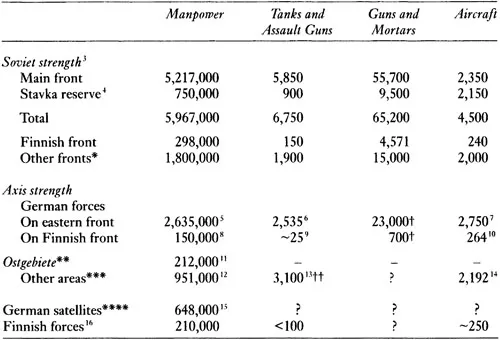
Notes:
| * | Other fronts include the Far East and the Soviet southern border. Figures are estimates only. |
| ** | Includes the rear occupied areas in eastern Europe. |
| *** | Includes forces in Norway, Netherlands, Belgium, France, Italy, Africa, Balkans and Germany. |
| **** | Includes Hungarian, Italian, Rumanian and Slovakian troops on the eastern front. Figures apply to 10 September 1942, additional satellite units had arrived since 1 July. The strength on that date must consequently have been lower, |
| † | Estimates based on T/O&E strength and number of units. |
| †† | Includes tanks accepted by the army but not yet supplied to units, tanks with training units as well as tanks with combat units, also included are 2,192 tanks considered unsuitable for front-line employment. |
Guns and Mortars include AT guns, AA guns, mortars and indirectly firing artillery pieces.
Soviet ambitions were, however, thwarted by the brilliant counter-stroke orchestrated by von Manstein, who succeeded in defeating the Red Army spearheads in the Ukraine and in stabilizing the front along much the same line as when the Germans launched their summer offensive of 1942. The outstanding difference lay in the two huge salients, which characterized the new front line. These were located around the towns of Orel and Kursk, two towns which, until Word War II at least, were relatively unknown. Since the German-held Orel salient formed the northern shoulder of the Soviet-held Kursk salient, operations against either of the salients were likely to involve forces in the other. Both areas offered the prospects of cutting off considerable enemy forces if a successful attack could be launched. Thus it is no surprise that this area did attract the eyes of the men in Berlin and Moscow when they gathered around their maps.
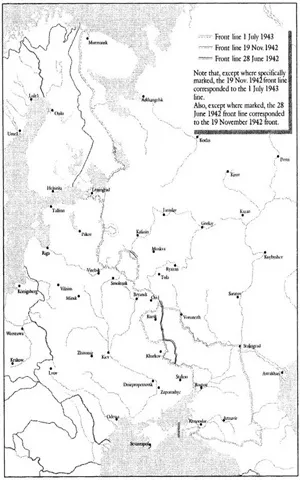
Map 1. The eastern front, 1942–43
The strategic situation in the spring of 1943 was in many respects different from the circumstances that had shaped the events during the summer campaign season of the previous year. The disaster at Stalingrad cast its shadow over the German high command, even though the German Army was actually stronger in 1943 than it had been in 1942. In terms of manpower, the German Army in the east had increased by nearly 20 per cent. The number of tanks and assault guns had risen from 2,53517 to 3,52418 in the same period. The quality of the tanks had also improved, as had the German AT guns. This was the encouraging side of the coin, but two more ominous facts also had to be considered. The first was the severe decline in the contribution made by Germany’s allies since the summer of 1942. The Italian forces were gone altogether, while Rumania and Hungary fielded much smaller forces in the spring of 1943 compared with the contribution they had made during the summer of 1942. The second, and most serious change, lay in the increasing strength of the Red Army, although the German generals were perhaps only partly aware of this. The change lay not so much in manpower, but in the increase in tanks, artillery and aircraft (see Tables 1.1 and 1.2 for a direct comparison). Tanks not only increased in numbers, but the more powerful vehicles were receiving a greater share of production resources. In 1942, medium and heavy tanks made up 61 per cent of all those produced, while their quota was 86 per cent in 1943.19 Artillery almost doubled in numbers, while the Soviets developed firing techniques suitable for their means of communication and fire direction. Thus, the summer of 1943 promised to be a much more challenging season for the Wehrmacht than the previous year had been.
Essentially, there were three choices for the German forces in Russia: (1) try a static defence; (2) use a mobile defence; or (3) try their fortunes with offensive action. Of these, the first was inevitably used over a large portion of the front. Most of the infantry units had only limited mobility and it had become more and more evident that the cost of attacks made by infantry without adequate tank support was not commensurate with the results, at least not in the longer term. A mobile defence was possible if the proportion of infantry units to mobile units was not too great.
TABLE 1.2: COMPARATIVE STRENGTH, 1 JULY 1943
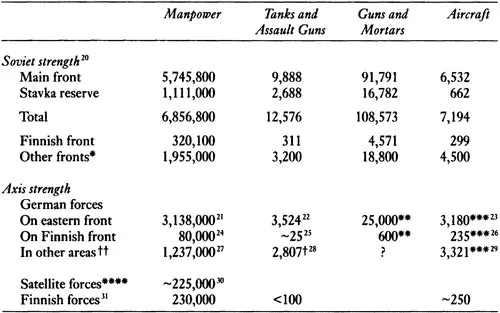
Notes:
| * | Other fronts include the Far East and the Soviet southern border. Figures apply to 1 April 1943, not 1 July 1943. |
| ** | This is an estimate, based on T/O&E strength of the units on the eastern front. |
| *** | Figure applies to 31 May 1943. Includes all types of aircraft, including transport and liaison planes. |
| **** | Includes Hungarian, Rumanian and Slovakian troops on the eastern front. |
| † | Includes tank and assault gun units being set up, also includes vehicles no longer regarded as suitable for combat, but still retained by the Army, |
| †† | Of the manpower in other areas, 296,000 were in the Balkans, 195,000 were in Italy and 746,000 were in western Europe.32 |
Guns and Mortars include AT guns, AA guns, mortars and indirectly firing artillery pieces.
In the Army Group North area the number of infantry divisions was 38, while only one panzergrenadier division and not a single panzer division was subordinated to the army group.33 In addition it had three Jäger divisions and one mountain division, which at least had somewhat better mobility than the infantry divisions. This was clearly not sufficient to mount a truly mobile defence at army-group level; neither did the terrain favour mobile operations. The final nail in the mobile defence coffin for Army Group North was Leningrad. It was unthinkable that Hitler would loosen the German grip on this city, even though it had been dented in January 1943, when the Red Army had opened a narrow land corridor to the besieged city.
In the Army Group Centre area, the prospects for a mobile defence were better, since the terrain, while not ideal, was more suitable. No specific geographical features tied the ground forces to certain positions, and the proportion of mobile units was higher, 11 mobile divisions compared with 64 infantry divisions.34 It is doubtful however, if it would have been possible to stage such a defence over more than limited sectors of the front, owing to the relatively limited number of mobile units.
In the Army Group South area the conditions for a successful mobile defence were more propitious than for any other army group. The number of mobile divisions was 13, while the infantry divisions amounted to 29 (including one mountain division).35 While even this presented rather a low ratio, it was considerably higher than the average for the German armed forces as a whole. The Wehrmacht simply could not expect anything better. While this ratio certainly was not ideal, it at least made mobile defence a viable option, especially since the Red Army had an even lower proportion of mobile units in their forces. The geography was also favourable to this type of defence. No large area in Europe provided better terrain for a mobile defence than the Ukraine. But more ominous for this defence alternative was the fact that Kharkov, the fourth-largest city in the Soviet Union, was located only 35 kilometres from the front line along the Donets River. To compound matters for the German field commanders, the important industrial region around Stalino was equally perilously close to the front. For Hitler these were objectives that had to be denied to Stalin. This ruled out mobile defence in the Ukraine, at least until Soviet pressure had forced the Germans out of Kharkov and the Donets industrial region. However, by then it could be too late.
Whether a mobile defence would or would not have been successful is, of course, open to debate. Ever since the campaigns in 1941 had faltered, the fighting on the eastern front had increasingly turned into a grinding war of attrition. Historians tend to focus on the overwhelming Soviet manpower resources and their considerably greater production of weapons. To this has been added the fact that Germany had to devote resources to the Mediterranean and to the defence of western Europe, even though the eastern front clearly was the main concern. The implication of this was that the larger Soviet resources made a German victory in a war of attrition impossible.
In a war of attrition, however, it is not only the ability to feed new troops, tanks, guns and planes into the fighting that matters: the ability to inflict losses on the enemy is equally important. In this respect, the German Army had a substantial superiority. As it turned out, during 1943 Germany lost 1,803,755 men on the eastern front (killed, wounded and missing), of which 1,442,654 were combat losses.36 This can be compared with Soviet casualties amounting to 7,857,503,37 or more than four times higher, during 19...
Table of contents
- Cover Page
- Half Title page
- Series Page
- Title Page
- Copyright Page
- Contents
- Tables and Figures
- Maps
- Series Editor's Foreword
- Preface
- Abbreviations
- 1 Background
- 2 The Assembly of Forces
- 3 Structure of Involved Forces
- 4 Tanks Employed at Zitadelle
- 5 The Air War
- 6 Chronology of the Offensive
- 7 Prokhorovka
- 8 The Cost of the Battle
- 9 An Analysis of the Battle
- 10 The Consequences of the Battle
- Appendix 1 Soviet Order of Battle
- Appendix 2 German Order of Battle
- Appendix 3 Soviet Tank Units Facing Army Group South
- Appendix 4 The Panther Tank in Zitadelle
- Appendix 5 Deliveries of New Tanks to the Eastern Front, June–August 1943
- Appendix 6 Daily Tank Strength in Army Group South
- Appendix 7 The Condition of 8th Army, 30 August 1943
- Appendix 8 Examples of Causes of German Tank Losses
- Appendix 9 Number of German Tanks and Assault Guns on the Eastern Front, April-December 1943
- Appendix 10 Further Information on German Casualties
- Appendix 11 Tank Data
- Appendix 12 Tank and AT Gun Data
- Appendix 13 Armour-Penetration Capabilities
- Appendix 14 Information on German Tank Losses
- Appendix 15 Ration Strength of the 4th Panzer Army
- Appendix 16 Divisional Structure for German Forces on 4 July 1943
- Bibliography
- Index
Trusted by 375,005 students
Access to over 1.5 million titles for a fair monthly price.
Study more efficiently using our study tools.
Frequently asked questions
Yes, you can cancel anytime from the Subscription tab in your account settings on the Perlego website. Your subscription will stay active until the end of your current billing period. Learn how to cancel your subscription
No, books cannot be downloaded as external files, such as PDFs, for use outside of Perlego. However, you can download books within the Perlego app for offline reading on mobile or tablet. Learn how to download books offline
Perlego offers two plans: Essential and Complete
- Essential is ideal for learners and professionals who enjoy exploring a wide range of subjects. Access the Essential Library with 800,000+ trusted titles and best-sellers across business, personal growth, and the humanities. Includes unlimited reading time and Standard Read Aloud voice.
- Complete: Perfect for advanced learners and researchers needing full, unrestricted access. Unlock 1.5M+ books across hundreds of subjects, including academic and specialized titles. The Complete Plan also includes advanced features like Premium Read Aloud and Research Assistant.
We are an online textbook subscription service, where you can get access to an entire online library for less than the price of a single book per month. With over 1.5 million books across 990+ topics, we’ve got you covered! Learn about our mission
Look out for the read-aloud symbol on your next book to see if you can listen to it. The read-aloud tool reads text aloud for you, highlighting the text as it is being read. You can pause it, speed it up and slow it down. Learn more about Read Aloud
Yes! You can use the Perlego app on both iOS and Android devices to read anytime, anywhere — even offline. Perfect for commutes or when you’re on the go.
Please note we cannot support devices running on iOS 13 and Android 7 or earlier. Learn more about using the app
Please note we cannot support devices running on iOS 13 and Android 7 or earlier. Learn more about using the app
Yes, you can access Kursk 1943 by Anders Frankson,Niklas Zetterling in PDF and/or ePUB format, as well as other popular books in History & Military & Maritime History. We have over 1.5 million books available in our catalogue for you to explore.