eBook - ePub
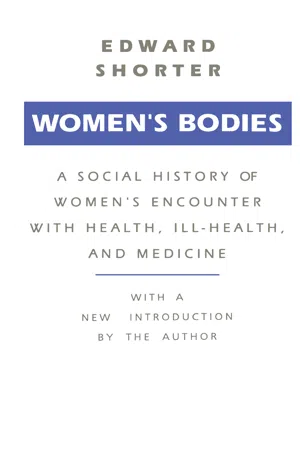
Women's Bodies
A Social History of Women's Encounter with Health, Ill-Health and Medicine
- 424 pages
- English
- ePUB (mobile friendly)
- Available on iOS & Android
eBook - ePub
Women's Bodies
A Social History of Women's Encounter with Health, Ill-Health and Medicine
About this book
What has been the source of women's oppression by men? Shorter argues that women were victimized by their own bodies. Exploring five centuries of medical records and folklore from Europe and the US, he shows how pregnancy, childbirth, and gynecological disease have kept women in positions of social
Part One
Women, Men, and Bodies
CHAPTER 1
Men, Women, and Sex
THROUGHOUT much of this book, I shall describe the harm done to women by sexual activity over which they had no control. “No control?” wonders the twentieth-century reader. In our own time, a married woman who dislikes her husband’s advances can leave the marriage, and an unmarried woman is usually able to avoid a man’s embraces if she so wishes. But today we have the “modern”—even the “post-modern”—family, and things are very different from two hundred years ago, when the traditional husband’s “conjugal rights” meant that the married woman could not in fact refuse intercourse.
Put yourself in the shoes of the typical housewife who lived in a small town or village then. Neither she nor anyone else had any idea when the “safe” period for a woman was; and for her, any sexual act could mean pregnancy. She was obliged to sleep with her husband whenever he wanted. And in the luck of the draw, she would become pregnant seven or eight times, bearing an average of six live children. Most of these children were unwelcome to her, for if one single theme may be said to hold my story together, it is the danger to every aspect of her health that this ceaseless childbearing meant.
The first issue thus becomes men. What was going on in the minds of husbands to make them subject their wives to these endless births?
Men over Women
A male unconcern for the welfare of women lay in the nature of traditional marriage. Two decades of research in the history of the family has now clearly established that the assumptions of traditional marriage differed radically from those of modern marriage.1 Unlike the twentieth century, when the point of matrimony is generally thought to be the emotional gratifications of romance and companionship, people in earlier times married for reasons of “lineage”: a man needed a wife to help him run the farm or to provide male children to whom he could pass along the patrimony. There was little emotional contact between man and wife; and in fact, men saw other men as their main “spiritual companions” and thus formed the basis of what Lionel Tiger has called “male bonding.”2 Women, in their turn, did not even imagine that their husbands might somehow “understand” them, and saw as their main allies other women. This was the basis of “female bonding.” Thus, with both men and women seeking their major sentimental allies outside the family, power relations inside were jarringly unequal. The woman had the status of “chief servant of her sons and of the farmhands,” to quote one observer of Brittany.3 And the man was the “master of his little kingdom,” or Herr im Hause, as the Germans said.
I should like to make several points about family life then, and call the reader’s attention to the anecdotal nature of the evidence that follows. Although one would like firm statistics on such things as wife beating, they are simply not to be had. I have worked for many years in the sources, and what follows is my general impression of relations between men and women—”anecdotal” to be sure, but I am convinced that it is nonetheless accurate.
The husband’s overtowering supremacy appears in many rituals of daily life. At table, the closer one sat to the father’s chair, the more status one had. In the farm kitchens of the Sauerland, the farmer would be at the head of the table, the other men sitting next to him on the bench against the wall, male children at the end. The women sat on stools across the table. A guest would usurp not the father’s place at the head, but the mother’s, and she and all the other females would bump down one place. An alternative arrangement would be for all the men to be seated at table, first the father, then the retired grandfather, then his unmarried brother, then the sons in order of their age, with the women all standing.4 Or, as in Vaud Canton, the father might eat alone, served separately by his wife. “Nobody dares raise his voice in the father’s presence.”5
So overawing was the authority of men that in Languedoc a wife would not open the door to searchers from the police when her husband was away, lest she dishonor his authority. His wife would call him “mister” (notre homme) and fall silent in the presence of a guest.6 In the Limousin a wife would not accompany her husband to the market, would not “stand at his side during civil or religious ceremonies,” and would address him with the polite vous. The husband would not refer to her directly, would never say, “My wife did such-and-such,” but, “The woman of this house did such-and-such.”7 French peasant proverbs demonstrate that a man was boss by virtue of his gender:
- “A rooster no larger than your fist will get the best of a hen as large as a stove.” (Lower Brittany)
- “A woman who doesn’t fear her husband doesn’t fear God.” (Catalogne)
- “As a man you’re strong as plaster if of your wife you aren’t the master.” (Languedoc)8
A woman ethnographer who lived in a German village just before the First World War reported how intensely the “subordination of the woman” was drummed into a young bride’s head right from the beginning of her marriage. She would find herself in a strange, already established household, where her mother-in-law and all the relatives were constantly inspecting her. Her new husband sharply criticizes her work, and she starts to get the impression that his good will depends not on her qualities as a woman but on her ability as a farm worker …. The custom is that a wife does not go out on her own, even if she pays for it out of her own money. It is like pulling teeth to persuade him to let her go on a small trip or a pilgrimage. He, for his part, goes out every Sunday afternoon with his neighbors to the tavern, and often spends the afternoon or evening there during the week.”9 Actual authority in a particular marriage would depend more on the characters of the individual man and woman; but custom stipulated that affection and intimacy were unimportant in negotiating the pitfalls of married life. The man was master.10
Moreover, the average husband in small towns and villages would beat his wife. Legally his right to do so was unclear, yet he certainly was responsible for his wife’s actions—a responsibility in which was implicit the power to correct her physically.11 As a practical matter, wife beating was universal. Mid wives saw a lot of domestic violence simply because they were so close to the family circle. Midwife Lisbeth Burger told of one husband who kept strongly urging his wife to get an abortion. She kept refusing.
He: “Why don’t you just go into town like everyone else and see the abortionist. Otherwise I’m leaving you.”
She: “No. If I’m really pregnant, then our child has a right to live and I won’t touch it.”
He: “You dare to say that in my face! You dare disobey me! Who’s the boss around here, you or me?”
Then “in a blind rage he grabbed her by the hair and started kicking her,” saying, “‘By God, I’ll show you what’s what around here.’”12 Burger’s account implies that this kind of marital scene occurred frequently in her practice.
The doctors, too, saw many beaten women. Eduard Dann in Danzig thought the reason that working-class wives did not drink brandy was that they suffered from the consequences of their husbands’ drinking—“terrible beatings,” among other things.13 The obstetrical literature often mentions in passing that a beating was the cause of a woman’s miscarriage. Thus in Fischhausen, in 1765, the medical examiner asked a woman who had miscarried:
“Did your husband strike you on that Tuesday?”
“He gave me a slap on the head, and then I went out of the room and when I came back in again he tore my dress off.”14
Johann Storch of Gotha, investigating the cause of a maternal death in 1724, found that the mother had a broken rib, probably caused by a kick from her husband sometime during the pregnancy. (Storch thought that the broken rib had made the placenta grow fast to the womb, thus killing her in childbirth.)15
These stories go on and on. The doctors were not particularly distressed by wife beating, but mentioned it casually along with other medical details.
The proverbs and jokes, which are a culture’s very core, assumed that a husband would normally use force to correct his wife. In peasant France:
- “Good or bad, the horse gets the spur. Good or bad, the wife gets the stick.” (Provence)
- “If your wife gets an attack of nerves, the best medicine is a good thrashing.” (Provence)
- Question: “What do mules and women have in common”? Answer: “A good beating makes them both better.” (Catalogne)16
Here is a joke from a seventeenth-century German collection of humor:
“A man beats his wife so badly that he has to call both the doctor and the apothecary, paying them twice.”
“Paying them twice”?
“Once for this time and once for the next!”17
These jokes and proverbs represent situations that were familiar to the men who told them and passed them on. If wife beating had not been widespread among the common people, the sayings would have been meaningless to them.
Along with a husband’s overt brutality to a wife went his apparent lack of concern over her illnesses, deliveries, and death. The point is important, for if men were uncaring at these crises, they would also be indifferent in general to a wife’s physical welfare. In an earlier book, I argued that the peasant’s stolidity in the face of a wife’s death betokened a lack of grief and an equal lack of attachment.*18 Critics of this viewpoint have maintained that men really felt bereaved, yet expressed their grief in ways unfamiliar to us.† Here I should like, therefore, to present several other indexes of male unconcern that may not be easy to explain away.
One is the ubiquity of folk sayings about how much more farmers valued their livestock than their wives:
If the cow kicks off, mighty cross.
If the wife kicks off, no big loss. (Hesse)22
Got a dead wife? No big deal
Got a dead horse? How you squeal. (Franconia)23
The underlying logic of these sayings is that farm animals were expensive, whereas a wife could easily be replaced with a new bride who would bring another dowry to the farm. Hence while the loss of a horse was a blow, the death of a wife definitely carried with it a silver lining.
Contemporary observers, moreover, confirm the cool emotional calculus that lay behind these proverbs. Jacques Cambry wrote of Brittany in the 1790s, “If the horse and the wif...
Table of contents
- Cover Page
- Title Page
- Copy Right
- Content Page
- List of Tables
- Introduction to the Transaction Edition
- Part One Women, Men, and Bodies
- Part Two A History of the Birth Experience
- APPENDIX
- Sources for the “200-Year Survey” of Maternal Sepsis Deaths
- Estimating the Mortality from Postpartum Sepsis
- Sources for Calculating Full-Term Sepsis Mortality 1860–1939
- SUPPLEMENTARY TABLES
- NOTES
- Notes to the Tables
- INDEX
Trusted by 375,005 students
Access to over 1.5 million titles for a fair monthly price.
Study more efficiently using our study tools.
Frequently asked questions
Yes, you can cancel anytime from the Subscription tab in your account settings on the Perlego website. Your subscription will stay active until the end of your current billing period. Learn how to cancel your subscription
No, books cannot be downloaded as external files, such as PDFs, for use outside of Perlego. However, you can download books within the Perlego app for offline reading on mobile or tablet. Learn how to download books offline
Perlego offers two plans: Essential and Complete
- Essential is ideal for learners and professionals who enjoy exploring a wide range of subjects. Access the Essential Library with 800,000+ trusted titles and best-sellers across business, personal growth, and the humanities. Includes unlimited reading time and Standard Read Aloud voice.
- Complete: Perfect for advanced learners and researchers needing full, unrestricted access. Unlock 1.5M+ books across hundreds of subjects, including academic and specialized titles. The Complete Plan also includes advanced features like Premium Read Aloud and Research Assistant.
We are an online textbook subscription service, where you can get access to an entire online library for less than the price of a single book per month. With over 1.5 million books across 990+ topics, we’ve got you covered! Learn about our mission
Look out for the read-aloud symbol on your next book to see if you can listen to it. The read-aloud tool reads text aloud for you, highlighting the text as it is being read. You can pause it, speed it up and slow it down. Learn more about Read Aloud
Yes! You can use the Perlego app on both iOS and Android devices to read anytime, anywhere — even offline. Perfect for commutes or when you’re on the go.
Please note we cannot support devices running on iOS 13 and Android 7 or earlier. Learn more about using the app
Please note we cannot support devices running on iOS 13 and Android 7 or earlier. Learn more about using the app
Yes, you can access Women's Bodies by Edward Shorter in PDF and/or ePUB format, as well as other popular books in History & Women in History. We have over 1.5 million books available in our catalogue for you to explore.