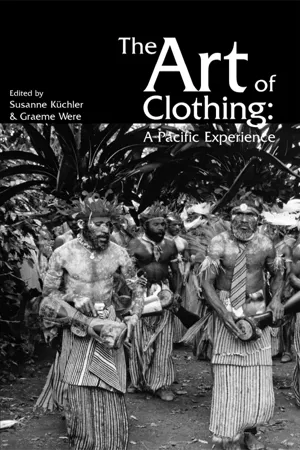
The Art of Clothing: A Pacific Experience is a collection of richly textured and tremendously engaging empirical studies of cloth and clothing in colonial and post-colonial Pacific contexts. By challenging readers to reconsider the very nature of the materiality of clothing, the editors productively situate this volume at the intersection of a number of ongoing interdisciplinary projects that are coalescing around an interest in cloth and clothing. The book as a whole speaks lucidly to issues of current concern in a wide range of academic fields - including cultural studies, material culture, Pacific history, art history, history of religions, and museum studies.
eBook - ePub
The Art of Clothing: A Pacific Experience
- 202 pages
- English
- ePUB (mobile friendly)
- Available on iOS & Android
eBook - ePub
The Art of Clothing: A Pacific Experience
About this book
Information
CHAPTER 1
THE HAZARDS OF NEW CLOTHES: WHAT SIGNS MAKE POSSIBLE1
As the people of the Pacific took on new forms of dress, they might well have been advised to consider these words from early in Henry David Thoreau’s book Walden, or Life in the Woods: ‘I say, beware of all enterprises that require new clothes, and not rather a new wearer of clothes’ (Thoreau 1971: 23). I want to start with this admonition since it seems appropriate – dare I say ‘fitting’? – for several reasons. Written in 1854, these words speak to us from the heyday of the missionary endeavour. Voicing Thoreau’s version of New England Transcendentalism, with its roots in Puritanism and ties to Universalism, they issue – however idiosyncratically – from the heart of Protestant modernity in a form that will be especially familiar to many of us today. It is perhaps no accident that, at least in America, Thoreau was revived as a guru in the Sixties when the likes of Henry Ward Beecher, Bronson Alcott and William Ellery Channing had long been forgotten.
Thoreau identified himself with the great philosophical traditions of renunciation and the radical return to foundations. But in contrast to those, his was informed by a certain utilitarianism. We identify what should be renounced by discovering what is functionally necessary and strip away everything else as superfluous luxury. ‘The object of clothing,’ he wrote, ‘is, first, to retain the vital heat, and secondly, in this state of society, to cover nakedness’ (Thoreau 1971: 21). Note the order in which he expresses these functions, and the qualification. A stricter theologian would insist that we are naked in any society, and even when alone. Thus, when Erasmus advised children on good bodily conduct in the 16th century, he reminded them that the angels are always watching (Elias 1994: 106). But Thoreau relativises the claims of modesty to ‘this state of society’ – to a particular historical moment, and to the presence of other persons.
And so Thoreau’s moralism dwells not on modesty, as it might have, but on the ways in which clothing marks social distinctions, subjects us to the vagaries of fashion, and displaces our proper concern with our spiritual condition. He writes: ‘there is greater anxiety, commonly, to have … clean and unpatched clothes, than to have a sound conscience’ (Thoreau 1971: 22). Clothes form a material outside that distracts us from the spiritual inside, with the result that, in Thoreau’s words, ‘We know but a few men, a great many coats and breeches’ (Thoreau 1971: 22). In this ironic rhetoric, we may hear something in common with the words of Thoreau’s junior by one year, Karl Marx. Recall how Marx famously appropriated ‘fetishism’, a concept that had until then been restricted to comparative religion, in order similarly to accuse his contemporaries of inverting the proper relations between animate and inanimate things.2
But there is more. Caring about clothing gives us over too much to the opinion of others. Thoreau’s discussion of clothing ends with an attack on fashion (Thoreau 1971: 25), which forces us to acknowledge the authority of others, whether that be the distant arbiters of style or the opinion of our neighbours. For Thoreau, the distinction between inner and outer provides ontological support for his individualism, which sees in social relations a threat to personal authenticity. For both Thoreau and Marx, despite their obvious political differences, the misapprehension of material things is not merely a mistake – it has grave consequences. It leads us to invert our values, imputing life to the lifeless, and thereby losing ourselves.
Thoreau’s remarks about clothing express some assumptions about clothes in the world from which the first missionaries took sail to the Pacific. They reveal an important link between the 19th century Protestant world of white churches, plain meeting houses and sincere speech, and the high modernist aesthetic of, say, the Austrian architect Adolf Loos a half century later. Thoreau would surely have welcomed Loos’s assertion that ‘the evolution of civilization is tantamount to the removal of ornament from objects of use’ (quoted in Gell 1993: 15) with its celebration of function over appearance, and rejection of surfaces not just as superfluous, but as immoral.
We can find that quotation from Loos, by the way, in Alfred Gell’s brilliant book on Polynesian tattooing, Wrapping in Images (1993). Gell’s spirit surely hovers over the contributors to this book. For if the authors are animated by one shared, underlying concern beyond their regional speciality, it is perhaps in their efforts to go beyond certain intellectual habits. These habits were summarised by Nicholas Thomas (drawing in turn on Marilyn Strathern, for example, 1979, 1988) when he criticised anthropology for having ‘continually reduced material artefacts to other relations or meanings in which they are embedded; our interpretations treat the objects as no more than an illustration of things that are external to it’ (Thomas 1999: 5). I want to pursue this thought today, and suggest how clothing exemplifies certain general problems in the analysis of material culture.
My central claim is this: if we still find it difficult to treat objects as no more than illustrations of something else, as, say, communicating meanings or identities, it is because we remain heirs of a tradition that treats signs as if they were merely the clothing of meaning, meaning that, it would seem, must be stripped bare. As this tradition dematerialises signs, it privileges meaning over actions, consequences and possibilities. Yet we must be wary of merely reversing this privilege and thereby inadvertently reproducing the same dichotomy. Drawing on concepts such as indexicality and semiotic ideology, I’d like to suggest some alternatives.
Thoreau’s spiritualism is most like Loos’s modernism when he dwells on clothing as superficial luxury. He rather ducks the problem raised by modesty, that by concealing our skin, clothing reveals our morality. But herein lies a persistent tension in missionary efforts to clothe the naked. For in covering our nakedness and directing attention to our artificial surface, clothing threatens to supplant us. Mission history across the colonial world shows a persistent and troubling tension between the hope that clothing will change people, and the danger that people once clad will invest their clothing with too great a significance (Comaroff and Comaroff 1997: 223; Hansen 2000: 26, 30–32; Spyer 1998). On the one hand, proper dress is essential to the inculcation of modesty, propriety and civility. Yet how much should one hope clothing will transform people? Not so much that they forget it is but a surface that can be removed. There are many dangers. They may, for instance, become frivolous and vain, or embark on new forms of fashion and status competition. Colonial writing is replete with depictions of dandified or otherwise ridiculous natives. Morality thus depends on the correct understanding of the materiality of things and the immateriality of persons.
Protestantism often sees itself as treading the middle way between two extremes: a disregard for clothing on the one hand, and excessive regard for it on the other. This is quite evident, for example, in the Dutch colonial Indies. If the pagans of Kalimantan, Sulawesi, or Maluku were insufficiently clad, the most orthodox Muslims of, say, Sunda and Aceh were too much so.3 Like Goldilocks, the judicious Christian should accord to clothing neither too little importance, nor too much, but just enough – a balancing act that invites perpetual anxiety.
Writing about Calvinist missionaries in the colonial Dutch East Indies, I have argued elsewhere that matter and materialism pose special difficulties for mainstream Protestants (Keane 1996). The effort to regulate certain verbal and material practices, and the anxieties that attend them, centre on the problem of consolidating a human subject that is at its core independent of, and superordinate to, the world of mere dead matter. What for anthropologists is a problem of social and cultural analysis – how to understand material things within human society – is faced by these missionaries as a practical problem: how to free humans from false relations to things as in fetishism, animism or naturalistic materialism. This view of signs has roots in an ontology that goes back before either Protestantism or modernity, to be sure, but it reaches a particularly strong and influential expression in their alliance, as expressed by Thoreau and Loos. And this model of the sign underlies much of both missionary endeavours and our own social and cultural theories.
Of course it is hardly news to the authors in this book that clothing is more than a matter of ‘mere appearances’, and that we should be circumspect about purported distinctions between ‘inner’ and ‘outer’. But I think we still have not sufficiently appreciated the extent to which this perception of clothing is rooted in a deeper set of semiotic assumptions and habits. Here I want to trace out some of the ways in which our discussion of clothing can be brought to bear on a rethinking of the concept of the sign in support of a more historically minded study of material culture.
To take clothes in particular, and objects more generally, as expressions of meanings that really lie elsewhere, is to depend on certain assumptions not just about objects, but about signs. Clothing seems most superficial to those who take signs to be the clothing of immaterial meanings. Like clothing, in this view, the sign both reveals and conceals, and serves to mediate relations between the self and others. These are the very grounds on which Thoreau and many other Protestants and modernists are suspicious of clothing and often of semiotic mediation altogether. In unmediated transparency they hope to discover unvarnished souls and naked truth. Here we have an example of what can be called representational economy. By representational economy, I mean the interconnections among different modes of signification. For instance, I have argued elsewhere that the ways in which people handle and value material goods may be implicated in how they use and interpret words, and vice versa (Keane 1996, 1997a, 2001, 2002). Their treatment of things and words both reflect certain underlying assumptions about the world and the beings that inhabit it. Such assumptions, for instance, will determine how one distinguishes between subjects and objects, with implications for what will or will not count as a possible agent – and thus, for what is a good candidate for being an intentional communication. Historically, changes in one will be reflected in changes in the other. Thus, they enter into a larger economy of mutual, often unexpected consequences.
Do new garments make a prince of a pauper? A woman of a man? It is not only missionaries who are unsettled by the question: how much change ought we to expect from a change of clothes? Transvestism, after all, is serious business. In Indonesia, the capacity of Buginese bissu to mediate between the world of the living and the dead, for instance, requires mixed-gendered dressing. And certainly new historical ambitions seem to demand new clothes. Across the Malay world, to convert to Islam required that one take on new kinds of clothing and food regulations, which is one reason people figured the same must be true of Christianity (Aragon 2000; Kipp 1993; Taylor 1997). Many Sumbanese assumed they needed Western clothes if they were to convert, despite the protestations of the Dutch missionaries; some still refer to this assumption today. By the end of the 19th century, young nationalists in the more urban parts of the Dutch East Indies were asserting their modernity and new capacities through sartorial transformations (Schulte Nordholt, 1997, especially the chapters by van Dijk, Danandjaja, Mrázek and Taylor). Numerous memoirs by members of the first generations of nationalists hinge on the moment in which they first acquired shoes and slacks (notably, women did not follow suit until well into the 20th century). Efforts in the 1930s by the Indonesian nationalist party to imitate Gandhi’s swadeshi movement, and clothe its adherents in locally produced, indigenous styles, failed as the leaders persisted in their love of white suits, ties and well polished shoes. When Sukarno was held by the Dutch during the war of independence in the 1940s, the prisoners were allowed a few requests. His companions asked for books and newspapers. Sukarno, however, asked for a new Arrow shirt (Schulte Nordholt 1997:19, n 17). Can we separate his leadership from such embodiments, which set the national fashion for men: Western suit jackets without ties, and black pici, Muslim caps?
Do such examples simply boil down to mere emblems of identity? I think not. Too much of the subjective pain and expectation of history centres on changes of dress. From Sumba to Sumatra, we find people’s single most vivid recollection of the Japanese occupation during the Second World War was often not the violence, the hunger, the fear, but rather the disappearance of textiles and return to bark cloth. In Sulawesi, one man is reported to have refused to give up his tattered sarong in exchange for a cow (Aragon 2000: 144–45). I doubt anyone with those humiliating memories would consider clothing a mere surface.
We needn’t look only to historical crises to see the power of new clothes. Think of how much anthropological fieldwork has depended on the hoped for – or feared – effects of cultural transvestism. My own experience is perhaps exemplary of the disquiet the question can provoke. Some mix of a life-long aversion to exposing my bony knees, and a postcolonial discomfort with the images of TE Lawrence clad as an Arab and Frank Hamilton Cushing as a Zuni, made me at first wary of donning Sumbanese dress. Most Sumbanese men wear a hinggi (in some dialects, regi), a rectangular cloth wrapped around the waist and upper thighs. It is held in a loose bundle with some assistance from a belt, one end left to hang down between the legs. The longer it hangs (yes, I’m afraid it’s true), the higher the man’s status claims. A smaller length of cloth (called a rowa) is wrapped around the head; different modes of tying facilitating a remarkable range of self-expression, far wider than that afforded by the tilt of a hat, and more adjustable than that of a haircut (see Keller 1992). Both above and below, I found all this a terribly insecure arrangement, threatening to expose, at the very least, my incompetence if not more.4 My companions, however, would not let me get away even with such compromises as long pants under a symbolic waistcloth. With the sharp command paborungumu! (‘gird your loins!’), they insisted I dress properly. And so I did. Yet, after two years I still hadn’t come to feel entirely at home in this dress. And by sheer material logic I suffered from an additional impropriety: given my long legs and the size of the locally available cloth, I was forced to show myself at the lowest end of social order, or else leave so little material for securing it around my waist that I was at even greater risk of having the whole thing fall off me.
Beware all enterprises that require new clothes indeed. The experience of comfort and discomfort has little to do with meaning, expression, identity, nor even, as Marcel Mauss (1979) would remind us, with some universal phenomenology of bodily experience. After all, most Sumbanese men feel at least as uncomfortable in pants and shoes (kalabi jiawa: foreign clothing) as I did in regi and rowa. No surprises here: we drape ourselves in habit, competence and constraint – with what clothing makes possible. Sumbanese cloth allows the comforting gesture of draping it protectively around oneself, as they say, like a hen huddled against the rain. The man’s waistcloth leaves legs free to straddle a horse, his headcloth is good for everything, from wiping sweat off the neck to transmitting magical power (I knew one man who, as a child, was brought back from death when his father slapped him with his headcloth). Men and women’s clothing has no pockets – another source of my discomfort – but special objects can be hidden in their folds and the very insecurity of this draping can be played to advantage. One man told me how he got rid of a powerful talisman that, while useful, was becoming dangerous. Knowing it would be even more dangerous were he intentionally to dispose of it, he folded it into his waistcloth and started on a long, cross-country trip. Somewhere, perhaps in crossing a river, the talisman was lost, as it were, accidentally on purpose. We could say he thereby elicits the very agency of the thing.
We should bear in mind the plasticity of the sense of comfort. Patricia Spyer (1998) points out that Dutch colonial observers sometimes exaggerated the discomfort of Aruese in western clothes, as if to insist on the irredeemable difference of native bodies, and on the limits of what new clothing could achieve. Indonesia’s early nationalists struggled against these limits. Henk Schulte Nordholt remarks: ‘Wearing a western suit with tie did facilitate a handshake instead of a humble sembah (a respectful Javanese gesture of greeting), and wearing trousers did lend itself to sitting on a chair instead of being seated on the floor’ (Schulte Nordholt 1997: 15). And today’s national s...
Table of contents
- Cover
- Half Title
- Title Page
- Copyright Page
- Table of Contents
- Acknowledgments
- List of Contributors
- Preface – Nicholas Thomas
- List of Illustrations
- Introduction – Susanne Küchler & Graeme Were
- 1 The Hazards of New Clothes: What Signs Make Possible
- PART I: CLOTHING AS THE ART OF INNOVATION
- PART II: CLOTHING AND THE PERFORMANCE OF TRANSLATION
- PART III: FASHIONING MODERNITIES
- EPILOGUE
- Index
Trusted by 375,005 students
Access to over 1.5 million titles for a fair monthly price.
Study more efficiently using our study tools.
Frequently asked questions
Yes, you can cancel anytime from the Subscription tab in your account settings on the Perlego website. Your subscription will stay active until the end of your current billing period. Learn how to cancel your subscription
No, books cannot be downloaded as external files, such as PDFs, for use outside of Perlego. However, you can download books within the Perlego app for offline reading on mobile or tablet. Learn how to download books offline
Perlego offers two plans: Essential and Complete
- Essential is ideal for learners and professionals who enjoy exploring a wide range of subjects. Access the Essential Library with 800,000+ trusted titles and best-sellers across business, personal growth, and the humanities. Includes unlimited reading time and Standard Read Aloud voice.
- Complete: Perfect for advanced learners and researchers needing full, unrestricted access. Unlock 1.5M+ books across hundreds of subjects, including academic and specialized titles. The Complete Plan also includes advanced features like Premium Read Aloud and Research Assistant.
We are an online textbook subscription service, where you can get access to an entire online library for less than the price of a single book per month. With over 1.5 million books across 990+ topics, we’ve got you covered! Learn about our mission
Look out for the read-aloud symbol on your next book to see if you can listen to it. The read-aloud tool reads text aloud for you, highlighting the text as it is being read. You can pause it, speed it up and slow it down. Learn more about Read Aloud
Yes! You can use the Perlego app on both iOS and Android devices to read anytime, anywhere — even offline. Perfect for commutes or when you’re on the go.
Please note we cannot support devices running on iOS 13 and Android 7 or earlier. Learn more about using the app
Please note we cannot support devices running on iOS 13 and Android 7 or earlier. Learn more about using the app
Yes, you can access The Art of Clothing: A Pacific Experience by Susan Kuchler, Graeme Were, Susan Kuchler,Graeme Were in PDF and/or ePUB format, as well as other popular books in Scienze sociali & Studi museali. We have over 1.5 million books available in our catalogue for you to explore.