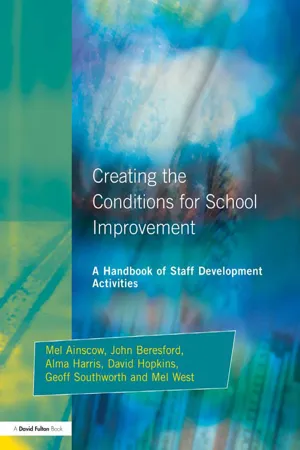
eBook - ePub
Creating the Conditions for School Improvement
A Handbook of Staff Development Activities
- 164 pages
- English
- ePUB (mobile friendly)
- Available on iOS & Android
eBook - ePub
Creating the Conditions for School Improvement
A Handbook of Staff Development Activities
About this book
First Published in 2001. This is the second edition of this school's improvement handbook of staff development activities by the IQEA (Improving Education for All) project. This book is not about what changes should be introduced into a school but rather about creating the conditions for supporting those changes which schools or individuals believe should be introduced. To be effective at managing change schools and teachers need to modify the internal conditions of the school at the same time as introducing changes in teaching or curriculum. The book therefore provides ideas and materials to help colleagues in school to create such conditions and suggests a strategic approach.
Information
CHAPTER 1
Creating the Conditions for School Improvement
When we began teaching some 20 years or so ago ‘change’ was usually about working with new curriculum materials prepared by national or local agencies. Occasionally it may have meant trying out a new teaching strategy. In either case, most of these changes were ad hoc, self-determined, single innovations which by and large individual teachers decided to work on by themselves. More recently there has not been the luxury of choice. In this country as elsewhere, the change agenda has increasingly been set by national politicians, rather than educationalists. With the centralization of educational reform, teachers have seemingly lost control of change.
Our current work principally involves working with teachers and schools as they struggle, for the benefit of their students, to reassert control over the educational agenda. We are increasingly realizing that any change, be it externally or internally inspired, will be successful only to the extent that the school creates the conditions within which change and innovation can flourish. Ignoring this key insight accounts for the failure of so much educational reform. Irrespective of the myriad of policy initiatives that currently beset us, it is only teachers who are in the position to create good teaching. But even those teachers whose work is characterized by grace and fluidity, are only able to continue to grow in strong, supportive and collaborative school cultures. We consider ourselves fortunate that over the past few years we have learned a little about what are the most effective conditions for quality teaching and the ways of creating them. It is some of this experience that we share in this book.
Who is the Book For?
In writing this book we have had in mind the teachers, or indeed groups of teachers, who have assumed responsibility for development work in their schools. It may be the head or deputy, the appraisal or curriculum coordinator, the teacher in charge of staff development or of drawing up the school’s development plan. It may even be those teachers who, although not part of the established hierarchy in the school, have a clear view of effective teaching and are taking on an informal leadership role within the school in order to share their vision with other colleagues. In short, this book is for anyone in a school who is taking responsibility for some form of development activity.
What Does the Book Do?
This book is not about what changes should be introduced into a school but rather about creating the conditions for supporting those changes which schools or individuals believe should be introduced. To be effective at managing change schools and teachers need to modify the internal conditions of the school at the same time as introducing changes in teaching or curriculum. The book therefore provides ideas and materials to help colleagues in school to create such conditions, and suggests a strategic approach.
How Should the Book be Used?
This book is not a step-by-step guide to school improvement. In our experience such ‘quick-fix’ approaches, although superficially attractive, rarely work in practice. Although schools can use similar broad approaches and strategies, there is no one way that is right for every school. Reinventing at least part of the wheel seems to be a necessary characteristic of successful school improvement. This book is therefore about recipes and ingredients rather than TV suppers. The book provides resources to be used within the context of the school’s own aspirations. Consequently a key task of those using the suggestions and materials provided here will be to decide which of them are most suitable and for what purpose.
Chapters 3–8 consist of a series of materials that can be used to organize workshop activities in schools. These activities are intended to involve groups of staff in reviewing aspects of the school’s conditions in order to support development activities. The materials include instructions for coordinators of such workshop activities, pages that might be used as overhead projector slides, and handouts that can be used to facilitate discussions.
How is the Book Organized?
As part of our work with schools we have identified six key conditions necessary for effective school improvement. The bulk of the book is taken up with describing in individual chapters what these conditions are, and in presenting staff development exercises on how they can he encouraged. Before this, in Chapter 2, we present a brief account of our current school improvement work and a rationale for the ‘conditions’ approach. At the end of the book we make some suggestions as to how a school can develop its own school improvement strategy. Some people may find it helpful to read the book cover to cover as an introduction to school improvement. Others, having a clear idea of where they are going, may wish just to plunder it for staff development activities. Both are fine by us – we hope that the book is organized sufficiently clearly to allow for both approaches, as well as those in between.
Where Do the Ideas Come From?
This book is based on our school improvement work which we have been pursuing in various guises and in different combinations of collaboration since the mid 1980s. Although we are for some of our life university teachers, we also work intensively with schools as facilitators of the change process. There are now some 100 schools in our network. As a consequence the book is grounded in practice, but also tested by reference to the available research evidence. Those who are interested in pursuing these ideas further should consult our School Improvement in an Era of Change (Hopkins et al., 1994) which gives a more theoretical discussion of our approach, and provides many practitioner accounts of school-based work on the conditions for school improvements. We have also produced a companion volume to this book that focuses in a similarly practical way on what we regard as the other key component of school improvement. We called it Creating the Conditions for Classroom Improvement (Hopkins et al., 1997).
It is appropriate however that this first handbook is about ‘creating the conditions for school improvement’. Despite the abundance of policy initiatives and change efforts, too few of them, even the good ones, actually positively affect day-to-day life in classrooms. We hope that this little book will help in some way to get those useful and helpful changes behind the classroom door.
CHAPTER 2
Improving the Quality of Education for All
In the 1990s the educational agenda was increasingly being dominated by a concern to make sense of and implement the radical reform agenda of the late 1980s. This quest for stability however was being sought against a background of continuing change, as expectations for student achievement rose beyond the capacity of the system to deliver. It also became increasingly apparent that change and improvement are not necessarily synonymous. Although it is true that external pressure is often the cause, or at least the impetus, for most educational change, this is not to imply that such changes are always desirable. Indeed in our opinion, some externally imposed change should be resisted, or at least adapted to the school’s own purpose.
As we work with schools within the framework of the national reform agenda we are committed to an approach to educational change that focuses on student achievement and the schools’ ability to cope with change. We refer to this particular approach to educational change as school improvement. We regard school improvement as a distinct approach to educational change that enhances student outcomes as well as strengthening the school’s capacity for managing change. In this sense school improvement is about raising student achievement through focusing on the teaching–learning process and the conditions which support it.
School improvement in the way that we define it is not, however, about how to implement centralized reforms in a more effective way. It is certainly not about blindly accepting the edicts of centralized policies, and striving to implement these directives uncritically. It is more to do with how schools can use the impetus of external reform to ‘improve’ or ‘develop’ themselves. Sometimes, what a school chooses to do in terms of school improvement will be consistent with the national reform agenda, at other times it will not. Whatever the case, the decision to engage in school improvement, at least in the schools that we work with, is based on clear evidence of what is the best for the young people in that school.
Since 1991 we have been working closely with some 100 schools in various parts of England and Wales, on a school improvement or development project known as Improving the Quality of Education for All (IQEA). This involves schools in working collaboratively with a group from the Institute of Education at Cambridge and, latterly, at the University of Nottingham, and representatives from their Local Education Authority (LEA), or with a local support agency such as Bramley Grange College in Leeds. The overall aim of the project is to produce and evaluate a model of school development, and a programme of support, that strengthens a school’s ability to provide quality education for all its pupils by building upon existing good practice. IQEA works from an assumption that schools are most likely to strengthen their ability to provide enhanced outcomes for all pupils when they adopt ways of working that are consistent with their own aspirations as well as the current reform agenda. At a time of great change in the educational system, the schools we are working with are using the impetus of external reform for internal purposes.
At the outset of IQEA we attempted to outline our vision of school improvement by articulating a set of principles that provided us with a philosophical and practical starting point. Because it is our assumption that schools are most likely to provide quality education and enhanced outcomes for pupils when they adopt ways of working that are consistent with these principles, they were offered as the basis for collaboration with those schools which wished to work with us. In short, we were inviting the schools to identify and to work on their own projects and priorities, but to do so in a way which embodied a set of ‘core’ values about school improvement. The principles represent both the expectation we have of the way project schools pursue school improvement, and as an aide-mémoire to ourselves. The five principles of IQEA are:
• The vision of the school (the school-in-the-future) should be one to which all members of the school community have an opportunity to contribute.
• The school will see in external pressures for change important opportunities to secure its internal priorities.
• The school will seek to create and maintain conditions in which all members of the school’s community can learn successfully.
• The school will seek to adopt and develop structures which encourage collaboration and lead to the empowerment of individuals and groups.
• The school will seek to promote the view that the monitoring and evaluation of quality is a responsibility in which all members of staff share.
We feel that these principles have a synergism – together they are greater than the sum of their parts. They characterize an overall approach rather than prescribing a course of action. The intention is that they should inform the thinking and actions of teachers during school improvement efforts, and provide a touchstone for the strategies they devise and the behaviours they adopt.
We underpin our school improvement work with a contract between the partners in the project – the school and its teachers, in some cases, the LEA or sponsoring agency, and ourselves. The contract defines the parameters of the project and the obligations of those involved to each other. It is intended to clarify expectations and ensure the climate necessary for success. In particular the contract emphasizes that all staff be consulted, that coordinators are appointed, that a ‘critical mass’ of teachers are actively involved in development work, and that sufficient time is made available for classroom observation and staff development. For our part, we coordinate the project, provide training for the school coordinators and representatives, make regular school visits and contribute to staff training, provide staff development materials, and monitor the implementation of the project. The detail of the contract expresses in our opinion the minimum commitments necessary for success:
• The decision to participate in the project is made as a result of consultation amongst all staff in the school.
• Each school designates a minimum of four members of staff as project coordinators (one of whom is the head teacher) who attend training and support meetings (the group of coordinators is known as the ‘project cadre’).
• The whole school will allocate substantial staff development time to activities related to the project.
• At least 40 per cent of teachers (representing a cross section of staff) will take part in specified staff development activities in their own classrooms. Each participating teacher will be regularly ‘released’ from teaching in order to participate in these classroom-based aspects of the project.
• Each school will participate in the evaluation of the project and share findings with other participants in the project.
From the beginning of the project we were determined that we would attempt to affect all ‘levels’ of the school. A major purpose of the contract is to ensure that this happens. One of the things that we had learned from research and our previous work is that change will not be successful unless it impacts all levels of the organization. Specifically our focus is on the three levels outlined in Figure 2.1 and the ways in which these interrelate. The school level is to do with overall management and the establishment of policies, particularly with respect to how resources and strategies for staff development can be mobilized to support school improvement efforts. At the level of working groups the concern is with working out the details of and arrangements for supporting improvement activities. Finally, at the individual teacher level the focus is on developing classroom practice.

Figure 2.1 Integrating the levels
In very effective schools these three levels of activity are mutually supportive. Consequently a specific aim of the IQEA project has to be to devise and establish positive conditions at each level and to coordinate support across these levels. It is in this connection that we require the establishment of a team of coordinators in each school whose task includes the integration of activities across the various levels. We refer to these coordinators, in association with advisory colleagues from the local authority, as the cadre. They are responsible for the day-to-day running of the project in their own school and for creating links between the ideas of the overall project and practical action. In many schools members of the cadre establish an extended cadre which serves to extend the project in a more formal way within the school.
So far we have summarized our broad approach to school improvement. There is now the conundrum of how best to support schools through this complex process. Our current thinking and practice is best summarized by describing what we do within and outside school.
Our within school work concerns the nature of our own intervention. As is by now quite...
Table of contents
- Cover
- Title Page
- Copyright Page
- Contents
- Acknowledgements
- Chapter 1 Creating the Conditions for School Improvement
- Chapter 2 Improving the Quality of Education for All
- Chapter 3 Enquiry and Reflection
- Chapter 4 Planning
- Chapter 5 Involvement
- Chapter 6 Staff Development
- Chapter 7 Coordination
- Chapter 8 Leadership
- Chapter 9 The Journey of School Improvement
- Chapter 10 Using the Conditions of School Rating Scale
- Appendix 1 Handout Sheets, OHT Masters and Materials for Activities in Chapters 3–8
- Appendix 2 The Conditions of School Rating Scale and Discussion Exercise for Chapter 9
- References
- Suggested Further Reading
- Index
Trusted by 375,005 students
Access to over 1.5 million titles for a fair monthly price.
Study more efficiently using our study tools.
Frequently asked questions
Yes, you can cancel anytime from the Subscription tab in your account settings on the Perlego website. Your subscription will stay active until the end of your current billing period. Learn how to cancel your subscription
No, books cannot be downloaded as external files, such as PDFs, for use outside of Perlego. However, you can download books within the Perlego app for offline reading on mobile or tablet. Learn how to download books offline
Perlego offers two plans: Essential and Complete
- Essential is ideal for learners and professionals who enjoy exploring a wide range of subjects. Access the Essential Library with 800,000+ trusted titles and best-sellers across business, personal growth, and the humanities. Includes unlimited reading time and Standard Read Aloud voice.
- Complete: Perfect for advanced learners and researchers needing full, unrestricted access. Unlock 1.5M+ books across hundreds of subjects, including academic and specialized titles. The Complete Plan also includes advanced features like Premium Read Aloud and Research Assistant.
We are an online textbook subscription service, where you can get access to an entire online library for less than the price of a single book per month. With over 1.5 million books across 990+ topics, we’ve got you covered! Learn about our mission
Look out for the read-aloud symbol on your next book to see if you can listen to it. The read-aloud tool reads text aloud for you, highlighting the text as it is being read. You can pause it, speed it up and slow it down. Learn more about Read Aloud
Yes! You can use the Perlego app on both iOS and Android devices to read anytime, anywhere — even offline. Perfect for commutes or when you’re on the go.
Please note we cannot support devices running on iOS 13 and Android 7 or earlier. Learn more about using the app
Please note we cannot support devices running on iOS 13 and Android 7 or earlier. Learn more about using the app
Yes, you can access Creating the Conditions for School Improvement by Mel Ainscow,John Beresford,Alma Harris,David Hopkins,Geoff Southworth,Mel West in PDF and/or ePUB format, as well as other popular books in Education & Education General. We have over 1.5 million books available in our catalogue for you to explore.