eBook - ePub
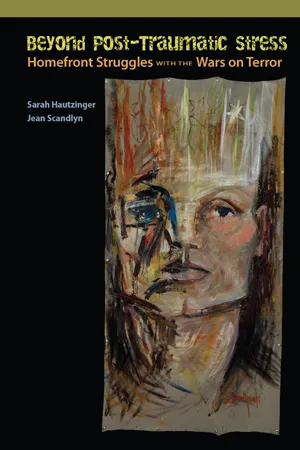
Beyond Post-Traumatic Stress
Homefront Struggles with the Wars on Terror
- 318 pages
- English
- ePUB (mobile friendly)
- Available on iOS & Android
eBook - ePub
Beyond Post-Traumatic Stress
Homefront Struggles with the Wars on Terror
About this book
When soldiers at Fort Carson were charged with a series of 14 murders, PTSD and other "invisible wounds of war" were thrown into the national spotlight. With these events as their starting point, Jean Scandlyn and Sarah Hautzinger argue for a new approach to combat stress and trauma, seeing them not just as individual medical pathologies but as fundamentally collective cultural phenomena. Their deep ethnographic research, including unusual access to affected soldiers at Fort Carson, also engaged an extended labyrinth of friends, family, communities, military culture, social services, bureaucracies, the media, and many other layers of society. Through this profound and moving book, they insist that invisible combat injuries are a social challenge demanding collective reconciliation with the post-9/11 wars.
Information
PART I: SOLDIERS COMING HOME
Chapter 1
“PTSD = Pulling the Stigma Down”
No one ever really gets used to nightmares.
—Mark Z. Danielewski, House of Leaves
I am not a fool. I am wise. I will run from my fear, I will outdistance my fear, then I will hide from my fear, I will wait for my fear, I will let my fear run past me, then I will follow my fear, I will track my fear until I can approach my fear in complete silence, then I will strike at my fear, I will charge my fear, I will grab hold of my fear, I will sink my fingers into my fear, then I will bite my fear, I will tear the throat of my fear, I will break the neck of my fear, I will drink the blood of my fear, I will gulp the flesh of my fear, I will crush the bones of my fear, and I will savor my fear, I will swallow my fear, all of it, and then I will digest my fear until I can do nothing else but shit out my fear. In this way I will be made stronger.
—Mark Z. Danielewski, House of Leaves
On a bright, sunny April morning, we sat in an auditorium in the newly completed battalion headquarters at Fort Carson among rows of seated enlisted men and women dressed in pixilated camouflage army combat uniforms, sitting silently or chatting quietly among themselves as they waited for a predeployment training program. When the lead trainer concluded the introductory slide presentation, a man in his mid-thirties, who had a buzz cut and was dressed in khakis and a button-down shirt, strode to the front of the room. Soldiers sat up straighter or leaned forward, focusing on this man as he energetically paced back and forth before us, declaring, “The media tells you, ‘War is going to fuck you up. You will come back harmed.’ Well, I am here to tell you that war is the most adverse environment you will ever encounter, but you can come back stronger and wiser.”
This statement opened the exercise segment of a training experiment for this combat brigade that would deploy to Afghanistan in a few weeks. The commanding colonel had embraced this new program, which promised to increase soldiers’ performance, strength, and resilience during deployment. A professional athlete turned sports psychologist designed the training, which his for-profit company provided under contract to the army. The program combined a basic explanation of neurophysiology with meditation, visualization, breath-control exercises, and techniques from sports psychology. Enhancing their credibility and identification with active-duty soldiers, five members of the training team were ex-military personnel who had deployed to Iraq or Afghanistan. The program’s creator emphasized the importance of stress and adversity, “We need stress in our lives—we cannot learn new skills without stress.” He explained that the training would provide stress and adversity in a controlled setting so that they would be ready for “the real shit.” “You must metabolize it [stress] so that it feeds you versus breaking you down. It’s bad when you don’t have resilience and it breaks you down.”
The unit’s commander had invited journalists and other public affairs contacts to the training, to show that they were taking active measures to address combat stress injuries. After receiving negative media attention for criminal violence committed by soldiers from this brigade, the commanding officer was understandably concerned that his brigade would return with as few mental health casualties as possible.
We begin our discussion of the army’s effort to attend to post-traumatic stress disorder (PTSD) with this episode from our fieldwork because it took place prior to the brigade’s deployment to Afghanistan. We have come to associate its emphasis on neurophysiological responses to combat on the one hand, and resilience, strength, and self-discipline in response to its stressors on the other hand, with the shifting terrain of discourse around these issues. Although military clinicians still provided trainings on recognition and treatment of PTSD, traumatic brain injury (TBI), and suicidal ideation, discussions increasingly included statements about soldiers’ “normal” responses to war. Beginning with the brigade combat team’s (BCT’s) deployment to Afghanistan and expanded to seven additional posts in 2011, the army deployed combat stress and mobile behavioral health teams with combat units, teams designed to head off short-term difficulties during combat to prevent them from becoming long-term problems when soldiers returned home (Carabajal 2011).
This story illustrates one of the central dilemmas the army faces as it deals with mental health issues. The therapeutic and civilian communities widely accept the diagnosis of PTSD as a risk and consequence of exposure to combat. The fact that it is so widely accepted represents a significant achievement of Vietnam War veterans and their advocates to recognize, treat, and compensate veterans for the suffering they experienced. Yet, despite the army’s concerted efforts to change the social meaning associated with PTSD, it remains stigmatized and problematic in the military. For Brigadier General Loree Sutton, who founded the Defense Centers of Excellence for Psychological Health and Traumatic Brain Injury (DCoE), it is stigma itself that is the major problem. The title for this chapter, “PTSD = Pulling the Stigma Down,” comes from Battlemind, a program of the DCoE designed to reduce stigma associated with soldiers’ seeking help for mental and emotional problems.1 In our interviews, we found that many active-duty soldiers and officers resisted and challenged the diagnosis of PTSD even if they accepted it as a valid explanation for responses to the trauma of war. Instead, army personnel prefer to focus on “combat stress,” a condition that has developed in parallel with the psychodynamic concepts that underlie PTSD, but that is more consonant with military institutions and culture.
Warrior Ethos
A formative moment in this fieldwork came while sitting with the brigade’s commander Scott Holmes. “We’ll figure out how to deal with PTSD,” he told us. “We figured out racial integration; we figured out integrating women—we’re the army, figuring things out is what we do. And we WILL figure this out, guaranteed. You watch.” One of the most interesting aspects of working in army settings with army personnel, particularly its leaders, is how frequently they invoke the concept of culture. Officers and mental health providers explicitly reference “army culture” and “creating cultural shifts.” Whereas anthropologists view culture as difficult to define, multifaceted, and only one factor of many that determines human behavior, military leaders, like the commander cited here, generally take a more mechanistic or technocratic approach. Desperate to solve the problem of PTSD, they grabbed onto culture as something they might “operationalize” to solve it.
Like culture itself, the military is a dynamic social institution. During our fieldwork we have been struck by how experimental, even innovative, the army can be in some practices while simultaneously being very conservative in terms of values and norms. Because of its hierarchical structure and legitimated authority, the army can effect sweeping organizational changes quickly. In 1948, President Harry S. Truman issued an executive order that established equal treatment and opportunity for all individuals regardless of race, religion, or national origin in all branches of military service, and the first enlisted women entered the regular army. This order preceded the Civil Rights Act (1964) by 16 years (MacGregor 1981).
However, the military also shares US cultural ideas; for example, those that divide gender into dichotomous categories of male and female, men and women. In everyday life and social interactions, gender may be less rigidly divided today, with people accepting a greater mix of qualities and characteristics once identified as stereotypically masculine and feminine. Army personnel are trained to be very careful in speaking of “males” and “females.”2 But the categories and stereotypes persist, and the military remains a highly gendered institution. The use of force and physical strength and the suppression of fear and emotional toughness are associated with men and masculinity and are highly valorized. Military occupations that require these qualities carry more prestige. So although infantry soldiers have the least status in rank and organizational prestige, their role in combat is more highly valued than those who serve to support them in clerical and housekeeping roles. Mutual stereotypes abound of the soldier with a desk job afraid to leave the protection of the base and the infantry soldier too dumb to stay out of harm’s way. Soldiers also draw on public discourses about sexuality, gender, and power to enact and enforce this hypermasculine ideal, and this valuation persists regardless of whether a man or a woman occupies that role. One Iraq War veteran told us of several women soldiers who volunteered to carry the bodies of dead Iraqis, proud of their bloodied uniforms because they were visible signs that they had been near “real action.”
The army’s core values, “loyalty, duty, respect, selfless service, honor, integrity, and personal courage,”3 which constitute a key element of army culture, remain relatively constant over time, but the expression and emphasis on those core values and how they are woven together at any given historical moment reflect political, economic, and social forces in the larger society. Recruiting ads are one reflection of changing public conceptions of military service. In 2006, well into the Iraq War, as the army struggled to meet its quotas for new recruits and the all-volunteer force (AVF) was stretched thin fighting on two fronts, the army launched its new advertising campaign, “Army Strong.”4 In the first Army Strong ad from October 2006, a movie-score theme that signals an impending battle builds in intensity as references to Webster’s definition of “strong” and allusions to biblical passages from Ecclesiastes emerge on a black screen. Technology is ever present in the background, while soldiers, diverse in gender, race, and ethnicity, populate the foreground. In contrast to the earlier ads, the Army Strong campaign transforms soldiers from civilians to warriors. Several of the ads feature recitation of the army’s core values as stated in the Warrior Ethos, the army’s official statement of the principles a soldier should uphold. “I will always place the mission first. I will never accept defeat. I will never quit. I will never leave a fallen comrade.”5
As part of its definition of strength, the new campaign incorporated the phrase “the strength to get yourself over,” voiced over the image of a soldier climbing over a wall on an obstacle course, and “the strength to get over yourself,” voiced over an image of a soldier reaching down to help another soldier over the same wall [emphasis ours]. From the first day of basic training through discharge, the military fosters team spirit or esprit de corps, camaraderie, and strong bonds among soldiers. Commitment to the group and its mission over individual needs, even when a soldier is injured, and accepting responsibility for others—“I will never leave a fallen comrade behind”—are actively fostered in military drills and training.
Whereas officers and politicians may invoke freedom and democracy to motivate their citizens to war, soldiers say that in the midst of a battle they fight for their fellow soldiers, their buddies. Soldier Wilson Lemmons said, “Whatever the American government’s agenda is, I don’t care, but when we get there it’s about taking care of each other and our mission to protect the people.”6 For the infantrymen we interviewed, this bonding was explicitly about heterosexual brotherhood, as their battalion’s previous nickname, “The Band of Brothers,” shows. These bonds are essential to getting soldiers to willingly face death, to be effective in achieving their military goals, and to minimize injuries and deaths. As Kelsoe Fitzgerald said:
I really do feel sorry for all of these new soldiers that we get … that didn’t deploy with us, because … yeah, they’re part of the unit, but they’re not necessarily part of the group…. But us guys that just got off this deployment, we’re real tight knit…. We’re like brothers.
As the commander stated, the army is all about solving problems, and its leaders recognize that merely setting out a statement of values will not necessarily instill them in its personnel. The warrior ethos is a core feature of basic training: it is implemented in tasks, drills, and after action reviews (AARs), and it is reinforced through the recounting of “historical deeds and vignettes” of soldiers who have lived and died by its principles (Riccio et al. 2004:12). Upon completing the initial values class in basic training, soldiers receive cards and a set of dog tags printed with the army values and warrior ethos (Rogers 2004). At Fort Carson, reminders of army values abound. At the first traffic circle past the main gate to Fort Carson, a large sign notifies military personnel, residents, and visitors that army values are enforced. A series of signs, each one listing one of the seven army values, lines the winding road leading to Evans Hospital.
PTSD versus TBI and the Mind-Body Dichotomy
For military personnel serving in Iraq, and to a lesser degree in Afghanistan, exposure to blasts from improvised explosive devices (IEDs) accounts for 40 percent of deaths and 40 percent of traumatic brain injuries (Elder and Cristian 2009). An IED creates an “overpressure blast wave” that can reach a considerable distance from the site of the explosion to shear and tear brain tissue even when the skull remains intact. Among civilians, a TBI diagnosis is often made by correlating a careful history of the event and assessment of the physical forces involved with observed symptoms. This task is made more difficult among soldiers in combat, as they often experience co-occurring injuries related to the blast; for example, motor vehicle accidents, wounds from shrapnel or other flying objects, or blunt force trauma from being thrown against solid objects.
Many soldiers fail to report episodes when they lose consciousness briefly. In the confusion following a blast, soldiers may not realize that they have lost consciousness momentarily or may not realize they are confused or disoriented as they concentrate on securing the area and taking action. They may be shocked to realize that they are okay or only mildly affected by the blast, often feeling guilty that they survived while others did not. So they focus on their buddies who were injured or killed, minimizing their own possible exposure and injuries. Some clinicians advocate retaining the term “concussion” over “mild TBI” because they expect full recovery from brain injuries at that level. One of the difficulties with mild TBI or concussions is that full recovery depends on adequate rest following injury. Officers may be reluctant to keep a soldier off duty for the recommended month, and soldiers may not want to be removed from activity duty for that long. So even when a mild brain injury is recognized, soldiers, especially those in frontline positions, may not receive adequate rest for full recovery.7

FIGURE 2. The Hello Dorothy Art Collective created alternative versions of these common children’s toys (photo used with permission).
The soldiers we interviewed considered both PTSD and TBI medical diagnoses that require professional assessment and treatment. They also differentiated TBI from PTSD. They defined TBI as a physical injury to the brain resulting from exposure to physical force, such as an IED blast, in contrast to PTSD, which they defined as a mental or psychological condition. Their definitions and statements about TBI describe both the source of the trauma and its effects on the brain in specific and often vivid terms and, in general, match medical definitions of the injury. In comparison, soldiers’ descriptions of PTSD are generalized and vague. Reinforcing the contrasting physical and mental sources of these conditions, soldiers see TBI as something for which reliable medical tests exist, as soldier Winston Wells commented: “TBI is actual physical trauma to your brain. PTSD is more of a mental thing, still in your head but you can’t really do an MRI to see PTSD.” Or as Scott Roberts explained it, “TBI is where your brain actually completely gets jarred in your skull, or your nervous system detaches from your brain and you start losing mobility. So it’s more of a physical thing. PTSD is more of a mental condition.” Clearly these soldiers use the mind-body dichotomy to understand and explain TBI and PTSD.8
The dichotomy between mind and body is significant because it affects how Americans attach social meaning to illnesses and their diagnosis and treatment. Biomedicine9 privileges the physical body as the site of illness and the focus of treatment. We understand the body through science, and science is based on understanding the material world, which includes our physical bodies. Thus, illnesses or trauma with a direct and observable or identifiable physical and material source or cause are “real” in a way that mental and cognitive illnesses and trauma may not, or cannot, be. As neuroscience advances our understanding of the physical nature and functions of the brain and nervous system, mind and body converge and disorders previously considered “in the mind” or in a person’s behavior become based in the body as well. This is the case with TBI. Whereas physicians and lay people have long recognized the physical effects of major trauma to the head, the association of milder and repeated head trauma with behavioral, emotional, and cognitive changes is relatively new. Although the pub...
Table of contents
- Cover
- Half Title
- Title Page
- Copyright Page
- Table of Contents
- List of Illustrations
- Preface
- Acknowledgments
- Introduction–Sharing War: A View from Home
- Part I Soldiers Coming Home
- Part II War’s Labyrinth at Home
- Part III Dialog
- Notes
- References
- Index
- About the Authors
Trusted by 375,005 students
Access to over 1.5 million titles for a fair monthly price.
Study more efficiently using our study tools.
Frequently asked questions
Yes, you can cancel anytime from the Subscription tab in your account settings on the Perlego website. Your subscription will stay active until the end of your current billing period. Learn how to cancel your subscription
No, books cannot be downloaded as external files, such as PDFs, for use outside of Perlego. However, you can download books within the Perlego app for offline reading on mobile or tablet. Learn how to download books offline
Perlego offers two plans: Essential and Complete
- Essential is ideal for learners and professionals who enjoy exploring a wide range of subjects. Access the Essential Library with 800,000+ trusted titles and best-sellers across business, personal growth, and the humanities. Includes unlimited reading time and Standard Read Aloud voice.
- Complete: Perfect for advanced learners and researchers needing full, unrestricted access. Unlock 1.5M+ books across hundreds of subjects, including academic and specialized titles. The Complete Plan also includes advanced features like Premium Read Aloud and Research Assistant.
We are an online textbook subscription service, where you can get access to an entire online library for less than the price of a single book per month. With over 1.5 million books across 990+ topics, we’ve got you covered! Learn about our mission
Look out for the read-aloud symbol on your next book to see if you can listen to it. The read-aloud tool reads text aloud for you, highlighting the text as it is being read. You can pause it, speed it up and slow it down. Learn more about Read Aloud
Yes! You can use the Perlego app on both iOS and Android devices to read anytime, anywhere — even offline. Perfect for commutes or when you’re on the go.
Please note we cannot support devices running on iOS 13 and Android 7 or earlier. Learn more about using the app
Please note we cannot support devices running on iOS 13 and Android 7 or earlier. Learn more about using the app
Yes, you can access Beyond Post-Traumatic Stress by Sarah Hautzinger,Jean Scandlyn in PDF and/or ePUB format, as well as other popular books in Scienze sociali & Antropologia. We have over 1.5 million books available in our catalogue for you to explore.