- 464 pages
- English
- ePUB (mobile friendly)
- Available on iOS & Android
eBook - ePub
About this book
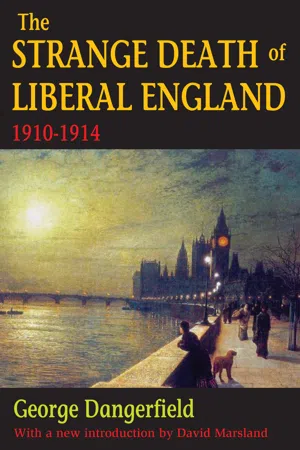
This book focuses on the chaos that overtook England on the eve of the First World War. Dangerfield weaves together the three wild strands of the Irish Rebellion (the rebellion in Ulster), the Suffragette Movement and the Labour Movement to produce a vital picture of the state of mind and the most pressing social problems in England at the time. The country was preparing even then for its entrance into the twentieth century and total war.Dangerfield argues that between the death of Edward VII and the First World War there was a considerable hiatus in English history. He states that 1910 was a landmark year in English history. In 1910 the English spirit flared up, so that by the end of 1913 Liberal England was reduced to ashes. From these ashes, a new England emerged in which the true prewar Liberalism was supported by free trade, a majority in Parliament, the Ten Commandments, but the illusion of progress vanished. That extravagant behavior of the postwar decade, Dangerfield notes, had begun before the war. The war hastened everything - in politics, in economics, in behavior - but it started nothing.George Dangerfield's wonderfully written 1935 book has been extraordinarily influential. Scarcely any important analyst of modern Britain has failed to cite it and to make use of the understanding Dangerfield provides. This edition is timely, since the year 2010 has seen a definitive resurrection of Liberal power. Subsequent to the General Election of July 2010 the government of the United Kingdom has been in the hands of a Conservative/Liberal Democrat coalition. The Deputy Prime Minister is the leader of the Liberal Democratic Party - the direct successor of the old Liberal Party examined by Dangerfield. Five Liberal Democrat members of Parliament were appointed to the Cabinet and there are Liberal Democrat ministers in all governmental departments. After decades of absence from government power, Liberalism seems to be back with a vengeance.
PART I
Their Lordships Die in the Dark
May, 1910—August, 1911
”The question is, shall we perish in the dark, slain by our own hand, or in the light, killed by our enemies.” Lord Selborne, in the House of Lords, August 10, 1911.
Chapter One
THE COMET
I
THE Right Honorable Herbert Henry Asquith was enjoying a brief holiday on the Admiralty yacht Enchantress, bound for the Mediterranean on some pleasant excuse of business. He had put in at Lisbon to dine with King Manoel of Portugal, and his reception in this pre carious capital had been very gratifying. The Enchantress then headed for Gibraltar, and was rolling its valuable political freight about halfway between that rock and Cadiz when news was received that Edward VII was seriously ill. The yacht turned hurriedly and made for home, and was well past the Bay of Biscay when, at three in the morning of May 7, 1910, a second message arrived. “I am deeply grieved to inform you that my beloved father the King passed away peacefully at a quarter to twelve tonight (the 6th). GEORGE.”
The Prime Minister, sad and shaken, went up on deck and stood there, gazing into the sky. Upon the chill and vacant twilight blazed Halley’s Comet—which, visiting the European heavens but once in a century, had arrived with appalling promptness to blaze forth the death of a king.
In London, darkness was gradually relinquishing the bleak façade of the dead king’s palace and the crowds which still surrounded it, like the rising of a curtain upon some expensive melodrama, where the electric dawn gradually reveals a scene thronged with mourners. But here Mr. Asquith held the stage alone, the only visible human being within the ghostly margins of sea and sky, staring up at that punctual omen. A character from one of Voltaire’s tragedies would have done justice to this magian situation with an où suis-je? or a Juste Ciel!; but neither Mr. Asquith’s temperament nor his rather stolid figure had any business to monopolize so pregnant a scene.
He has recorded it in one lightless sentence in his Fifty Years of British Parliament, and one can imagine his face, faintly illuminated in the twilight, a bland and weary face, in which frankness and reserve had long fought themselves to a stand-still. A touch of flamboyance in the long white hair, a hint of fantasy at the corners of the mouth gave this face a certain incongruity, as though a passage of correct and scholarly prose had been set up in too fanciful a type. Mr. Asquith was essentially a prosaic character.
The historian of pre-war England is at one grave disadvantage. Upon the face of every character he deals with there has stiffened a mask of facts, which only the acid of time can dissolve. Two centuries from now, Mr. Asquith will be a fiction, a contrivance of taste, sensibility, and scholarship; perhaps they will see him then as a man extravagantly moderate, who was facing at this precise moment four of the most immoderate years in English history.
Such is the brief opening scene of a political tragicomedy. And since dramatic irony consists of the audience’s knowing what the actor does not know, it is at least an ironical scene. History unfortunately has decreed that the rest of the play should be somewhat wanting in nobility and balance; that it should be hysterical, violent, and inconclusive: a mere fragment of a play, with the last act unwritten. Yet, before the curtain was hastily called down in August, 1914, Mr. Asquith and the Liberal Party of which he was such a placid leader had already been dealt a mortal wound; and this he had no means of telling, as he stood on the damp deck, thinking kindly of the late king. Edward VII was an irritable man, but in his relations with his Prime Minister he had been frank and gracious, even when they disagreed. How would the new king behave, in the political crisis which lay just ahead? These thoughts occupied Mr. Asquith all the way to Plymouth.
II
It was a full fortnight before the late king was permitted to rest with his fathers in St. George’s Chapel, Windsor. But there is hardly a recorded event in his last journey from London to Windsor—from the Highland lament in the late Spring sunshine to the unseemly disarray of canons and choir in St. George’s Chapel—which does not recall some grief and disorder in the heart of things. Yet the melancholy pageant had been attended by a brave collection of foreign royalties, foreign diplomats, and Mr. Theodore Roosevelt; it had been marked with every appearance of public sorrow; and had, taken all in all, done much credit to the Duke of Norfolk who staged it, and even more to the corpse himself. Edward had been loved.
But in that ponderous flesh which had gone, thus gloriously mourned, to its long home, one part at least was silenced by nothing more than worry. Whatever sickness—whether a common cold, or pneumonia, or over-indulgence—it was that killed the King, it was political controversy which occupied and alarmed his brain, and reduced his mental resistance to illness almost to a cipher.
When the funeral was over, there was a dinner at Buckingham Palace, where the visiting notabilities were served with the customary bakemeats. After that nightmare dinner—so well described by Mr. Roosevelt and M. Maurois—where the assisting royalties forgot the solemn purpose that had brought them there; where the King of Greece melted into tearful self-pity, and harsh things were whispered about the Tsar of Bulgaria—after that dreadfully comic banquet, the Emperor of Germany composed a letter to his Chancellor, von Bethmann-Hollweg. “The outlook all round is black,” wrote this vigorous and partial observer. “The Government is thoroughly hated. It is reported with satisfaction that in the days of the King’s death and during his lying-in-state, the Prime Minister and other of his colleagues were publicly hissed in the streets and that expressions like ‘You have killed the King’ were heard.” …
Some part of this hysterical missive was true. Though the Ministers had not been publicly hissed, nor were they hated, yet a certain controversy for which they were responsible had hastened King Edward into the shades. It is a controversy which has gone down into history attended with a great deal of frankly comic circumstance, and assisted into an unjust oblivion by such a chorus of English peers as might have sprung, fully coroneted, from the brain of Sir William Gilbert: yet during its petty career the English constitution was gravely threatened, and the Liberals emerged from it, flushed with one of the greatest victories of all time.
From that victory they never recovered.
Chapter Two
THE LIBERALS 1906-1910
I
THE England upon which Mr. Asquith landed in May, 1910, was in a very peculiar condition. It was about to shrug from its shoulders—at first irritably, then with violence—a venerable burden, a kind of sack. It was about to get rid of its Liberalism.
Liberalism in its Victorian plenitude had been an easy burden to bear, for it contained—and who could doubt it?—a various and valuable collection of gold, stocks, bibles, progressive thoughts, and decent inhibitions. It was solid and sensible and just a little mysterious; and though one could not exactly gambol with such a weight on one’s shoulders, it permitted one to walk in a dignified manner and even to execute from time to time those eccentric little steps which are so necessary to the health of Englishmen.
Whatever his political convictions may have been, the Englishman of the ‘70s and ‘80s was something of a liberal at heart. He believed in freedom, free trade, progress, and the Seventh Commandment. He also believed in reform. He was strongly in favor of peace—that is to say, he liked his wars to be fought at a distance and, if possible, in the name of God. In fact, he bore his Liberalism with that air of respectable and passionate idiosyncrasy which is said to be typical of his nation, and was certainly typical of Mr. Gladstone and the novels of Charles Dickens.
But somehow or other, as the century turned, the burden of Liberalism grew more and more irksome; it began to give out a dismal, rattling sound; it was just as if some unfortunate miracle had been performed upon its contents, turning them into nothing more than bits of old iron, fragments of intimate crockery, and other relics of a domestic past. What could the matter be? Liberalism was still embodied in a large political party; it enjoyed the support of philosophy and religion; it was intelligible, it was intelligent, and it was English. But it was also slow; and it so far transcended politics and economics as to impose itself upon behavior as well. For a nation which wanted to revive a sluggish blood by running very fast and in any direction, Liberalism was clearly an inconvenient burden.
As for the Liberal Party, it was in the unfortunate position of having to run, too. It was the child of Progress, which is not only an illusion, but an athletic illusion, and which insists that it is better to hurl oneself backwards than to stand still. By 1910, the Liberals had reached a point where they could no longer advance; before them stood a barrier of Capital which they dared not attack. Behind them stood the House of Lords.
In its political aspect, the House of Lords was extremely conservative, quite stupid, immensely powerful, and a determined enemy of the Liberal Party. It was also an essential enemy. If anything went wrong, if one’s radical supporters became too insistent, if one’s inability to advance became too noticeable, one could always blame the Lords. It was therefore a melancholy fate which decreed that the Liberals should turn upon their hereditary foe; that they should spend their last energies on beating it to its knees; and should thereupon themselves—expire.
It was this impending and paradoxical crisis—this battle between the Liberals and the Lords—which had assisted Edward VII into his grave, and which now confronted a new and not very popular king called George V. …
II
In 1903, when Joseph Chamberlain—who had proved how insubstantial were party differences by being a Unitarian, a radical, and a Conservative at one and the same time—returned from South Africa with a plea for protective tariffs, it was unfortunate that his voice should have sounded like the voice of Cassandra, that unwelcome prophetess. But so it was. The Conservatives were drifting out of popularity like a swimmer caught in the undertow. Their prestige had suffered as the Boer War dragged on and England discovered how much blood it cost to run an Empire, particularly when that blood was spent in the prolonged and frequently ludicrous pursuit of a number of undaunted Dutch farmers. The Imperialist cause was useful enough so long as it kept the country in a state of sentimental rage; it had even divided the Liberals into two warring factions, slow to forgive each other: but now something realistic had to be done if the Empire were not to dwindle back into what a Liberal statesman had once described as “one of the most idle and ill-contrived systems that ever disgraced a nation.”
So Chamberlain decided to prove, with characteristic force, that the Empire was a paying proposition. Markets had begun it, by markets it should live. The scheme he had in mind was this: to build a tariff wall around England for the single purpose of knocking holes in it, through which Imperial goods might pass; for you could not ask favors of the colonies without having something to give in return, and the colonies, alas, were all protectionist. The proposal was an ingenious one; yet the mere description of this singular Empire, free trader at heart and protectionist in all its limbs, was enough to damn the describer. For it carried with it one implication which nobody cared to face in 1903: it meant that England was no longer commercial dictator of the world; that the Empire of Free Trade must soon become one with Nineveh and Tyre.
Chamberlain had to show how true this was, but his words were heresy and defeatism to all but the very few. Free Trade had been an article of British faith—whether Liberal or Conservative—since the repeal of the Corn Laws: it had been a faith to which America and Europe had subscribed because they were in no position to do anything else; it had been rooted in the backwardness of other countries. To Englishmen of the nineteenth century it had represented that combination of the ideal and the profitable which is peculiarly English—while it stilled their consciences, it stuffed their pockets. From time to time the cry of Protection had been raised, but always in lean years and wavering accents.
Chamberlain wrecked his party. The 1906 elections, fought around this prophetic, precarious, and unpopular issue, resulted in a Liberal landslide.
But the Liberal Party which came back to Westminster with an overwhelming majority was already doomed. It was like an army protected at all points except for one vital position on its flank. With the election of fifty-three Labor representatives, the death of Liberalism was pronounced; it was no longer the Left. The Conservatives might have consoled themselves with the fact that they represented a logical Right; they might have waited to see what would come. But theirs was the gift of tongues, not of divination. To them, as to their opponents and the country at large, this Labor contingent rapidly lost its terror. Even its twenty-nine professed socialists, those scandalous and impertinent revolutionaries, seemed prepared to vote with the Liberal majority, to wear frock coats, to attend royal garden parties, to become as time passed just a minor and far from militant act in the pantomime of Westminster.
The Conservatives were as sad and quarrelsome a pack as ever bayed a Liberal moon. And it was now, in this desolate political midnight to which Chamberlain had condemned them, that they turned to an old and faithful ally, an ally with whose aid—they openly but not wisely declared—they could run the country in or out of power. They turned to the House of Lords.
The House of Lords had been forgotten for nearly twelve years.
III
The soil of the eighteenth century was very rich. Far beneath its surface the struggles of history, long dead, worked their powerful chemistry: here were the corpses of feudalism and absolutism, in various stages of decay; here were the ashes of heretics, the blood of rebels, the nourishing mineral relics of ignorance and patriotism. There was scarcely an institution, political or social, which did not flourish in this earth and grow fat; and particularly was this true of the House of Lords. In 1700 it was a little assembly of great nobles, jealous, stubborn, and perverse; in 1801, through a lavish creation of peerages, it had come to represent the opulent and landed classes. In this way the bribery of George III and the vision of William Pitt had worked to a common end. The Crown was well rid of an obstinate and capricious enemy; the Constitution had gained its first distinctly conservative element. For the Lords never again demonstrated any desire for change. They fought the Whig Reform Bill in 1832; they killed the Liberal Home Rule Bill in 1884: over sixty years of startling progress had left them unmoved. The occasional voice of a Rosebery or a Dunraven, raised in this upper wilderness and crying for reform, died away unheard, and by 1906, when the Liberals returned to power after eleven years of opposition, their lordships were little better than a powerful Conservative caucus.
It was with these hereditary allies that Mr. Balfour and his colleagues proposed to harry the vast majority opposed to them. Their lordships, after all, had almost unlimited powers. Looking at these noble statesmen in the early years of the twentieth century, it was impossible not to think that the English Constitution contained certain elements of almost reckless optimism. Ideally, their lordships were supposed to act in the interests of the electorate. When any piece of hasty or foolish legislation was sent up to them from the House of Commons, their business was to veto it, a course which, if it led to the government’s resignation and a new election, would give the people another chance to express their opinion at the polls. And very nice too, always supposing their lordships to be gifted with the legendary wisdom of a witenagemot. Their boast was that they embodied the people’s constitutional right to have the last word; that, since no party kept within the bounds of its election platform, they stood—a noble, uncomplaining buffer—between the country and all kinds of bruising legislation. Yet it was a curious thing that only about Liberal laws was the country offered its right to second thoughts: Conservative bills went through the Upper House unquestioned and unharmed.
In ‘84 and ‘94 the Liberals had threatened this hereditary obstacle with a large curbing of its powers, though nobody seemed to take these threats with quite the seriousness they deserved. A Commons sufficiently goaded could turn the House of Lords into a harmless jest by persuading the Crown to create such a horde of new noblemen as would overwhelm, with an obedient Liberal vote, any Conservative opposition their lordships could bring against them. And it was precisely this remote and laughable contingency which, in 1906, Mr. Balfour and his Conservative minority refused to consider. And, refusing, ran themselves into one of the strangest constitutional comedies in English history.
It was clearly unwise to vex an opponent who had just been returned to Parliament with one of those majorities which mean that the people have spoken—to vex him, that is, otherwise than with words. The wise course would have been to wait. No government, however strongly supported in the Commons, can resist the melancholy climate of popular opinion, the gradual erosions of disillusion and boredom. The Liberal majority, as afterwards appeared, was built of showy but not very durable stuff; its splendid and somewhat arrogant 1906 façade would very soon have flaked and stained.
IV
But to the Conservative leader and ex-Prime Minister, Mr. Arthur James Balfour, politics was littl...
Table of contents
- Cover Page
- Title Page
- Copyright Page
- Contents
- Introduction to the Transaction Edition
- Foreword
- Part I Their Lordships Die in the Dark May, 1910-August, 1911
- Part II Hubris 1911-1913
- Part III The Crisis January-August, 1914
- Epilogue
- Bibliography
- Index
Trusted by 375,005 students
Access to over 1.5 million titles for a fair monthly price.
Study more efficiently using our study tools.
Frequently asked questions
Yes, you can cancel anytime from the Subscription tab in your account settings on the Perlego website. Your subscription will stay active until the end of your current billing period. Learn how to cancel your subscription
No, books cannot be downloaded as external files, such as PDFs, for use outside of Perlego. However, you can download books within the Perlego app for offline reading on mobile or tablet. Learn how to download books offline
Perlego offers two plans: Essential and Complete
- Essential is ideal for learners and professionals who enjoy exploring a wide range of subjects. Access the Essential Library with 800,000+ trusted titles and best-sellers across business, personal growth, and the humanities. Includes unlimited reading time and Standard Read Aloud voice.
- Complete: Perfect for advanced learners and researchers needing full, unrestricted access. Unlock 1.5M+ books across hundreds of subjects, including academic and specialized titles. The Complete Plan also includes advanced features like Premium Read Aloud and Research Assistant.
We are an online textbook subscription service, where you can get access to an entire online library for less than the price of a single book per month. With over 1.5 million books across 990+ topics, we’ve got you covered! Learn about our mission
Look out for the read-aloud symbol on your next book to see if you can listen to it. The read-aloud tool reads text aloud for you, highlighting the text as it is being read. You can pause it, speed it up and slow it down. Learn more about Read Aloud
Yes! You can use the Perlego app on both iOS and Android devices to read anytime, anywhere — even offline. Perfect for commutes or when you’re on the go.
Please note we cannot support devices running on iOS 13 and Android 7 or earlier. Learn more about using the app
Please note we cannot support devices running on iOS 13 and Android 7 or earlier. Learn more about using the app
Yes, you can access The Strange Death of Liberal England by George Dangerfield in PDF and/or ePUB format, as well as other popular books in History & British History. We have over 1.5 million books available in our catalogue for you to explore.