- 223 pages
- English
- ePUB (mobile friendly)
- Available on iOS & Android
eBook - ePub
About this book
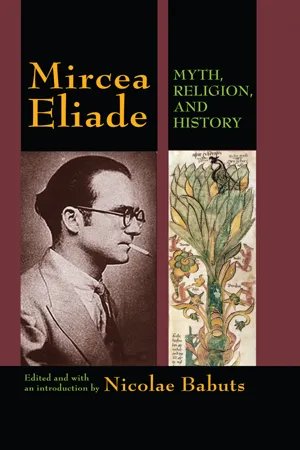
Mircea Eliade (1907–1986) was one of the twentieth century's foremost students of religion and cultural environments. This book examines the emergence, function, and value of religion and myth in his work.Nicolae Babuts, Robert Ellwood, Eric Ziolkowski, John Dadosky, Robert Segal, Mac Linscott Ricketts, Douglas Allen, and Liviu Borda examine Eliade's views on the interaction between the sacred and the profane. Each explores Eliade's phenomenological approach to the study of religion and myth. They show that modern rites of initiation, cultural activities, and spectacles like bullfighting, film, and, perhaps surprisingly, reading and writing, all harken back to the archetypal structures of the mythical imagination. Perhaps the greatest achievement of Eliade's phenomenological approach is that it reveals what we have in common with pre-Socratic man: the mind's structural capacity to endow objects and events with spiritual values and meanings.As a study of Eliade's concept of the mythic imagination, the book posits an analogy between the myths of the past and modern imitations. The authors suggest that in spite of their differences and their separate historical sources, myths represent basic structures of human consciousness. This book is essential reading for all students of religion, philosophy, and literature.
Information
1
Eliade: Essentialist or Postmodern? The Sacred and an Unseen Order
The title of one of Mircea Eliade’s basic books, The Sacred and the Profane, offers a key to his thought about the nature of religion. Religion, in his view, is fundamentally a symbol and vehicle for humankind’s profound yearning for transcendence of the ordinary, “profane” world of everyday space and time, to share in the mythic and absolute realm of origins, the “other time,” illud tempus, when the gods made the world and heroes walked the earth. Times of religious rite and festival are sacred times that seek to offer means of access to, and temporary participation in, the strong primal time. Sacred space demarcates on the face of this earth, in the terrain of temples, shrines, pilgrimage sites, holy mountains and sacred trees, places offering entry to that level of reality; often they are at the site of a mythic event back then, or of a later hierophany or sacred manifestation of its personalities or powers.
Eliade never provided a simple, brief definition of religion, indeed writing in the Preface of The Quest that, “It is unfortunate that we do not have at our disposal a more precise word than ‘religion’ to denote the experience of the sacred” (Preface, n.p.). But clearly, according to him, religion is that in human culture which has to do with the sacred and our attempts to find access to it. The sacred is unseen of itself, perhaps, but must be given, or gives us, forms and instruments by which it can be seen and touched; these means are religion.
Religion, then, is that which shows ways in which homo religiosus, “religious man,” “attempts to remain as long as possible in a sacred universe” (Eliade, Sacred and Profane, 13). This understanding of religion is in the spirit of William James, a very different kind of thinker, when he said that religion “consists of the belief that there is an unseen order, and that our supreme good lies in harmoniously adjusting ourselves thereto” (James, 53). But Eliade was far more interested than the American psychologist, with his focus on religious subjectivity, in the external representation of sacred space and time in temple and rite, though he granted that the sacred could be internalized in such phenomena as shamanism, yoga, and mysticism. Whether within or without, he perceived such patterns or structures as sacred space and time, symbolic ways of transcendence.
Eliade was a structuralist. The overall outline of a place of pilgrimage, or a festival like New Year’s, he saw as consistent through many religions though the names and externals change. Structuralism, following the linguist Ferdinand de Saussure and the anthropologists Émile Durkheim and Claude Lévi-Strauss, claimed particularly that structures declare their meaning through binary oppositions: good/evil, day/night, male/female, and of course Eliade’s sacred and profane: the time of the festival versus ordinary time (Durkheim), and the shifting circumferences around sacred space. Always one finds interaction—dialectics—between the sacred and the profane in form and in psyche, but always both are there. It is worth noting that the structural, dialectical manifestations of religion, like that of culture generally, do not directly meet physical human needs, those for food, shelter, clothing, or reproduction. Rather, they clearly cater to another kind of need, one for harmony with an unseen order of which we are also a part.
The Sacred after the Death of God
What is the significance of this kind of thinking in our times? There are those who would say a central aspect of the world of Eliade’s times and after—the modern world—was that it all became profane, or at best the sacred and profane were inextricably mixed, so that to speak of their “dialectics” no longer had meaning.
For Friedrich Nietzsche and his followers, the decisive event that separated the modern world from what went before was the death of God. “God is dead. God remains dead. And we have killed him” (181). However literally or metaphorically one were to take such a statement, the suggestion is certainly put forward that, for modern people, God—or his spokespersons—are no longer absolute sources of value, whether or not people remain nominally religious.
Thomas J. J. Altizer, author of Mircea Eliade and the Dialectics of the Sacred, the first book-length study of Eliade as a historian of religion, went on to become a leading voice for the 1960’s “Death of God” theology, declaring in books like The Gospel of Christian Atheism that “the message the Christian is now called to proclaim is the gospel, the good news or the glad tidings, of the death of God,” a—or rather the—supreme redemptive event of our times (Altizer, Gospel, 15). In the former work, Altizer proposed that the ultimate fulfillment of Eliade’s “dialectic” of the sacred and the profane would be a coincidentia oppositorum in which the twain became one in a world after the death of God, for it is the deity’s existence that separates holy and unholy. But Eliade, who knew Altizer and was somewhat bemused by his attention, also thought the “in our time” aspect of the death of God was a bit overdone. The primordial deus otiosus, God resting after making the world, could be called “the first example of the ‘death of God.’ that Nietzsche so frenziedly proclaimed” (Eliade, Myth and Reality, 95).
The idleness of one God, albeit the Creator, hardly meant the end of religion or even of gods, for his place was inevitably taken by a brood of lesser deities and ancestral spirits. In the same light, Nietzsche declared that after the divine death, “the invention of the domain of the divine… will once again proliferate,” to become “the religion of religion,” a faith focused on affirming all life and every moment (cited Lukacher, 119). We might also add that, if combined with the German philosopher’s famous doctrine of eternal recurrence, the death of God itself must be an event that has happened, and will happen, an infinite number of times as worlds come and go: in Shelley’s line, “like the bubbles on a river, sparkling, bursting, borne away.” So also the rise and fall of religion.
Modernism and Postmodernism
Perhaps religion after the, or a, death of God is like postmodernism after modernism. For modernism we may allude to the dual “metanarratives” Jean-François Lyotard has proposed as its essence: the metanarrative of the emancipation of humanity by progress, and the metanarrative of the unity of knowledge (Preface, ix). The first means, briefly, that through the advance of democracy, education, and scientific knowledge humankind is emancipating itself from the ignorance and oppression of the past; the second informs us that this liberating knowledge is made universal through the generalized, abstract, and rational ways of knowing, and of organizing what is known, characteristic of science and social science. Thereby the particular is generally subordinated to the abstract category; the old gives place to the new and improved; the local is subsumed to the universal. Gods, being typically particular, at least in name and form, being old and being local in their cults, are not exempt from this subordination. The lively, highly personal divinities of old are replaced by such abstractions as “the Absolute,” their ancient and concrete worship considered premodern superstition often standing in the way of progress.
What about postmodernism? It was, first of all, said to mean a loss of that sense of unity embodied in the two metanarratives, under the influence of deconstructionists like Jacques Derrida and Michel Foucault, who criticized the notion of a single self, and therefrom of a single message in a work of art or literature, a single religious meaning, or of the unity of truth or a straight-line march of progress in the supposed modernist sense. In psychology this means no doubt the psychic neo-polytheism of James Hillman, with its disparagement of the “imperial ego” and allowance for many diverse gods within the self.
In philosophy and religious studies, the new way of thinking has led the philosopher Richard Rorty to challenge the idea that religious reality has a definite independent nature, calling such a presumption “essentialism.” Instead, we should look at the pragmatic meaning the symbol of a supposedly transcendent, supernatural or sacred reality actually has in a particular situation. Perhaps it is only a social convention or a relic whose former meaning is practically forgotten, like that of a long-empty ancient temple. In any case, Rorty claimed that many people are, in Max Weber’s words, “religiously unmusical,” just don’t get it; their experience deserves as much regard as that of the pious (Rorty 30–32).
A perspective in religious studies has emerged that is deeply influenced by the deconstructionists and antiessentialists. Jonathan Z. Smith, a progenitor of this school, has said that religion as we study it in the classroom is an artificial construct: “It is the study of religion that invented religion” (Smith, “Religion,” 234. See also Smith, Imagining Religion). Russell McCutcheon has therefore insisted that religion is simply social formations labeled religion by a particular culture, and different cultures may have different ways of using the label. For this reason, “the study of religion has no special methodology,” but rather is, or should be, “a nonessentialist, multidisciplinary field” (208).
Mircea Eliade has not seldom been the bête noire of such scholars. He has been charged with the academic sin of essentialism with regard to religion by claiming that religion is sui generis, of believing that there is either an ontological reality beyond the reach of scholarly investigation behind religious phenomena, or at least that the phenomena can be probed only down to an irreducible essence (McCutcheon, 208; Allen, 141).
Sui Generis
To these critiques, a protagonist of Eliade could make three responses. First, Eliade’s claim that religion is sui generis need not mean “essentialism” in any ontological or even methodological sense; second, that the notion of the sacred and of homo religiosus as “ideal types” is not inconsistent with recognizing that, in practice, not all worshipers are on the same page in their understanding of the temple or rite, or equally “religiously musical”; and finally, that in view of the obvious fact that any modern or postmodern disappearance of religion, or of the sacred and its dialectic, has not yet taken place, Eliade’s structures as ideal types can still help us in understanding its current as well as its past forms.
As for sui generis and essentialism, Eliade knew well enough that the sacred was not “out there” of itself but was “an element in the structure of consciousness” (“New Humanism,” Quest, 3). Despite its central role in the arguments of his critics, Eliade actually seldom used the term sui generis. One place where he does is in assessing the primal monotheism (“urmonotheismus”) of the learned priest Wilhelm Schmidt, who held that primal man developed the idea of God through a rational quest for causation. Eliade’s response: “He neglects the obvious fact that religion is a very complex phenomenon—that it is, first of all, an experience sui generis, incited by man’s encounter with the sacred” (Quest, 25).
The idea of the sacred, influenced by Rudolf Otto and “the Holy,” a numinous, transrational experience lifting one out of the ordinary, was, to be sure, viewed by Eliade as a common category of perception, “indissolubly linked to the effort made by man to construct a meaningful world” (No Souvenirs, 313). But the sacred was really a phenomenological entity. To call a temple or mountain sacred was simply shorthand for saying that these people regard it as sacred or the object itself “speaks” a cultural language that denotes it as sacred.
Of course, the same person can experience religion both as insider and outsider, and perhaps such a dual stance affords deepest understanding. Eliade once remarked to Fr. Alexander Schmemann, late Dean of St. Vladimir’s Orthodox Theological Seminary, that [in the Orthodox church] his faith was that of a Romanian peasant, not that of a theologian or a historian of religion (Schmemann, 268).
So it is that the sacred, like religion, is not an abstraction outside of time or place. This does not mean, of course, that a religious phenomenon can be understood outside of its “history,” that is, outside of its cultural and socioeconomic contexts. There is no such thing as a “pure” religious datum, outside of history, for there is no such thing as a human datum that is not at the same time a historical datum. Every religious experience is expressed and transmitted in a particular historical context. But admitting the historicity of religious experiences does not imply that they are reducible to non-religious forms of behavior. (Quest, 25)
Does sui generis then mean that, though it may not be “out there,” the sacred or religion is in a class of its own in human society, irreducible to anything else? Sui generis does not mean, as some critics seem to presuppose, of its own essence, but rather of its own kind or type. Religion does not necessarily, in other words, have some esse as object—though of course theologians may argue that it does—but is only a unique configuration of cultural entities, each explicable in its own terms but unique in their collective organization, putatively centered around something like James’s “unseen order.” It is this configuration that is sui generis, not the individual parts or the object as essence.
Such a special collection could be compared to words in a conversation, as it were between sacred and profane. Nicolae Babuts has pointed out that
a word has its own icon, that is to say, it is itself an auditory or visual image or both.… But words themselves are very seldom meaningful in isolation.… The strength of these associations comes from the frequency with which they were encountered in reading and conversation and also from the affective value attached to them. After one or several fixations, as soon as there is enough sensory, conceptual, and syntactic information given, the incoming sequences contact and activate the relevant mnemonic sequences. (Dynamics, 72)
In the same way, presumably the “sentences” of meaningful words, gestures, and symbols that make up a composition culturally recognized as sacred may, in those who are “religiously musical,” activate remembered responses to generate actions and feelings regarded as religious, until time to leave.
Likewise, a “conversation” using words, images, and symbols to constitute a recognized “sacred” (as Babuts adds in a later work after specific reference to Eliade and sacred time) has a correlate in
the relation between the child who obeys the mother’s call for story-time, or the reader who succumbs to the allure of the written story, novel or poem. Although this time does not necessarily prevent us from entering and leaving, it is strong enough to isolate us and allow us to exist in a privileged realm that has different intensity and diff...
Table of contents
- Cover
- Half Title
- Title
- Copyright
- Dedication
- Contents
- Acknowledgments
- Mircea Eliade: Biographical Note
- Introduction
- 1 Eliade: Essentialist or Postmodern? The Sacred and an Unseen Order
- 2 The Place of Literature in Eliade’s “Rediscovery” of the Archaic World
- 3 Eliade and Girard on Myth
- 4 Eliade on Myth and Science
- 5 Mircea Eliade: Theös Éghènou …
- 6 Eliade’s Phenomenological Approach to Religion and Myth
- 7 The Magic Fact and the Mystic Fact: Eliade’s First Encounter with the Works of Evola
- Contributors
- Index
Trusted by 375,005 students
Access to over 1.5 million titles for a fair monthly price.
Study more efficiently using our study tools.
Frequently asked questions
Yes, you can cancel anytime from the Subscription tab in your account settings on the Perlego website. Your subscription will stay active until the end of your current billing period. Learn how to cancel your subscription
No, books cannot be downloaded as external files, such as PDFs, for use outside of Perlego. However, you can download books within the Perlego app for offline reading on mobile or tablet. Learn how to download books offline
Perlego offers two plans: Essential and Complete
- Essential is ideal for learners and professionals who enjoy exploring a wide range of subjects. Access the Essential Library with 800,000+ trusted titles and best-sellers across business, personal growth, and the humanities. Includes unlimited reading time and Standard Read Aloud voice.
- Complete: Perfect for advanced learners and researchers needing full, unrestricted access. Unlock 1.5M+ books across hundreds of subjects, including academic and specialized titles. The Complete Plan also includes advanced features like Premium Read Aloud and Research Assistant.
We are an online textbook subscription service, where you can get access to an entire online library for less than the price of a single book per month. With over 1.5 million books across 990+ topics, we’ve got you covered! Learn about our mission
Look out for the read-aloud symbol on your next book to see if you can listen to it. The read-aloud tool reads text aloud for you, highlighting the text as it is being read. You can pause it, speed it up and slow it down. Learn more about Read Aloud
Yes! You can use the Perlego app on both iOS and Android devices to read anytime, anywhere — even offline. Perfect for commutes or when you’re on the go.
Please note we cannot support devices running on iOS 13 and Android 7 or earlier. Learn more about using the app
Please note we cannot support devices running on iOS 13 and Android 7 or earlier. Learn more about using the app
Yes, you can access Mircea Eliade by Nicolae Babuts in PDF and/or ePUB format, as well as other popular books in Teología y religión & Crítica literaria religiosa. We have over 1.5 million books available in our catalogue for you to explore.