- 308 pages
- English
- ePUB (mobile friendly)
- Available on iOS & Android
eBook - ePub
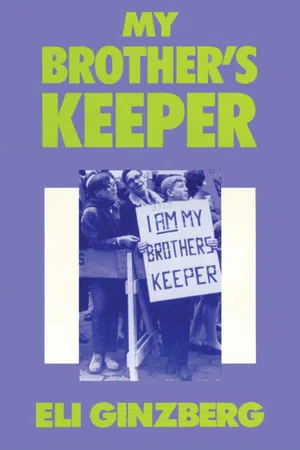
My Brother's Keeper
About this book
This is a deeply personal memoir by the doyen of applied economics in the United States. His name is indelibly linked to the creation, expansion, and refinement of employment policy and human resource needs from 1935 to the present. Eli Ginzberg has been a longtime consultant to the federal government, including nine presidents. In this volume, the focus is on American Jewry in the present century from the perspective of an active participant observer and a critical social science based analyst.My Brother's Keeper deals with the changing position of American Jewry in the twentieth century. Ginzberg makes extensive use of his own experiences to review the changes that have taken place in urban life, university involvement, and government agencies. The work covers Jewish life from pre-Hitler Germany to the present, and discusses with intimate candor synagogue life. Drawing upon his unique vantage point, Ginzberg presents new material about many leaders and events that helped transform the role of American Jews in their relationship with other Americans and Israel. At a more conceptual level the author explores major new influences that have reshaped American Jewry, such as the rise of neo-orthodoxy, the substantial increase in Jewish day schools, the blossoming of Judaica studies in American universities, and the rise of women in leadership roles.This memoir makes use of the best social science evidence, and draws on the special experiences of the author in the world of a deeply religious family and tradition. It ranks as a major contribution to the small shelf of self-reflections by social scientists.
Information
1
Themes and Directions
This book assesses major transformations in the lives and institutions of American Jews in the twentieth century, using as the point of departure my personal involvement in some, and my ongoing study of other of these transformations. To claim that this effort is an exercise in historical scholarship would be pretentious, but it would also be wrong to view it solely as a foray into autobiographical writing. It is a mixture of the two.
I have sought to illuminate selective aspects of the transformations that American Jews have experienced during this century in the dominant areas of their lives — as individuals in search of a better future; in their attitudes and behavior toward Jewish communal activities, in particular the synagogue, philanthropy, and Jewish education; their changing relations to their fellow citizens; and their involvement with, and support for Jews in other countries, particularly those in Israel.
But I claim some special advantages that have helped me in developing this personal retrospective. The first relates to the length of my perspective: as a seventy-seven-year-old, I have lived much longer than most of my compatriots and co-religionists. Age is surely no guarantee of understanding, and even less of wisdom, but if perspective is needed, then age is an advantage. As will become clear in the next chapter, I started with a major assist: my father helped me to understand and interpret the paths and bypaths of two millennia of Jewish experience in the Diaspora. My discipline, economics, and a specialty in human resources provided me with useful tools. And I have been not only an observer but an active participant in some of the transformations that comprise the core of this account. What is more, I have been forced in developing this retrospective to come to terms with — or at least to become aware of—the multiplicity of forces that have pulled me in different directions with respect to my own “Jewishness” in the realms of both ideas and behavior.
I can remember the noise, crowding, and poverty that characterized the lower East Side of New York City in the mid-1920s when I was an ambulatory patient at the old Beth Israel Hospital. There are still a great many Jewish families in the lower income brackets, but in the mid 1920s the proportion was much larger. At that time only a relatively small number of Jews were in the higher income brackets. In the 1930s Father Coughlin attracted an ever larger radio audience whose listeners he harangued with scurrilous attacks on the Jews, their power, and their nefarious behavior. He was well advanced in making anti-Semitism a potent force in the political arena when his ecclesiastical superiors silenced him For those of us oldsters who remember Father Coughlin and others of his ilk, it is hard to buy into the increasingly fashionable theory of contemporary analysts of the Jewish scene in the United States, which holds that political anti-Semitism is a scourge that has been permanently eliminated. If all continues to go well that may indeed turn out to be the correct forecast. But history is a warning that things seldom continue to turn out well.
At the outbreak of World War II, Eastern Europe was the heartbeat of the Diaspora, surely when measured in terms of number of Jews who lived Jewish lives and who were loyal to their tradition. At the end of the war, 6 million of these Eastern European Jews had been exterminated and there remained nothing more than a few artifacts from the creative culture of more than half a millennium.
The slaughter of the innocents was camouflaged by the still greater slaughter that was occurring on both the Eastern and the Western fronts, a camouflage aided and abetted by the press and by all the political leaders of the West, from President Franklin D. Roosevelt to Pope Pius XII. But the silence of the Christian leadership is less surprising and disturbing than the silence of most of the American Jewish leadership even after it became privy to Hitler’s implementation of the Final Solution.
The issue remains moot whether or not local Jewish leaders in the towns and cities in Eastern Europe more or less “voluntarily” cooperated with the exterminators in determining who was sent to the camps, earlier or later. But we know, surely with the advantage of hindsight, that the American Jewish leadership in pursuing a policy of not “rocking the boat” enabled President Roosevelt and his State Department to pursue their priority of winning the war against Hitler without deflecting any resources, material or moral, to slow the Nazi extermination machine.
In the third year after V-E (Victory-in-Europe) day, the United Nations (UN) voted to establish the state of Israel, which set the stage, after an interregnum of two millennia, for Jewish hegemony in a major part of the Holy Land. This great victory following close on the heels of the Holocaust goes far to explain how American Jewry and the Jews of other nations that were not in the path of the Nazi war machine were not totally demoralized by the mass murder of 6 million of their fellow Jews. The fact that the slaughter became generally known only at war’s end gave it an unreality second only to the magnitude of the evil that had taken place.
This greatly encapsulated account of the momentous events of the last half century affecting Jews and Jewish communities must also take note of the fate of the Jews in the Soviet Union (USSR). Drawing on centuries-old Russian tradition of virulent anti-Semitism, the Communist leadership has found it expedient to discriminate against Jews as individuals and to restrict severely their opportunities for career advancement; to outlaw all Jewish efforts at communal activity — religious, cultural, and other; and to sponsor the preparation, publication, and dissemination of virulent anti-Jewish and anti-Israel propaganda for both internal and international (mostly Muslim) markets. But that is not the whole of the story. The USSR voted in the UN in 1948 in favor of establishing the state of Israel: in the early 1970s and again in the late 1970s it facilitated the outmigration of tens of thousands of Russian Jews to Israel and to the West. And in mid-1988 there are signs that its anti-Israel, anti-Jewish policies may again be moderated.
I have called attention to three momentous events: the Holocaust; the establishment of the state of Israel; the holding hostage of Soviet Jews. The question that remains is how I plan to deal with these world-shattering events. I spent a year and a half in Germany as a student at Heidelberg University (1928-29), only a few years before the street-brawling Nazis succeeded in toppling the Weimar Republic, thereby setting the stage for the Final Solution. In chapter 4 I draw on my firsthand experiences and observations about the early days of the Nazi bid for power in the hope that these experiences can add a little insight to the immensity of the evil that continues to challenge our understanding.
My exposures to the problems of the Yishuv (the Jews engaged in building their homeland in Palestine) and later to the young and maturing state of Israel have been many and continuing, and again I hope that the facts and the interpretations that I venture in chapter 8 may add some new perspectives.
There is no chapter on the Jews in Soviet Russia, since I have had no opportunity to become informed about their plight other than through secondary sources and through occasional discussions with refugees.
This book is first and foremost a personal view of selected aspects of major events in the lives of American Jews informed by my background, my discipline, my lengthened perspective and, finally, my own set of values, which helped me to cope sometimes more and sometimes less successfully with both my Jewish and my American roots.
I will start with my background, which is the focus of the next chapter. Even though I opted in my youth for playing baseball over studying Hebrew, and for the most part succeeded in winning that struggle with my parents, and even though until my adolescence I was critical about my father’s pattern of work and life — he didn’t know who Babe Ruth was and he never went (at that time) to the movies — I learned by osmosis a great deal about all things Jewish, past and present; a process of learning that accelerated on my return from Heidelberg, which still left me twenty-four years in which to deepen my intellectual relationship with my father before he died.
I have written at length about my father in Keeper of the Law: Louis Ginzberg (1966). While he would probably question and often disagree about many points of fact and interpretation, this present book has his initials on every page. In a moment of rare intimacy — because he was a very private person — my father remarked that, had his father been alive, he would not have been able to publish his three-volume life’s work—A Commentary on the Palestinian Talmud (1941) — because my grandfather would have considered his critiques of the great rabbinic masters and his reconstructions of the sacred texts unacceptable.
We know in this post-Freudian age that sons do not settle accounts with their fathers nearly so easily and neatly as the preceding paragraphs suggest. My father’s existence was based on three mutually reinforcing commitments: the survival of the Jewish people was his overriding goal; a respect for Jewish law and tradition was the foundation of his life; and a dedication to Jewish scholarship was his lodestar.
I surely absorbed from my father a respect for the historicity of the Jewish people, but in my case the understanding was more intellectual than emotional. I recall my father’s crying out loud when he read the prayers on Tishabov at the little synagogue in Waterville, Maine, with a sense of immediacy that he himself had been present at each of the tragic events that the fast-day recalled. He was part of a living continuity with the Jews of earlier ages. In my case, it was more a matter of understanding than of feeling.
How does my training as an economist and my research specialty of human resources help me to deal insightfully with the themes that comprise this book? One of the central phenomena that provides the spine for this analysis is the impressive gains in education, occupational status, and income that American Jews have been able to achieve in the post-World War II era. Clearly an economist, with a special interest in human resources, is better positioned than most to unravel what happened and why; at a minimum such a person should be innoculated against accepting facile interpretations. But the links between my specialty and my interest in Jewish affairs have been much closer and more direct. Let me illustrate.
My first formal connection with any Jewish organization was in helping to establish in the mid-1930s the Jewish Occupational Council of which Morris Raphael Cohen, the distinguished philosopher at City College of New York, was the founding head. Until the advent of Adolf Hitler, Cohen had distanced himself from Jewish activities and had adopted in his classroom a mocking if not hostile attitude toward those of his students who were affirming Jews. But he early realized that Hitler’s doctrines could leap over borders and oceans and threaten the United States. Faced as the country was by intractably high levels of unemployment, it was important for Jews as individuals and as members of an exposed minority to consider carefully their options with respect to their education and career choices. Cohen, with his East European roots, concluded that too many American Jews were crowding into a limited number of service fields, making them potentially vulnerable. I do not recall a great deal about the nature and scope of the council’s work, but I remember that I recruited the first director. Professor Albert Abraham-son of the Economics Department of Bowdoin College, who got the council off to a good start.
About a quarter of a century later I was in Jerusalem on one of my many missions on behalf of the United States or the Israeli government. My visit coincided with the monthly meeting of the Study Group on Contemporary Jewish Issues, which Professor Moshe Davis of the Hebrew University had organized and which met at the home of the president of Israel, at the time Yitzhack Ben-Zvi. I was asked to speak and selected as my theme “The Changing Occupational Status of American Jews.”
I have no detailed recollection of what I said, but I vividly recall the stormy discussion that followed. Most of those present, and particularly the oldsters such as Ben-Zvi, refused to accept my basic propositions: that American Jews had secured a strong niche for themselves in the American economy, which, if the economy did not falter, assured them a favorable economic future; that it was fortunate that the Jews were vastly “overrepresented” in professional and service occupations, for that was the direction in which the U.S. economy was headed; that the relatively small number of American Jews in basic industries, particularly agriculture, manufacturing, and construction, was a sign not of weakness but of strength. While Ben-Zvi was too polite an individual and host to tell me outright that I was naïve, even foolish, he hinted at what he considered to be the preeminent lesson of Jewish history — the inevitable decline and collapse, sooner or later, of every Jewish community in the Diaspora no matter how great its prior accomplishments. Why should the United States be different from Alexandria, Spain, Lithuania, Germany?
There have always been major differences among Jews as to how they interpret their past, how they evaluate their present circumstances, and what they anticipate in the future. But never were such differences greater than among Eastern European Jewry during the half century between 1880 and the coming to power of Hitler in 1933. Over 2 million came to America and some tens of thousands went to Palestine. Several million were trapped inside Russia once the Communists took over. That left several million more, mostly in Poland and in southeastern Europe, covering the spectrum from the ultra-Orthodox to alienated modernists.
Ben-Zvi, more Hebraist than politician, was certain that sooner or later the Diaspora would once again play the Jews false and their only security was, while they still had time, to relocate in Israel. The fact that this “theory” was outside the experience and expectations of American Jews made no difference. Committed Zionists, like other committed people, have a corner on the truth. I learned early not to argue with those who know that theirs is the only right answer.
From one perspective, all of my assignments for Jewish organizations in the United States, in Israel, and most recently for World ORT (Organization for Rehabilitation through Training) have been directly related to my field of specialization. I early decided to respond affirmatively to any reasonable request from any Jewish organization whose program I respected even if it did not square with all or even most of my preconceptions and preferences.
In 1941 I served as the second director of the Allotment Committee for the United Jewish Appeal (UJA). After many years of negotiation, the American Jewish Joint Distribution Committee, which had concentrated its philanthropic efforts on assisting Jews and Jewish communities in the Diaspora, and the United Palestine Appeal, which devoted itself to building up the homeland, joined forces for fund-raising purposes in the hope and expectation that a combined effort would result in a larger total sum and reduced costs of operations. The two agreed on a formula to divide a predetermined minimum and left open till later the distribution of the remainder. That decision was to be made by an Allotment Committee of seven members, composed of two representatives from each of the principals and three neutrals. As director of research, my analysis was to guide the Allotment Committee. I had one assistant, Isaiah Frank, who went on to have a distinguished career, first in the Department of State and later as the William L. Clayton Professor ofInternational Economic Studies at the Johns Hopkins School of Advanced International Studies in Washington, D.C.
Of the seven members on the Allotment Committee, I reacted most strongly to Rabbi Abba Hillel Silver, whose behavior, bargaining tactics, and language were totally at variance with what I knew and expected from a leading member of the rabbinate. I quickly recognized that he was a man of strong commitment and substantial talent, but I never was able to accept his bullying tactics, disingenuousness, and ruthlessness. But then I was young and this was my first experience with organizational infighting.
A more constructive recollection that I retain from that assignment was my persuading Milton Friedman to develop a preliminary estimate of the distribution of income among American Jews. On the basis of his estimates I concluded that only a small proportion of potential donors was contributing to the joint appeal, and that the prospects for raising additional sums was much greater than even an aggressive bureaucrat such as Henry Montor had realized. But Montor shortly thereafter raised his sights and his goals and kept raising them, and in the process proved that the potential for additional giving was indeed substantial (see my Report to American Jews: On Overseas Relief, Palestine and Refugees in the U S. ., 1942).
Shortly after my return from war service, Dr. I. S. Wechsler, the distinguished neurologist and a long-term friend of my family, asked me to join the Executive Committee of the American Friends of the Hebrew University, the chair of which he had recently assumed. Over the next years I tried to be helpful, but was able to contribute relatively little, since it took Wechsler many years to attract wealthy and devoted laypersons to the board. But at one point I was able to assure that the negotiations between the Hebrew University and a young economist from the Midwest, Don Patinkin, did not fall through as had so many prior negotiations between principals 6,000 miles distant from each other. Patinkin moved to Jerusalem and over the years developed an outstanding department of economics at the Hebrew University and trained two generations of able economists. It was surely not his fault that the Israeli government has until recently made infrequent use of this talent pool. Patinkin has served both as rector and as president of the university, retiring in 1986 from the last post when the exploding deficit of the university, dating largely from his predecessors, ledto a forced change of the guard.
Shortly after I Joined the Army Services Forces in September 1942, I met, through my former teacher at Columbia College, T. C. Blaisdell, Israel Sieff (later Lord Sieff) of Britain’s Marks and Spencer, who was to become a close friend. While living in Washington, Sieff engaged in a number of activities, including efforts to enlarge British exports in order to increase Britain’s capacity to wage war. But, as I soon learned, he was also deeply involved in advancing the development of Palestine.
Sieff took the lead in organizing a discussion group of economists, lawyers, and other government officials to look at the potential of Palestine at the war’s end to absorb large numbers of refugee Jews who would need to be relocated. In late 1943 Sieff was called before a congressional co...
Table of contents
- Cover
- Half Title
- Title Page
- Copyright
- Dedication
- Contents
- Acknowledgments
- Chapter 1. Themes and Directions
- Chapter 2. My Father’s Influence
- Chapter 3. Columbia University—Six Decades
- Chapter 4. Heidelberg University—Prelude to Hitler
- Chapter 5. Washington, D.C.
- Chapter 6. Synagogue and Federation
- Chapter 7. Jews and Other Minorities
- Chapter 8. Israel
- Chapter 9. In Search of Perspective
- Chapter 10. The Future Will Tell
- Selected Bibliography
- Index
Trusted by 375,005 students
Access to over 1.5 million titles for a fair monthly price.
Study more efficiently using our study tools.
Frequently asked questions
Yes, you can cancel anytime from the Subscription tab in your account settings on the Perlego website. Your subscription will stay active until the end of your current billing period. Learn how to cancel your subscription
No, books cannot be downloaded as external files, such as PDFs, for use outside of Perlego. However, you can download books within the Perlego app for offline reading on mobile or tablet. Learn how to download books offline
Perlego offers two plans: Essential and Complete
- Essential is ideal for learners and professionals who enjoy exploring a wide range of subjects. Access the Essential Library with 800,000+ trusted titles and best-sellers across business, personal growth, and the humanities. Includes unlimited reading time and Standard Read Aloud voice.
- Complete: Perfect for advanced learners and researchers needing full, unrestricted access. Unlock 1.5M+ books across hundreds of subjects, including academic and specialized titles. The Complete Plan also includes advanced features like Premium Read Aloud and Research Assistant.
We are an online textbook subscription service, where you can get access to an entire online library for less than the price of a single book per month. With over 1.5 million books across 990+ topics, we’ve got you covered! Learn about our mission
Look out for the read-aloud symbol on your next book to see if you can listen to it. The read-aloud tool reads text aloud for you, highlighting the text as it is being read. You can pause it, speed it up and slow it down. Learn more about Read Aloud
Yes! You can use the Perlego app on both iOS and Android devices to read anytime, anywhere — even offline. Perfect for commutes or when you’re on the go.
Please note we cannot support devices running on iOS 13 and Android 7 or earlier. Learn more about using the app
Please note we cannot support devices running on iOS 13 and Android 7 or earlier. Learn more about using the app
Yes, you can access My Brother's Keeper by Eli Ginzberg in PDF and/or ePUB format, as well as other popular books in Social Sciences & Social Science Biographies. We have over 1.5 million books available in our catalogue for you to explore.