- 356 pages
- English
- ePUB (mobile friendly)
- Available on iOS & Android
eBook - ePub
About this book
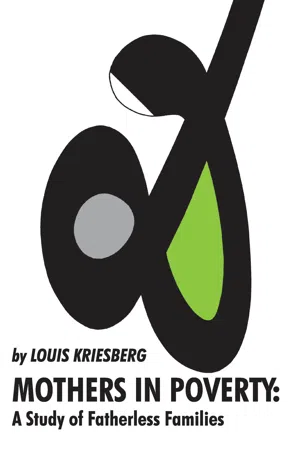
Professor Kriesberg explores in this book the many myths about the poor, the welfare dependents, and the husbandless mothers. The evidence marshalled does not support the idea that people continue on welfare generation after generation, that the children of broken families have disrupted marriages themselves, that the poor seek out public housing and public assistance because they prefer such dependency, or that husbandless mothers all have lower educational goals for their children than do married mothers. Beginning with major theoretical issues, Kriesberg developed hypotheses about the life of the poor and culture of poverty; the hypotheses were tested with data from a study of families in public housing projects.
Information
1
On Explaining the Life Style of the Poor
THE DEMANDS of the poor in America for more equality and for government efforts to combat poverty have quickened public attention to a fundamental sociological topic: social stratification. Sociologists have studied the ways people rank each other, how people are recruited into different ranks, and how the values, beliefs, and conduct of people in various ranks differ. Most of the studies have described these phenomena, and some have attempted to account for the variations. Government programs against poverty have brought into sharp focus the need to know the causes of poverty and of the immobility of poor people. Programs designed to change poor people or to reduce poverty are based on some beliefs about the significant causal connections.
Some programs are aimed at young children in poor families, presuming that the skills and motives acquired in early life determine later chances to escape from poverty. Other programs aim at providing occupational skills for adolescents and young adults, presuming that changes in children of poverty are still possible and necessary to avoid future poverty. In addition, some programs are directed at expanding the number of jobs available, presuming that if opportunities are available, they will be utilized. Still other programs are aimed at simply insuring a more equitable distribution of available income.1
Central to many of these programs is the belief that the way of life of the poor plays a critical role in maintaining poverty, that it impedes the movement out of poverty. On the other hand, it is argued that the poor are made poor and kept poor by circumstances around them. Even granting a critical role to life styles, there is disagreement about the extent to which the poor have a comprehensive and distinctive life style and the degree to which this is an integrated subculture transmitted from one generation to the next.
The vicious circle poor people are ensnared in has been frequently portrayed.2 That each aspect of poverty compounds the effects of every other one is not hard to understand. An illness that may be worrisome and unpleasant for a family with an adequate income is a disaster for a poor family. Similarly, the likelihood and consequences of being laid off from a job are increased among impoverished families. Recurring disasters make planning difficult and apparently hopeless. In innumerable ways people living in poverty develop attitudes and patterns of conduct that seem to be an accommodation to their circumstances. These accommodative ways of thinking and behaving are transmitted to the children of poor families. In addition, the children are subjected to unstable family life, inadequate school environment, and a life of the streets —all of which handicap them in learning how to get out of poverty. What they have learned as children is integrated and imbedded in their personalities and it is resistant to alteration by later experiences.
Compelling as these descriptions may be, they can provide only partial views of the infinite complexity of the life of any category of people. It is true that values, beliefs, and conduct tend toward mutual consistency; they support each other, and they are responses to circumstances they themselves help structure. The meaning of any situation depends on the context provided by other circumstances and the subjective perception and evaluation of the conditions. It is illuminating to point out such interdependence and the resulting integrated set of unique values and practices, but the illuminating beam also casts shadows that obscure other truths.
No category of humans have a way of life completely distinct from other humans. Many experiences are shared by all persons. No human is utterly alien from any other. The shared elements of life are especially important when we compare categories of persons within the same society. It is necessary to recognize that some experiences are shared by everyone, that others are unique to a given category, and still other experiences are shared by some persons in one category with some others in a different category. Furthermore, various aspects of life are changing —at different rates and in response to different sets of conditions. Consequently, no completely integrated set of values, beliefs, and conduct exists for any category of persons. Discrepancies, inconsistencies, and tensions among values, beliefs, and practices are inevitable.
All this suggests another approach to differences in life styles among families of varying incomes. Particular values and beliefs may be shared while others differ as a response to a given situation. Being responsive to particular circumstances, the apparent stability of certain values and beliefs reflects the stability of those circumstances. Under new circumstances, patterns of conduct, beliefs, and values are altered.3
These observations are especially pertinent in discussing the heterogenous category of the poor. Families can become poor from loss of income if the family wage earner becomes disabled or too old, or if the market for the wage earner’s skills declines. For people reared in families that were not poor, many earlier parental ideas and practices are not appropriate to their new state, and some would be altered, but not all in the same way or at the same rate. On the other hand, many children raised in poor families escape poverty when they grow up. They may have acquired values, beliefs, and practices from their experiences in poverty, but many of these do not persist in changed circumstances, and the persistence varies with the ideas and conduct and the circumstances.
Not only do most of the poor in the United States share many values, beliefs, and practices with the nonpoor, those they do not share are vulnerable to change under changed circumstances, and all together do not constitute an integrated way of life distinctive from that of the nonpoor.
In this book I wish to clarify some of the issues in contention and to present findings pertinent to those issues. I shall consider specific values, beliefs, and patterns of conduct associated with poverty, for example, in regard to the lower educational achievement of children of the poor. I shall examine how these characteristics are affected by prior and contemporary conditions. Such an undertaking should contribute to a sounder explanation of how certain aspects of the way of life of the poor are maintained, perpetuated, resisted, or discontinued.
Fatherless families are the particular subjects of the present undertaking. Aside from our intrinsic concern about their plight, we study them as a strategic category in understanding the life of the poor and the perpetuation of poverty. Fatherless families constitute an important segment of the poor. About one-quarter of the poor families in the United States are fatherless, and about 30 per cent of the children living in poverty are in fatherless families.4 Furthermore, studying fatherless families has several analytic advantages for the issues being considered. In many ways poor fatherless families seem to epitomize the life style of the hard-core poor. The conditions of poverty seem particularly intractable for them and the handicaps of children from such families are particularly severe. Among these families, then, are many that may well exemplify the intergenerationally transmitted subculture of poverty. Yet many fatherless families have fallen into poverty by ill chance: by the death of the husband-father or by divorce, separation, or desertion. The husbandless mothers in many families were raised in a household with an adequate income before the family was disrupted.
Consequently, by comparing fatherless and complete families, it is possible to study the impact of a condition often associated with poverty: the absence of a father in the family. More significantly, we can readily compare the effects of this condition on persons of different social origins and of varying contemporary conditions. At the same time we will assess the consequences of different socioeconomic backgrounds and contemporary circumstances for both complete and fatherless families.
The Subcultural and Situational Views
I have sketched out two different approaches to the study of poor families. These two perspectives require further amplification. After discussing each of them in detail, I will explain some underlying and cross-cutting issues. The next chapter will present more specific ideas pertaining to poverty and fatherless families.
In examining the subcultural view of poverty, I include research about persons who differ in rank along other dimensions than income. Income, education, occupation, place of residence, and class identification are all highly related to each other. Innumerable studies have been made of people who vary along one, or a combination of several, of these dimensions. Many ideas about the way of life of people in poverty have been drawn from studies made in low-income neighborhoods or of persons with varying occupational or educational levels.
According to the subcultural approach, poor people, like people in every other stratum, possess a mutually consistent and supporting set of values, beliefs, and patterns of conduct. This integrated set of characteristics is shared by members of the stratum and differs in important ways from that possessed by persons in other strata. These characteristics form a way of life appropriate to the recurrent problems the members of the stratum face. The way of life is acquired early in life, and it is perpetuated from one generation to the next.
This view is expounded in many textbooks on social stratification wherein the life styles of different strata in the society are described. For example, Bergel writes,
Each class has its specific set of values, goals, habits, behavior patterns, its specific “class mentality.” Classes live in comparative social isolation; from earliest childhood their members are reared in a specific “class atmosphere/’ are imbued with specific class values, and thereby acquire specific group traits that set them apart from members of other classes.5
Similarly, in studies of a particular stratum, usually the working-class or lower-class strata, researchers report an integrated life style. This has been formulated for persons living in poverty, notably by Oscar Lewis. As he observed, the “culture of poverty” is a catchy phrase and appears frequently in the current literature. He explains that he uses the phrase as
the label for a specific conceptual model that describes in positive terms a subculture of Western society with its own structure and rationale, a way of life handed on from generation to generation along family lines. The culture of poverty is not just a matter of deprivation or disorganization, a term signifying the absence of something. It is a culture in the traditional anthropological sense in that it provides human beings with a design for living with a ready-made set of solutions for human problems, and so serves a significant adaptive function. This style of life transcends national boundaries and regional and rural-urban differences within nations. Wherever it occurs, its practitioners exhibit remarkable similarity in the structure of their families, in interpersonal relations, in their value systems and in their orientation in time.6
The culture of poverty as described by Oscar Lewis is similar to the descriptions of lower-class life in urban centers of the United States and of Negro slum dwellers. Variations in the subcultural approach to the study of poor persons will be discussed later. At this point we need only observe that in one approach to the study of poor persons, students may emphasize the interrelationship among values, norms, beliefs, and behavior patterns as they are collectively shaped and perpetuated.
The many pitying, romanticizing, empathetic, condescending, pejorative as well as evaluatively neutral descriptions of the way of life of the poor or of the lower class testify to the interrelations. Poor people are trapped in a vicious circle in which each aspect supports every other aspect. One can start anywhere to note the interrelations. Lacking occupational skills, dependent upon low-paying and unstable employment, they feel cut off from advancement; their situation seems hopeless; they are victims of fate and chance. Their time orientation is shortened and gratifications indulged rather than delayed. Security is found in sharing limited resources with close kin or a network of peers. Work is not valued even when available or cannot be sustained when attempted. Family life is unstable and children grow up without learning the skills and attitudes necessary for employment and a stable marriage. Each spouse maintains close ties with his or her relatives as a refuge, which adds to the brittleness of the marriage. Within the family, activities are clearly demarked between males and females and the mother-child relations are particularly strong and enduring. Female-headed families are common and in some ways represent the epitome of the way of life outlined. Not expecting legal, binding, and faithful marriage nor only legitimate children, legal marriage and legitimate children are not highly valued or normatively controlled.
Several aspects of the subcultural approach can be contested. One point about which there is widespread disagreement is how different are in fact the norms and values of the poor from those of others in the society. Some observers stress the extent to which all members of the society are expected and do indeed share notions of what is desirable. Thus, Merton in his classic essay on social structure and anomie argues:
Our egalitarian ideology denies by implication the existence of non-competing individuals and groups in the pursuit of pecuniary success. . . . Goals are held to transcend class lines, not be bounded by them, yet the actual social organization is such that there exist class differentials in accessibility of the goals. . . . “poverty” is not an isolated variable which operates in precisely the same fashion wherever found: it is only one in a complex of identifiably interdependent social and cultural variables. .. . when poverty and associated disadvantages in competing for the cultural values approved for all members of the society are linke...
Table of contents
- Cover Page
- Title Page
- Copyright Page
- Table of Contents
- Preface
- Acknowledgments
- 1 On Explaining the Life Style of the Poor
- 2 Conditions and Processes
- 3 Research Design and Characteristics of Families in the Study
- 4 Enclaves of Poverty
- 5 The Selection of Housing
- 6 Work, Welfare, and Other Income Sources
- 7 Intergenerational Patterns of Poverty and Broken Families
- 8 Rearing Children for Independence and Achievement
- 9 Training for Educational Achievement
- 10 Conclusions
- Appendix A Sampling and Data Collection Procedures for Cross-Sectional Survey
- Appendix B Sampling and Data Collection Procedures for Panel Survey*
- Name Index
- Subject Index
Trusted by 375,005 students
Access to over 1.5 million titles for a fair monthly price.
Study more efficiently using our study tools.
Frequently asked questions
Yes, you can cancel anytime from the Subscription tab in your account settings on the Perlego website. Your subscription will stay active until the end of your current billing period. Learn how to cancel your subscription
No, books cannot be downloaded as external files, such as PDFs, for use outside of Perlego. However, you can download books within the Perlego app for offline reading on mobile or tablet. Learn how to download books offline
Perlego offers two plans: Essential and Complete
- Essential is ideal for learners and professionals who enjoy exploring a wide range of subjects. Access the Essential Library with 800,000+ trusted titles and best-sellers across business, personal growth, and the humanities. Includes unlimited reading time and Standard Read Aloud voice.
- Complete: Perfect for advanced learners and researchers needing full, unrestricted access. Unlock 1.5M+ books across hundreds of subjects, including academic and specialized titles. The Complete Plan also includes advanced features like Premium Read Aloud and Research Assistant.
We are an online textbook subscription service, where you can get access to an entire online library for less than the price of a single book per month. With over 1.5 million books across 990+ topics, we’ve got you covered! Learn about our mission
Look out for the read-aloud symbol on your next book to see if you can listen to it. The read-aloud tool reads text aloud for you, highlighting the text as it is being read. You can pause it, speed it up and slow it down. Learn more about Read Aloud
Yes! You can use the Perlego app on both iOS and Android devices to read anytime, anywhere — even offline. Perfect for commutes or when you’re on the go.
Please note we cannot support devices running on iOS 13 and Android 7 or earlier. Learn more about using the app
Please note we cannot support devices running on iOS 13 and Android 7 or earlier. Learn more about using the app
Yes, you can access Mothers in Poverty by Louis Kriesberg,F.G. Bailey in PDF and/or ePUB format, as well as other popular books in Social Sciences & Social Policy. We have over 1.5 million books available in our catalogue for you to explore.