eBook - ePub
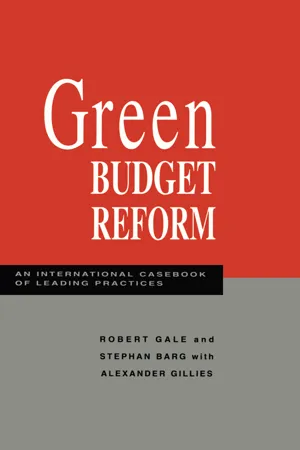
Green Budget Reform
An International Casebook of Leading Practices
- 380 pages
- English
- ePUB (mobile friendly)
- Available on iOS & Android
eBook - ePub
About this book
This volume explores 25 case studies of fiscal measures that have been adopted successfully by governments in North America and Europe to reduce environmental degradation. Each study lays out the implementation issues and problems faced, and compares the effectiveness of the measure against its expectations. The political implications are also discussed, and the text draws on common themes and lessons to be gained from the measures so far. The volume is divided into sections on energy, agriculture, air and water pollution, and waste management.
Information
1
The Greening of Budgets: The Choice of Governing Instrument
Robert J P Gale and Stephan R Barg
INTRODUCTION
Massive restructuring of our economies is necessary if we are to prevent global environmental catastrophe and major economic disruption or collapse. The onrush of environmental problems such as global warming, stratospheric ozone depletion, acid rain, air and water pollution, and species extinction, as well as the depletion of renewable natural resources such as forest and fish stocks, indicate that our planet cannot sustain existing patterns of economic activity indefinitely. Without fundamental change, environmental problems may overwhelm the ability of our economies to respond to resource and environmental management challenges.
The fact that fundamental changes including major lifestyle changes will be necessary to bring about sustainable development should not deter decision makers from action. In a recent survey in North America, one in two Canadians (50 per cent) and four in ten Americans (38 per cent) agreed that ‘major’ lifestyle changes will be necessary to bring about more sustainable development (Environmental Monitor, 1993). Another four in ten Canadians (38 per cent) and five in ten Americans (48 per cent) say that ‘moderate’ lifestyle changes will be required for sustainable development. This implies public acceptance of the need for behavioural change; an acceptance that will require careful reinforcement given the discrepancies that can arise between espoused views and actual behaviour in decisions about environment and development (Gale, 1991).
A proactive strategy of adjustment and adaptation is necessary to restructure economies from unsustainable to sustainable modes of development. Such restructuring will be impossible unless policy makers take account of the full range of regulatory and economic instruments that can be brought to bear on the challenge of environmental management and sustainable development. Although conflicts can frequently be resolved by legislation and regulations, we should also be open to other instruments, such as taxes and subsidies, that can be designed to promote resource and environmental management objectives. When these instruments are more efficient, effective, and economic than regulatory instruments, they should be given serious consideration by policy and decision makers. Tax payers will likely support these instruments if the rationale for their selection is based on sound judgements about their ability to reduce pollution, internalize costs, promote research and development of new environmental technologies, assist the commercialization of such technologies, and achieve a fair distribution of costs and benefits to society.
The single most important instrument of power over environment and development policy that government policy makers can state and give effect to is contained in the government’s annual budget. This is the instrument which provides figures and projections concerning government expenditures and the allocation of public funds among competing claimants in society. It is also the instrument that determines how and from whom revenues are to be raised. Since a country’s public expenditures typically constitute between 35 and 50 per cent of its Gross Domestic Product (GDP), its budget provides the most compelling and practical statement about government policies, programs and intentions. Public sector spending and taxation have the kind of direct, long-term and structural impacts on economic and social development as well as environmental protection that warrant scrutiny from a sustainability perspective.
In addressing the issue of budget reform through economic incentives for environmental protection and sustainable development, this book of case studies is about leading practices in resource and environmental management. More specifically, it is about the mix of subsidies, taxes, and other incentives called economic instruments. This huge topic covers many complex and diverse issues. In this collection the focus of attention for economic instruments includes environmentally sound energy development, sustainable agriculture, waste management, air and water pollution, and natural resources management. Although it is difficult to generalize from the case studies presented here, a better mix of government regulations and economic incentives may well resolve some of the more pervasive and serious natural resource, environmental, and sustainability problems facing industrial countries. Sustaining economic activity in social and environmental terms will require a better suite of policy instruments for use in government budgets.
Environment, Development, and Budget Reform
The inability of our financial, political, and social institutions to integrate economic, ecological, and human welfare systems together leads to unsustainable development (WCED, 1987; UNCED, 1992). This failure is widespread and includes government budgets because fiscal, monetary, program, and policy decisions are seldom, if ever, considered with regard to their impacts on the environment and sustainable development. Furthermore, in a decade of mounting national debt and troublesome annual deficits, budget makers are striving to curtail public expenditures while still honouring program commitments. One approach to these commitments is to design budgets consistent with the goal of sustainable development. This will require a fundamental change in how tax systems affect the interface between ecological and economic systems, although the prescriptions for reform vary widely (Schramm and Warford, 1989; Costanza, 1991; Kembell-Cook, Mattingly and Baker, 1991; Pearce, 1993).
The possibility of reducing pollution and waste through the budget and tax system, by reinforcing the axiom that prevention is better than cure, is generally not taken into account in budget making decisions. Environmental externalities — that is, the impacts of economic activity on the environment — are not considered in market transactions. To address this shortcoming, budget policy makers will have to consider the sustainability of economic growth and development in social and environmental terms (Barbier, 1987; Gale, 1992; Holmberg and Sandbrook, 1992; Pearce, 1993). Increasingly, they will be required to promote cost internalization and account for the likely impacts a program expenditure or tax may have on social and environmental welfare as well as public debts and revenues (Gillies, 1994). As policy makers recognize that anticipatory and preventative strategies are not only environmentally superior but also superior in financial and social terms, the design of budgets will change. They will become more proactive. The emphasis on program spending will shift to a broader mix of strategies, including strategies that employ economic incentives to change corporate and personal behaviour. A sustainability-oriented budget will also require analysts to be more concerned about how taxes and subsidies for non-environmental programs impact on the environment and sustainability. Tax exemptions may have to be tied to environmental performance in a way that will be likely to have considerable bearing on the future of government budget and policy making. They will need to complement regulatory activity with economic incentives. In some instances this will provide a more efficient and socially optimal approach to environmental protection and sustainable development. In other instances, regulatory instruments will continue to be of primary importance.
Government budgets are based on a mix of policy instruments (Trebilcock et al, 1982; von Weizsacker and Jesinghaus, 1992; Jacobs, 1993; OECD, 1989; 1991; 1994b). These include voluntary measures, regulations, public expenditures, and taxation (Table 1.1). By combining public expenditure and taxation programs with regulatory and voluntary programs, a government can create a category of economic instruments to make better use of the market mechanism and price incentives. This has led to a number of studies of how economic instruments can, along with other environmental policy instruments, contribute to the achievement of environmental goals. By designing environmental economic policy instruments with a sustainability planning framework, a government can redirect its budgetary practices to more sustainable forms of economic activity.
Given our focus on budget reform and the complex mix of instruments that are often involved in an environmental protection initiative, it is constructive to distinguish programs according to their budgetary impact; that is, whether they raise revenues, create expenses, or are neutral. We believe that the budget is a key place to address ‘goods’ and ‘bads’ in the economy but that in doing so, the notion of ‘good’ and ‘bad’ has to be redefined from a sustainability perspective, debates about sustainability notwithstanding (Costanza, 1991; Pearce, 1993). To this end, we propose a framework that would distinguish between revenue generation, revenue expenditure, and budget neutrality (Table 1.2). Although focusing mainly on expenditures and taxation, we make reference to other instruments such as market creation and financial enforcement incentives as circumstances warrant. In distinguishing between environmentally detrimental and environmentally beneficial instruments, we recognize that there are many instances where it may be difficult to make this differentiation. We do, however, want to make three points: first, that the more obvious gains from pro-environmental budget reform may be dwarfed by hidden (albeit unintentional) anti-environment measures. Second, the fact that economic instruments can be put to positive or negative uses draws attention to the policy goals and design options in choosing an instrument. Third, small economic influences can have large impacts on environmental protection and resource management. The case studies present options that indicate how instruments can be used to pursue a particular policy goal.
Table 1.1 The mix of policy instruments
| Voluntary mechanisms • Promotion, persuasion, exhortation, mora... |
Table of contents
- Cover
- Half Title
- Title Page
- Copyright Page
- Table of Contents
- The Contributors
- Foreword
- Preface
- Acknowledgements
- 1 The Greening of Budgets: The Choice of Governing Instrument
- Part I The Energy and Automotive Sectors
- Part II Agriculture
- Part III Air and Water Pollution
- Part IV Waste Management
- Part V Environment and Development Policy
- Index
Trusted by 375,005 students
Access to over 1.5 million titles for a fair monthly price.
Study more efficiently using our study tools.
Frequently asked questions
Yes, you can cancel anytime from the Subscription tab in your account settings on the Perlego website. Your subscription will stay active until the end of your current billing period. Learn how to cancel your subscription
No, books cannot be downloaded as external files, such as PDFs, for use outside of Perlego. However, you can download books within the Perlego app for offline reading on mobile or tablet. Learn how to download books offline
Perlego offers two plans: Essential and Complete
- Essential is ideal for learners and professionals who enjoy exploring a wide range of subjects. Access the Essential Library with 800,000+ trusted titles and best-sellers across business, personal growth, and the humanities. Includes unlimited reading time and Standard Read Aloud voice.
- Complete: Perfect for advanced learners and researchers needing full, unrestricted access. Unlock 1.5M+ books across hundreds of subjects, including academic and specialized titles. The Complete Plan also includes advanced features like Premium Read Aloud and Research Assistant.
We are an online textbook subscription service, where you can get access to an entire online library for less than the price of a single book per month. With over 1.5 million books across 990+ topics, we’ve got you covered! Learn about our mission
Look out for the read-aloud symbol on your next book to see if you can listen to it. The read-aloud tool reads text aloud for you, highlighting the text as it is being read. You can pause it, speed it up and slow it down. Learn more about Read Aloud
Yes! You can use the Perlego app on both iOS and Android devices to read anytime, anywhere — even offline. Perfect for commutes or when you’re on the go.
Please note we cannot support devices running on iOS 13 and Android 7 or earlier. Learn more about using the app
Please note we cannot support devices running on iOS 13 and Android 7 or earlier. Learn more about using the app
Yes, you can access Green Budget Reform by Robert Gale,Stephan Barg in PDF and/or ePUB format, as well as other popular books in Politics & International Relations & Economic Theory. We have over 1.5 million books available in our catalogue for you to explore.