- 832 pages
- English
- ePUB (mobile friendly)
- Available on iOS & Android
eBook - ePub
About this book
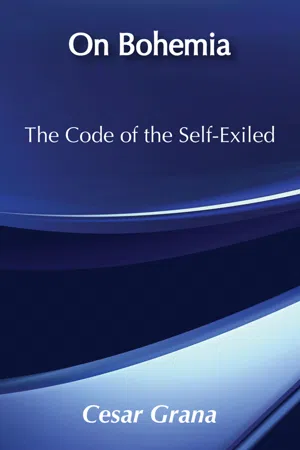
Bohemia has been variously defined as a mythical country, a state of mind, a tavern by the wayside on the road of life. The editors of this volume prefer a leaner definition: an attitude of dissent from the prevailing values of middle-class society, one dependent on the existence of caf life. But whatever definition is preferred, this rich and long overdue collective portrait of Bohemian life in a large variety of settings is certain to engage and even entrance readers of all types: from the student of culture to social researchers and literary figures n search of their ancestral roots. The work is international in scope and social scientific in conception. But because of the special nature of the Bohemian fascination, the volume is also graced by an unusually larger number of exquisite literary essays. Hence, one will find in this anthology writings by Malcolm Cowely, Norman Podhoretz, Norman Mailer, Theophile Gautier, Honore de Balzac, Mary Austin, Stefan Zweig, Nadine Gordimer, and Ernest Hemingway. Social scientists are well represented by Cesar Grana, Ephraim Mizruchi, W.I. Thomas, Florian Znaniecki, Harvey Zorbaugh, John R. Howard, and G. William Domhoff, among others.The volume is sectioned into major themes in the history of Bohemia: social and literary origins, testimony by the participants, analysis by critics of and crusaders for the bohemian life, the ideological characteristics of the bohemians, and the long term prospect as well as retrospect for bohemenianism as a system, culture and ideology. The editors have provided a framework for examining some fundamental themes in social structure and social deviance: What are the levels of toleration within a society? Do artists deserve and receive special treatment by the powers that be? And what are the connections between bohemian life-styles and political protest movements?This is an anthology and not a treatise, so the reader is free to pick and choose not only wha
Information
I
The Social and Literary Origins of Bohemia
Bohemianism such as it was sprang up in
Paris. And that is sufficiently good reason for
its failure in England.
Paris. And that is sufficiently good reason for
its failure in England.
—Anonymous British editorial
The Ideological Significance of Bohemian Life
César Graña, 1964
The new literary ideals and the struggling, searching, voluble young men who were their natural protagonists joined together in Paris to make of intellectual discontent a cultural spectacle. They created la vie de bohème as a means of intruding into daily reality their willful and unpredictable energies, their thrust for novelty, and their colorful contempt for the established spiritual order. The language of Bohemia, said Henri de Mürger (who was to make his reputation as the chief chronicler of the garret) was a paradise to experimentalists and a hell to classicists. And Alexandre Dumas, when he felt like posing as a Bohemian, at once assumed the idiom of self-dramatized and shimmering sensitivity and the air of unstable, pulsing intellectual excitement; “a brush in one hand, a pen in the other, laughing, crying, scribbling.”1 Balzac, on the other hand, in A Prince of Bohemia, saw Bohemian glamor and even Bohemian fun as the symbol of enforced failure, the spectacle of young intellectuals who had turned to iconoclasm and exhibitionism, because of their frustration before what he called the “gerontocracy” of the Restoration and Orleanist periods. If the Tsar would buy Bohemia and set it down in Odessa, Odessa would be Paris within a year. There were, he said, writers, administrators, soldiers, artists, and diplomats in Bohemia “quite capable of overturning Russia’s designs, if they but felt the power of France at their backs.”2
Most writers who succeed in their work are, in the strict sense, unsatisfactory Bohemians. True Bohemian sectarianism is usually carried on by people of excitable imaginations and modest talent, a combination which disables them for an ordinary existence and forces them, as consolation, to a life of dedicated unconventionality. For the really talented, as Balzac suggests, Bohemia is a stimulating interlude until the chance for real work arrives. Yet, Balzac knew that within Bohemia, as generally within modern literary life, there was a struggle between the most passionate ambition and the fear that success would mean only the kiss of death to freedom and integrity. As he put it in his curious piece of speculation about Paris and Odessa, even if Russia were thrown open to the intellectual colonization of young Parisians they might not choose to leave “the asphalt of the boulevards behind them.”3 The point is that, although Bohemia has never been, as such, the house of the intellect, the spirit of intellectual vagrancy which it represents has considerable ideological significance and an affectionately legendary place in the world of artists and writers. Every literary generation since the nineteenth century has had its Bohemian moment, and the inheritance shows in some detail of personal display, in the occasions of spiritual revelry and comradeship observed in the academy, the studio, and the newspaperman’s saloon, and in the paraphernalia and voluntary stigmata of Latin Quarters everywhere. The reason is that Bohemia embodies as a social fixture the burning and doomed enthusiasm for the life of the spirit, the daily battle against the powers of the modern world. As the founders of this tradition, the Parisian Bohemians created a fellowship which a young artist or writer could become a part of, invented the basic Bohemian manner, and named it appropriately with a variant of the French word for gypsy. For the Bohemian image has always been an intellectually uplifted version of the gypsy image as a community of chosen outcasts, claiming the spontaneous gift of creativity and willing to undergo great penalties to preserve their peculiar freedoms. By its very nature Bohemia was too impersonal, unbusinesslike, and lacking in unified goals to become an organized utopia in the sense of a Brook Farm or a religious community. But it did represent the intention to translate into daily experience the romantic code of existence for the sake of beauty, creative work, and the free individual who was the servant and, if necessary, the victim of such values. In other words, it created the sociological props for the literary existence as a “subculture,” as a public way of life.
One of the recurrent features of a period calling into question established social principle seems to be to drive young people into unexpected forms of defiance and unrest.
The French Revolution, for example, had, as one of its aftermaths, the appearance of youthful gangs and coteries dedicated to the cultivation of special passions and adventures. Some, like the Unbelievables (Incroyables) of the Thermidorian reaction, were aristocratic and monarchist and had as their purpose the terrorizing of their radical counterparts of the Jacobin Club. Their clothing identification (always a concomitant of youth groups) was expensive and precise—abundant lace, high cravat, tight trousers, a short velvet waistcoat with eighteen mother-of-pearl buttons, and artificial beauty marks. Their hair was cut short in the back and hung over the face in free locks. The style was a piece of macabre taunting called à la victime because it imitated the appearance of a person about to be placed under the guillotine. Others, like the Bousingots (one translation is the “Hell-raisers”) of the Restoration Period, were apparently recruited from among middle-class discontents and held radical-sounding, erratic political ideas which somehow were never followed by practical action. According to Balzac they could be recognized by their off-center cravats, greasy coats, long beards, and dirty finger nails.4 The Bohemians of the 1830’s and 1840’s were young, actually and ideologically; they claimed that youth itself was the collective expression of genius. It is exaggerating very little to say that Bohemians hoped to be seen as a band of intellectual raiders and freebooters, who routed convention everywhere and kept all contented souls in a state of dazzled alarm. In this, if we believe Mrs. Trollope, they succeeded only too well. In 1836, she wrote that, “Young France,” (one of the Bohemian tags) had become a cabalistic figure of speech “by which everybody seems to be expected to understand something great, terrible, volcanic and sublime.”5 In all accounts of the Bohemia of the Orleanist years, the first impressions have always to do with its ingenious techniques of social outrage. When Thackeray first came on the Paris Bohemia, he was astonished enough to make a careful record of their appearance—their ringlets, straight locks, toupees, English, Greek and Spanish nets, and the variety of their beards and jackets.6 The painter Pelletier went on walks accompanied by a pet jackal. De Nerval took a lobster on a leash through the Tuilleries gardens; “It does not bark,” he said, “and knows the secrets of the deep.” Théophile Gautier’s red waistcoat staggered the bourgeois at the premiere of Hernani, though by Bohemian standards such apparel was in no way extraordinary. In the recollection of Hugo’s wife, the Hugoiste claque at this most storied of first nights also wore Spanish cloaks, Robespierre waistcoats, and Henry III caps.7
Obviously prankish as these things were, there stood behind them the effort to give manner and presence to the aristocratic credo of the new intelligentsia. However, as was pointed out in an earlier chapter, this credo did not represent a continuation or revival of the Old Regime’s learned courtliness. On the contrary, at least in the Bohemian case, the chosen gained a sense of their condition, either from the reverse pride of the citizen of an outcast world or from an identification with the glamorous aggression and egotism of the outlaw. For, in the sense that romanticism is a glorification of “predatory efficiency” (the basis, according to Thorstein Veblen, of barbaric elites),8 Bohemian imagination was, above all, romantic, that is to say, filled with bandits, pirates, robber barons, and other such heroes who were at the same time aristocratic and primitive, splendid and threatening. It is not surprising, therefore, that in their farewell notes to the world the young Parisian suicides of Mrs. Trollope’s day would speak of yearning for a greatness that “should cost neither labor nor care” and express “profound contempt for those who are satisfied to live by the sweat of their brow.”9
Of course, the aesthete’s war was bound to be a war of the imagination—a member of Gautier’s circle wrote that, while Saint-Simonians and Fourierists attacked the bourgeoisie at the political and economic level, the artistic faction had as its weapons only “the brush, the lyre, and the chisel.”10 And perhaps for that reason, it was waged with a degree of psychological aggression which reached near-cultist proportions. Examining the dramatists of the 1830’s, Mrs. Trollope was taken aback by their infatuation with vice, poison, rape, murder, and blasphemy. Gautier himself spoke of the “carrion novels” written by his contemporaries. “Black humor” and talking “graveyard stuff” (parler cadavre) became essential to the jargon of the Bohemians.11 The painters appeared to Chateaubriand to have, in addition to their alarming mustaches, heads full of deluges, seas, rivers, forests, cataracts, tempests, slaughters, and tortures. Their aim, he said, was to form a separate species between the ape and the satyr.12 The accuracy of this reading of the artist’s inner thoughts as a forecast of the character of the art itself is attested by the death, massacre, and battle scenes which became the staple of so much romantic painting.13
Just as Bohemians dreamed of themselves as the protagonists of picturesque violence, so were their anecdotes and stunts symbolic acts of terror on society. Skeletons provided “atmosphere” for many garrets and were sometimes used for such primeval apocalyptic gestures as the famous attempts by Borel, Gautier, and de Nerval to quaff sea water out of a human skull. Borel called his quarters “The Tartar War Camp,” and de Nerval pitched a nomad’s tent in the middle of his apartment. The Bousingots were said to eat wild boar (“not digestible, but Gothic”) and to hang their walls with tomahawks and “poisoned” daggers. The constitution of one student band, the Badouillards, required its members to be initiated at a night-long vigil, during which they guarded arms in the medieval fashion to show courage in fighting and proficiency in fencing and boxing. They took an oath of vengeance on the bourgeoisie, and had to display a repertory of obscene songs suitable for disturbing the peace.14
The following (a poem in prose translation), by Théophile Dondey,15 is a typical document of the period.
In the center of the room, round a blazing punch bowl whose prystmatic flames resemble a steamy lake, and whose size is the equal of the expanses of Hell, sit twenty young men, artists to the core, pipes puffing, sardonic of eye, their heads adorned with the Liberty Cap; the bearded Young France ready for the orgy. … In the morning these Fate-touched Young Men will revel in a river of wrathful madness, will grasp their daggers, pledge themselves to rip open the bellies of the money-counters, and swear to devote their lives to waging war against these barren times. …16
What Dondey offers us here is a short catalogue of Bohemian romantic hatreds and devotions: the chosen Young Man, beautiful, satanic, savage and sensitive; the witchcraft (and the burden) of genius; the soul-deprived world, languishing under the sterile tyranny of the merchant; the duty of the creative outcast to be reckless and free; the Avenging Angel of Art who will finally plunge the knife into the heart of bourgeois society—that is, its stomach.
The dadaistic clowning and esoteric jokes which have always been hallmarks of Bohemia also flourished among these originals. In their stories women died laughing, while lovers tickled their feet. Their chapter headings were written in English, Latin, Provençal, and Spanish. Their books had titles like On the Incommodiousness of Commodes or On the Effect of the Tales of Fishes upon the Undulations of the Sea. The preface to a book by Dondey read:
Ah
Eh he
He! hi! hi!
Oh
Hu! Hu! Hu!
Profession of faith of the author.17
Yet all of this provocative tomfoolery was designed to furnish comic relief for a profound feeling of frustration and abhorrence. If Théophile Dondey’s “profession of faith” was a stammering of gibberish it was only because, as he wrote Borel, “Like you, I despise society … and especially its excrescence, the social order.”18
One cause of cynicism was political bewilderment. Gautier complained that his “best enemies” advised him to be red one day and white the next (and out of boredom he concluded that “poets, dreamers, and musicians had no business trying to be good citizens”).19 Early in Mürger’s Vie de Bohème, Rodolphe, the young artist, instructs the concierge in charge of his garret to awaken him every morning by announcing the day of the week, the day of the month, the quarter of the moon, and the form of the government.20 After two generations of revolution, war, propaganda, and countless panaceas, there were those who could only respond with exhaustion, hilarity, and contempt, or seek the respite of new forms of imagination. Yet it was precisely political confusion that permitted Bohe mian life to exist. For however the bourgeoisie might defile the life of the spirit, it lacked the ideological bone structure capable of placing all of society under the pale of one jealous and inflexible order. Bohemia, for its part, despite all of the burning bitterness of its anti-social feeling, was, almost by definition, politically powerless. What it caused to flourish instead was, in Dondey’s words, the “arsenal of the soul,” the pursuit of purely ideal engagements. Of these the most typical and the most influential historically was the religion of beauty, l’art pour l’art, a kingdom whose integrity was free from the secular world, whose tasks arose only out of the individual’s own creativity and which, therefore, permitted the gratification of the romantic need to be at the same time significant and self-centered.
Art for art’s sake was a saving vision. It was also a sectarian devotion exhibiting and accepting the martyrdom of philistine incomprehension, or as Châteaubriand called it, “the pageant of the bleeding heart.”21 What this meant to a generation without religious faith and incapable of social optimism may be seen in the theatrically sincere notes of office workers, law clerks, and minor fonctionnaires collected by the literary historian René Maigron, in which obscure young men pay the symbolic homage of life and death to the romantic dream of redeeming beauty. One, written by a “future littérateur” in 1836, says:
I shall open my breast to the great wind of Art and my quivering heart will ecstatically exult while my ship, upon the wind of beauty will joyfully sail over the purple sea. Far, far and even farther, believe not in the abyss. Fly my beautiful vessel, far from the hated shore. Higher and always higher. We shall lull sweetly along, over the misty expanses, toward the enchanted dream.22
Another reads:
Heroes die smiling in the flames, and like them, I go smiling to the funeral pyre. Divine Art, I carry you in my soul. Let me be worthy of you.23
For men so precious, so exacting, and so vulnerable, death appeared, understandably, as the only harbor open to lonely sensibility. Their books had titles like Nécropolis, Philosophie du désespoir, Entre la vie et la mort, Mémoires d’un suicide, and L’Amour de la mort. According to Sainte-Beuve the ideal of the romantic generation was to be a great poet and to die. “Never was death more loved than then,” said Maxime DuCamp speaking of the romantic years and the sensuous necrophilia of writers for whom death had “the delicate aroma of flowers or perfume” bears him out.24
There were, in fact, some semi-serious efforts to formalize the suicidalideal, such as The Suicide Club (originally called the Fed-ups Club) organized at the Sorbonne in 1846. The Suicide Club recruited its members between the ages of eighteen and thirty. It pledged them to show the bourgeoisie that nothing could be nobler than self-destruction. It excluded those wishing to end their lives because of disappointment in love, financial difficulties, or incurable disease. And it prohibited all suicid...
Table of contents
- Cover
- Half Title
- Title Page
- Copyright Page
- Dedication
- Table Of Contents
- Preface
- Acknowledgments
- Part I. The Social and Literary Origins of Bohemia
- Part II. The Testimony of Bohemia
- Part III. The Continuous Demise of Bohemia
- Bibliography
Trusted by 375,005 students
Access to over 1.5 million titles for a fair monthly price.
Study more efficiently using our study tools.
Frequently asked questions
Yes, you can cancel anytime from the Subscription tab in your account settings on the Perlego website. Your subscription will stay active until the end of your current billing period. Learn how to cancel your subscription
No, books cannot be downloaded as external files, such as PDFs, for use outside of Perlego. However, you can download books within the Perlego app for offline reading on mobile or tablet. Learn how to download books offline
Perlego offers two plans: Essential and Complete
- Essential is ideal for learners and professionals who enjoy exploring a wide range of subjects. Access the Essential Library with 800,000+ trusted titles and best-sellers across business, personal growth, and the humanities. Includes unlimited reading time and Standard Read Aloud voice.
- Complete: Perfect for advanced learners and researchers needing full, unrestricted access. Unlock 1.5M+ books across hundreds of subjects, including academic and specialized titles. The Complete Plan also includes advanced features like Premium Read Aloud and Research Assistant.
We are an online textbook subscription service, where you can get access to an entire online library for less than the price of a single book per month. With over 1.5 million books across 990+ topics, we’ve got you covered! Learn about our mission
Look out for the read-aloud symbol on your next book to see if you can listen to it. The read-aloud tool reads text aloud for you, highlighting the text as it is being read. You can pause it, speed it up and slow it down. Learn more about Read Aloud
Yes! You can use the Perlego app on both iOS and Android devices to read anytime, anywhere — even offline. Perfect for commutes or when you’re on the go.
Please note we cannot support devices running on iOS 13 and Android 7 or earlier. Learn more about using the app
Please note we cannot support devices running on iOS 13 and Android 7 or earlier. Learn more about using the app
Yes, you can access On Bohemia by Cesar Grana in PDF and/or ePUB format, as well as other popular books in Social Sciences & Literary Criticism for Comparative Literature. We have over 1.5 million books available in our catalogue for you to explore.