- 260 pages
- English
- ePUB (mobile friendly)
- Available on iOS & Android
eBook - ePub
About this book
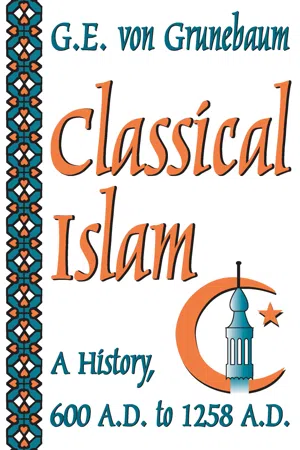
In a book written with the poignancy and beauty appropriate to its subject matter, the author opens by reminding us that the essence of a society is in a sense identical with its history. Classical Islam also serves as a reminder that in the case of Islam, despite its triumphs on the fields of battle, telling its history is the only way open to us to render that essence accessible and show it from all sides. The work offers a grand narrative of a faith that offers an interpretation of the world, a way of life, and a style of thinking, that goes far beyond institutional or political supports. The relevance of this historical perspective is beyond dispute. The period from 610 A.D. when Muhammad received his call until the conquest of Baghdad by the Mongols in 1258 is known as the classical period of Islam. This was the period of the great expansion of Islam both as a political structure and as a religious and intellectual community. It established the base for the development of the high Islamic civilization of North Africa, the Near East, Persia, and India, as well as further expansion of the Islamic religious and intellectual community throughout the world. This book presents an authoritative history of the period written by one of the world's leading experts on the subject.Classical Islam examines the relationships, both cultural and political, between the Islamic world and the Mediterranean countries and India and elaborates on the economic, social, and intellectual factors and forces that shaped the Muslim world and molded its interactions with infidels. The work is written in a clear and direct narrative form, emphasizing simultaneously the major intellectual trends and the political events and tendencies of the formative period in Islamic history that still resonates today.
Information
Index
The index contains the names of persons, places, and countries that are mentioned in the text as well as Arabic terms and many subject headings. The Arabic article al has been disregarded in the alphabetical order.
al-‘Abalät 24
‘Abbad, Banū 177
al-‘Abbās 44, 77
al-‘Abbās ibn al-Aḥnaf 136
‘Abbāsids 44, 74, 77-98, 101, 107, 112, 114, 120, 123, 126, 141, 142, 167, 171, 175, 180, 186, 191, 194, 204, 206, 210
‘Abdallāh ibn al-Mu‘tazz 206
‘Abdallāh ibn az-Zubair 72, 203
‘Abd al-Latīf 200
‘Abd al-Malik 25, 69, 72, 75, 97, 203
‘Abd al-Mu’min 182, 185, 186, 187, 190, 209
‘Abd al-Qādir al-Jïlï 195, 209
‘Abd ar-Raḥmān I 121, 204
‘Abd ar-Raḥmān II 120, 205
‘Abd ar-Raḥmān III 121, 123, 146, 177, 206
‘Abd al-Wad, Banū 190
Abélard 133, 199
Abīd ibn al-Abras 17
abnā’ 46
Abraha 22,...
Table of contents
- Cover Page
- Title Page
- Copyright
- Contents
- Preface
- Pre-Islamic Arabia
- Muhammad
- External Power and Internal Division
- The Umayyads
- The ‘Ahbāsids
- Islamic Society and Social-Religious Movements
- Egypt under the Fāṭimids and Ṭūlūnids
- The Arab West
- The Horizon of Islam: Theology, Philosophy, Literature
- ‘The Downfall of the Caliphate
- The Latin States
- Divisions in the Islamic World
- Religious Reform and Berber Nationalism
- Withdrawal and Mysticism at the end of the Caliphate
- Bibliography
- Index
Trusted by 375,005 students
Access to over 1.5 million titles for a fair monthly price.
Study more efficiently using our study tools.
Frequently asked questions
Yes, you can cancel anytime from the Subscription tab in your account settings on the Perlego website. Your subscription will stay active until the end of your current billing period. Learn how to cancel your subscription
No, books cannot be downloaded as external files, such as PDFs, for use outside of Perlego. However, you can download books within the Perlego app for offline reading on mobile or tablet. Learn how to download books offline
Perlego offers two plans: Essential and Complete
- Essential is ideal for learners and professionals who enjoy exploring a wide range of subjects. Access the Essential Library with 800,000+ trusted titles and best-sellers across business, personal growth, and the humanities. Includes unlimited reading time and Standard Read Aloud voice.
- Complete: Perfect for advanced learners and researchers needing full, unrestricted access. Unlock 1.5M+ books across hundreds of subjects, including academic and specialized titles. The Complete Plan also includes advanced features like Premium Read Aloud and Research Assistant.
We are an online textbook subscription service, where you can get access to an entire online library for less than the price of a single book per month. With over 1.5 million books across 990+ topics, we’ve got you covered! Learn about our mission
Look out for the read-aloud symbol on your next book to see if you can listen to it. The read-aloud tool reads text aloud for you, highlighting the text as it is being read. You can pause it, speed it up and slow it down. Learn more about Read Aloud
Yes! You can use the Perlego app on both iOS and Android devices to read anytime, anywhere — even offline. Perfect for commutes or when you’re on the go.
Please note we cannot support devices running on iOS 13 and Android 7 or earlier. Learn more about using the app
Please note we cannot support devices running on iOS 13 and Android 7 or earlier. Learn more about using the app
Yes, you can access Classical Islam by G. E. von Grunebaum in PDF and/or ePUB format, as well as other popular books in Social Sciences & Islamic Theology. We have over 1.5 million books available in our catalogue for you to explore.