eBook - ePub
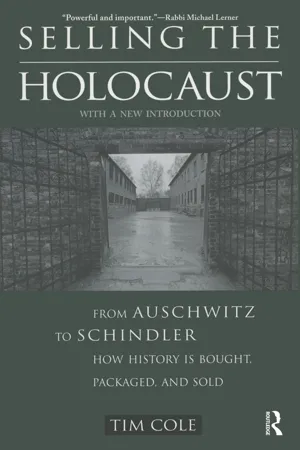
Selling the Holocaust
From Auschwitz to Schindler; How History is Bought, Packaged and Sold
- 234 pages
- English
- ePUB (mobile friendly)
- Available on iOS & Android
eBook - ePub
About this book
Cole shows us an "Auschwitz-land" where tourists have become the "ultimate ruberneckers" passing by and gazing at someone else's tragedy. He shows us a US Holocaust Museum that provides visitors with a "virtual Holocaust" experience.
Information
Part I
People
1
Anne Frank
At the end of the twentieth century, Anne Frank is ubiquitous. She is simultaneously 'the Holocaust's most famous victim'1, 'the most famous child of the twentieth century'2, and 'her face with the sad shy smile is one of the icons of this century, a present-day Mona Lisa'.3 Since the 1950s Anne Frank's name has been attached to a day, a week, a rose, a tulip, countless trees, a whole forest, streets, schools and youth centres, and a village. Her diary has been translated into more than 55 languages, has sold over 24 million copies worldwide and is the canonical 'Holocaust' text. In 1997, there were more than 700,000 visitors to the Amsterdam house which was the Frank family's hiding place during the war, among them the American First Lady Hillary Clinton and the 1970s pop group the Bee Gees.
And yet, it is perhaps rather surprising that it is Anne Frank's diary which has assumed the status of'Holocaust' text par excellence. It is after all, only one amongst many 'Holocaust' diaries to survive the war. Moreover, in the text of The Diary of Anne Frank, the implementation of the 'Final Solution of the Jewish Question' plays a somewhat peripheral role. The 'Holocaust' is essentially the context within which the diary is written, rather than the central focus. In the words of Anne's father – Otto Frank – in a letter of 1952, the diary 'is not a warbook. War is the background. It is not a Jewish book either, though Jewish sphere, sentiment and surrounding is the background'.4
Unlike the ghetto diary written by – for example – Avraham Tory in Vilna,5 Anne's diary – written in hiding in Amsterdam – does not describe the unfolding of the Nazi persecution of the Jews in depth. Aside from detailing the nature of Hitler's anti-Jewish laws in the entry for 20 June 1942, specific references in the diary to the activities of the Nazis are restricted to the few snippets of information gleaned from radio reports or Dutch 'Christian' visitors. Anne herself writes in her entry for 28 March 1944: 'I could write a lot more about politics, about the news bulletin early this morning, about Miep's and Bep's questions and so on and so forth, but I have heaps else to tell you today.'6 The 'heaps else' relate to the relationships within the annexe in general, and her relationship with Peter in particular. It is this developing relationship between two adolescents which dominates the diary. The Holocaust is merely the setting within which this relationship evolves, and the reason why both of them find themselves in hiding together.
When Anne does make specific references to events going on outside of the annexe, they are subsumed by the concerns of an adolescent girl living with seven other people, one of whom she is growing to love. On 31 March 1944 she writes briefly of the German occupation of Hungary where 'there are still a million Jews ... so they too will have had it now', and at more length of the birthday presents given to Peter's father, and her developing relationship with Peter himself:
The chatter about Peter and me has calmed down a bit now, he's coming to fetch me this evening, nice of him don't you think, because he finds it such a bore himself! We are very good friends, are together a lot and discuss every imaginable subject. It is awfully nice never to have to keep a check on myself as I would have to with other boys, whenever we get onto precarious ground. We were talking, for instance, about blood and via that subject we began talking about menstruation etc. He thinks we women are pretty tough, seeing that we can stand up to losing 1 to 2 litres of blood. He thinks I'm tough as well. I wonder why?7
Nonetheless, Anne Frank's diary has become the central 'Holocaust' text. It is Anne's diary – rather than someone else's–which has become the 'Holocaust bible', and this despite (or perhaps precisely because of) being 'one of the "easiest" and most antiseptic works of Holocaust literature'.8 It is this book above all others which is the most widely read 'Holocaust' text, and yet as Alvin Rosenfeld suggests, 'to limit one's understanding of the Holocaust to such a book as Anne Frank's diary is to grasp only the most preliminary outline of the coming war against the Jews'.9
From the perspective of the present it is easy to assume that The Diary of Anne Frank was in some ways destined to worldwide popularity because of the remarkable maturity of Anne's writing.However, Anne Frank made an inauspicious start as a 'contemporary cultural icon'10 in the years immediately after the end of the war. Despite its later phenomenal success, the early post-war attempts of Anne's father Otto – the only survivor from the 'secret annexe' – to get her diary published, were unsuccessful. Anne's diary was rejected by at least four leading Dutch publishers, before finally being published by Uitgeverij Contact in a limited print run of 1, 500 copies in June 1947. Annie Romein, who showed a copy of the diary to the Dutch publishers Querido in 1946, saw their rejection of the manuscript to be a result of 'the certainty [which] prevailed there at the time that interest in anything to do with the war was stone cold'.11 And yet reading the diary had made a profound impact upon her historian husband, Jan Romein. It was he who referred to the diary – although not by name – for the first time in print, in an article published in the newspaper Het Parool on 3 April 1946. There he recounted reading a diary written by a thirteen-year-old Jewish girl who had been in hiding with her parents and older sister for two years before being arrested by the Gestapo and dying in a German concentration camp shortly before liberation. Writing in the context of the start of the war crimes trials, Jan Romein claimed that 'this apparently inconsequential diary by a child, this "de profundis" stammered out in a child's voice, embodies all the hideousness of fascism, more so than all the evidence at Nuremberg put together'.12 It was primarily as a result of this article that the publisher Contact expressed an interest in the diary.
However, it would be wrong to suggest that there was anything like a straight line between the publication of The Diary of Anne Frank, in Dutch Het Achterhuis, by Contact in 1947, and this 'apparently inconsequential diary by a child' becoming a central icon in the myth of the 'Holocaust' some fifty or so years later. The diary was moderately successful in the Netherlands, and went through six Dutch editions in three years, but this remained a relatively slow start. Indeed, almost five years separated the printing of the sixth (July 1950) and seventh (April 1955) editions of Het Achterhuis.13
From 1957 onwards, the popularity of the diary increased rapidly in the Netherlands: three editions were published in 1955, three more in 1956, a further nine in 1957 and five in 1958.14 In 1957 the decision was made not to demolish Prinsengracht 263 and it opened to the public in 1960. This renewed interest in Anne Frank and her diary in the Netherlands was stimulated by the opening of the Broadway play based on the diary there on 27 November 1956, meaning it 'came about "via an international detour".'15 For Anne Frank to become famous in the Netherlands, she had to be taken to America in 1952, and then taken back to the Netherlands in 1956. Arguably the 'Anne Frank' who returned to the Netherlands in the mid-fifties was not the same 'Anne Frank' who had been taken across the Atlantic four years previously. 'Anne Frank' had been 'Americanised', and her story reshaped and repackaged.
Although the original manuscript of the diary is written in Dutch, when Anne and her family were in hiding in wartime Amsterdam, the Frank family were German Jews. Anne had been born in Frankfurt on 12 June 1929. Thirteen years later – when one of her birthday presents was a red and white checked autograph album, which became the first book in which Anne wrote her diary – she was living in a suburb in southern Amsterdam. The family had moved from Germany to Amsterdam at the end of 1933, after the Nazi rise to power. Amsterdam was well known to Otto Frank, who had travelled there on business during the early to mid 1920s. It was, therefore, in many ways a natural place to take his family when Otto started to consider emigrating. He arrived in the middle of 1933 to establish a Dutch branch of the pectin manufacturers Opekta-Wwerke, on the recommendation of his brother-in-law who headed the Swiss Opekta subsidiary. In December 1933, his family joined him in their second floor apartment at Merwedeplein 37, although Anne did not arrive in Amsterdam until February – or possibly March – 1934.16
It was in this apartment that Anne wrote her first diary entries in June 1942. However, less than a month later the family moved into the building which was to become associated with her name –Prinsengracht 263 – where Otto Frank had moved his offices and warehouse in December 1940. After the issuing of call-up notices for German Jews at the beginning of July 1942, the family went into hiding in the 'secret annexe' at the rear of the office building. The original plan to go into hiding on 16 July was brought forward by ten days as a result of the call-up papers. For a little more than two years, the 'secret annexe' was home to Anne, her sister Margot, her father and mother Otto and Edith, Mr and Mrs van Pels and their son Peter (2 years older than Anne) and the dentist Dr Friedrich Pfeffer (who moved in at the end of 1942). Herman van Pels and his family, and Pfeffer had been family friends for a number of years.
While Anne and her sister Margot had both been born in Germany, they had moved to Amsterdam as young girls and, in reflecting on her identity in her diary, Anne no longer saw herself as German. On 9 October 1942, news of German shootings of hostages led her to comment: 'Nice people the Germans and to think that I am really one of them too! But no, Hitler took away our nationality long ago, in fact Germans and Jews are the greatest enemies in the world'.17 And in her 'Prospectus and Guide to the "Secret Annexe"' Anne had specified that 'it is strictly forbidden to listen to German news bulletins', and that 'German [radio] stations are only listened to in special cases, such as classical music'. As far as 'use of language' went, 'all civilised languages are permitted, therefore no German! ... No German books may be read ...'18
Anne considers her Jewishness perhaps nowhere more so than in a passage written after the shock of another break-in:
We have been pointedly reminded that we are in hiding, that we are Jews in chains, chained to one spot, without any rights, with a thousand duties. We Jews mustn't show our feelings, must be brave and strong, must accept all inconveniences and not grumble, must do what is within our power and trust in God. Sometime this terrible war will be over. Surely the time will come when we are people again, and not just Jews!
Who has inflicted this upon us? Who has made us Jews different from all other people? Who has allowed us to suffer so terribly up till now? It is God that has made us as we are, but it will be God, too, who will raise us up again. If we bear all this suffering and if there are still Jews left, when it is over, then Jews, instead of being doomed, will be held up as an example. Who knows, it might even be our religion from which the world and all peoples learn good, and for that reason and that reason only do we have to suffer now. We can never become just Netherlanders or just English or any other nation for that matter, we will always remain Jews, we must remain Jews, but we want to, too.19
Yet it is clear that whiie identifying herself as a Jew, Anne also identified with the Netherlands, writing of'our beloved queen',20 and of her desire to 'become Dutch! I love the Dutch, I love this country, I love the language and want to work here'.21 However, news of growing antisemitism in Dutch circles and the possibility that Jewish immigrants may be forced to leave the Netherlands after the war, caused Anne to reflect on her relationship with her adopted country:
I hope one thing only, and that is that this hatred of the Jews will be a passing thing, that the Dutch will show what they are after all, and that they will never totter and lose their sense of right, for this is unjust! And if this terrible threat should actually come true, then the pitiful little collection of Jews that remain in Holland will have to leave. We, too, shall have to move on again with our little bundles, and leave this beautiful country, which offered us such a warm welcome and which now turns its back on us. I love Holland. I who, having no native country, had hoped that it would become my fatherland, and I still hope it will!22
This Anne who distances herself from her German roots, and reflects upon her Jewishness in the pages of her diary, was made into someone else when she was exported. That reshaping of her identity can be seen first of all in the German translation of her diary. Originally intended for Anne's grandmother, who could not read Dutch, Anneliese Schutz's 1946 German translation of Otto Frank's typescript of the diary was published by Lambert Schneider Verlag in 1950. Anne's negative references to Germans were either toned down or removed entirely. Thus the rule in her 'Prospectus and Guide to the "Secret Annexe"' that 'German [radio] stations are only listened to in special cases, such as classical music' was left out of the German translation, and the rule 'Speak softly at all times, by order! All civilised languages are permitted, therefore no German!' became 'All civilised languages ... but softly'.23 Anne's statement that 'there is no greater hostility than exists between Germans and Jews' was changed in the German translation into 'there is no greater hostility in the world than between these Germans and Jews!'24 This last change was specifically justified by Otto Frank on the grounds that Anne, 'despite the great tribulations she had suffered as a result of the persecution of the Jews and which she felt so acutely despite her youth, by no means measured all Germans by the same yardstick. For, as she knew so well, even in those days we had many good friends among the Germans'.25 The removal of anything which could be taken as anti-German was justified by Der Spiegel on the grounds that 'a book intended for sale in Germany ... cannot abuse the Germans'.26
In the process of publication, 'Anne' was stripped of more than simply any comments which could be perceived as 'anti-German', There were clear attempts by Otto Frank and the early publishers not to compromise Anne and her mother's posthumous reputation. Thus the passages of sexual self-discovery were heavily edited, and the Anne who writes: 'Dear Kitty, There's no one in the world I've told more about myself and my feelings than you, so I might as well tell you something about sexual matters too',27 was more or less silenced. No doubt, Anne's adolescent description of her vagina was seen to be inappropriate in the conservative context of the late 1940s and early 1950s.28 The 'Anne Frank' who was published was not only seemingly disinterested in sex. She was also made into a teenager whose poor relationship with her mother was patched up through the editing of her most cutting and critical observations. It wasn't until the late 1980s that Anne was given back her sexuality and trouble...
Table of contents
- Cover
- Half Title
- Title
- Copyright
- Contents
- Dedication
- Acknowledgments
- Introduction to the Paperback Edition
- Prologue: The Rise (and Fall?) of the Myth of the 'Holocaust'
- PART I. PEOPLE
- PART II. PLACES
- Epilogue
- Notes
- Select Bibliography
- Index
Trusted by 375,005 students
Access to over 1.5 million titles for a fair monthly price.
Study more efficiently using our study tools.
Frequently asked questions
Yes, you can cancel anytime from the Subscription tab in your account settings on the Perlego website. Your subscription will stay active until the end of your current billing period. Learn how to cancel your subscription
No, books cannot be downloaded as external files, such as PDFs, for use outside of Perlego. However, you can download books within the Perlego app for offline reading on mobile or tablet. Learn how to download books offline
Perlego offers two plans: Essential and Complete
- Essential is ideal for learners and professionals who enjoy exploring a wide range of subjects. Access the Essential Library with 800,000+ trusted titles and best-sellers across business, personal growth, and the humanities. Includes unlimited reading time and Standard Read Aloud voice.
- Complete: Perfect for advanced learners and researchers needing full, unrestricted access. Unlock 1.5M+ books across hundreds of subjects, including academic and specialized titles. The Complete Plan also includes advanced features like Premium Read Aloud and Research Assistant.
We are an online textbook subscription service, where you can get access to an entire online library for less than the price of a single book per month. With over 1.5 million books across 990+ topics, we’ve got you covered! Learn about our mission
Look out for the read-aloud symbol on your next book to see if you can listen to it. The read-aloud tool reads text aloud for you, highlighting the text as it is being read. You can pause it, speed it up and slow it down. Learn more about Read Aloud
Yes! You can use the Perlego app on both iOS and Android devices to read anytime, anywhere — even offline. Perfect for commutes or when you’re on the go.
Please note we cannot support devices running on iOS 13 and Android 7 or earlier. Learn more about using the app
Please note we cannot support devices running on iOS 13 and Android 7 or earlier. Learn more about using the app
Yes, you can access Selling the Holocaust by Tim Cole in PDF and/or ePUB format, as well as other popular books in Social Sciences & Sociology. We have over 1.5 million books available in our catalogue for you to explore.