- 424 pages
- English
- ePUB (mobile friendly)
- Available on iOS & Android
eBook - ePub
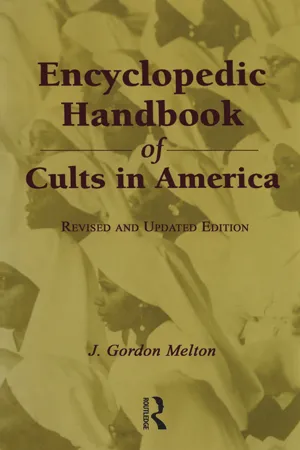
Encyclopedic Handbook of Cults in America
About this book
Covers the history, founders, beliefs, and literature of over five hundred nonconventional and alternative religious movements.
Information
IV.
The Newer Cults
A. CHRISTIAN FOUNDATION
Also known as the Music Square Church, Holiness Tabernacle Church, and the Holy Alamo Christian Church, the Christian Foundation dates to the beginning of what became known as the Jesus People Movement in the early 1970s. As one of the original groups working among the street people who emerged in California urban centers in the later 1960s, the Foundation moved on to become a large, successful Evangelical Christian body. However, beginning with attacks in the late 1980s, the Foundation has been all but destroyed, and its future (as of the beginning of 1992) is very much in doubt.
Founders
The Christian Foundation was incorporated in 1969 by Susan and Tony Alamo. Susan, born Edith Opal Horn in Arkansas, came to California to begin a singing career under the name Susan Fleetwood. Though her musical efforts did not succeed, she married, converted to Evangelical Christianity, and began informally to preach and teach. In 1964 she founded the short-lived Susan Lipowitz Foundation (Lipowitz being her married name).
Tony Alamo was born Bernie Lazar Hoffman in a Romanian Jewish family in Missouri. He journeyed to California as a young man, changed his name, and became involved in show business as a singer and promoter. In 1964, he had a most remarkable experience in the midst of a business meeting. He became deaf to his normal surroundings, and he heard a voice say to him, “I am the Lord thy God. Stand up on your feet and tell the people in this room that Jesus Christ is coming back to earth, or thou shalt surely die.”
Shortly after the experience he sought out Susan who became his Bible teacher. Eventually they were married and in the late 1960s began to evangelize among the street people in Hollywood. They moved into a house six blocks from Sunset Strip and obtained a brightly painted bus. They and their early converts “witnessed” on the street, and the bus carried interested people to the services each evening at the house. Their ministry was formally incorporated in January 1969. In 1970 they purchased a ranch near Saugus, about forty miles from Los Angeles, and soon the bus was carrying people to the ranch, converted into a camp retreat, for evening meetings. Of the many who attended the services, several hundred decided to stay and become full-time members and workers in the Foundation’s ministry.
Soon after the move to Saugus, the Foundation became the target of the growing militant anti-cult movement which accused the group of improper recruiting techniques and brainwashing. If that was not enough, Susan realized that she had cancer. In 1973 the Alamos moved to Dyer, Arkansas, Susan’s childhood home. Several of the Foundation members joined them. In 1974 they opened a small clothing shop in Nashville, Tennessee. The favorable climate in Arkansas combined with the growing hostility of the anti-cultists in California precipitated the movement of the headquarters and most of the members of the Foundation to Arkansas. Several businesses were purchased, and the expanding shop in Nashville supplied an economic base for the operation.
It did not take long for the anti-cult movement to follow the Alamos to Arkansas. The various businesses operated to support the Foundation became the focus of criticism and eventually led the government to enter the case. In the midst of the controversy, in 1982 Susan died. She was interred in a mausoleum at Dyer.
Beliefs
The Christian Foundation is conservative evangelical Christian. It has followed traditional Protestant teaching and not engaged in any doctrinal innovation.
It teaches that
Jesus Christ is the Son of the living God, that he died on the cross and shed his blood for our sins, that he rose from the dead, ascended into the heavens, and took his seat beside God the Father, becoming the high priest, and the appropriation (propitiation?) for our sins. We believe that Christ is alive. That he lives forevermore and is coming back to earth very soon. We believe, as the Bible says, that you must be born again. It is a commandment of God that we repent of our sins and ask Christ to come into our hearts and make us a new creature, that old things must pass away and all things, all lives, become new in him.
The King James Version of the Bible is preferred to both the Revised Standard Version and the Today’s English Version as the latter attack the Virgin Birth, the redemptive blood, and the deity of Christ.
The Foundation is against abortion and has frequently made offers to pay for the delivery of any unwanted babies and to feed, clothe, and house them after birth.
Current Status
The Foundation is headed by a three-person board which includes Tony Alamo as its president. Through the 1980s, headquarters of the Christian Foundation were at the Holiness Tabernacle in Dyer, six miles east of Alma, Arkansas. Many of the members lived in houses owned by the Foundation in Dyer and Alma. They operated several businesses including a restaurant, service station, and clothing store; the store in Nashville had grown into a large Western clothing outlet. Tony also promoted country music in both Nashville and western Arkansas.
Members of the Foundation were totally supported by its activities, and money from the businesses was used to support the total program.
Besides the center in Saugus, California, churches were operated in Omaha, Chicago, and Brooklyn, with mission centers in Miami, Phoenix, and Tulsa. Each church held daily services, one each evening and two on Sunday. Today members may still be found throughout the country doing missionary work, but local centers are extremely unstable. Besides the witnessing directed primarily to young adults and street people, members had developed a program of visitation to nursing and retirement homes.
Controversy
The militant anti-cult movement, which originated in the early 1970s in Southern California, directed its earliest efforts against several of the new Jesus People groups, and the Christian Foundation was among its initial targets. The Foundation attracted attention after the movement of its operations to Saugus. Critics charged that the Alamos would take unsuspecting young people to the isolated ranch and subject them to high-power conversion pressure. The accusations of deceit and brainwashing from the heyday of the Saugus center followed the Foundation to Arkansas where several attempts to deprogram members occurred.
With little success from the deprogramming attempts, the Foundation’s enemies filed lawsuits charging the Foundation with holding members in “virtual slavery,” in that members worked for the Foundation but received no wages and were forced to live in very poor conditions. While the civil suits did not bear direct fruit, the controversy led to the U.S. Department of Labor filing suit in 1977 demanding that the Foundation pay $15,500,000 in back wages to members of the group. When the suit was finally settled in 1985, the Foundation was ordered to pay minimum wages to those who work and had worked in the various Foundation businesses. Alamo remarried in December 1985, but a year later his new wife turned against him and accused him of dictatorial practices in attempts to control everything around him and beating her.
In the midst of the controversy, the Foundation gained new enemies as a result of its religious polemics. The group preached a strong anti-Catholicism which alienated it from the Roman Catholic Church. Both Evangelical Protestants and Jews came to the defense of the Roman Catholic Church after the widespread circulation of several strongly worded anti-Catholic tracts in the early 1980s. Alamo accused the Church of arranging the assassinations of Presidents Lincoln and Kennedy. The Jewish community had an additional reason for offense at the Foundation, Alamo being an outspoken convert from Judaism to Christianity.
The settlement of the labor suit did not end the Foundation’s legal problems. The IRS moved against the Foundation and in 1985 revoked its tax-exempt status and then moved against it for back taxes. It looked as if the Foundation was headed for a lengthy tax court battle. Then Alamo was accused of beating an 11-year-old boy at the Foundation’s center in Saugus. Threatened with arrest, in 1988 he dropped out of sight, though he frequently appeared to have his picture taken with a celebrity or to call a talk show. As a result of his flight, charges mounted against him, and he was unable to defend the Foundation against civil actions aimed at stripping its assets.
In early 1991, the situation changed dramatically. On February 13, law enforcement agents seized the property in Arkansas. The store in Nashville, Tennessee, had already been seized. Within a week all of the residents left and Susan Alamo’s body was taken from the mausoleum. In June, six former members of the Foundation won a $1.4 million lawsuit from the group. Finally in July, Alamo was arrested in Tampa, Florida. As of the end of 1991, he remains in custody awaiting trial.
With the seizure of the property, the membership scattered, and Alamo in jail, the future of the Foundation is in question. It is too early to count it out. The many members of the Foundation testify to lives changed by its ministry, and there have been strong professions of loyalty. Given its growth among people used to living on the streets, it could easily survive what are destined to be lengthy future legal battles. It could just as easily dissolve.
Sources-Primary
The Foundation published no substantive books but issued millions of copies of several tracts.
Alamo, Tony. Duped. Alma, AK: Holy Alamo Christian Church, n.d. 8-page tract.
———. Fugitive Pope. Van Buren, AK: Music Square Church, n.d. 6-page tract.
———. Jesus Said That Satan Would Have a Church and Government. Alma, AK: Holy Alamo Christian Churches, n.d. 8-page pamphlet.
———. The Pope’s Secrets. Alma, AK: Holy Alamo Christian Church, n.d. 8-page tract.
———. Tony Alamo—My Side of the Story. New York: Holy Alamo Christian Church, 1989. 8-page tract.
Alamo, Tony, and Susan Alamo. Tricked. Alma, AK: Christian Foundation, n.d. 4-page tract.
Sources-Secondary
Impact of Cults on Today’s Youth. Sacramento, CA: State of California, Senate Select Committee on Children and Youth, 1974.
Poett, James. “Do They Have the Right to Be Weird?” The Village Voice (October 24, 1977).
Tracy, Phil. “The Jesus Freaks.” Commonweal (October 30, 1970).
B. THE CHURCH OF SCIENTOLOGY
One of the few genuinely “new” religions to originate in the United States during the twentieth century, the Church of Scientology has become known for the numerous controversies, particularly with the Internal Revenue Service, and with those whom it claims have libeled and tried to destroy it.
Founder and Early History
The Church of Scientology was founded by L. Ron Hubbard (1911–1986). A man of varied experience, Hubbard grew up in rural Montana but during his teen years traveled internationally before settling briefly in the east. He attended George Washington University for a year (1931–32) and soon afterward began a successful career as a writer. Though he wrote a variety of true adventure and juvenile fiction, he is best remembered as a science fiction writer. He was made a member of the Explorers Club as his service in the Navy. Wounded in the South Pacific, he spent almost a year in the hospital.
During the years after his recovery, he synthesized the ideas which later became Dianetics and finally developed into Scientology. In 1948 he informally published and circulated copies of Dianetics: the Original Thesis, the first statement of his system. The volume brought him the interest and allegiance of John W. Campbell, Jr., editor of the popular Astounding Science Fiction, and Dr. J. A. Winter, a general practitioner from Michigan. In 1949 Campbell began to mention Dianetics in his magazine, and in May 1950 he published Hubbard’s first article describing the new way to understand and treat mental health. This article, along with Hubbard’s general association with the community of fellow science fiction writers, led many people to label Scientology a “science fiction religion.”
Even before the article in Astounding Science Fiction, Hubbard had formed the Hubbard Dianetic Research Foundation, headquartered in Elizabeth, New Jersey. By the end of the year, authorized branches were opened in New York, Washington, Chicago, Los Angeles, and Honolulu. Informal and independent dianetics groups sprang up around the country, especially after the publication of Dianetics, the Modern Science of Mental Health, which became a national bestseller in 1951.
Following a brief period of growth, problems arose. The medical and psychiatric community rebuffed Winter’s attempt to describe Dianetics in professional journals, and individual doctors attacked the practice. A multitude of independent dianetics groups began to mix Hubbard’s thought with occult and Eastern ideas and techniques, and Hubbard discovered that he had lost much control of Dianetic practice.
Amid the chaos and confusion, Hubbard also began to pay attention to a phenomenon which emerged during “auditing,” the dianetics counseling practice, namely the phenonenon of “exteriorization” and resulting material on past lives. Exteriorization, similar to astral travel, is the separation of the consciousness from the body. Past lives are previous incarnations of the continuing essence of a person (in Scientology terminology, a “Thetan”). In 1952, Hubbard took these additional insights and, moving to Phoenix, Arizona, founded the Hubbard Association of Scientologists International, by which it is known today. He also published his first books on Scientology.
The additional material on past lives and exteriorization led to speculation on metaphysical and spiritual matters, with the further result that in 1953, Hubbard incorporated the Church of Scientology. The first congregations of the new Church were opened in Los Angeles and Auckland, New Zealand, the following year. The Founding Church of Scientology of Washington, D.C., was established in 1955. Once established, the Church spread quickly throughout the English-speaking world and in the late 1960s began to spread through all of Europe. In 1959 the Church purchased the St. Hill Manor as a residence for Hubbard and a headquarters for the growing movement.
The year 1966 proved an important one for the prospering Church. First, in the face of a growing number of attacks upon Scientology, the office of the Guardian was established and assigned the double task of defending Scientology from attacks by outside critics and keeping the teachings and practice correct throughout the Church. Shortly after the office was created, Hubbard resigned all formal positions within the Church and began to devote his life to further development of the system. Finally a ship, renamed the Apollo, was purchased and the Sea Org(anization), a fraternal group made up of the most dedicated Church members, was formed. Hubbard, a former naval officer, moved on board the vessel and made it his research facility.
The Sea Org became the center for the development of the more advanced grades of Scientological work. In 1967, the Advanced Organization was created to run the new advanced courses. In 1970 the Flag Management Bureau was created to oversee the management of the advanced courses. In 1975, the operation aboard the Apollo was abandoned, and the Advanced Organization moved into the facilities of the Church at Los Angeles, which had previously had oversight of the Sea Org. Flag was moved into newly purchased facilities at Clearwater, Florida, and designated the Flag Land Ba...
Table of contents
- Cover Page
- Half Title Page
- Title Page
- Copyright Page
- Table of Contents
- Introduction to the First Edition
- Introduction to the Revised and Updated Edition
- I. What Is a Cult?
- II. The Established Cults
- III. The New Age Movement
- IV. The Newer Cults
- V. Counter-Cult Groups
- VI. Violence and the Cults
- Index
Trusted by 375,005 students
Access to over 1.5 million titles for a fair monthly price.
Study more efficiently using our study tools.
Frequently asked questions
Yes, you can cancel anytime from the Subscription tab in your account settings on the Perlego website. Your subscription will stay active until the end of your current billing period. Learn how to cancel your subscription
No, books cannot be downloaded as external files, such as PDFs, for use outside of Perlego. However, you can download books within the Perlego app for offline reading on mobile or tablet. Learn how to download books offline
Perlego offers two plans: Essential and Complete
- Essential is ideal for learners and professionals who enjoy exploring a wide range of subjects. Access the Essential Library with 800,000+ trusted titles and best-sellers across business, personal growth, and the humanities. Includes unlimited reading time and Standard Read Aloud voice.
- Complete: Perfect for advanced learners and researchers needing full, unrestricted access. Unlock 1.5M+ books across hundreds of subjects, including academic and specialized titles. The Complete Plan also includes advanced features like Premium Read Aloud and Research Assistant.
We are an online textbook subscription service, where you can get access to an entire online library for less than the price of a single book per month. With over 1.5 million books across 990+ topics, we’ve got you covered! Learn about our mission
Look out for the read-aloud symbol on your next book to see if you can listen to it. The read-aloud tool reads text aloud for you, highlighting the text as it is being read. You can pause it, speed it up and slow it down. Learn more about Read Aloud
Yes! You can use the Perlego app on both iOS and Android devices to read anytime, anywhere — even offline. Perfect for commutes or when you’re on the go.
Please note we cannot support devices running on iOS 13 and Android 7 or earlier. Learn more about using the app
Please note we cannot support devices running on iOS 13 and Android 7 or earlier. Learn more about using the app
Yes, you can access Encyclopedic Handbook of Cults in America by J. Gordon Melton in PDF and/or ePUB format, as well as other popular books in Theology & Religion & World History. We have over 1.5 million books available in our catalogue for you to explore.