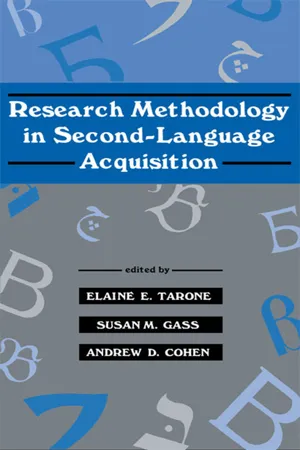
This volume addresses salient theoretical issues concerning the validity of research methods in second-language acquisition, and provides critical analysis of contextualized versus sentence-level production approaches. The contributors present their views of competence versus performance, the nature of language acquisition data, research design, the relevance of contextualized data collection and interpretation, and the desirability of a particularistic nomothetic theoretical paradigm versus more comprehensive consideration of multiple realities and complex influencing factors. This book presents varying and antithetical approaches to the issues, bringing together the thinking and approaches of leading researchers in language acquisition, language education, and sociolinguistics in an engaging debate of great currency in the field.
eBook - ePub
Research Methodology in Second-Language Acquisition
- 384 pages
- English
- ePUB (mobile friendly)
- Available on iOS & Android
eBook - ePub
Research Methodology in Second-Language Acquisition
About this book
Information
Subtopic
LinguistiqueCHAPTER
1
THE COMPETENCE–PERFORMANCE ISSUE IN SECOND-LANGUAGE ACQUISITION THEORY: A DEBATE
Fred R. Eckman
University of Wisconsin—Milwaukee
One of the ways in which a discipline advances is through scholarly debate. When the proponents of different sides of an issue can confront each other with proposals, critiques, and counterproposals, it is possible to highlight the distinctions among the positions and to focus on the facts and argumentation that would decide the issue one way or the other. And out of such debate distills progress.
However, not all scholarly debates are worthwhile. Occasionally, issues that should be decided on empirical grounds are debated on a priori considerations that have no bearing on the matter. Such debates, rather than advancing the field, have the opposite effect: Time and energy that should be applied to data gathering and analysis are expended instead in advancing and parrying arguments.
This chapter argues that there is such a debate currently going on in the field of second-language acquisition (SLA) theory, and that the two sides involved in this discussion should cease immediately and get on with the job of theorizing about SLA. I attempt to show that the issue in question is an empirical one, that it is not being addressed on empirical grounds, and that it cannot be decided on the basis of the arguments that are currently being advanced.
The debate in question centers around whether the proper domain for a theory of SLA should be the abstract linguistic competence of the L2 learner, or alternatively, whether the domain should incorporate within-speaker variation. On one side of the issue, Gregg (1989, 1990) argued that the linguistic competence of the L2 learner constitutes the only viable subject of study for any SLA theory. Central to this position is Gregg’s claim that real progress in SLA can be made only by achieving the level of abstraction entailed in studying an idealized construct, namely, the linguistic competence of the L2 learner. According to Gregg, linguistic competence must be abstracted away from the within-speaker variation that exists in virtually all L2 data. Gregg’s position is that such variation is part of performance and can be safely ignored or discounted by the investigator.
Opposing this view are Ellis (1990) and Tarone (1990), who argued that variability is one of the hallmarks of interlanguages, and that theories that fail to recognize and explain this variability will necessarily be uninsightful.
In this chapter I make the following two points:
1. Gregg’s contention that SLA theory must confine itself to the linguistic competence of the L2 learner is misguided and cannot, in principle, be demonstrated.
2. The proponents of a variationist model have not advanced the most convincing type of evidence that IL variability must be taken into account.
What both sides in this debate have apparently missed is that the issue is an empirical one and therefore must be decided on empirical grounds.
The organization of this chapter is as follows. First, I attempt to characterize the two positions in the debate, presenting Gregg’s criticisms of the variationists’ model, followed by the response of Ellis and Tarone. I argue that the major area of contention revolves around what the domain of a theory of SLA should be, specifically, whether or not this domain should include data on variability. I then attempt to shed light on the matter by putting the issue into a larger context, in which I consider the types of arguments that have force in debates about domains of scientific theories, in general, and of linguistic theories, in particular.
THE POSITIONS
Gregg’s Criticisms
As just suggested, the debate between Gregg and the proponents of the variationist model centers around what the subject matter of a theory of SLA should be. Gregg claimed that the domain for such a theory is the linguistic competence of the L2 learner: “It is this knowledge, acquired or innate, that I believe should be viewed as the domain of SLA theory” (Gregg, 1989, p. 18). For Gregg, the study of linguistic competence excludes data on variability, which, presumably, would be included under linguistic performance: “But if we are careful to establish the domain of a theory of second language acquisition so that it is confined to the acquisition of linguistic competence, then we will not be compelled to account for those data on variability as far as that theory is concerned” (Gregg, 1989, p. 22).
Gregg maintained that the variationist model fails to make the distinction between linguistic competence and linguistic performance: “The trouble with this concept of language is that it fails to distinguish between competence and performance”1 (Gregg, 1989, p. 18). Failure to make this distinction, according to Gregg, excludes the variationist model as a viable theory of SLA: “I am taking it for granted that if the variable competence model cannot … lead to an explanation of the acquisition of competence it cannot be the basis for a successful SLA theory” (Gregg, 1990, p. 365). He argued further:
The distinction between performance and competence has been with us for over twenty years now, and although not without problems or controversy, it has pretty much established itself in linguistic theory and (to a lesser extent perhaps) in acquisition research… . Making this distinction is simply a fundamental prerequisite to progress in the scientific study of language acquisition. (Gregg, 1990, p. 370)
Gregg’s position in this debate can be summarized as in (1); and although there are other points that he makes in his critique of the variationist model, the following constitutes a fair representation of his position.
(1) a. The domain of a theory of SLA must be the linguistic competence of the learner.
b. The study of linguistic competence necessarily excludes the type of within-speaker variability that is important to variationist models.
c. Theories of SLA that attempt to account for this variability blur the competence/performance distinction, which, in turn, prevents such models from forming the basis for a successful theory of SLA.
The Responses
The responses that Ellis and Tarone made to Gregg’s criticisms were similar, although not identical.
Ellis’ counterargument to Gregg’s contention that his model obscures the competence/performance distinction was the claim that variability is part of the L2 competence of the learner. That is to say, for Ellis (1990) the domain of study for a theory of SLA includes variability data: “My position, therefore, is that the learner’s competence is variable” (p. 387).
Tarone’s (1990) approach was to suggest that the competence/performance distinction is unnecessary: “If we view knowledge itself as containing variability, the competence/performance distinction may become unnecessary” (p. 394). Both Ellis and Tarone attempted to defend their models by arguing that variability is part and parcel of the subject matter of SLA theory. Let us now attempt to evaluate the two sides of this debate.
CONSIDERATION OF THE DEBATE
In this section, I argue that Gregg’s criticisms of the variationist model are not compelling, because they are based on assumptions about linguistic competence that are not defensible. More specifically, Gregg’s arguments assume that data on within-speaker variability are necessarily excluded from any SLA theory dealing with the linguistic competence of the L2 learner. This position is not defensible because there is no permanent boundary between competence and performance. That is to say, Gregg’s argument assumes two things: (a) that linguists know ahead of time what must be included under the study of competence and what is included under performance, and (b) that the study of competence excludes data on variability. As I show here, this position cannot be defended. The boundary between linguistic competence and performance is not fixed but instead is adjusted as the field advances. This being the case, criticisms of the variationist model on the grounds that such a theory does not distinguish linguistic competence from performance are beside the point.
I then conclude this section by evaluating the counterargument of the proponents of the variationist model.
Gregg’s Arguments
I begin with Gregg’s argument that within-speaker variability is necessarily excluded from the study of linguistic competence. This position is evidenced in the following quotation, which is repeated for convenience: “But if we are careful to establish the domain of a theory of second language acquisition so that it is confined to the acquisition of linguistic competence, then we will not be compelled to account for those data on variability as far as that theory is concerned” (Gregg, 1989, p. 22).
The point that Gregg is trying to make here is that variationist models of SLA run into difficulty because they do not confine themselves to the study of the L2 learner’s linguistic competence. The way one knows that the variationists are not dealing with competence is that they include data on variability as part of their domain.
Gregg’s claim here does not go through for two reasons: First, the domain of any theory is itself a hypothesis, and second, what is included within the domain of linguistic competence is not fixed but instead changes with advancements in the field. We consider each of these points in turn.
Let us grant, for the sake of argument, Gregg’s assumption that a theory of SLA should explain an L2 learner’s linguistic competence. The question to be considered is exactly what this competence includes. As Gregg correctly points out, this issue pertains to what the domain of SLA theory is.
The domain of any theory is the body of information that, at a given stage of investigation, is considered to be the subject of study. The basis for this consideration is the belief that some set of facts is related, and that it is therefore possible to give a unified account of these facts. Because the belief that a set of facts is related is dependent on the state of knowledge of the field at that time, the domain of a theory is itself a hypothesis (Shapere, 1977). In this context, Gregg’s statement that we must be careful to “establish the domain of a theory of second language acquisition,” so that the domain excludes data on variability, has no force: One does not “establish” the domain of a theory any more than one “establishes” any hypothesis. Rather, the domain of a theory entails a claim that has to be defended, and that may change over time as more is learned about the subject matter.
In the early stages of a theory’s development, it may be believed that certain facts are not related and are therefore to be explained differently. It may turn out, upon further investigation, that these differences are superficial, that there exists a deeper relationship between the facts in question, and that this relationship permits a unified account. In other words, in the early stages of a theory, it may be believed that certain facts are not part of the domain of that theory, but, upon further investigation, it may turn out that those facts are to be included within the theory’s domain.
Let’s look at a concrete example. In the early 19th century, electricity and magnetism were thought to be distinct subjects of investigation for which different explanations were to be given. This belief was based on the observation that there existed a number of differences between electricity and magnetism. Whereas a magnet required no stimulation or friction to attract objects, static electricity did require friction; whereas a magnet attracted only magnetizable substances, electricity attracted all substances; and whereas the attraction by a magnet was not affected by interposing a screen, electric attraction was destroyed by a screen. These differences formed the basis for the belief that electricity and magnetism were fundamentally different. However, in 1833 Faraday succeeded in showing that every known effect of magnetism and surface electricity could be obtained either by friction or from a voltaic cell, thereby supporting the unity of the two (Gilbert, 1958, cited in Shapere, 1977). Thus, by the middle of the 19th century, it had been shown that these fields were subsumable within the same theory and therefore did not constitute different domains of inquiry.
The point of the example just given with regard to the competence/performance distinction is this: What is to be included as part of competence and what is to be considered performance is a matter of hypothesis. Two linguists could be in total agreement that the subject matter of SLA theory is the competence of the L2 learner, and yet these same linguists might disagree as to what that competence entails. Therefore, it simply carries no force for Gregg to assert that the variationist model is not a viable theory of SLA because it blurs the competence/performance distinction.
An example from linguistic theory may help illustrate the second point: that the boundary between competence and performance is not permanent but instead moves as progress is made in the field.
Chomsky (1965) argued that the explanation of certain facts about sentences with center-embedded clauses, such as those in (2), lay outside the domain of linguistic competence and therefore fell within the domain of performance.
(2) a. ??Did that John showed up please you?
b. ??That that John showed up pleased her was obvious.
Chomsky pointed out that not all sentences with center-embedded clauses were deviant, but that there appeared to be a limit on the number of center-embedded clauses that a sentence could contain; exceeding this limit made the sentence unacceptable/ungrammatical. He argued that incorporation of principles to account for this fact would unnecessarily complicate the grammar. Consequently, a grammar of English did not have to explain this aspect of center-embedded clauses; rather, the explanation of this fact was excluded from the domain of inquiry. Sentences with unlimited center-embedded clauses were generated by the grammar, and their ungrammaticality/unacceptability, along with the deviance of the sentences in (2), was considered to be an artifact of performance.
However, Kuno (1973) showed (a) that certain sentences containing center-embeddings, for example, those in (3), were not deviant; and (b) that it was possible to formulate general principles that would explain the grammaticality or ungrammaticality of certain center-embeddings without undue complication of the grammar.
(3) a. That what used to cost a dollar now costs a lot more is very annoying.
b. The cheese (which) the rat that...
Table of contents
- Cover
- Title Page
- Copyright Page
- Dedication
- Contents
- Preface
- Introduction
- I EVALUATING COMPETING FRAMEWORKS
- 1 The Competence–Performance Issue in Second-Language Acquisition Theory: A Debate
- 2 The Subset Principle in Second-Language Acquisition
- 3 Anecdote or Evidence? Evaluating Support for Hypotheses Concerning the Development of Tense and Aspect
- 4 Constructs and Measurement in Parameter Models of Second-Language Acquisition
- 5 Toward an Ethnomethodological Respecification of Second-Language Acquisition Studies
- II METHODOLOGIES FOR ELICITING AND ANALYZING LANGUAGE IN CONTEXT
- 6 Research Methodology in Context-Based Second-Language Research
- 7 The Role of Language Tests in the Construction and Validation of Second-Language Acquisition Theories
- 8 Researching the Production of Second-Language Speech Acts
- 9 Interlanguage Variation and the Quantitative Paradigm: Past Tense Marking in Chinese–English
- III METHODOLOGIES FOR ELICITING AND ANALYZING SENTENCE-LEVEL DATA
- 10 Preferences Versus Grammaticality Judgments: Some Methodological Issues Concerning the Governing Category Parameter in Second-Language Acquisition
- 11 Local and Long-Distance Anaphora in Second-Language Acquisition
- 12 Elicited Imitation and Grammaticality Judgment Tasks: What They Measure and How They Relate to Each Other
- 13 Elicited Imitation as a Measure of Second-Language Competence
- 14 Two Heads May Be Better Than One: Mental Activity in Second-Language Grammaticality Judgments
- 15 Investigating the Validity and Reliability of Native Speaker and Second-Language Learner Judgments About Sentences
- 16 The Reliability of Second-Language Grammaticality Judgments
- 17 A Summary: Research Approaches in Studying Second-Language Acquisition or “If the Shoe Fits . . .”
- Author Index
- Subject Index
Trusted by 375,005 students
Access to over 1.5 million titles for a fair monthly price.
Study more efficiently using our study tools.
Frequently asked questions
Yes, you can cancel anytime from the Subscription tab in your account settings on the Perlego website. Your subscription will stay active until the end of your current billing period. Learn how to cancel your subscription
No, books cannot be downloaded as external files, such as PDFs, for use outside of Perlego. However, you can download books within the Perlego app for offline reading on mobile or tablet. Learn how to download books offline
Perlego offers two plans: Essential and Complete
- Essential is ideal for learners and professionals who enjoy exploring a wide range of subjects. Access the Essential Library with 800,000+ trusted titles and best-sellers across business, personal growth, and the humanities. Includes unlimited reading time and Standard Read Aloud voice.
- Complete: Perfect for advanced learners and researchers needing full, unrestricted access. Unlock 1.5M+ books across hundreds of subjects, including academic and specialized titles. The Complete Plan also includes advanced features like Premium Read Aloud and Research Assistant.
We are an online textbook subscription service, where you can get access to an entire online library for less than the price of a single book per month. With over 1.5 million books across 990+ topics, we’ve got you covered! Learn about our mission
Look out for the read-aloud symbol on your next book to see if you can listen to it. The read-aloud tool reads text aloud for you, highlighting the text as it is being read. You can pause it, speed it up and slow it down. Learn more about Read Aloud
Yes! You can use the Perlego app on both iOS and Android devices to read anytime, anywhere — even offline. Perfect for commutes or when you’re on the go.
Please note we cannot support devices running on iOS 13 and Android 7 or earlier. Learn more about using the app
Please note we cannot support devices running on iOS 13 and Android 7 or earlier. Learn more about using the app
Yes, you can access Research Methodology in Second-Language Acquisition by Elaine E. Tarone,Susan M. Gass,Andrew D. Cohen in PDF and/or ePUB format, as well as other popular books in Langues et linguistique & Linguistique. We have over 1.5 million books available in our catalogue for you to explore.