- 256 pages
- English
- ePUB (mobile friendly)
- Available on iOS & Android
eBook - ePub
About this book
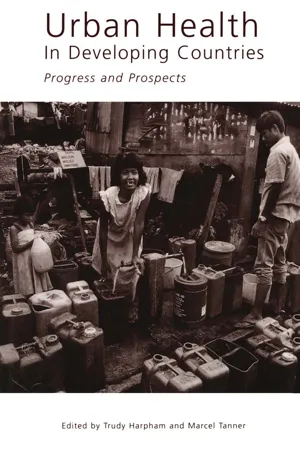
The impact of urbanization on the health of citizens in developing countries has received increasing attention recently. This book addresses the problems in an integrated way, looking in detail at both the problems themselves and the action and research necessary to alleviate them. It includes contributions from leading practitioners and advisors to many of the main international agencies and presents the latest thinking of those institutions. It also presents recent information on research findings, the management and financing of urban health services and trends in urban health policy. Case studies examine major initiatives in cities as diverse as Santiago, Dar es Salaam, Dhaka, Kampala and Bombay.
Information
Topic
Medicina1 Urbanization and Health in Developing Countries — a Review of Some Trends
DOI: 10.4324/9781315070698-1
Cities are the locus of productive economic activities and hope for the future, yet they face growing environmental problems and increasing poverty’… ‘It is clear that, in the short term, the bright lights of the city have dimmed and are, for many urban households, extinguished.(World Bank 1991)
Urbanization… will become one of the most critical development issues in the years ahead. Lynda Chalker, Minister of Overseas Development, UK(Harris 1992)
INTRODUCTION
Since the publication of the first two books on urban health in developing countries (In the shadow of the city: community health in the urban poor by Harpham (ed) et al 1988 and Spotlight on the cities by Tabibzadeh et al 1989) there have been a number of shifts on the part of international agencies with regard to their policy towards urban health development. There have also been a number of interesting programme development activities within countries and the production of additional information on health status among low income urban populations. This chapter highlights a selection of trends which both point to the direction of future developments and link to chapters in this book.
The chapter is divided into two sections: initiatives arising in the health sector and initiatives arising in the urban sector. While this division is somewhat artificially contrived it nonetheless reflects the reality that individuals working on health projects and programmes attempting to address urban specific issues often know little about what their colleagues in the urban sector are doing and vice versa. Indeed, one of the issues for the late 1990s and the 21st century is to enable these two sectors to interact more closely and to draw lessons from each other. The very definition of the ‘urban sector’ itself causes problems which are addressed below. The demographics of urbanization in developing countries are not rehearsed here as there is now an abundance of texts and articles on the phenomenon (for example, see Drakakis-Smith 1987 and Palen 1992). Similarly, it is not the intention of this book to repeat descriptions of urban health problems which can be found in other, recent texts, although highlights of selected studies are briefly discussed.
URBAN ISSUES IN THE HEALTH SECTOR
Multilateral organizations
The two multilateral organizations which have explicit objectives to improve health are the World Health Organization (WHO) and UNICEF. The chapters by Goldstein et al and Padmini document the support that these two organizations have provided to urban health initiatives. Taking a wider look at the activities of the two organizations one can discern in both of them a struggle to deal with the need to consider broader issues when dealing with urban health. In WHO the Healthy Cities Project is unique because of its inter-programmatic function. However, this attribute might also explain the fact that the project has been criticized for ‘its lack of overt progress and measurable impact’ (Silimperi 1994, p 13). Although an urban health committee was established with members from the Control of Diarrhoeal and Respiratory Diseases Programme (CDR), the Expanded Programme on Immunization (now the Global Vaccination Programme), Strengthening Health Services (SHS), and Environmental Health Division, most initiatives remain specific to the separate divisions (at the time of writing, the Healthy Cities Project initiative is still firmly within the Environmental Health Division). However, the Healthy Cities Project is now receiving an increasing amount of attention from bilateral funders and is likely to take off in the next few years (with, for example, the possibility of the Dutch government funding the project in numerous cities).
Turning to UNICEF, the Urban Basic Services (UBS) Programme (see the chapter by Padmini) finds itself at a crisis point and has recently undergone institutional scrutiny. A meeting of ‘urban experts’ was called in late 1993 to examine UNICEF’s new urban policy and to assess the future direction of UBS. During the meeting the issue of evaluation of UBS was often raised. While UBS has a fine tradition of community development work it has not always been able to demonstrate achievement in terms of UNICEF’s mid-decade and summit goals. In other words, it is rare to find impact measures of success for UBS in documents. It is ironic that the Urban Basic Services Programme appears to be under threat from the headquarters of UNICEF while at the national level it is being adopted by national governments as a way forward for urban development in general. In India for example, UBS is pivotal in the future national urban development programme which is attempting to replicate the UBS approach across whole states such as Andhra Pradesh. Indeed, arguments are being presented to bilateral funders, like the UK Overseas Development Administration (ODA), that they should move away from their support for Slum Improvement Projects in India to supporting Urban Basic Services nationally, which might lead their aid to be more sustainable and replicable (see Harpham and Stephens 1992 for a discussion of the strengths and weaknesses of the slum improvement approach).
Bilateral and Non-governmental organizations
The early 1990s witnessed a growing number of urban health initiatives as integral parts of national health sector reform efforts. For example, the UK ODA support of health sector reform in Zambia includes an urban health project in Lusaka which will strengthen the role of urban health centres vis à vis the hospital, facilitate community involvement in health councils, improve the management capacity of the city health department etc. ODA supports a similar project in Lahore within the ‘Second Pakistan Family Health Project’. Other European bilaterals are convinced of the importance of supporting urban health development, for example the German technical agency GTZ (see the chapter by Merkle and Knobloch) and the Swiss Development Corporation (SDC). SDC started its interest in urban health on the basis of its health sector policy. Least developed countries, high risk groups of the population and the implementation of primary health care are basic guiding principles of the policy. With regard to implementation strategies, SDC emphasizes the health district management approach (reviewed in Lorenz et al 1994). It is in this context that SDC also paid attention to the development of cities in selected countries, namely the Republic of Chad and Tanzania. The urban health components for the cities of Dar es Salaam, Tanzania, and N’Djamena, Republic of Chad, were initiated in 1989 when the World Bank designed the structural adjustment programmes (SAP) for these countries. In the Republic of Chad, SDC co-financed the SAP and targeted its funds to the urban health component for N’Djamena. The Swiss Tropical Institute (STI), on behalf of the Chadian and Swiss governments, became responsible for the technical assistance of the urban health component. Consequently the urban health component became well integrated into the overall health development approach of the Prefecture of Chari Baguirmi (of which the city of N’Djamena is part) for which STI was already responsible as part of a bilateral agreement between Switzerland and the Republic of Chad.
In Tanzania, the urban health project is implemented under a bilateral agreement between Switzerland and Tanzania. The project is funded by SDC, and STI acts as the executing agency on behalf of both governments. The project aims at the structural and functional rehabilitation of the governmental health care delivery and health promotion services. After a preparation phase of nearly two years, it started in late 1990 and initially emphasized structural rehabilitation. This phase was soon followed by a strong emphasis on community involvement, assisting local initiatives and health promotion activities.
SDC pursues in both urban health ‘projects’ a programme-based approach that consists of assisting the regional health authorities to plan and implement health development activities within the concept of health district management. Strong emphasis is placed on implementing primary health care principles and comprehensive district health plans. Given the nature and concept of SDC’s support for urban health, it is evident that SDC has a long-term commitment, up to ten years, to supporting health development in the metropolitan areas of these countries.
Turning to another bilateral, Fluty and Lissfelt’s chapter provides an account of the rising interest in urban health within the United States Agency for International Development (USAID) and emphasizes that a particular strategy is needed because most of the problems and opportunities arising from urbanization cross USAID’s sectoral and programme boundaries. This is a problem which an increasing number of agencies are facing and it will be interesting to observe which agencies tackle the challenge with imagination and which retreat into the secure, traditional sectoral divisions.
International Non-governmental organizations (NGOs) have an increasingly important role in urban health development as reflected in the chapter by Atkinson (ed) and as evidenced by the pioneering efforts in this field by groups such as Oxfam (UK) which supported the first international meeting on urban health back in 1984. New actors on the scene include the Rockefeller Foundation which is identifying challenges for urban health in the 21st century. No case studies of Third World NGOs are given here but an excellent, recent publication (Arrossi et al 1994) presents 18 case studies of intermediary institutions (most of them Third World NGOs) who provide technical, legal and financial services to low-income urban households for improving housing, sanitation, drainage, health care and other community services (see also Hardoy et al 1990). The case studies demonstrated
that there are ways to address poverty successfully, without large subsidies. The methods used in the case studies are generally far more cost-effective than those of traditional development projects which tend to have a relatively small impact in relation to the scale of investment… [and]… demonstrate that intermediary institutions can provide support for individual and community initiatives in which poorer groups and their community organizations retain control of what is done and how it is done.(Arrossi et al 1994 p70)
A changing urban health profile
In addition to changes in the level of interest in supporting urban health initiatives in the last decade there has also been more information made available about the extent and types of urban health problems. A sufficient number of descriptive studies have documented that the urban poor suffer the worst of both worlds — infectious disease and malnutrition from underdevelopment and chronic diseases from modernization (Harpham et al 1988, Songsore and McGranahan 1993, Pryer 1993, Surjadi 1993 and Satterthwaite 1993). Just as in the North where the epidemiological transition saw the so-called ‘diseases of affluence’ transformed into the diseases of the poor, in the South we also begin to see coronary heart disease, stroke and obesity becoming more common among the least well off (Wilkinson 1994). This pattern is most evident in urban areas (Stephens et al 1994). The increasing importance of psychosocial health problems in low-income urban areas of the South has also been recently documented (Harpham 1994). It is now time to turn to studies which assess the cost-effectiveness of interventions against ‘the new urban killers’ (see below and the chapter by Seager).
HEALTH ISSUES IN THE URBAN SECTOR
Until recently few aid agencies gave much support to city or municipal governments to improve urban health. Many of the recent initiatives in urban health are strongly project based, as reflected in the descriptions of the activities of bilateral and multilateral donors in many countries of the developing world (see the chapters by Goldstein et al, Padmini, Hecht, Fluty and Lissfelt, and Merkle and Knobloch). These projects are often not very well integrated into the existing health care delivery and health promotion system of the countries concerned and / or do not pursue the health district management approach. Reviewing the chapters that describe the various initiatives of these donors as well as NGOs reveals the strong relationship of the projects and programmes with the respective Ministries of Health. However, any Ministry of Health is mainly a technical ministry that has little control of overall planning activities at central and local government levels. One might therefore argue, and this is reflected in the conclusions of the chapter on determinants (Tanner and Harpham), that future approaches should reduce the degree of medicalization of urban health projects and no longer rely to such a large extent on Ministries of Health, but finalize the implementation arrangements with Ministries of Local Government and munic...
Table of contents
- Cover
- Title Page
- Copyright Page
- Table of Contents
- List of illustrations
- List of contributors
- Preface
- Glossary
- 1. Urbanization and Health in Developing Countries — a Review of Some Trends
- 2. Linkages for Urban Health — the Community and Agencies
- 3. Features and Determinants of Urban Health Status
- 4. Organizing and Managing Urban Health Services
- 5. Research on Urban Health — the Priorities and Approaches
- 6. Costing and Financing Urban Health and Environmental Services
- 7. How the World Health Organization Supports Urban Health Development
- 8. Urban Health — Emerging Priority for the World Bank
- 9. The Evolution of UNICEF’s Activities in Urban Health
- 10. USAID’s Experience in Urban Health and Directions for the Future
- 11. A Decade of GTZ’s Experience in Urban Health
- 12. Non-governmental Organizations — at the Interface between Municipalities and Communities
- 13. View from the Slums of Asia: The Experience of a Christian Missionary Group
- 14. Action and Research in Urban Health Development — Progress and Prospects
- Index
Trusted by 375,005 students
Access to over 1.5 million titles for a fair monthly price.
Study more efficiently using our study tools.
Frequently asked questions
Yes, you can cancel anytime from the Subscription tab in your account settings on the Perlego website. Your subscription will stay active until the end of your current billing period. Learn how to cancel your subscription
No, books cannot be downloaded as external files, such as PDFs, for use outside of Perlego. However, you can download books within the Perlego app for offline reading on mobile or tablet. Learn how to download books offline
Perlego offers two plans: Essential and Complete
- Essential is ideal for learners and professionals who enjoy exploring a wide range of subjects. Access the Essential Library with 800,000+ trusted titles and best-sellers across business, personal growth, and the humanities. Includes unlimited reading time and Standard Read Aloud voice.
- Complete: Perfect for advanced learners and researchers needing full, unrestricted access. Unlock 1.5M+ books across hundreds of subjects, including academic and specialized titles. The Complete Plan also includes advanced features like Premium Read Aloud and Research Assistant.
We are an online textbook subscription service, where you can get access to an entire online library for less than the price of a single book per month. With over 1.5 million books across 990+ topics, we’ve got you covered! Learn about our mission
Look out for the read-aloud symbol on your next book to see if you can listen to it. The read-aloud tool reads text aloud for you, highlighting the text as it is being read. You can pause it, speed it up and slow it down. Learn more about Read Aloud
Yes! You can use the Perlego app on both iOS and Android devices to read anytime, anywhere — even offline. Perfect for commutes or when you’re on the go.
Please note we cannot support devices running on iOS 13 and Android 7 or earlier. Learn more about using the app
Please note we cannot support devices running on iOS 13 and Android 7 or earlier. Learn more about using the app
Yes, you can access Urban Health in Developing Countries by Marcel Tanner, Trudy Harpham in PDF and/or ePUB format, as well as other popular books in Medicina & Pianificazione urbana e paesaggistica. We have over 1.5 million books available in our catalogue for you to explore.