- 398 pages
- English
- ePUB (mobile friendly)
- Available on iOS & Android
eBook - ePub
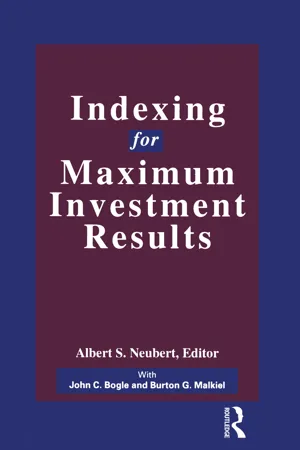
Indexing for Maximum Investment Results
About this book
Twenty four years after investment managers decided to implement Standard & Poor's 500 indexing strategy, the verdict is in. The first indexers beat more than 99% of all actively managed stock funds. Over the last ten years, funds based on the S&P 500 out-performed more than 80% of all mutual funds. Today about $450 billion is indexed to the S&P 500, almost 10% of the total market value of all stocks traded in the US. The strategy has been applied to other asset classes, including bonds and real estate. In total, indexing now accounts for more than 25% of the investment methodology of all pension funds in the US. Topics include: choosing a benchmark; overview of the marketplace; using derivatives to index; performance track record versus active management; index methodology and other styles; and index price effects on constituent securities. Albert S. Neubert is director of the Domestic S&P Indexes Unit within the Equity Services Group.
CHAPTER 1
Why the Case for Indexing Remains Strong
Burton G. Malkiel
Chemical Bank Chairman's
Professor of Economics
Princeton University
Chemical Bank Chairman's
Professor of Economics
Princeton University
I have been a believer in indexing for 25 years. I began advocating an indexing strategy in the first edition of my book, A Random Walk Down Wall Street, published in 1973—before index funds were publicly available. This paper will first review the intellectual justification for indexing, as well as the critique of that justification. Then I will present the evidence that has accumulated during the past quarter century that supports the original indexing thesis. Finally, I will review the practical arguments used against too narrow a definition of indexing and show the applicability of the strategy to markets other than large-capitalization United States stocks. The chapter concludes with a discussion of the role of financial analysis in determining the overall portfolio mix.
The Intellectual Case for Indexing
The intellectual case for indexing rests in large part on the efficient-market theory. The basic idea behind the theory is that securities markets are extremely efficient in digesting information about individual stocks or about the stock market in general. When information arises about a stock (or the market as a whole), the news spreads very quickly and gets incorporated into the prices of securities without delay. Thus, neither technical analysis (utilizing past price patterns in an attempt to predict the future) nor fundamental analysis (studying individual company's earnings, dividends, future prospects, and so on to determine a stock's proper value) will help an investor to achieve returns greater than would be obtained by buying and holding a well-diversified portfolio of equivalent risk.
The efficient-market theory is associated with the idea of the "random walk" theory, which is a term loosely used in the finance literature to characterize a price series where all subsequent price changes represent random departures from previous prices. The logic of the random walk theory is not that pricing is capricious, but rather that if the flow of information is unimpeded and information is immediately reflected in stock prices, then tomorrow's price change will reflect only tomorrow's news and will be independent of the price changes today. But news is by definition unpredictable and, thus, resulting price changes must be unpredictable and random. As a result, prices fully reflect all known information and even uninformed investors buying a diversified portfolio at the tableau of prices given by the market will obtain a rate of return as high as that achieved by the experts. The way I put it in my 1973 book, a blind-folded chimpanzee throwing darts at The Wall Street Journal could select a portfolio that would do as well as the experts. Of course, the practical strategy for investors is not to throw darts, but rather to simply buy and hold a diversified portfolio such as that contained in one of the broad stock-market indexes.
In a world where markets are reasonably efficient, switching among securities in an attempt to achieve superior performance will be useless at best. In fact, such portfolio turnover will be worse than useless because it will entail two important detractions from performance: transactions costs and taxes. At present turnover levels for mutual funds, transactions costs may be expected to subtract between 0.5 and 1.0 percent annually from gross portfolio returns. Trading involves brokerage costs on both the buying and selling side of the transaction of perhaps a few pennies a share. Much more important, there is typically a spread between the bid price for a share (the price at which it can be sold) and the asked price (the price at which it can be purchased). Moreover, when investment managers attempt to move large blocks of stocks, they tend to move equity prices away from their desired purchase and sales levels. Most active portfolio managers turn their portfolios over every one or two years. Such high activity is invariably costly.
In addition to turnover costs, actively managed funds incur substantial management fees. For example, the average general-equity mutual fund has an expense ratio of about 1 1/3 percentage points per annum. Passively managed index funds are available to individuals with an annual expense ratio of only 1/5 of one percentage point per annum. (Of course, institutions can obtain such indexed portfolios at far lower fees.) Over time such expense differentials compound to substantial differences in net returns.
Indexing has another substantial advantage over active management: It tends to minimize taxes. Because the stock market has a long-run uptrend, portfolio turnover involves the realization of capital gains. For taxable investors, this can make an enormous difference in net returns. Dickson and Shoven (1993) took a sample of 62 mutual funds with long-term records and found that pre-tax, one dollar invested in 1962 would have grown to $21.89 in 1992. After paying taxes on dividends and capital gains distributions, however, that same dollar invested in mutual funds would have grown to only $9.87. By not trading from security to security, index funds tend to avoid the realization of capital gains and thus help solve the tax problem.
The Critique of Indexing
The general thrust of much of the academic empirical work over the 1980s and 1990s has been that, at least to some extent, stock prices and returns are predictable. For example, there appears to be a predictable relationship between the returns realized from stocks over several quarters or years and the initial dividend yields at which they were purchased. Several researchers have found that when stocks could be purchased at relatively high (low) initial yields, subsequent returns tended to be above (below) average.1 Similarly, Shiller (1996) found that the high initial price-earnings (P/E) multiples for the market as a whole are associated with low future returns and vice versa. These findings have been confirmed cross-sectionally by Basu (1983) and Fama and French (1992). There has been a tendency for stocks with low P/Es to outperform those with high P/Es. Fluck, Malkiel, and Quandt (1997), as well as Fama and French, confirmed that stocks that sell at low multiples of their book values also tend to produce higher subsequent returns.
There is even some evidence that past price patterns have some predictive power for future price behavior. Lo and MacKinlay (1990) found that broad portfolio stock returns for weekly and monthly holding periods displayed positive serial correlation, i.e., a positive return in one week is more likely than not to be followed by a positive return in the next week On the other hand, Poterba and Summers (1988) found that when stock returns were measured over longer periods, such as years or decades. there was likely to be negative serial correlation, i.e., relatively high returns in one period were more likely than not to be followed by relatively low returns in a subsequent period. Similarly, there have been findings of seasonal effects and day-of-the-week effects. Haugen and Lakonishok (1988) have documented a "January effect" where stock returns, especially for smaller firms, have been abnormally high during the first few days of January. French (1980) has documented a "weekend effect" where average stock returns tend to be negative on Mondays.

Exhibit 1 Basic Series: Summary Statistics of Annual Total Returns from 1926 to 1996
* The 1933 Small Company Stock Total Return was 142.9 percent.
Source: Ibbotson Associates.
* The 1933 Small Company Stock Total Return was 142.9 percent.
Source: Ibbotson Associates.
Perhaps the strongest predictable pattern concerns the relationship between firm size and subsequent return. Exhibit 1, with return data since 1926, shows that stocks of smaller companies have returned about two percentage points more than the stocks of larger companies. Fama and French (1992) separated a sample of exchange-traded stocks into deciles according to their market capitalization and found a clear relationship showing that smaller stocks have produced larger rates of return than larger stocks over time. Exhibit 2 presents the results updated through the mid-1990s. Finally, a number of researchers, such as Shiller (1981, 1984) and DeBondt and Thaler (1985) have argued that stock prices clearly overreact and suggest that fads and psychological contagion influences markets as much as hard news.

Exhibit 2 The Relationship of Return and Size: 1963-1994
Source: Burton G. Malkiel and Yexiao Xu, "Risk and Return Revisited," The Journal of Portfolio Management, Vol.23, No. 3, Spring 1997.
Source: Burton G. Malkiel and Yexiao Xu, "Risk and Return Revisited," The Journal of Portfolio Management, Vol.23, No. 3, Spring 1997.
The general conclusion from this work is that stock prices do not conform perfectly to the random walk/efficient market model. Moreover, the existence of several predictable patterns in the stock market, as well as the likelihood that there are periods when mass psychology overtakes fundamentals, suggests that it should be possible for an astute professional money manager to outperform the market as a whole.2 Before we examine the evidence, some general comments should be made concerning the body of empirical work on predictable patterns.
The Indexing Counter-Attack
Indexers admit that the stock market may be somewhat predictable. But they deny that the predictable patterns that exist are large enough or dependable enough to overcome the substantial costs involved in trying to exploit them. Moreover, they argue that some of the apparent predictable patterns may be the result of spurious statistical techniques or, even if valid, may be perfectly consistent with the efficient functioning of markets. Finally, they suggest that any exploitable opportunities to earn excess returns will self-destruct in the future as they are arbitraged away.
Many of the patterns of stock price behavior that have been uncovered by researchers may be statistically significant but economically insignificant. For example, the short-run serial correlations documented by researchers (as well as the January effect and the day-of-the-week effect) are small relative to the transactions costs required to exploit them. Any investor who pays transactions costs cannot outperform a buy-and-hold strategy by employing a trading strategy designed to exploit the pattern. Moreover, some statistical regularities are not dependable in every period. For example, the mean reversion phenomenon discussed above, which appears to support a contrarian strategy, is far stronger in some decades than it is for other periods. Moreover, it may not be possible to profit from the tendency for individual stocks to exhibit patterns of return reversals. For example, my colleagues and I at Princeton tried to simulate a strategy of buying stocks that had particularly poor returns over the past three to five years.3 We found very strong statistical evidence of return reversals, but it was truly a reversion to the mean, not an opportunity to make extraordinary returns. We found that stocks with very low returns over the past three to five years had higher returns in the next period. Stocks with very high returns over the past three to five years had lower returns in the next period, but the returns in the next period were similar for both groups. While we found strong evidence of mean reversion, we could not confirm that a contrarian approach would yield higher than average returns. Statistically there was a strong pattern of return reversal, but not one you could make money on.
It is also the case that some predictable patterns may be perfectly consistent with the efficient functioning of markets. One pattern with strong statistical support is that between 25 and 40% of the variance of stock market returns can be "explained" by the initial dividend yield at which the stocks were purchased. When stocks could be bought at higher in...
Table of contents
- Cover
- Title
- Copyright
- Contents
- Preface
- Contributors
- Chapter 1—Why the Case for Indexing Remains Strong
- Chapter 2—Benchmarks: Definitions and Methodologies
- Chapter 3—The First Index Mutual Fund
- Chapter 4—Optimal Indexing
- Chapter 5—Enhanced Indexing—Without Enhanced Risk?
- Chapter 6—Choosing a Benchmark
- Chapter 7—The "S&P Effect" Has Moved Beyond the S&P Composite
- Chapter 8—The S&P500 is Not Your Father's Index
- Chapter 9—Performance Track Record versus Active Management
- Chapter 10—Overview of the Equity Index Fund Marketplace
- Chapter 11—Implementing Equity Index Portfolios
- Chapter 12—Adding Value Through Equity Style Management
- Chapter 13—Using Style Analysis to Build Completeness Funds
- Chapter 14—Index Shares
- Chapter 15—Fixed-Income Indexing
- Chapter 16—The Tax Advantages of Indexing
- Chapter 17—Optimizing Performance
- Chapter 18—The Licensing of Financial Indexes: Implications for the Development of New Index-Linked Investment Products
- Index
Trusted by 375,005 students
Access to over 1.5 million titles for a fair monthly price.
Study more efficiently using our study tools.
Frequently asked questions
Yes, you can cancel anytime from the Subscription tab in your account settings on the Perlego website. Your subscription will stay active until the end of your current billing period. Learn how to cancel your subscription
No, books cannot be downloaded as external files, such as PDFs, for use outside of Perlego. However, you can download books within the Perlego app for offline reading on mobile or tablet. Learn how to download books offline
Perlego offers two plans: Essential and Complete
- Essential is ideal for learners and professionals who enjoy exploring a wide range of subjects. Access the Essential Library with 800,000+ trusted titles and best-sellers across business, personal growth, and the humanities. Includes unlimited reading time and Standard Read Aloud voice.
- Complete: Perfect for advanced learners and researchers needing full, unrestricted access. Unlock 1.5M+ books across hundreds of subjects, including academic and specialized titles. The Complete Plan also includes advanced features like Premium Read Aloud and Research Assistant.
We are an online textbook subscription service, where you can get access to an entire online library for less than the price of a single book per month. With over 1.5 million books across 990+ topics, we’ve got you covered! Learn about our mission
Look out for the read-aloud symbol on your next book to see if you can listen to it. The read-aloud tool reads text aloud for you, highlighting the text as it is being read. You can pause it, speed it up and slow it down. Learn more about Read Aloud
Yes! You can use the Perlego app on both iOS and Android devices to read anytime, anywhere — even offline. Perfect for commutes or when you’re on the go.
Please note we cannot support devices running on iOS 13 and Android 7 or earlier. Learn more about using the app
Please note we cannot support devices running on iOS 13 and Android 7 or earlier. Learn more about using the app
Yes, you can access Indexing for Maximum Investment Results by Albert S. Neuberg in PDF and/or ePUB format, as well as other popular books in Business & Obbligazioni. We have over 1.5 million books available in our catalogue for you to explore.