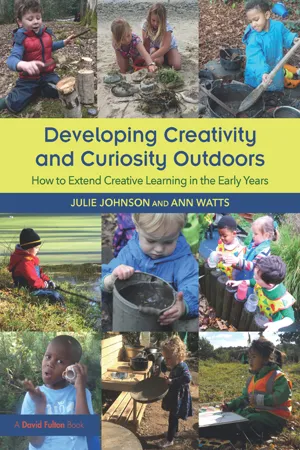
This accessible guide will inform, prompt and inspire practitioners as they develop their own creativity and seize the rich opportunities offered by outdoor environments to cultivate and encourage the creative skills of the young children in their care.Including information on Forest School, Developing Creativity and Curiosity Outdoors builds on theories of creative learning and development, and offers a wealth of ideas and activities for application in a range of outdoor settings.
From designing and building structures, to making music and exploring colour, shape and pattern, this book illustrates how engagement in and with the natural world might extend children's creative development, encouraging them to speak, listen, move freely, play and learn. Case studies demonstrate good practice and each chapter concludes with questions, encouraging the reader to reflect on and develop their own practice. Practical ideas can be adapted for use in more urban environments, and further reading, online resources and lists of suppliers make Developing Creativity and Curiosity Outdoors an essential resource for those looking to maximise the natural curiosity of children.
This book will give early years practitioners and students the confidence and knowledge they need to embark on an exciting journey of outdoor discovery with young children.
This first chapter of this book looks at some definitions of creativity and how it develops from birth onwards. It demonstrates how adults can support children to move from the present situation into one where there are many possibilities. The emotional relationship between adult and children is key to supporting children’s creativity as they begin to experiment and explore ideas for themselves. There is further discussion about the role of children’s imagination in creativity and what we mean by creativity skills.
It explores:
■ theories of creativity in relation to learning and development in the early years
■ the importance of emotional wellbeing in brain development and subsequent creativity
■ the role of imagination and development of ‘possibility thinking’
■ the role of the adult as a Creative teacher
■ what we mean by creative learners
■ creative skills and why we need them.
Creativity – what is it?
The Oxford English Dictionary defines creativity as the ‘ability to transcend traditional ideas rules and patterns and to create meaningful new ideas forms methods interpretations etc originality or imagination’. One online definition defines it as an
act of transformation by which we turn one idea or thing into something else by way of intellectual chemical or manual alchemy . . . The sum of creativity is always greater than its parts. Creativity may look like a noun but it is really a verb – and in specific an action. It could be an interior or exterior process, – a thought or a manifestation, an idea or a product, but it is always an action, an energy, a putting one’s self forth into the unknown. Creativity is the world of the intrepid explorer, of the adult two year old, who never ceases to ask the questions: Why? What if?
This definition puts us straight back into the world of the two-year-old and workshops run by this company often ask adults to think back to the time when they were children: ‘We were all creative as children. We were creativity specialists before we learned to walk or talk. You never have to learn about your creativity from scratch – but you might need to reengage.’
Ironically, education through our own national curriculum will often stifle our originality so much that we can forget we were ever creative at all. Picasso seemed to reiterate this idea with his well-known statement: ‘All children are artists. The problem is how to remain an artist once we grow up’ (in Peter 1979, p. 25).
Contrary to our own current national curriculum, the curriculum for Scotland is based on creativity and there is a detailed and comprehensive report, ‘Creativity Across Learning’ published in 2013, which defines creativity as a ‘process which generates ideas that have value to the individual. It involves looking at familiar things with a fresh eye examining problems with an open mind, making connections, learning from mistakes and using imagination to explore new possibilities’ (Education Scotland 2013, p. 3).
This definition is well thought through and totally relevant for young children. It focuses on their thought processes and flow of ideas rather than any end product. It also uses the word ‘imagination’ and there will be an exploration of ideas on how this develops in very young children later in this chapter. The definition offered by the Thomas Coram centre in London states that creativity means ‘connecting the previously unconnected in ways that are new and meaningful to the individual concerned to make real something you have imagined’ (Duffy 2006).
Mel Rhodes (1961) identified the ‘four Ps – Process, Product, Person and Place’ and, more recently, the work of Kaufman and Beghetto introduces a ‘four C’ model of creativity (2009). They use the term ‘mini c’ to define the ‘novel and personally meaningful interpretation of experiences, actions and events’. ‘Little c’ is the term applied to creative innovation in everyday activities available to the majority of people. ‘Pro-c’ describes the developmental progression beyond the last two that represents professional level expertise in any field and ‘big C’ is the term applied to what we may commonly refer to as a ‘creative genius’: that is someone who is eminent in their particular field.
This model has been explored further in connection with children’s learning by Professor Anna Craft. She used the framework of ‘big C’ and ‘little c’ in her work with children and there is a section later in the chapter looking at her use of the term ‘possibility thinking’.
Creativity – where does it start?
Brain development
Current research is using MRI scanning in very young children to examine the ways in which the human brain develops. Neuroscience is now able to map out the ways in which young brains make the connections that are the key to each child’s individuality. Normal brain development is dependent upon environmental input and in particular warm, loving interactions with key adults, as well as a stimulating and appropriate environment for children to explore. Babies’ brains continue to develop after birth. A baby’s brain grows so much in the first three years of life that the head size needed to envelop it would not be able to pass down the birth canal. Consequently human babies are born earlier in their developmental cycle than most other mammals. This also has implications for the societal nature of our world. It means that children who receive the appropriate stimuli develop their speech patterns and language to reflect that of the adults around them. They develop taste preferences according to the kind of food they receive. They learn at a very early age how to attract the attention of adults and also how to communicate their needs. At the end of the first year a staggering 70 per cent of the adult brain size is in place and by the age of three around 90 per cent of the brain mass is in place. What is even more crucial is the nature of the development inside that brain mass.
The importance of emotional wellbeing in brain development
It follows that the experiences gained in the early years will have a fundamental effect on the way the brain develops. There is a powerful image published by Child Trauma Academy led by Bruce Perry MD PhD, which demonstrates the physical impacts of neglect on a child’s brain. It shows the brain scan of a three-year-old who has been raised in a Romanian orphanage with very little if any sensory experience. The image sits next to the image of a healthy normal three-year-old and is significantly smaller in size. Malnutrition could be another factor but the researchers consider that the connectors in the brain have actually been pruned because of the lack of stimulating experiences (Early Arts 2017).
Although a baby’s brain has around 100 billion neurons, evidence shows that only a quarter of the synaptic connections have been made. From birth until the age of three the young brain makes billions of new connections as knowledge is absorbed and children become more able to decode and make sense of the world around them. If the synapses are not connected, the under-used ones get pruned out so the connections that are used regularly get stronger and become more effective. There may be times later in life when these can be relearnt and this is referred to as a window of ‘plasticity’, but generally speaking it is in the first few years that the brain is able to develop its skills and competencies. This has major implications for the type and quality of experiences that adults offer to young children. ‘By encouraging creativity and imagination we are promoting children’s ability to explore and comprehend their world and increase their opportunities to make new connections and reach new understandings’ (Duffy 2006).
The website www.zerotothree.org states that in the first three years the brain produces 700 new neural connections every second. Children’s relationships with each other, the adults who care for them and the quality of their interaction with their surroundings, all play a crucial role in their development.
The development of creative activity
In his work, ‘Imagination and creativity in childhood’ (2004), Vygotsky states that people’s behaviour falls into two basic categories. The first type is closely linked to memory and he calls this ‘repro ductive’ behaviour or activity. This consists of reproducing or repeating previously developed behavioural patterns or resurrecting traces of earlier impressions. The second behavioural type he names ‘creative activity’. This begins in the pretend play of young children and can be observed by what he refers to as object substitution. He gives the example of a young child using a stick as a horse. This is the beginning of imagination and it develops as the child internalises his language and thinking. In adolescence, it combines with conceptual thought and can reach its peak in adulthood through artistic, scientific and technological innovation.
CASE STUDY: MANAGING AND INITIATING LEARNING
W. aged 13 months came to stay overnight and while I was preparing lunch in the kitchen she crawled in to see me. I opened a cupboard door. She was immediately attracted by this and crawled to the space and proceeded to empty the cupboard of its contents, all plastic bowls, boxes and lids. She explored them in infinite detail putting a lid on her head and then sitting on another one. When she appeared to be losing interest after about ten minutes, I put a few wooden and plastic spoons on the floor and sat down with her and we experimented with different sounds as we banged on the boxes and the floor. Her concentration lasted for twenty minutes.
What was interesting, however, was that when she next came to visit a week later we were all in our sitting room but she immediately crawled away from us into the kitchen on her own and pulling herself up managed to open the cupboard door and proceeded to get out all the boxes. This was her activity of choice.
Babies have a natural curiosity and a need to explore.
W. is showing here what Vygotsky defines as reproductive activity which is closely linked to memory. As she gets older she will engage in creative activity which is defined as creating something new. It may be ...
Table of contents
Cover
Half Title
Title Page
Copyright Page
Table of Contents
Foreword
Acknowledgements
About the authors
Overview of the book
1 The nature of creativity
2 The nature of curiosity and imagination
3 The Forest School background
4 Communication in the natural world
5 Creative structures and design in the natural world
6 Movement outdoors
7 Colour, shape, pattern and form in the natural world
8 Music and sound outdoors
9 Conclusion
Index
Trusted by 375,005 students
Access to over 1.5 million titles for a fair monthly price.
Study more efficiently using our study tools.
Frequently asked questions
Yes, you can cancel anytime from the Subscription tab in your account settings on the Perlego website. Your subscription will stay active until the end of your current billing period. Learn how to cancel your subscription
No, books cannot be downloaded as external files, such as PDFs, for use outside of Perlego. However, you can download books within the Perlego app for offline reading on mobile or tablet. Learn how to download books offline
Perlego offers two plans: Essential and Complete
Essential is ideal for learners and professionals who enjoy exploring a wide range of subjects. Access the Essential Library with 800,000+ trusted titles and best-sellers across business, personal growth, and the humanities. Includes unlimited reading time and Standard Read Aloud voice.
Complete: Perfect for advanced learners and researchers needing full, unrestricted access. Unlock 1.5M+ books across hundreds of subjects, including academic and specialized titles. The Complete Plan also includes advanced features like Premium Read Aloud and Research Assistant.
Both plans are available with monthly, semester, or annual billing cycles.
We are an online textbook subscription service, where you can get access to an entire online library for less than the price of a single book per month. With over 1.5 million books across 990+ topics, we’ve got you covered! Learn about our mission
Look out for the read-aloud symbol on your next book to see if you can listen to it. The read-aloud tool reads text aloud for you, highlighting the text as it is being read. You can pause it, speed it up and slow it down. Learn more about Read Aloud
Yes! You can use the Perlego app on both iOS and Android devices to read anytime, anywhere — even offline. Perfect for commutes or when you’re on the go. Please note we cannot support devices running on iOS 13 and Android 7 or earlier. Learn more about using the app
Yes, you can access Developing Creativity and Curiosity Outdoors by Julie Johnson,Ann Watts in PDF and/or ePUB format, as well as other popular books in Education & Early Childhood Education. We have over 1.5 million books available in our catalogue for you to explore.