- 526 pages
- English
- ePUB (mobile friendly)
- Available on iOS & Android
eBook - ePub
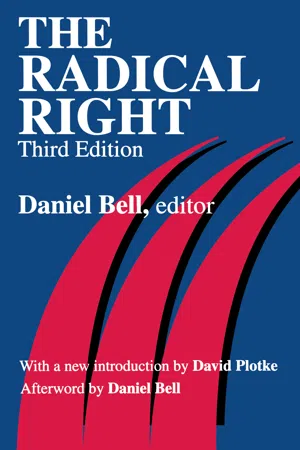
The Radical Right
About this book
Two vivid sets of images epitomize the dramatic course of the American right in the last quarter of the twentieth century. The main image is of a triumphant President Ronald Reagan, reasonably viewed as the most effec-tive president of recent decades. A second set of images comes from the bombing of a government building in Oklahoma City by Timothy McVeigh, a man linked to shadowy parts of the contemporary ultraright. The roots of Reaganism are conservative, intellectual, and political movements of the 1950s and 1960s, including currents that in those years were considered marginal and ex-tremist. The roots of the ultraright of the 1990s have intersecting though by no means identical sources.Serious evaluation of the American right should begin with The Radical Right. It describes the main positions and composition of distinctive forces on the right in the first half of the 1950s and the next decade. It recognizes the right's vehement opposition to domestic and international Communism, its sharp rejec-tion of the New Deal, and its difficulty in distinguishing between the two. Bell's controversial point of departure is to regard the basic position of what he terms the radical right as excessive in its estimation of the Communist threat and unrealistic in its rejection of New Deal reforms. From this starting point, Bell and his authors evaluate the ways the right went beyond programs and the self-descriptions of its leaders and organizers.The Radical Right explains McCarthyism and its successors in terms of conflicts over social status and the shape of American culture. Daniel Bell focuses on the social dislo-cation of significant groups in the post-New Deal decades. Many members of these groups perceived themselves as dispossessed and victimized by recent changes, even if it was not possible to regard them as having undergone any great suffering.David Plotke's major new introduction discusses the book's argument, McCarthyism
Information
1
THE DISPOSSESSED (1962)*
Daniel Bell
The American has never yet had to face the trials of Job…. Hitherto America has been the land of universal good will, confidence in life, inexperience of poisons. Until yesterday, it believed itself immune from the hereditary plagues of mankind. It could not credit the danger of being suffocated or infected by any sinister principle….
GEORGE SANTAYANA,
Character and Opinion
in the United States
Character and Opinion
in the United States
In the winter of 1961–62, the “radical right” emerged into quick prominence on the American political scene. The immediate reasons for its appearance are not hard to understand. The simple fact was that the Republican Party, now out of power, inevitably began to polarize (much as the Democrats, if they were out of power, might have split over the civil rights and integration issue), and the right wing came to the fore. The right-wing Republicans have an ideology—perhaps the only group in American life that possesses one today—but during the Eisenhower administration they had been trapped because “their” party was in power, and the American political system, with its commitment to deals and penalties, does not easily invite ideological—or even principled-political splits. An administration in office, possessing patronage and prestige, can “paper over” the inherent divisions within a party. But out of office, such conflicts are bound to arise, and so they did within the G.O.P.
Clearly there is more to all this than merely a contest for power within a party. Something new has been happening in American life. It is not the rancor of the radical right, for rancor has been a recurrent aspect of the American political temper. Nor is it just the casting of suspicions or the conspiracy theory of politics, elements of which have streaked American life in the past. What is new, and this is why the problem assumes importance far beyond the question of the fight for control of a party, is the ideology of this movement—its readiness to jettison constitutional processes and to suspend liberties, to condone Communist methods in the fighting of Communism.
Few countries in the world have been able to maintain a social system that allows political power to pass peacefully from one social group to another without the threat of hostilities or even civil war. In the mid-twentieth century, we see such historical centers of civilization as France, let alone states just beginning to work out viable democratic frameworks, torn apart by ideological groups that will not accept a consensual system of politics. The politics of civility, to use Edward Shils’ phrase, has been the achievement of only a small group of countries—those largely within an Anglo-Saxon or Scandinavian political tradition. Today, the ideology of the right wing in America threatens the politics of American civility. Its commitment and its methods threaten to disrupt the “fragile consensus” that underlies the American political system.
I believe that the radical right is only a small minority, but it gains force from the confusions within the world of conservatism regarding the changing character of American life. What the right as a whole fears is the erosion of its own social position, the collapse of its power, the increasing incomprehensibility of a world—now overwhelmingly technical and complex—that has changed so drastically within a lifetime.
The right, thus, fights a rear-guard action. But its very anxieties illustrate the deep fissures that have opened in American society as a whole, as a result of the complex structural changes that have been taking place in the past thirty years or so. And more, they show that the historic American response to social crisis, the characteristic American style, is no longer adequate to the tasks.
I
The Emergence of the Radical Right
Social groups that are dispossessed invariably seek targets on whom they can vent their resentments, targets whose power can serve to explain their dispossession. In this respect, the radical right of the early 1960s is in no way different from the Populists of the 1890s, who for years traded successfully on such simple formulas as “Wall Street,” “international bankers,” and “the Trusts,” in order to have not only targets but “explanations” for politics. What lends especial rancor to the radical right of the 1960s is its sense of betrayal not by its “enemies” but by its “friends.”
After twenty years of Democratic power, the right-wing Republicans hoped that the election of Dwight Eisenhower would produce its own utopia: the dismantling of the welfare state, the taming of labor unions, and the “magical” rollback of Communism in Europe. None of this happened. Eisenhower's Labor Secretary courted the unions, social-security benefits increased, and, during the recession, unemployment benefits were extended, while the government, in good Keynesian style, ran a twelve-billion-dollar budgetary deficit. In foreign policy, Secretary of State Dulles first trumpeted a “liberation policy,” and then retreated, talked brinkmanship but moved cautiously, announced a policy of “massive retaliation,” and, toward the end of his tenure, abandoned even that, so that the subsequent Eisenhower moves toward summitry were no different from, or from a “hard” right line were “softer” than, the Truman-Acheson containment policy. Thus eight years of moderation proved more frustrating than twenty years of opposition.
Once the Democrats were back in office, the charge of softness in dealing with Communism could again become a political, as well as an ideological, issue. And the radical right was quick to act. The abject failure in Cuba—the name of the landing place for the abortive invasion, the Bay of Pigs, itself became a cruel historical joke—seemed to reinforce the picture of the United States that emerged out of the stalemate in Korea a decade ago—of a lurching, lumbering power, lacking will, unsure of its strength, indecisive in its course, defensive in its posture. The theme of the radical right was voiced by Rear Admiral Chester Ward (ret.), the Washington director of the American Security Council, who declared, “Americans are tired of defeats. They are tired of surrenders covered up as ‘negotiated settlements.’ They are, indeed, tired of so much talk and little action by our leaders. For the first time in sixteen years of the cold war, a demand for victory is beginning to roll into Washington.”
Thus the stage was set.
The factors that precipitated the radical right into quick notoriety in early 1961 were the rancor of their attacks and the flash spread of the movement in so many different places. McCarthyism in the mid-1950s was never an organized movement; it was primarily an atmosphere of fear, generated by a one-man swashbuckler cutting a wide swath through the headlines. In some localities—in Hollywood, on Broadway, in some universities—individual vigilante groups did begin a drumbeat drive against Communists or former fellow-travelers, but by and large the main agitation was conducted in government by Congressional or state legislators, using agencies of legislative investigation to assert their power. In contrast, the radical right of the 1960s has been characterized by a multitude of organizations that seemingly have been able to evoke an intense emotional response from a devoted following.
Three elements conjoined to attract public attention to the radical right. One was the disclosure of the existence of the John Birch Society, a secretive, conspiratorial group obedient to a single leader, Robert Welch, who argued that one could combat the methods of Communism only with Communist methods. Thus, membership lists were never disclosed, fronts were organized to conduct campaigns (such as the one to impeach Chief Justice Warren, which turned, with heavy-handed jocularity, into calls to “hang” him), and a symbol of patriotism was put forth in the name of an Army captain who had been shot in China by the Communists.
The second was the fashionable spread of week-long seminars of anti-Communist “schools,” conducted by evangelist preachers who adapted old revivalist techniques to a modern idiom, which swept sections of the country, particularly the Southwest and California. These schools promised to initiate the student into the “mysteries” of Communism by unfolding its secret aims, or unmasking the philosophy of “dialectical materialism.” And, third, there was the disclosure of the existence of extreme fanatic groups, such as the Minutemen, who organized “guerrilla-warfare seminars,” complete with rifles and mortars, in preparation for the day when patriots would have to take to the hills to organize resistance against a Communist-run America. Such fringe movements, ludicrous as they were, illustrated the hysteria that had seized some sections of the radical right.
To a surprising extent, much of the radical-right agitation—and the spread of the seminar device—was unleashed by the Eisenhower administration itself. In 1958, the National Security Council issued a directive, as yet still unpublished, which stated that it would be the policy of the United States government, as Senator Fulbright cited it, “to make use of military personnel and facilities to arouse the public to the menace of Communism.”1 Following this directive, the Joint Chiefs of Staff and the National War College entered into consultation with the Foreign Policy Research Institute of the University of Pennsylvania, and the Institute of American Strategy (a creation of the Richardson Foundation), to plan curriculum and seminars for reserve officers and local businessmen. A basic text was adopted, American Strategy for the Nuclear Age, edited by Walter F. Hahn and John C. Neff, of the University of Pennsylvania group. An equally influential text was the book Protracted Conflict, by Robert Strausz-Hupe and Colonel William Kintner, which argues that no negotiations with the Russians leading to a stable settlement are really possible. The Strausz-Hupe group is neither part of, nor should it be identified with, the lunatic fringes of the right. Its arguments are serious and subject to the debate and rival assessments of other scholars. But the actions initiated by the Joint Chiefs of Staff did lead to a large number of Projects Alert and indoctrination seminars, carried out by official Navy and Army spokesmen, that went far beyond the original scope of the National Security Council directive, and that brought into these sessions the pitchmen of the radical right.
In August, 1960 (as detailed in the Fulbright memorandum), the United States Naval Air Station, at Glenview, Illinois, sent out invitations to community leaders and businessmen, inviting them to a seminar on “Education for American Security.” The announced purpose of the seminar was to stimulate an active force against “moral decay, political apathy and spiritual bankruptcy,” and to teach the participants how to create similar schools in other Midwestern communities. The conference was addressed by a number of high-ranking naval officers. But it also included Dr. Fred C. Schwarz, the organizer of the Christian Anti-Communism Crusade; E. Merrill Root, author of Brainwashing in the High Schools and Collectivism on the Campus, and an endorser of the John Birch Society; and Richard Arens, former research director of the House Un-American Activities Committee, and a member of Schwarz's Christian Crusade. The speeches during the sessions, according to the Christian Century, the liberal Protestant weekly published in Chicago, not only attacked Communism but condemned as well “liberals, modernists, John Dewey, Harvard students, the New York Times, the American Friends Service Committee, pacifists, naive ministers,” and so on.
It was this same mixture of official military sponsorship and propagandists of the radical right that characterized dozens of similar seminars around the country. On April 21, 1961, the Chamber of Commerce of Greater Pittsburgh sponsored a Fourth-Dimensional Warfare Seminar, with the cooperation of the commanding general of the 2nd U. S. Army, Lieutenant General Ridgely Gaither, and his staff, at whose sessions the House Un-American Activities Committee film Operation Abolition was shown, and the principal speaker, Admiral Chester Ward (ret.), attacked Adlai Stevenson and George Kennan, as advisers to the President whose “philosophies regarding foreign affairs would chill the typical American.” A Strategy for Survival conference held on April 14th and 15th in Fort Smith, Fayetteville, and Little Rock, Arkansas, sponsored by the local Chamber of Commerce and promoted by Major General Bullock, the area commander, heard speakers from Harding College, a small institution in Searcy, Arkansas, operated by members of the Church of Christ, which has been the source of much extreme right-wing material. And on the program was the film Communism on the Map, prepared by Harding College, which equates Socialism with Communism. A Project Alert was organized at the Pensacola Naval Air Training station, in Florida, based on Harding College materials, and the program was repeated in similar “alerts” in Georgia, South Carolina, and Texas. Dr. Fred C. Schwarz held a seminar at the headquarters of the 8th Naval District, in New Orleans, which was endorsed by the Commandant, Rear Admiral W. G. Schindler. A Houston Freedom Forum was held by Schwarz's Christian Anti-Communism Crusade at which Admiral F. W. Warder gave the keynote address.
And so it went. In almost every area of the country, seminars, schools, and projects, organized by the military or by business groups in cooperation with the military, spread the propaganda of the radical right and gave a broad aura of authority and legitimacy to such propaganda and to such pitchmen of the radical right as the Reverend Dr. Schwarz and the Reverend Billy Hargis.
II
The Psychological Posture
The psychological stock-in-trade of the radical right rests on a threefold appeal: the breakdown of moral fiber in the United States; a conspiracy theory of a “control apparatus” in the government which is selling out the country; and a detailed forecast regarding the Communist “takeover” of the United States.
Central to the appeal of the radical right is the argument that old-fashioned patriotism has been subverted by the cosmopolitan intellectual. An editorial in the National Review on the space flight of astronaut John Glenn sums up this theme in striking fashion. Glenn, said the editorial, is an authentic American hero because he is unashamed to say that he gets a thrill when the American flag goes by and because he will openly acknowledge the guidance of God. “It is ‘American’ as in older storybooks, as in legends, and myths and dreams—brought up to technological date, of course—as, let's say it plainly, in the pre-1930 Fourth of July celebrations; and the Saturday Evening Post covers before they, too, not long ago, went modern; and a touch of soap opera. Yes, a bit corny—for that is the traditional American style. Too corny by far for the Norman Cousinses, Arthur Schlesingers, Adlai Stevensons, Henry Steele Commagers, Max Lerners, John Kenneth Galbraiths, and those others of our enlightened age—so many of them now fluttering around the Kennedy throne—who have long left behind the old provincial com for a headier global brew.”
Here one finds the praise of the “simple virtues”—they are always simple—the evocation of small-town life, the uncluttered Arcadia, against the modern, the sophisticated, the cosmopolitan. But the Glenn flight, according to the editorial, proved more: it proved the victory of “man” against the “mechanical” and, implicitly, against the intellectual. “This and that went wrong, we all learned, with the unbelievably complex mechanism of Glenn's ship, as it whirled through the emptiness of Space,” continued the National Review.
The attitude control thingamajigs didn't work right. There were troubles in some of the communication instruments. A signal indicated that the latching of the heat shield was precarious. This and that went wrong with the mechanism, and man took over and brought Friendship 7 to its strange harbor…. And that is fine news, though it should hardly be news. It is good technically, because we Americans, with our gadgetry obsession and our wish for too much convenience, safety and comfort, tend to crowd all our machines and vehicles with too immensely many tricky devices. Every additional transistor in these automatic mechanisms means that many more connections to loosen;...
Table of contents
- Cover
- Half Title
- Title Page
- Copyright Page
- Dedication
- Table of Contents
- The Contributors
- Introduction to the Transaction Edition
- Preface
- Chapter 1. The Dispossessed (1962)
- Chapter 2. Interpretations of American Politics (1955)
- Chapter 3. The Pseudo-Conservative Revolt (1955)
- Chapter 4. Pseudo-Conservatism Revisited: A Postscript (1962)
- Chapter 5. The Intellectuals and the Discontented Classes (1955)
- Chapter 6. The Intellectuals and the Discontented Classes: Some Further Reflections (1962)
- Chapter 7. The Revolt Against the Elite (1955)
- Chapter 8. The Philosophical “New Conservatism” (1962)
- Chapter 9. Social Strains in America (1955)
- Chapter 10. Social Strains in America: A Postscript (1962)
- Chapter 11. The John Birch Society (1962)
- Chapter 12. England and America: Climates of Tolerance and Intolerance (1962)
- Chapter 13. The Sources of the “Radical Right” (1955)
- Chapter 14. Three Decades of the Radical Right: Coughlinites, McCarthyites, and Birchers (1962)
- Afterword (2001): From Class to Culture
- Acknowledgments
- Index
Trusted by 375,005 students
Access to over 1.5 million titles for a fair monthly price.
Study more efficiently using our study tools.
Frequently asked questions
Yes, you can cancel anytime from the Subscription tab in your account settings on the Perlego website. Your subscription will stay active until the end of your current billing period. Learn how to cancel your subscription
No, books cannot be downloaded as external files, such as PDFs, for use outside of Perlego. However, you can download books within the Perlego app for offline reading on mobile or tablet. Learn how to download books offline
Perlego offers two plans: Essential and Complete
- Essential is ideal for learners and professionals who enjoy exploring a wide range of subjects. Access the Essential Library with 800,000+ trusted titles and best-sellers across business, personal growth, and the humanities. Includes unlimited reading time and Standard Read Aloud voice.
- Complete: Perfect for advanced learners and researchers needing full, unrestricted access. Unlock 1.5M+ books across hundreds of subjects, including academic and specialized titles. The Complete Plan also includes advanced features like Premium Read Aloud and Research Assistant.
We are an online textbook subscription service, where you can get access to an entire online library for less than the price of a single book per month. With over 1.5 million books across 990+ topics, we’ve got you covered! Learn about our mission
Look out for the read-aloud symbol on your next book to see if you can listen to it. The read-aloud tool reads text aloud for you, highlighting the text as it is being read. You can pause it, speed it up and slow it down. Learn more about Read Aloud
Yes! You can use the Perlego app on both iOS and Android devices to read anytime, anywhere — even offline. Perfect for commutes or when you’re on the go.
Please note we cannot support devices running on iOS 13 and Android 7 or earlier. Learn more about using the app
Please note we cannot support devices running on iOS 13 and Android 7 or earlier. Learn more about using the app
Yes, you can access The Radical Right by Daniel Bell in PDF and/or ePUB format, as well as other popular books in Politics & International Relations & 20th Century History. We have over 1.5 million books available in our catalogue for you to explore.