- 253 pages
- English
- ePUB (mobile friendly)
- Available on iOS & Android
eBook - ePub
About this book
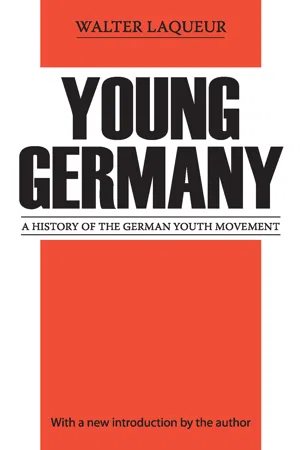
Young Germany explores the revolt of the younger generation in Germany from 1896 to 1933. It is a readable history of the Free Youth Movement, one of the most significant factors in shaping modern Germany. Laqueur, who grew up in Germany, retraces the history of the movement, its central ideas, and its cultural background.Today his study is of even greater interest and importance than when it was first published in 1962. In his new introduction to this edition, Laqueur shows that the German Youth Movement can be seen as a precursor of contemporary youth revolt. It inspired all of the ideas which continue to preoccupy proponents and students of generational conflict today.
PART ONE
One
ROMANTIC PRELUDE
I
Officially, the German youth movement was born in the late hours of the evening of 4 November 1901 in a back room of the Ratskeller in Steglitz, a suburb of Berlin. Its roots can, however, be traced back for at least one hundred years, to the period of ‘Storm and Stress,’ the Burschenschaft, and above all to German romanticism. One was a literary revolt against the repression of individual emotions and the canons of classicism, the other a movement of patriotic students who disliked both Prussian autocracy and the French Revolution. Heir to so old a tradition, the youth movement of 1901 cannot be understood without reference both to its historical roots and to the spirit of the age that engendered it.
Europe had made unprecedented economic and technical progress between 1860 and 1900. While standards of living rose faster than ever before, not all classes benefited equally and strong social tensions were generated. But in most European countries the working class could view with satisfaction and confidence the constant growth of its political influence, as well as its economic and social achievements. There had been no major war in Europe for several decades, and there was every reason to expect another long period of peace, progress, and general well-being.
But serious symptoms of cultural decline were not lacking in that world of growing plenty and rapid technical advance. It would be interesting to speculate about the psychological sources of the discontent, the sense of emptiness and general dissatisfaction that found its expression in a fin de siècle mood even in a country like Russia, which faced more urgent political and social problems than the West. Why did so many people throughout Europe welcome the outbreak of the First World War as a ‘liberation’? Such an investigation might show that man has often found it difficult to suffer serenely a prolonged period of tranquillity and well-being. When no major problems exist, minor problems tend to take their place.
We tend to look back on the world that ended in 1914 with a nostalgia mixed with a certain amusement. It is true that the great crisis of 1900 seems somewhat unreal, if not artificial, in comparison with the problems of the twenties and thirties. But for those who lived then, the cultural crisis was real enough; it turned some towards socialism, others towards an attitude of aristocratic disdain of the masses and hostility to bourgeois society and its culture or lack of culture. Politically, this rejection of society and its values could lead to either left-or right-wing extremist solutions. The German youth movement was an unpolitical form of opposition to a civilization that had little to offer the young generation, a protest against its lack of vitality, warmth, emotion, and ideals.
The angry young men of 1900 were found among the more articulate sections of the younger generation throughout Europe. Some developed a new cult of youth in an attempt to bring fresh air into the stale and musty atmosphere surrounding their elders. The writings of ‘Agathon’ in France, and of the early Italian Futurists, are evidence of this trend. The Wandervogel was one of the specific German forms of protest. It was and remained unique in many respects, since Germany’s situation in Europe was different from that of other countries. The triumph of liberalism in France, Britain, and the United States had never extended to Germany; the ‘bourgeois revolution’ had never been completed; the middle classes were not fully emancipated. Capitalism had indeed prevailed in Germany and industrialization had made rapid strides, but in many sections of the population a medieval, anti-liberal, and anti-capitalist mentality survived because the people themselves had not taken a prominent and active part in these developments, which had frequently been initiated from above or from outside. The conspicuous part played by the Jews both in banking and in the German Liberal party during the second half of the nineteenth century was a natural consequence of this situation.
The official ideology of this society and its declared values were not those of individual freedom and the pursuit of happiness, but consisted of aristocratic Prussian ideas about loyalty and service to Kaiser and Reich. If the middle classes had been the leading force in German society, dissatisfaction would have taken very different forms from those it eventually did; it would have been a protest from inside or a post-liberal critique of society. In Germany, because of the weakness of the liberal movement itself, the movement was pre-liberal, romantic, in some respects medieval. These characteristics can be more clearly discerned in the second period of the German youth movement, its bündische phase after 1920. In its first period, between 1900 and 1914, the movement was to a certain extent individualistic; young people wanted to lead their own lives and demanded a partial release from the tutelage of the parental home and the Oberlehrer. But even in that early period the beginnings of a retrograde development can easily be traced. The official ideals in which the young generation was educated had a powerful attraction, even though they were curiously unreal, unrelated to the daily experience of middle-class youth. Only comparatively few could expect ultimately to enter professions in which they would be of direct service to Kaiser and Reich; they had to put up with the fact that the leading positions were barred to them, and not only those in the army. Hence the wide prevalence of völkische ideas as a form of middle-and lower-middle-class protest against the official upper-class nationalist ideology of the Germany of Wilhelm II.
The pioneers of the youth movement were young men without great cultural pretensions. Their literary taste was strictly middlebrow; they read not the classics of German literature but Grimmels-hausen’s Simplizissimus and Jörg Wickram’s Rollwagenbüchlein, which when taken in massive doses had a deplorable effect on their style. They were succeeded by a more refined and articulate generation who had read Hölderlin and Novalis, and who were to echo time and again Hyperion’s lament upon Diotima’s death after he had parted again from Alabanda:
It is a hard saying, and yet I say it because it is the truth: I can conceive of no people more dismembered than the Germans. You see workmen but no human beings, thinkers but no human beings, priests but no human beings, masters and servants, youths and staid people, but no human beings.…
The youth movement wanted above all to be integrated human beings, as one would put it today, and they were critical of a society that was not conducive to the development of such men and women. They felt very strongly what an earlier—and a later—generation of philosophers called ‘alienation.’ They were vague in their diagnosis and even less clear in their proposals for remedying the situation. But they felt strongly and sincerely about it. Broadly speaking, two ways of revolt were open to them: they could have pursued their radical critique of society, which in due course would have brought them into the camp of social revolution. But Social Democracy had little attraction for sons and daughters of middle-class German homes. They wanted a change in human relations, and there was no certainty that these could be changed by a new political and social system, however radically different from that under which they lived. The Wandervogel chose the other form of protest against society—romanticism. Their return to nature was romantic, as were their attempts to get away from a materialistic civilization, their stress on the simple life, their rediscovery of old folk songs and folklore, their adoption of medieval names and customs. Romanticism probably has a closer hold on Germany than on any other country. There have been classical schools in every culture, but nowhere has romanticism been so deeply rooted as in German literature, music, art, and the general Zeitgeist.
But there is more to the story of the German romantic school than the search for the blue flower, Schubert Lieder and Schumann concertos, the verse and stories of Arnim, Brentano, Tieck and Eichendorff. The political philosophy of the romantic school had a fatal impact on German thinking throughout the nineteenth century and beyond. Not every Romantic was a reactionary, but reactionary the mainstream of romantic opinion certainly was; having rediscovered the Fatherland and national history, they proceeded to reject alien influences and to hate the foreigner. A religious revival degenerated into religious intolerance and obscurantism. The Middle Ages became the great ideal: the manly virtues and poetic love, true faith and loyalty had disappeared with the age of chivalry. The only way to reestablish a harmonious society was to model it as closely as possible on the medieval pattern with its knights and vassals, its guilds and estates. The romantics glorified the peasantry in its bondage and were opposed to the growth of industry and trade.The whole development of the German youth movement was shaped by the impact of romantic philosophy, by a glorification of the past fraught with misgivings for the future. It was a repetition, on a smaller scale, of the general German misfortune: The German national consciousness was first awakened under reactionary auspices, in a war of liberation that put an end not only to Napoleon’s rule but to the achievements of the French Revolution.
It could be argued with some semblance of justice that political views have been read into the Wandervogel’s intentions which did not really exist at the time. It did not discuss politics, nor did it in any way encourage its members to participate in what were believed to be the shabby affairs of parties and vested interests. The youth movement was anti-political, hostile to the hurrah patriotism of the beer halls, the nationalist swagger and pomposities of official Germany. All this is only too true, but it hardly goes to the root of the matter. The Wandervogel was certainly opposed to party strife and many of its members believed themselves to be profoundly uninterested in politics. But underneath they had accepted as articles of faith, not open to discussion and re-examination, many of the basic tenets of the official ideology propagated in the school, the parental home and elsewhere. The German youth movement talked politics, as M. Jourdain talked prose, without being aware of it.
II
The youth movement emerged spontaneously, not as the result of intellectual reflection, nor with the intention of copying the past. There were no ulterior motives; it was strictly rambling for rambling’s sake. In later years its medieval mannerisms (Teutschtümelei) were occasionally criticized, as were its attempts to imitate the style of the wandering scholars of the Middle Ages. But this was not an act of political identification; the itinerant scholars were, if anything, practical anarchists, not political thinkers. Their latter-day admirers simply liked the style with all its crudities because it was rough, friendly, and free of many of the conventions of the first decade of the twentieth century. It was precisely those who had criticized Karl Fischer, the first Wandervogel leader, for his primitive and boorish style, his ‘lack of ideology,’ who were later to introduce the openly political element. To walk twenty-five miles a day in the dust of the roads was boring and stupid, they argued. Rambling was an art, they said; it had to be purposeful, those who engaged in it had to learn to be observant, to become more familiar with the Fatherland and its people.1 This education by rambling was to produce a new German who had a better, more rounded picture of his country, and whose identification with and love of that country was deeply rooted in his personal experience.
The gradual introduction of the ideological element can be traced in the introductions to the Zupfgeigenhansl, the famous song-book of the Wandervogel. In the Introduction to the first edition in 1909 Hans Breuer, the editor, merely wished his readers happy rambling. In the Introduction to the fourth edition in 1911 the patriotic element first appeared: our search and striving is the sincere German way of life deeply rooted in our native soil. In the Introduction to the war edition of the song-book—which by then had passed the halfmillion mark—Breuer writes: ‘We should become ever more German. Rambling is the most German of all innate instincts, it is our basic existence, the mirror of our national character.’ Shortly before his death on the Western front he wrote to his father: ‘I consciously cultivated the German, the national element (in the Wandervogel) long before the war came, and the war has shown that this was the right way.’2
It was probably inevitable that the youth movement should become ‘ideological’ as the first generation of its leaders grew up and came into closer contact with public affairs. In the universities they first heard in detail about a movement that seemed to have been a precursor of their own, Father Jahn’s gymnasts and the Burschenschaft of the early nineteenth century. Father Jahn introduced a mixture of organized physical culture and patriotism in Germany, and he has not fared badly in recent German historiography. He was adopted as a fervent nationalist, Jew-hater, and Francophobe in the Hitler era, and he is now considered a progressive figure in East Germany because of his opposition to the reactionary forces of his time. Jahn, and the members of the Burschenschaft, whom he greatly influenced, were indeed democrats of sorts and were deeply aggrieved by the setback to their hopes of reform and greater freedom that followed the victory over Napoleon in 1815. But apart from such harmless antics as living in a cave (Jahn) or walking about in bearskins (Karl Sand), there were disturbing elements in their general attitude. They hated everything foreign and firmly believed in the superiority of the German race. Some of the members of the Burschenschaft subsequently adopted a more consistent democratic line, but most of them were attracted by the purely nationalistic elements of the movement. It was perhaps symbolical that at the great meeting on the Wartburg in 1817 not merely the symbols of Prussian autocracy were burned but also books that were disliked for very different reasons. If the youth movement of the twentieth century traced some of its origins to the Burschenschaft it is only fair to add that it usually ignored the less savoury aspects.1
However, neither Jahn nor the Burschenschaft could be regarded as a living influence, since the problems they had faced almost a century earlier were very different from those facing young men in Germany around the turn of the century. More modern teachers and prophets were needed. It was said that the German students went into the First World War with Nietzsche’s Zarathustra in their knapsacks, but in the youth movement Nietzsche became known comparatively late; his impact was of short duration and in some cases not very deep. The early Wandervogel was not interested in philosophy, and the Oberlehrer who were influential then were right not to consider Nietzsche one of their own kind. There was much in Nietzsche’s writing that endeared him to the nationalists, but there were other, dangerous and heretical ideas as well, and on the whole he was not considered a beneficial influence on the younger generation. Nietzsche entered the youth movement only around 1912 through the Freideutsche youth. His impact was felt during the early part of the First World War,1 but the ecstatic rhymes did not stand up too well to the great test. Those who had been through the holocaust of Flanders and the mud and ice of the Eastern front knew all they needed to know about the spirit of tragedy. After the end of the war another, more human Zarathustra2 had, for a while, a deeper impact than Nietzsche’s.
Two other writers, more consistent and infinitely more pedestrian, had a greater effect on the pre-war generation: Paul Lagarde, a biblical scholar whose real name was Boetticher, and Langbehn, who wrote Rembrandt as Educator. Both were extremely critical of modern democracy, and favoured an aristocratic order in which the Germans would rightfully rule the world. Langbehn was mainly concerned with Kulturpolitik, Lagarde with the younger generation’s lack of ideals, for which he blamed the leaders who withheld those ideals. If they would only give marching orders, if they would only permit German youth to come to the assistance of their persecuted brethren outside the Reich, if only there were a war, if the banners were flying, if the trumpets were to sound—what idealis...
Table of contents
- Cover
- Title Page
- Dedication
- Copyright
- Contents
- Preface
- Introduction
- Part One
- Part Two
- Part Three
- Part Four
- Part Five
- Conclusion
- Appendix: The Foreign Policy of the Bünde
- Index
Trusted by 375,005 students
Access to over 1.5 million titles for a fair monthly price.
Study more efficiently using our study tools.
Frequently asked questions
Yes, you can cancel anytime from the Subscription tab in your account settings on the Perlego website. Your subscription will stay active until the end of your current billing period. Learn how to cancel your subscription
No, books cannot be downloaded as external files, such as PDFs, for use outside of Perlego. However, you can download books within the Perlego app for offline reading on mobile or tablet. Learn how to download books offline
Perlego offers two plans: Essential and Complete
- Essential is ideal for learners and professionals who enjoy exploring a wide range of subjects. Access the Essential Library with 800,000+ trusted titles and best-sellers across business, personal growth, and the humanities. Includes unlimited reading time and Standard Read Aloud voice.
- Complete: Perfect for advanced learners and researchers needing full, unrestricted access. Unlock 1.5M+ books across hundreds of subjects, including academic and specialized titles. The Complete Plan also includes advanced features like Premium Read Aloud and Research Assistant.
We are an online textbook subscription service, where you can get access to an entire online library for less than the price of a single book per month. With over 1.5 million books across 990+ topics, we’ve got you covered! Learn about our mission
Look out for the read-aloud symbol on your next book to see if you can listen to it. The read-aloud tool reads text aloud for you, highlighting the text as it is being read. You can pause it, speed it up and slow it down. Learn more about Read Aloud
Yes! You can use the Perlego app on both iOS and Android devices to read anytime, anywhere — even offline. Perfect for commutes or when you’re on the go.
Please note we cannot support devices running on iOS 13 and Android 7 or earlier. Learn more about using the app
Please note we cannot support devices running on iOS 13 and Android 7 or earlier. Learn more about using the app
Yes, you can access Young Germany by Walter Laqueur in PDF and/or ePUB format, as well as other popular books in History & 20th Century History. We have over 1.5 million books available in our catalogue for you to explore.